
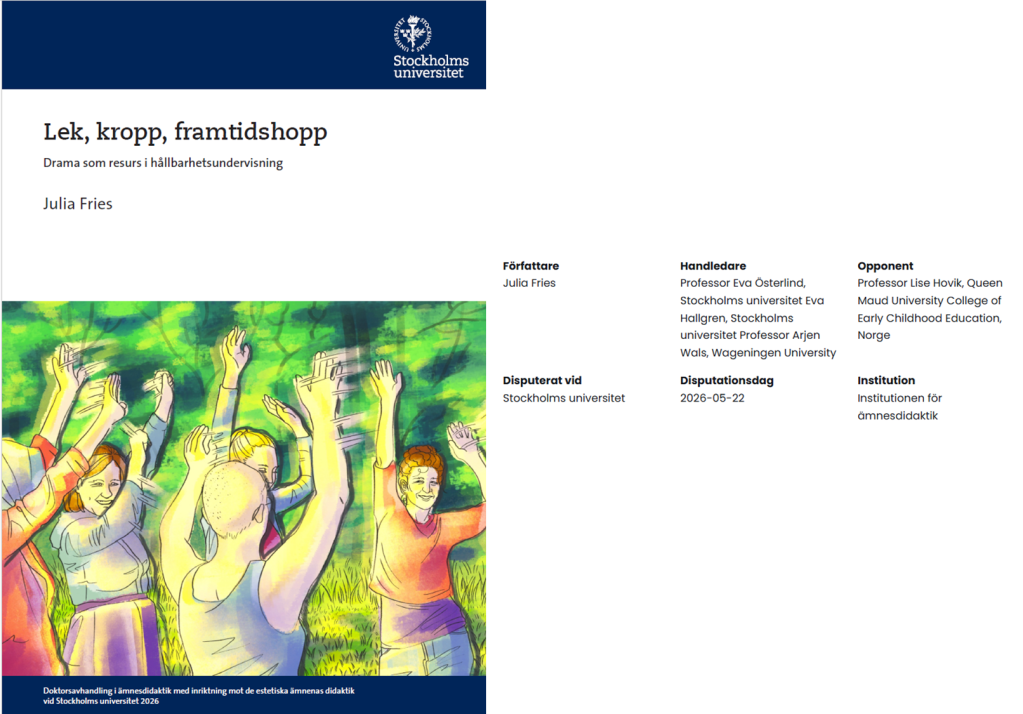
Another exciting dissertation just came out on drama and arts-based approaches and methods in sustainability education and sustainability education research. This dissertation by Julia Fries – with whom I had the pleasure to work over the past 6 years or so – is mainly in Swedish but all her published work, in English, is included as well (just click on the image above to get to it!). Here is an abstract:
In a time marked by ecological and social uncertainty, there is a growing need for educational practices that foster hope, agency, and embodied engagement with the future. This doctoral thesis explores how applied drama can serve as a resource in sustainability education. The study investigates how university students and young adults engage in embodied and imaginative practices that enable them to relate to sustainability issues in new ways. The research is conducted within the framework of drama education and is based on drama interventions with students in a university course and participants in a youth project. Of the 85 participants in four groups, 36 volunteered to be interviewed afterwards about their experiences. The transcribed interviews and other documentation were analysed through an approach that evolved from qualitative to post-qualitative, including arts-based elements. Additionally, the thesis contains autoethnographic traces and reflections from clown work related to sustainability issues.
The findings show drama to be a powerful, yet demanding, pedagogical tool in environmental and sustainability education. It enables emotional expression and embodied and collective reflection in the creation of imagined futures. It also fosters group cohesion and a sense of hope in the face of complex challenges. However, drama as a teaching method requires not only knowledge of both drama and sustainability but also participant willingness, psychological safety, and time to build trust. The research further demonstrates that drama and creative processes can contribute in a meaningful way to knowledge production, particularly when addressing existential and societal crises. The aesthetic dimension is revealed as valuable in order to remain open, playful and creative in the midst of uncertainty.

