
New book on 50 years of Education and Learning for Sustainable Futures

We are pleased to share with you the publication of our new book, Education and Learning for Sustainable Futures: 50 years of learning and environmental change. This book explores fundamental questions about how the role of education has evolved over the decades since the pivotal 1972 Stockholm Conference, which brought environmental learning to the forefront of global awareness.

Co-authors, Daniella Tilbury and Thomas Macintyre and myself, have attempted to find some answers by tracking through the decades (1970-2020) the development of narratives, thinking, and practice of learning and education in support of the environment and sustainability. What is clear is that the profile and presence of learning and education for the environment has been elevated in today’s policy discourses and communities of practice. Yet, our analysis identified some clear differences in the way education and learning for the environment has been approached over time. 

In our new book, we trace these changes over the decades while looking ahead to the challenges and opportunities of the future.  A key wildcard in this journey is Artificial Intelligence (AI), which holds immense potential to bridge digital and green agendas, enabling smarter environmental management and driving innovation toward a sustainable future. However, we also address critical concerns: data privacy breaches, outsourcing human thinking to profit-driven algorithms, exacerbation of inequalities, and the environmental footprint of AI infrastructure.

This book provides a light way into the history, developments and prospects of the field of Environmental and Sustainability Education.

Full reference:

Macintyre, T., Tilbury, D., & Wals, A. (2024). Education and Learning for Sustainable Futures: 50 Years of Learning for Environment and Change (1st ed.). Routledge. https://doi.org/10.4324/9781003467007

Wish to read more? Our book is open access thanks to the funding of the Dutch Government that funded this publication: https://www.routledge.com/Education-and-Learning-for-Sustainable-Futures-50-Years-of-Learning-for-Environment-and-Change/Macintyre-Tilbury-Wals/p/book/9781032727912

Our thanks also go to Stakeholder Forum and to @JanGustav for his leadership role in the Stockholm+50 reflective dialogues, and to UNEP/ the Swedish Government for spurring us on to track the historical development of education and learning for the environment. We are also grateful to @Routledge for taking an interest in publishing the text.
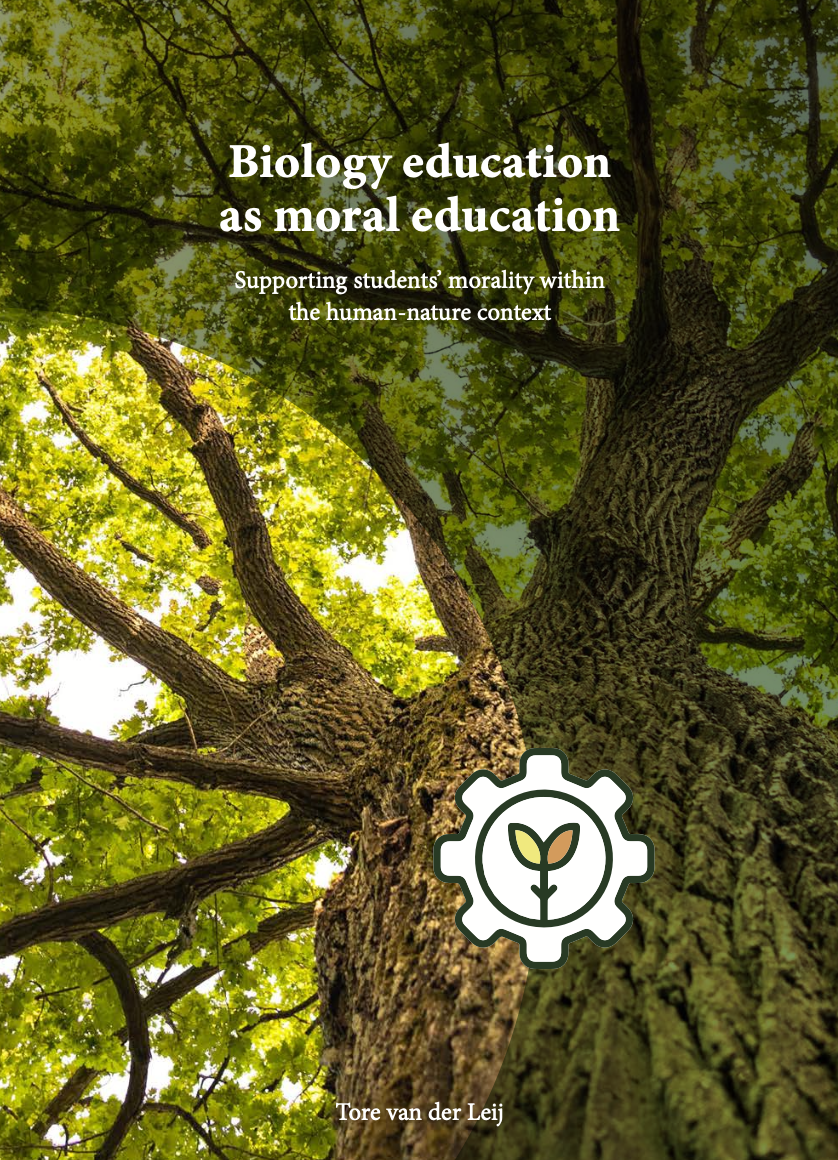
Tore vd Leij successfully defends: ´Biology education as moral education: Supporting students’ morality within the human- nature context´

On this day, February 13th, one of my first Masters students during my tenure at Wageningen University (in the mid-1990s!), Tore van der Leij, defended his PhD on ´Biology Education as a moral education´. He did so in the Aula of the University of Groningen which hosted his research. Tore is a Biology Teacher at Hondsrug College Secondary School in Emmen in the North of the Netherlands. Under the mentorshop of Prof. Martin Goedhart (RUG), Prof. Lucy Avraamidou (RUG) and myself, Tore worked, over a period of 7 years (COVID19 inclusive) with secondary school students and fellow teachers in two schools in figuring out how their morality can best be developed within the human-nature context. He developed a series of lessons to help trigger students´morality (all available in Dutch in the appendix). Tore had all four of his empirical chapters published in high quality journals. As an appetiser for his excellent work, I am sharing the Epilogue of his thesis below. The entire thesis can be downloaded via the University of Groningen´s Library System.

Epilogue

“As I described in the introduction to this chapter, many biology teachers in the Netherlands consider supporting students in developing skills related to morality important (e.g., CvTE, 2019; SLO, 2021; Van Maanen, 2021). Unfortunately, most teachers do not get around to it, mainly because of the overloaded exam programme (CvTE, 2019; SLO, 2021). In addition, the skills are not tested in the central exams, but only in the school exams. As a result, supporting students in developing skills related to morality are not teachers’ priority.

All this notwithstanding, the outlined urgency of the context in which supporting students’ morality should take place is evident. Above that, given that many biology teachers do consider supporting students’ morality important, it is my hope that the results from this research project provide a valuable practical interpretation of biology education aimed at supporting students’ morality in the human-nature context.

When I started this PhD journey in 2016, an important motive for conducting this research project was my concern about the socio-ecological challenges, both globally and locally, in which the negative impact of human actions on ‘other-than-human’ beings, and future generations have become increasingly prominent. I felt, and still feel, that education should respond to this urgency by providing our students with the necessary ‘free space’, ‘skolè’, to develop, form and reflect upon these challenges, and give them opportunities to act in relation to the constantly changing world around them.

The fact that Gretha Thunberg (a 15-year old student at the time) with her ‘Skolstrejk för klimatet’ in 2018 (about two years after the start of this research project) chose not to go to school, is perhaps illustrative for education’s challenge to offer our students the valuable and meaningful education, that meets the big challenges of our time. In any case, the following that Gretha has received since then – for instance, the Climate Strikes in which tens of thousands of young people participated – shows that there is plenty of commitment, need and motivation among young people to engage with these moral dilemmas.”

High school biology students’ use of values in their moral argumentation and decision-making in times of polarization, confusion and unsustainability

Another paper based on PhD Tore van der Leij just appeared in the Journal of Moral Education. I took the liberty to add a few words to the title… ‘in times of polarization, confusion and unsustainability’ to emphasize the importance of this work.

In this qualitative case study Tore examined the impact of a specially-designed classroom intervention for a group of 15–16-year-old Dutch biology students’ use of values in contemplating five socioscientific issues in the human-nature context. The students worked in small groups to support various aspects of their morality. An ethical matrix was used as a heuristic to explore different arguments and moral values from different perspectives. The collected data consisted of written assignments, group conversations, and individual interviews. The results show that students’ use of values differed from one issue to another. The values they used in their moral decision-making indicated that the influence of the intervention activities, aimed at enhancing a relationship between moral agent (student) and moral object (topic), was limited. The study provides evidence that the intervention positively conduced to students’ cognition of the values that are personally relevant. Recommendations for further theorization, research and practice are discussed.

Here is the link: https://www.tandfonline.com/doi/full/10.1080/03057240.2023.2185595

Full citaton:Leij, Tote, van der, Martin Goedhart, Lucy Avraamidou & Arjen Wals (2023) High school biology students’ use of values in their moral argumentation and decision-making, Journal of Moral Education, DOI: 10.1080/03057240.2023.2185595