
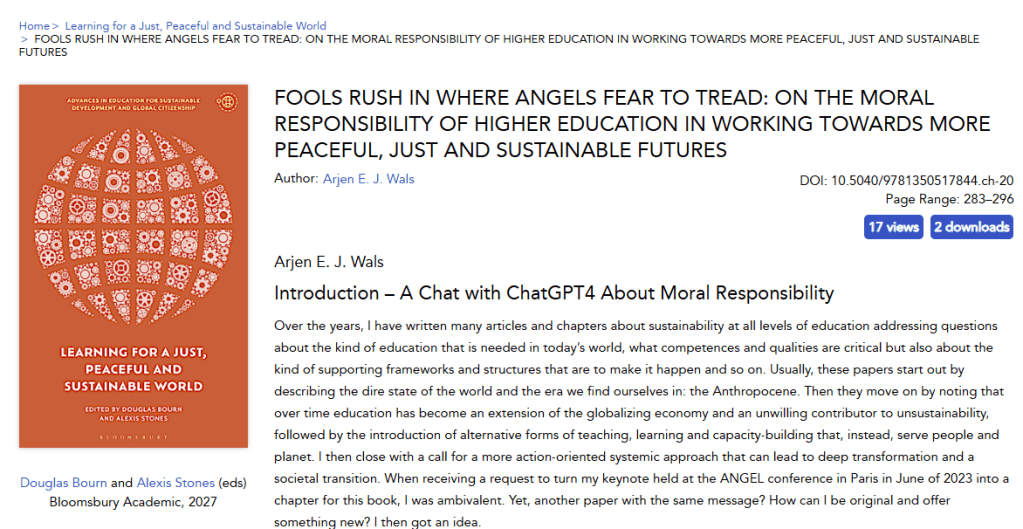
FOOLS RUSH IN WHERE ANGELS FEAR TO TREAD: ON THE MORAL RESPONSIBILITY OF HIGHER EDUCATION IN WORKING TOWARDS MORE PEACEFUL, JUST AND SUSTAINABLE FUTURES

Today (July 1st, 2026) a new open access book will be launched “Learning for a Just, Peaceful and Sustainable World” edited by Douglas Bourn and Alexis Stones. The book showcases current debates in the field of global education and learning and the importance of the Declaration on Global Education to 2050. It features chapters from academics, researchers, policy-makers and practitioners based in Australia, Canada, Finland, Germany, India, Ireland, Italy, Nigeria, Pakistan, Poland, Sweden, The Netherlands and the UK who are working in the fields of global citizenship, education for sustainable development and peace and human rights education. The chapters cover a range of topics that span formal, non-formal and informal learning spaces including gender justice, democracy, moral education, climate change policy, decolonizing global learning, PISA, the Sustainable Development Goals and the role of UNESCO. The importance of learning about global issues and sustainable development has never been seen as more important than it is today and this book addresses the big global issues of today, be they climate change, war and conflict, human rights, quality of learning and reducing global poverty.

I was asked to contribute a chapter based on a key note I held at UNESCO for the Academic Network on Global Education and Learning (ANGEL) which partnered with Global Education Network Europe (GENE). Both focus on issues like global citizenship, sustainability, and human rights. When I started converting the keynote into a chapter, back in 2024, I was just bcoming familiar with GenAI and quite unsure about how to use it, if at all. The chapter starts out with, wht I still think, is a remarkeable chat with ChatGPT (an older version that ‘ talked back at me’ and used humour and, even cynicism. The chapter  outlines five possible guideposts for learning for peace, justice and sustainability that can be distilled from a re-contextualizing Pope’s eighteenth-century poem with the current Anthropocene as a backdrop. In the final postscript I revsit my engagement with ChatGPT.

You can find the open access chapter here!

Full Reference:

Wals, AEJ (2026). FOOLS RUSH IN WHERE ANGELS FEAR TO TREAD: ON THE MORAL RESPONSIBILITY OF HIGHER EDUCATION IN WORKING TOWARDS MORE PEACEFUL, JUST AND SUSTAINABLE FUTURES In: Bourn, Douglas , and Alexis Stones , ed. Learning for a Just, Peaceful and Sustainable World. London,: Bloomsbury Academic, Bloomsbury Collections. Web. 1 Jul. 2026. http://dx.doi.org/10.5040/9781350517844

I couldn´t resist: A SWOT analysis of ChatGPT – implications for educational practice and research

Source: https://evaluationcomics.freshspectrum.com/comic/chatgpt-and-plagiarism/

After a very good impromptu explanation of how ChatGPT works and will affect the future of research and education by ELS colleague Auke Westerterp in a homemade videoclip (have a look here), a lively discussion started among colleagues about the pro´s and cons of ChatGPT.

I found myself on the side of being skeptical and, indeed, worried. But there were also colleagues who see AI and chatbots as inevitable and potentially beneficial. In fact, it turned out they were already using it in both research and education, and, upon asking around a bit, I found out that many students are using it to (re)write their papers and to save the time of reading (which apparently is seen as an inefficient activity).

I then tried it out myself and was perplexed by what ChatGPT can create in seconds. I out in key words we use in our RiverCommons project which focuses on things like ´rights to nature´, ´water justice,´ ´decolonization´ and sustainable development, social learning, etc. I put in these words and asked ChatGPT to write a 300-word paper, with references APA style. To convince the project leader – Prof Rutgerd Boelens of Wageningen University´s Water Resource Management Group, I also asked to refer to the work of Boelens in the. article. The result was impressive and could have easily fooled the reviewers of a bunch of journals. To top things off, I asked ChatGTP to include a 100 biography of Rutgerd Boelens.

In fact, a good colleague of mine, also active in sustainability in higher education, Debby Cotton based at the University of Plymouth, submitted a paper to a journal, together with colleagues, to a journal which had been written by ChatGTP. They told the editor beforehand. The editor was in for an experiment and the paper went through a proper review process and… was accepted and then published with a discussion of what happened and what might be possible implications of this. The paper – have a look here – got featured in major newspapers like the Guardian and the Washington Post.

In the meantime, my colleagues working on ICT-supported learning had already started working on a SWOT of the use of ChatGPT in education. When I showed my interest in the debate, they asked me to join. Given the magnitude of the phenomenon, I could not resist and agreed to join. The paper just got published in Innovations in Teaching International and can be downloaded here. Have a look and see what you think. One of my concerns, not highlighted in the paper, is that these technologies will only expand our screen time (videophilia) and further disconnect us from places and people and the relations between them. As such they serve Nasdaq-listed companies and their shareholders most, while further eroding life on this Earth (biophilia). Perhaps, now that the AI is becoming so powerful, it will lead to a new discussion about the purpose of education and people´s motivations to learn. That, in the end, might be the best outcome.

Full citation:

Farrokhnia, M., Seyyed Kazem Banihashem, Omid Noroozi & Arjen Wals (2023) A SWOT analysis of ChatGPT: Implications for educational practice and research, Innovations in Education and Teaching International, DOI: 10.1080/14703297.2023.2195846