

Lightheartedness in dark times – Clowning as a pedagogy for leaders: learning to transgress unsustainable ‘normality’

“…we explore clowning as part of a pedagogy of transgression to be offered to leaders who need to break free from habits of the mind and resistant power structures that keep us stuck in unsustainable models.”

Surely one of the most exciting papers that have contributed to recently is the one that came out today in Environmental Education Research. Francine Cruz de Lima came to us at Wageningen University just over a year ago as an external PhD canditate from the School of Arts, Sciences and Humanities, University of São Paulo, São Paulo, Brazil. In her PhD she is exploring how humor, and clowning in particular, can help people, leaders in particular, become unstuck from normalized ways of thinking, being and acting. The paper led by her “Clowning as a pedagogy for leaders: learning to transgress unsustainable ‘normality’” makes up the first study of her PhD. The paper is publishedin EER which published a Special Issue on Humor and Environmental Education in 2023. It will be followed by empirical studies of workshops conducted in São Paulo with (business) leaders who will experience clowning in practice.

From the abstract:

The sustainability polycrisis that the world is facing can be understood as a systemic response to a relational crisis that comes from the normalization of unnatural separations and hierarchies. These separations prevent conscious connection with interdependent parts of the whole, including diverse social groups, ethnicities, species, ecosystems, and personal dimensions. Decision-makers of our time are expected to have the capacity to transcend such separation paradigms to foster systems transformation towards sustainability. A few scholars are investigating the role of leadership programs in this challenge. Hoping to contribute to this scholarship, we explore clowning as part of a pedagogy of transgression to be offered to leaders who need to break free from habits of the mind and resistant power structures that keep us stuck in unsustainable models. This article is a narrative literature review that seeks conceptual and methodological affinities between clowning, humor, playfulness, adult play, critical pedagogies, transformative learning, and inner-outer transformation frameworks. The results are synthesized into initial educational design principles, aiming to guide the creation of group learning opportunities that facilitate making power dynamics visible, denormalizing unjust hierarchies, and promoting a paradigm shift towards relationality. We discuss the implications of our propositions to formal and non-formal sustainability education of adults, including leadership programs, and suggest how they can be refined and tested in future research.

Full citation:

Cruz de Cerqueira Lima, F., & Wals, A. (2026). Clowning as a pedagogy for leaders: learning to transgress unsustainable ‘normality.’ Environmental Education Research, 1–31. https://doi.org/10.1080/13504622.2026.2744862

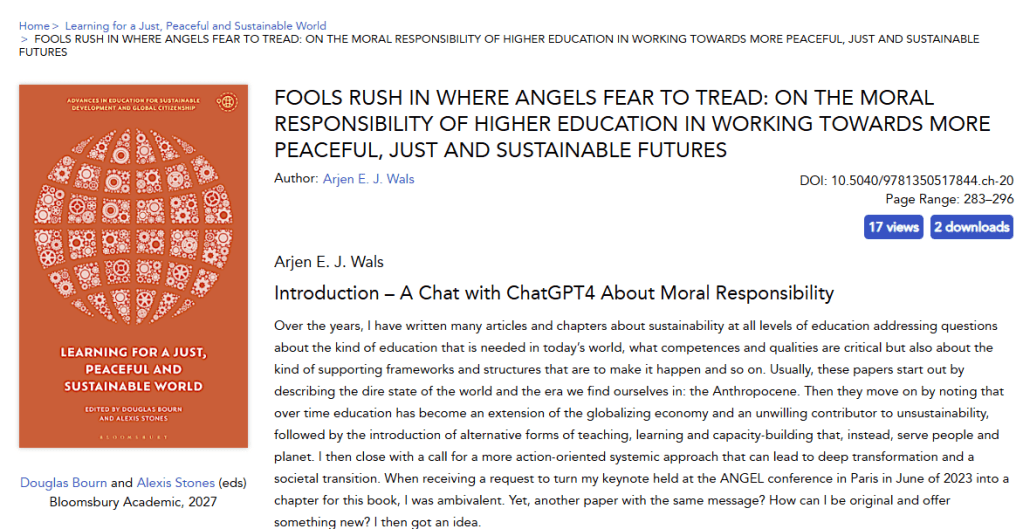
FOOLS RUSH IN WHERE ANGELS FEAR TO TREAD: ON THE MORAL RESPONSIBILITY OF HIGHER EDUCATION IN WORKING TOWARDS MORE PEACEFUL, JUST AND SUSTAINABLE FUTURES

Today (July 1st, 2026) a new open access book will be launched “Learning for a Just, Peaceful and Sustainable World” edited by Douglas Bourn and Alexis Stones. The book showcases current debates in the field of global education and learning and the importance of the Declaration on Global Education to 2050. It features chapters from academics, researchers, policy-makers and practitioners based in Australia, Canada, Finland, Germany, India, Ireland, Italy, Nigeria, Pakistan, Poland, Sweden, The Netherlands and the UK who are working in the fields of global citizenship, education for sustainable development and peace and human rights education. The chapters cover a range of topics that span formal, non-formal and informal learning spaces including gender justice, democracy, moral education, climate change policy, decolonizing global learning, PISA, the Sustainable Development Goals and the role of UNESCO. The importance of learning about global issues and sustainable development has never been seen as more important than it is today and this book addresses the big global issues of today, be they climate change, war and conflict, human rights, quality of learning and reducing global poverty.

I was asked to contribute a chapter based on a key note I held at UNESCO for the Academic Network on Global Education and Learning (ANGEL) which partnered with Global Education Network Europe (GENE). Both focus on issues like global citizenship, sustainability, and human rights. When I started converting the keynote into a chapter, back in 2024, I was just bcoming familiar with GenAI and quite unsure about how to use it, if at all. The chapter starts out with, wht I still think, is a remarkeable chat with ChatGPT (an older version that ‘ talked back at me’ and used humour and, even cynicism. The chapter  outlines five possible guideposts for learning for peace, justice and sustainability that can be distilled from a re-contextualizing Pope’s eighteenth-century poem with the current Anthropocene as a backdrop. In the final postscript I revsit my engagement with ChatGPT.

You can find the open access chapter here!

Full Reference:

Wals, AEJ (2026). FOOLS RUSH IN WHERE ANGELS FEAR TO TREAD: ON THE MORAL RESPONSIBILITY OF HIGHER EDUCATION IN WORKING TOWARDS MORE PEACEFUL, JUST AND SUSTAINABLE FUTURES In: Bourn, Douglas , and Alexis Stones , ed. Learning for a Just, Peaceful and Sustainable World. London,: Bloomsbury Academic, Bloomsbury Collections. Web. 1 Jul. 2026. http://dx.doi.org/10.5040/9781350517844

Imagining Sustainability: A Nomadic Inquiry of Applied Drama in Higher Education

At last a chapter appeared in the wonderful Handbook of Ecological Civilization published by Springer that I am proud of both for its content and for the pleasure of working with PhD candidate from Stockholm University, Julia Fries. Julia over the years has developed a wonderful collection of arts-based, drama-inspired research in a somewhat unusual setting: business education. Her research embodies her pedagogy which is fascinating. This chapter explores how drama can contribute to the necessary renewal of higher education to meet the sustainability challenges of our time. Results are presented from a drama-based research project in higher education, and in a youth project. In the chapter, so-called nomadic enquiry is combined with an arts-based approach to participant interviews. Through this innovative method, an image of a rhizome emerged. This rhizome of expanded learning highlights five necessities or critical nodes for expanded sustainability-oriented learning: emer-gence, expansion through role, embodiment, connection to self and others, and crucial conditions. The rhizomatic perspective not only shows the transformative potential of drama in higher education and adult learning but also identifies the levers and barriers teachers, students, and the academy as an institution are likely to encounter when trying to move towards a socio-ecologically more civilized world. The results point to how the integration of knowledge and wisdom that are striven for in the philosophy of ecological civilization can be put into pedagogical practice through the holistic learning of drama.

The Handbook of Ecological Civilization, unfortunately, is not an Open Access Handbook – but your library may have access. But I am happy to share the corrected proffs for your own use here!

Full citation: Fries, J., Wals, A. (2025). Imagining Sustainability: A Nomadic Inquiry of Applied Drama in Higher Education. In: Peters, M.A., Green, B.J., Misiaszek, G.W., Zhu, X. (eds) Handbook of Ecological Civilization. Springer International Handbooks of Education. Springer, Singapore. https://doi.org/10.1007/978-981-97-8101-0_73-1