
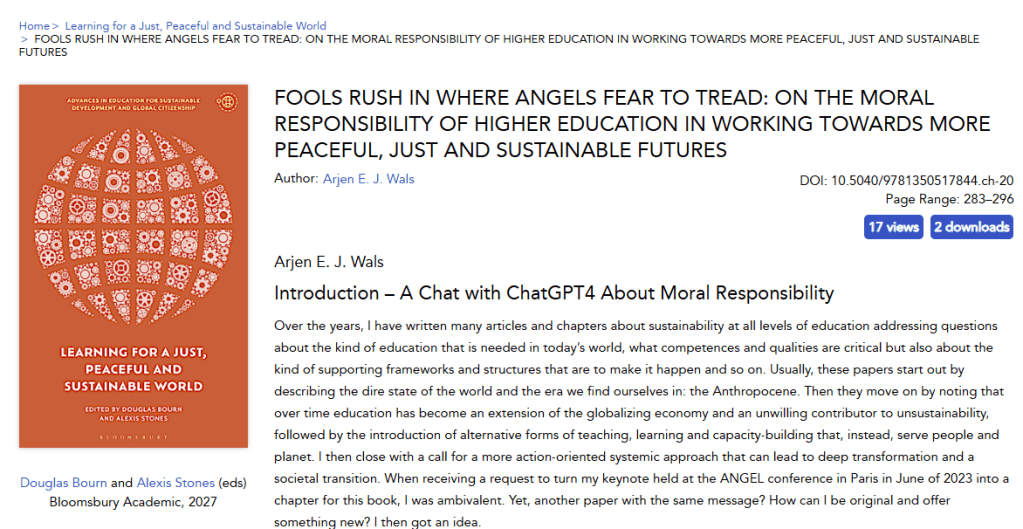
FOOLS RUSH IN WHERE ANGELS FEAR TO TREAD: ON THE MORAL RESPONSIBILITY OF HIGHER EDUCATION IN WORKING TOWARDS MORE PEACEFUL, JUST AND SUSTAINABLE FUTURES

Today (July 1st, 2026) a new open access book will be launched “Learning for a Just, Peaceful and Sustainable World” edited by Douglas Bourn and Alexis Stones. The book showcases current debates in the field of global education and learning and the importance of the Declaration on Global Education to 2050. It features chapters from academics, researchers, policy-makers and practitioners based in Australia, Canada, Finland, Germany, India, Ireland, Italy, Nigeria, Pakistan, Poland, Sweden, The Netherlands and the UK who are working in the fields of global citizenship, education for sustainable development and peace and human rights education. The chapters cover a range of topics that span formal, non-formal and informal learning spaces including gender justice, democracy, moral education, climate change policy, decolonizing global learning, PISA, the Sustainable Development Goals and the role of UNESCO. The importance of learning about global issues and sustainable development has never been seen as more important than it is today and this book addresses the big global issues of today, be they climate change, war and conflict, human rights, quality of learning and reducing global poverty.

I was asked to contribute a chapter based on a key note I held at UNESCO for the Academic Network on Global Education and Learning (ANGEL) which partnered with Global Education Network Europe (GENE). Both focus on issues like global citizenship, sustainability, and human rights. When I started converting the keynote into a chapter, back in 2024, I was just bcoming familiar with GenAI and quite unsure about how to use it, if at all. The chapter starts out with, wht I still think, is a remarkeable chat with ChatGPT (an older version that ‘ talked back at me’ and used humour and, even cynicism. The chapter  outlines five possible guideposts for learning for peace, justice and sustainability that can be distilled from a re-contextualizing Pope’s eighteenth-century poem with the current Anthropocene as a backdrop. In the final postscript I revsit my engagement with ChatGPT.

You can find the open access chapter here!

Full Reference:

Wals, AEJ (2026). FOOLS RUSH IN WHERE ANGELS FEAR TO TREAD: ON THE MORAL RESPONSIBILITY OF HIGHER EDUCATION IN WORKING TOWARDS MORE PEACEFUL, JUST AND SUSTAINABLE FUTURES In: Bourn, Douglas , and Alexis Stones , ed. Learning for a Just, Peaceful and Sustainable World. London,: Bloomsbury Academic, Bloomsbury Collections. Web. 1 Jul. 2026. http://dx.doi.org/10.5040/9781350517844


T-learning in Times of Transition Towards a Sustainable World – Keynote held for Learning for Sustainability Scotland

I was invited to give the closing keynote of the 2020 Annual General Meeting and Networking of Learning for Sustainability Scotland. The event was held online for the first time on 12th January 2021. More than 150 members gathered to explore the theme Building Forward Better: The role of Learning for Sustainability – What role does Learning for Sustainability play in making the world a better place, and how can we make this a reality? You can find a summary of the event and link to each of the programma elements here: https://learningforsustainabilityscotland.org/2021/01/28/report-from-the-lfs-scotland-jan-dec-2020-agm/

My talk titled ‘T-learning in Times of Transition Towards a Sustainable World’ presented an ultimately hopeful perspective on the role of new forms of learning and more ecological approaches of education in overcoming global systemic dysfunction – outlining some principles, perspectives and sharing international practice. You can see the 40 minute talk introduced generously by Rehema White, here: https://media.ed.ac.uk/media/1_gcmxxtyz The talk is followed up by some responses to questions raised by the participants.

Time for ‘T-learning’ – transformative, transgressive learning in times of climate change

transgressive

Still feeling very privileged and a bit lucky to be part of a very rich consortium of partners from 4 different continents – as one of 3 selected proposal out of more than 500 (!) original expressions of interest – to work on this ICSS-funded project on T-learning. The project just launched its website: http://transgressivelearning.org/ with the case studies form the 10 different countries. Here is what we are talking about:

Radical changes in society are needed for responding to climate change, and for transforming to sustainability. It is increasingly clear that people everywhere will need to learn to transform to sustainability in ways that are socially just, peaceful and ecologically sustainable.

It is now already widely known that transformations to sustainability can occur if people learn to make changes at niche level. This can drive wider social changes and regime shift transformations, especially if such forms of learning become more collective.

Transformations to sustainability do not come about easily because of ‘lock-ins’ in the system. Transformative, transgressive types of learning are needed to help ‘unlock’ the lock-ins and to strengthen wider forms of collective social learning.

Yet, we know little about the type of transformative, transgressive learning (t-learning) that enables such change.

Here’s the initial ‘academic’ paper we wrote: transgressiveSocialLearning (only to have a look, not for sharing with others).

Full reference: Lotz-Sisitka H, Wals AEJ, Kronlid D, McGarry D. (2015) ‘Transformative, transgressive social learning: rethinking higher education pedagogy in times of systemic global dysfunction’, Current Opinion in Environmental Sustainability , 16, 73-80, doi:10.1016/j.cosust.2015.07.018

Go visit the website! http://transgressivelearning.org/ or here: Join T-learning form