
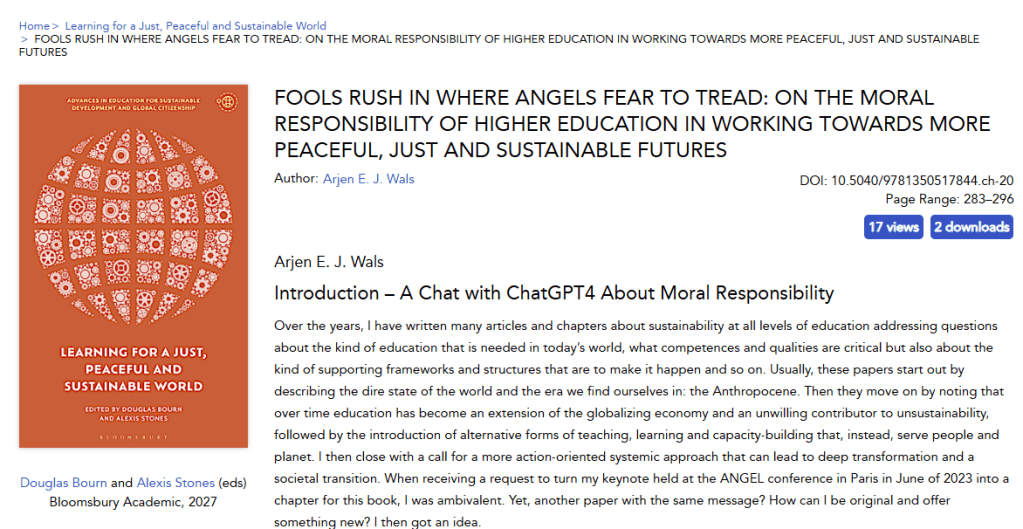
Today (July 1st, 2026) a new open access book will be launched “Learning for a Just, Peaceful and Sustainable World” edited by Douglas Bourn and Alexis Stones. The book showcases current debates in the field of global education and learning and the importance of the Declaration on Global Education to 2050. It features chapters from academics, researchers, policy-makers and practitioners based in Australia, Canada, Finland, Germany, India, Ireland, Italy, Nigeria, Pakistan, Poland, Sweden, The Netherlands and the UK who are working in the fields of global citizenship, education for sustainable development and peace and human rights education. The chapters cover a range of topics that span formal, non-formal and informal learning spaces including gender justice, democracy, moral education, climate change policy, decolonizing global learning, PISA, the Sustainable Development Goals and the role of UNESCO. The importance of learning about global issues and sustainable development has never been seen as more important than it is today and this book addresses the big global issues of today, be they climate change, war and conflict, human rights, quality of learning and reducing global poverty.
I was asked to contribute a chapter based on a key note I held at UNESCO for the Academic Network on Global Education and Learning (ANGEL) which partnered with Global Education Network Europe (GENE). Both focus on issues like global citizenship, sustainability, and human rights. When I started converting the keynote into a chapter, back in 2024, I was just bcoming familiar with GenAI and quite unsure about how to use it, if at all. The chapter starts out with, wht I still think, is a remarkeable chat with ChatGPT (an older version that ‘ talked back at me’ and used humour and, even cynicism. The chapter outlines five possible guideposts for learning for peace, justice and sustainability that can be distilled from a re-contextualizing Pope’s eighteenth-century poem with the current Anthropocene as a backdrop. In the final postscript I revsit my engagement with ChatGPT.
You can find the open access chapter here!
Full Reference:
Wals, AEJ (2026). FOOLS RUSH IN WHERE ANGELS FEAR TO TREAD: ON THE MORAL RESPONSIBILITY OF HIGHER EDUCATION IN WORKING TOWARDS MORE PEACEFUL, JUST AND SUSTAINABLE FUTURES In: Bourn, Douglas , and Alexis Stones , ed. Learning for a Just, Peaceful and Sustainable World. London,: Bloomsbury Academic, Bloomsbury Collections. Web. 1 Jul. 2026. http://dx.doi.org/10.5040/9781350517844


