Lightheartedness in dark times – Clowning as a pedagogy for leaders: learning to transgress unsustainable ‘normality’

“…we explore clowning as part of a pedagogy of transgression to be offered to leaders who need to break free from habits of the mind and resistant power structures that keep us stuck in unsustainable models.”

Surely one of the most exciting papers that have contributed to recently is the one that came out today in Environmental Education Research. Francine Cruz de Lima came to us at Wageningen University just over a year ago as an external PhD canditate from the School of Arts, Sciences and Humanities, University of São Paulo, São Paulo, Brazil. In her PhD she is exploring how humor, and clowning in particular, can help people, leaders in particular, become unstuck from normalized ways of thinking, being and acting. The paper led by her “Clowning as a pedagogy for leaders: learning to transgress unsustainable ‘normality’” makes up the first study of her PhD. The paper is publishedin EER which published a Special Issue on Humor and Environmental Education in 2023. It will be followed by empirical studies of workshops conducted in São Paulo with (business) leaders who will experience clowning in practice.

From the abstract:

The sustainability polycrisis that the world is facing can be understood as a systemic response to a relational crisis that comes from the normalization of unnatural separations and hierarchies. These separations prevent conscious connection with interdependent parts of the whole, including diverse social groups, ethnicities, species, ecosystems, and personal dimensions. Decision-makers of our time are expected to have the capacity to transcend such separation paradigms to foster systems transformation towards sustainability. A few scholars are investigating the role of leadership programs in this challenge. Hoping to contribute to this scholarship, we explore clowning as part of a pedagogy of transgression to be offered to leaders who need to break free from habits of the mind and resistant power structures that keep us stuck in unsustainable models. This article is a narrative literature review that seeks conceptual and methodological affinities between clowning, humor, playfulness, adult play, critical pedagogies, transformative learning, and inner-outer transformation frameworks. The results are synthesized into initial educational design principles, aiming to guide the creation of group learning opportunities that facilitate making power dynamics visible, denormalizing unjust hierarchies, and promoting a paradigm shift towards relationality. We discuss the implications of our propositions to formal and non-formal sustainability education of adults, including leadership programs, and suggest how they can be refined and tested in future research.

Full citation:

Cruz de Cerqueira Lima, F., & Wals, A. (2026). Clowning as a pedagogy for leaders: learning to transgress unsustainable ‘normality.’ Environmental Education Research, 1–31. https://doi.org/10.1080/13504622.2026.2744862

Imagining Sustainability: A Nomadic Inquiry of Applied Drama in Higher Education

At last a chapter appeared in the wonderful Handbook of Ecological Civilization published by Springer that I am proud of both for its content and for the pleasure of working with PhD candidate from Stockholm University, Julia Fries. Julia over the years has developed a wonderful collection of arts-based, drama-inspired research in a somewhat unusual setting: business education. Her research embodies her pedagogy which is fascinating. This chapter explores how drama can contribute to the necessary renewal of higher education to meet the sustainability challenges of our time. Results are presented from a drama-based research project in higher education, and in a youth project. In the chapter, so-called nomadic enquiry is combined with an arts-based approach to participant interviews. Through this innovative method, an image of a rhizome emerged. This rhizome of expanded learning highlights five necessities or critical nodes for expanded sustainability-oriented learning: emer-gence, expansion through role, embodiment, connection to self and others, and crucial conditions. The rhizomatic perspective not only shows the transformative potential of drama in higher education and adult learning but also identifies the levers and barriers teachers, students, and the academy as an institution are likely to encounter when trying to move towards a socio-ecologically more civilized world. The results point to how the integration of knowledge and wisdom that are striven for in the philosophy of ecological civilization can be put into pedagogical practice through the holistic learning of drama.

The Handbook of Ecological Civilization, unfortunately, is not an Open Access Handbook – but your library may have access. But I am happy to share the corrected proffs for your own use here!

Full citation: Fries, J., Wals, A. (2025). Imagining Sustainability: A Nomadic Inquiry of Applied Drama in Higher Education. In: Peters, M.A., Green, B.J., Misiaszek, G.W., Zhu, X. (eds) Handbook of Ecological Civilization. Springer International Handbooks of Education. Springer, Singapore. https://doi.org/10.1007/978-981-97-8101-0_73-1

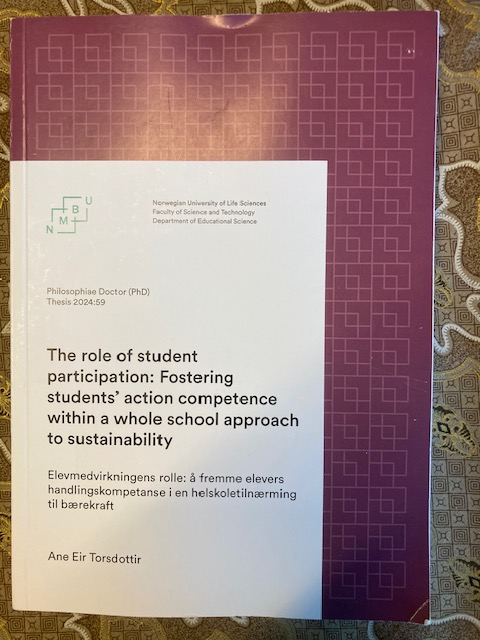
Ane Eir Thorsdottir Successfully Defends PhD-dissertation on Youth Participation in a Whole School Approach

On Friday November 1st one of my Norwegian PhD Candidates successfully defended her dissertation. Over the past few years I have been working with colleagues both at Wageningen University and at the Norwegian Life Sciences University (NMBU) on researching the potential merits of so-called Whole School and/or Whole Institution Approaches (WSA/WIA) to sustainability. At NMBU there are currently four PhD-candidates doing research related to this, Ane Eir Thorsdottir is or rather, was one of them. Her work focusses on one aspect of the WSA which is critically important: students participation. In addition to myself, Prof Astrid Sinnes of NMBU and Dr. Daniel Olsson of Karlstad University in Sweden were her supervisors. Jan Cincera and Elin Saether (Olso Univerity) were her ‘ opponents’ .She has published three articles that are central in the dissertation: two in Environmental Education Research and one in Global Environmental Research.


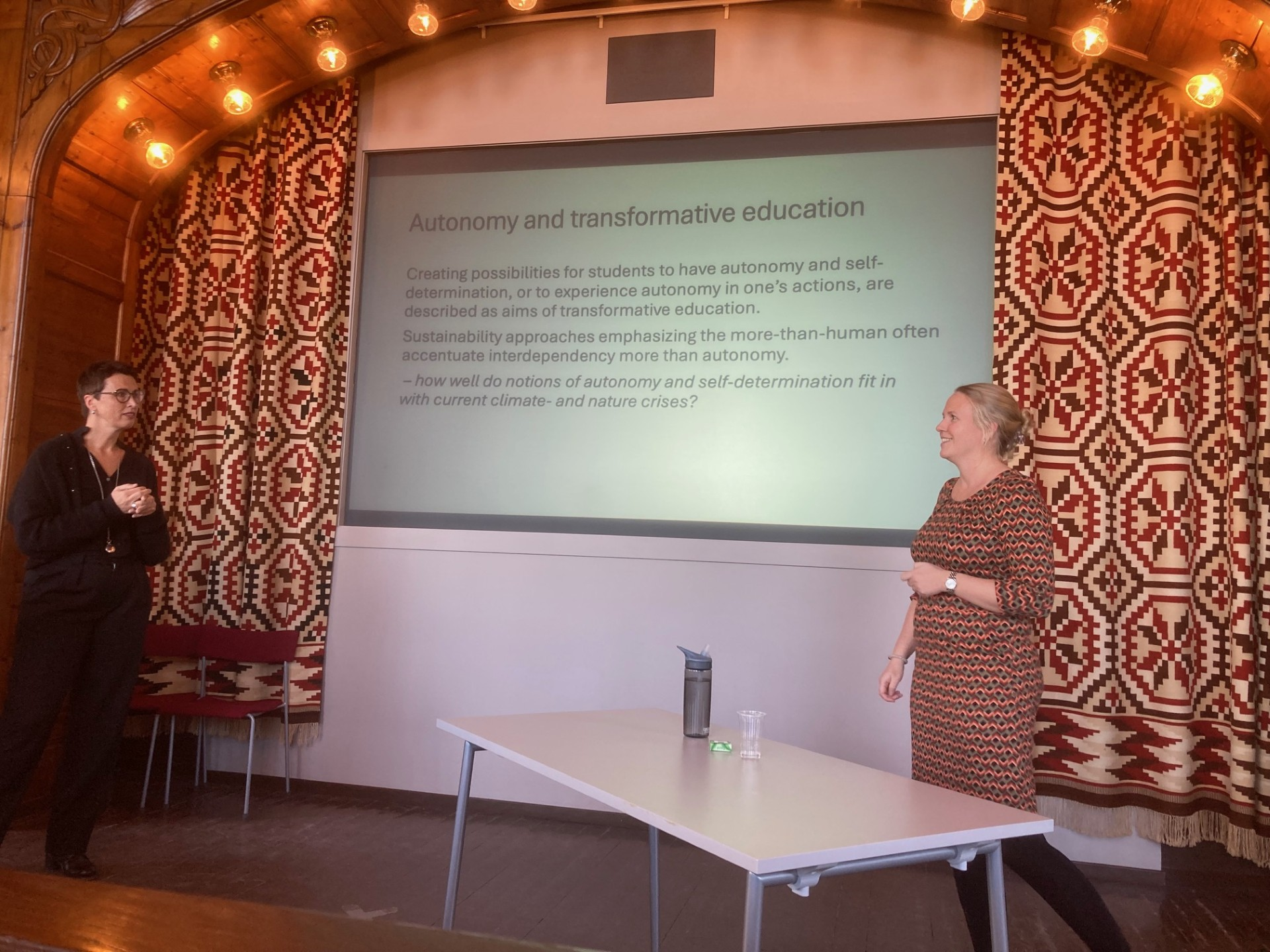
Elin Seather (left) having a dialogue with Ane (right) during the defence – posing an interesting question about autonomy and self-determination as pedagogical principles in a world that requires a decentering of ‘ self’ and opening up for ‘ other’ as well.