This paper led by ELS-WUR PhD-candidate Marlies van der Wee – Bedeker was published earlier this Fall. The paper is the first peer reviewed article based on her research that is grounded in the City of Rotterdam using her home institute Hogeschool Rotterdam as a base. Below a summary of the main fiindings. The full paper can be found here!
We are pleased to share with you the publication of our new book, Education and Learning for Sustainable Futures: 50 years of learning and environmental change. This book explores fundamental questions about how the role of education has evolved over the decades since the pivotal 1972 Stockholm Conference, which brought environmental learning to the forefront of global awareness.
Co-authors, Daniella Tilbury and Thomas Macintyre and myself, have attempted to find some answers by tracking through the decades (1970-2020) the development of narratives, thinking, and practice of learning and education in support of the environment and sustainability. What is clear is that the profile and presence of learning and education for the environment has been elevated in today’s policy discourses and communities of practice. Yet, our analysis identified some clear differences in the way education and learning for the environment has been approached over time.
In our new book, we trace these changes over the decades while looking ahead to the challenges and opportunities of the future. A key wildcard in this journey is Artificial Intelligence (AI), which holds immense potential to bridge digital and green agendas, enabling smarter environmental management and driving innovation toward a sustainable future. However, we also address critical concerns: data privacy breaches, outsourcing human thinking to profit-driven algorithms, exacerbation of inequalities, and the environmental footprint of AI infrastructure.
This book provides a light way into the history, developments and prospects of the field of Environmental and Sustainability Education.
Full reference:
Macintyre, T., Tilbury, D., & Wals, A. (2024). Education and Learning for Sustainable Futures: 50 Years of Learning for Environment and Change (1st ed.). Routledge. https://doi.org/10.4324/9781003467007
Our thanks also go to Stakeholder Forum and to @JanGustav for his leadership role in the Stockholm+50 reflective dialogues, and to UNEP/ the Swedish Government for spurring us on to track the historical development of education and learning for the environment. We are also grateful to @Routledge for taking an interest in publishing the text.
This paper appeared online in 2022 and was a part of the wonderful dissertation of Koen Wessels which was later published by Springer Nature as a book within the publisher´s SDG 4 ´Quality Education´ Series. Now has been formally published in open-access form as a part of the latest issue of Pedagogy, Culture and Society. Full citattion: Wessels, K. R., Bakker, C., Wals, A. E. J., & Lengkeek, G. (2024). Rethinking pedagogy in the face of complex societal challenges: helpful perspectives for teaching the entangled student. Pedagogy, Culture & Society, 32(3), 759–776. View and download here: https://doi.org/10.1080/14681366.2022.2108125
Here is the abstract to give you a bit of a flavor of the paper:
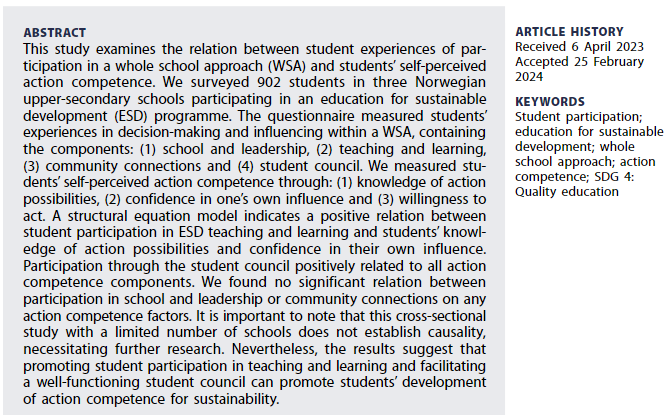
Over the past few years I have been working with colleagues both at Wageningen University and at the Norwegian Life Sciences University (NMBU) on researching the potential merits of so-called Whole School and/or Whole Institution Approaches (WSA/WIA) to sustainability. At NMBU there are currently four PhD projects related to this. One of the PhD candidates I am working with is Ane Thorsdottir who focusses on one aspect of the WSA which is critically important: students participation. A paper of which she is the lead researcher and lead author just came out in Environmental Education Research (open access). In the paper students’ self-perceived action competence within a WSA is a central topc. Here is the abstract:
Here is the full reference and a link to the full paper:
Ane Eir Torsdottir, Daniel Olsson, Astrid Tonette Sinnes & Arjen Wals (2024) The relationship between student participation and students’ self-perceived action competence for sustainability in a whole school approach, Environmental Education Research, DOI: 10.1080/13504622.2024.2326462
Today, the first article from Ane Torsdottir’s PhD Research on High School student’s partcipation in schools trying to work within a Whole School Approach in Southern Norway, was published in Environmental Education Research. The article, co-authored by her supervising team with Daniel Olsson, Astrid Sinnes and myself, demonstrates how a questionnaire gauging students’ experiences of participation in decision-making at their school can operationalise student participation in a whole school approach (WSA) to education for sustainable development model.
Some 902 students in three upper secondary schools participated in the study by giving their answers to Likert-scale items developed to tap into their experience of participation in the decision-making at their school.
The students identified four distinct pathways of participation:
(i) School and Leadership,
(ii) Teaching and Learning,
(iii) Community Connections, and
(iv) Student Council.
The results are discussed in the light of focus group interviews with eleven of the participants. The student WSA participation questionnaire proved to be a reliable and valid instrument that, together with the student WSA participation model, can be used by school leaders wanting to increase student participation, and by researchers investigating student participation throughout the whole school.
Full citation:Torsdottir A.E, Sinnes A, Olsson D. & Wals, A. (2023) Do students have anything to say? Student participation in a whole school approach to sustainability, Environmental Education Research, DOI: 10.1080/13504622.2023.2213427




 Transformative learning