
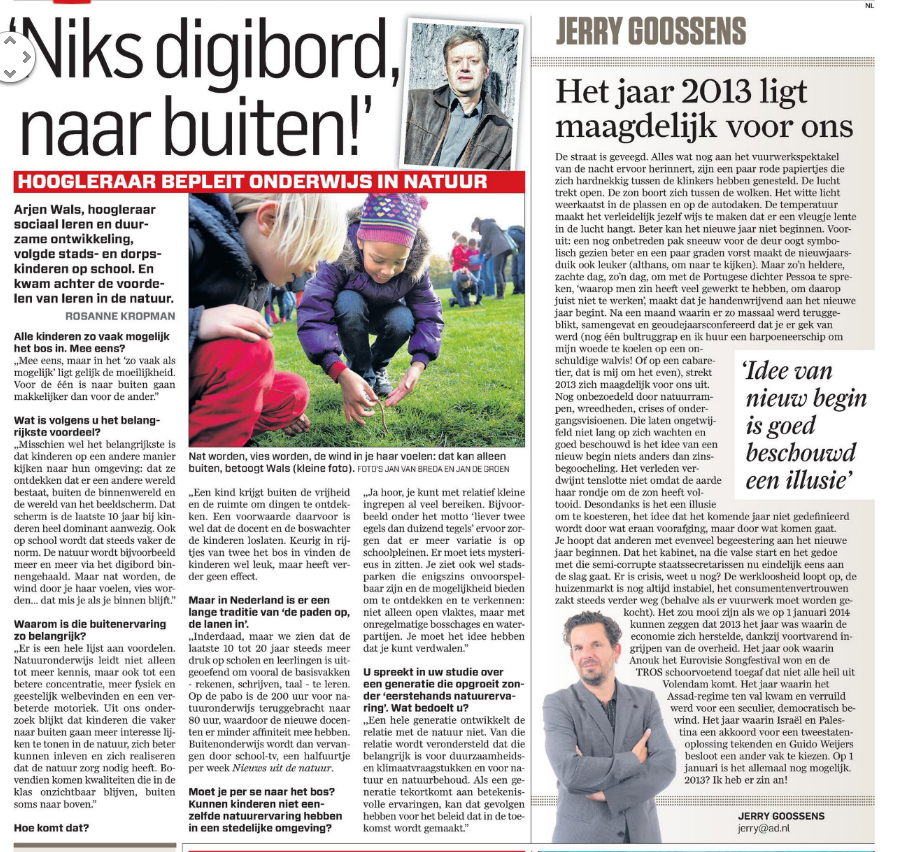
With nowadays many people, young and older, all over the world spending 80-90 % of their waking hours behing a screen (smart phone, tablet, laptop,TV or PC – to mix it up a bit) it is time to refer back to a study on the impact of educational nature immersion programme’s on child development completed by Wageningen University back in 2012. The study received some national press at the time via an interview for the Dutch news paper ‘Het Parool’ which was also picked-up by another major paper ‘het Algemeen Dagblad’ in its first issue of 2013 (I have included a copy of the latter interview at the end of this post, in Dutch I’m afraid).
A question that we did not ask at the time is whether the ICTs can be designed and used in such a way that they can perhaps help people reconnect with people and planet/place, given that these technologies are likely to stay. This is something the more recent paper in Science on the convergence of science education and environmental education using ICT-supported Citizen Science as a bridge suggests. See: ScienceWalsetall2014
Below I have pasted the English Executive Summary of the report. For the full report please click the link just above the photo of the report’s cover which is shown below as well.
Please note that the report itself and the articles are in Dutch
Toen ik er meer over ging weten werd het leuk Compleet(3)inclUKabstract
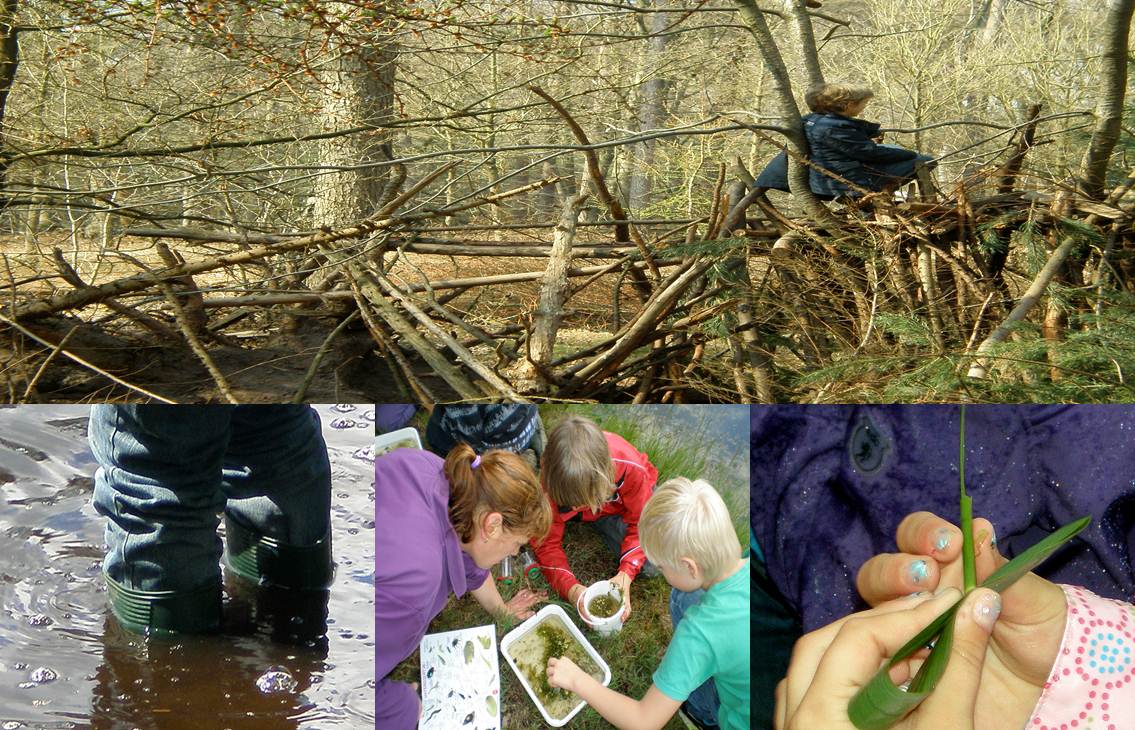
The impact of educational nature immersion programme’s on child development
Connecting Children to Nature through an Educational Nature Immersion Programme
Full citation in Dutch:
Van der Waal, M.E., Hovinga, Wals, A.E.J en van Koppen, C.S.A. (2012) “Toen ik er meer over ging weten werd het leuk”: Onderzoek naar de meerwaarde van het educatieve natuurbelevingsprogramma ‘NatuurWijs’ in vergelijking met regulier natuuronderwijs. Rapport, Wageningen: Educatie & Competentiestudies, Wageningen Universiteit, 116 p.
Full citation in English:
Van der Waal, M.E., Hovinga, Wals, A.E.J en van Koppen, C.S.A. (2012) “Once I started to get to know it better, it became fun”: A study of the added-value of an educational nature-immersion programme ‘NatureWise’ in comparison with standard nature education in Dutch Primary schools. Research Report, Wageningen: Education and Competence Studies, Wageningen University, 116 p.
Executive Summary
Most of the world’s children grow up in urban areas with little access to the natural world. Presently there is a renewed interest in The Netherlands but elsewhere as well, in the provision of educational experiences that can help children connect with the natural world. This interest is fuelled by an increased concern about the decline in (young) people’s health (e.g. the rise of obesity in many parts of the world), their understanding of how nature works (e.g. in relation to climate change and biodiversity loss), their ability to concentrate and engage in deep thinking, as a result of the rapid rise of digitally mediated interaction, Around the globe school-based programmes have been developed that immerse children in nature-oriented experiences near (e.g. on school grounds) and not so near places (e.g. in a natural area driving distance away from the school). The programmes vary in intensity (from once a year to periodically throughout the year), educational approach (from more cognitive and understanding oriented to more whole person-oriented) didactical orientation (from show and tell modes of instruction to more free flowing, experiential and discovery-based approaches), and the role of outside experts (from low involvement of outside expertise to high involvement of outside expertise.
Little research has been done on the impact of such programs on children’s development, learning and their understanding of and connections with nature. Longitudinal studies where children are followed over a longer period of time are even scarcer. This study reports on a three year longitudinal study of children (age 8-10) who participated in NatureWise, a nature immersion programme that takes children into the forest under the guidance of a forest ranger three times a year. NatureWise (NW) is a carefully designed programme that requires school-based preparation for each of the so-called forest days as well as school-based reflection on the significance and lessons learnt of each on those days. The programme seeks to develop ‘head’ (development of cognitive understanding of ecological principles and life in and management of the forest), ‘hart’ (development of affective, emotional bonding with nature and associated values) and, ‘hands’ (development of psycho-motor skills needed to care for nature).
An experimental design was created that included 6 primary schools, 3 from urban areas and 3 from more rural areas. In each school for each participating grade a NatureWise-class was followed as was a control class which did not participate in NW but followed the normal nature education programme that can be considered typical for most Dutch primary schools. Most Dutch primary schools at present allocate limited time to both nature-oriented and experience-oriented education mainly because of pressure to increase the scores on standardized tests in reading, writing, general sciences and arithmetic. In the worst case schools only provide 30 minutes weekly of a school television programme called ‘News from Natural World.” Within each class a group of eight pupils was followed more intensively to obtain a deeper understanding of the children’s development. Children’s concept-maps and activity booklets (in year 1 and year 3 of the study) were analysed as well as interviews with the eight focus children from each class. In addition all participating teachers (n=24) were interviewed about their understanding of nature education in general and NW in particular (for those who participated in NW) as well as about the changes they observed in the children and about the influence of the children’s home-situation on their exposure to and connection with nature. In addition classes were observed periodically during lessons about nature. In total 185 children between the ages of 8 and 10 participated in the study. Methodologically the study can be classified as a phenomenological study in that as much as possible the researchers tried to capture children’s understanding of and connection with nature, and the teacher’s understanding thereof, through their own eyes by trying to minimize the influence of the researcher’s own preconceived notions about what to expect while trying to maximize the opportunities for children and teachers to express themselves freely, undistorted by expectations about what is ‘right’.
The relationship between children and nature, according to this study, is in its essence mostly playful and animal-oriented. The children are not always conscious or aware of this relationship but the relationship becomes stronger and more explicit when given the opportunity to explore nature in their own life-world. The children’s relationship can be classified as pluralistic and culture-bound. In highly urbanized settings the relationship appears weaker as the opportunities to explore and connect with nature, both in the home setting and the neighbourhood, are rather limited. The role of the parents and the school in fostering children’s connections with nature is quite significant. A nurturing home and school environment, enabling children to have multiple and idiosyncratic experiences in nature or nature-like areas, can help create conditions that allow children to develop a stronger and more meaningful bond with nature. Such experiences include: discovering new things and pathways in nature, seeing how others respond to experiences in nature, learning to cope with anxiety, overcoming challenges, learning how to ‘observe’ and developing a heightened awareness of one’s surroundings, storing of memories both mentally and physically (e.g. by taking home artefacts from nature, and, finally, by sharing experiences in nature in conversation and through other forms of expression (e.g. arts) at home and at school with parents, care-givers, siblings, peers and teachers.
For the pupils it is important that they learn to know and to identify nature – or what is seen as nature or green in a country where nature arguably hardly exists in in a ‘pure’ and overwhelming sense – in their own neighbourhood. This knowing and identifying makes it possible for them to shape their own meaningful relationship with nature. This connects with the general interest most children display in nature: they want to know how nature works, how they can be good for nature and environment, how they can survive in nature, what they can find in nature, and how animals live. Given the somewhat impoverished state of nature (conservation) education in most Dutch schools, addressing these questions and building up ecological literacy must not be rushed but rather needs to be done gradually. One difference between the children growing up in the heavily urbanized environments and the children growing up in more rural environments is that the urban children also display a keen interest in cultural aspects and are more pre-occupied with the human-nature relationship.
When considering the regular nature education ‘taught’ to the control groups in the participating schools it can be concluded that there is quite a bit of variation in between the schools and even within the schools. This leads to great differences in the ways children are exposed to nature in the school setting.
In some classes the occasional watching of ‘News from the Natural World’ on school TV is all that is offered. In other classes teachers do their utmost to develop knowledge and literacy in connection to the natural world and seek to extend this to also develop positive attitudes towards nature and the skills to care for nature. But there are many other differences: some schools have a specific nature education method or text book others do not, some schools make an effort in getting students outside of the classroom, others do not, some schools bring plants and animals to the classroom, others do not, some schools do classroom experiments, others do not, some schools bring in outside experts to talk about nature, others do not, some schools have special projects weeks, others do not…
Clearly, the children participating in the NatureWise programme do so within different contexts, some being more conducive to nature education than others. The research shows that most children, not all, benefit from participating in NW frequently over a 2-3 year which is expressed in an increase in knowledge of nature, deepened sensory and affective engagement with nature, and more sensitive behaviour towards nature. The added value of NW lies is multiple: children are in a position to establish direct contact with nature, children gain more confidence and interest in nature which helps them understand information about nature that comes to them through the media, children are better positioned to develop empathy towards another species, children come to see the importance of caring for nature, children are given hands-on opportunities to care for nature, and, finally, children get to enjoy being in nature aesthetically, psycho-motorically and intellectually. All this combined makes children more inclined to actively seek nature. The research therefore confirms the key premises of experience-oriented nature education programmes, although it should be noted that not all participating students display such a development and that in the control group some students display a similar development under favourable conditions in the school and/or home environment.
Participation in NW also results in a number of positive spin-off effects among the teachers, especially among those who already have some affinity with nature and nature education and/or are at least open to it from a professional development perspective and/or are part of a school characterized by a positive pedagogical climate emphasizing continuous improvement. Where these conditions or a subset thereof, exist, it turns out that teachers come to view their pupils differently: they discover qualities that they failed to see before or only moderately recognized in a regular classroom setting. In addition they come to appreciate the value of emotions, the affective domain and using all the senses for children’s personal development but also for teaching and learning in general. As a result these teachers are better positioned to see the educational potential of the green outdoors, even in highly urbanized areas, and seem more capable in connecting learning outside school with learning inside school. Another spin-off effect concerns the children’s parents. The anecdotes and narratives provided by both the teachers and the pupils suggest that NW, at least in some instances, also positively influences the parents when the outdoor experiences are shared at home.
Although these findings can be considered positive some cautionary remarks need to be made. The impact of NW is highest when a number of factors help enhance the NW-experience. These factors are:
- The geographical location of the school – NW at present has more impact on children growing-up in city environments.
- The pedagogical climate at school – NW has more impact when there is space for experiential and discovery-based learning but also when a school dares to abandon the standard curriculum at times.
- The teacher’s attitude towards nature and nature education – NW has more impact when a teacher has affinity with Biology, nature and the outdoors.
- The educational qualities of the outdoor guide – NW has more impact when the outdoor guide understands the world of a child and possesses didactical and pedagogical qualities.
- The involvement of parents and/or care givers – NW has more impact when the home environment engages with the children’s experiences.
When all or even a sub-set of these factors work in the right direction, these positive impacts are more likely to occur, even in children who do not participate in NW. At the same time, when most of these factors work in the other direction these impacts are less likely to occur, even in children who do participate in NW.
Overall, the potential added value of participating in an educational nature immersion programme such as NW, is highest in urban settings where the challenge to (re)connect children with nature appears greatest. In order benefit from a programme such as NW the most it is recommended that before implementing the programme an inventory is made of the five factors listed above. A first analysis or quick-scan of these factors can help reveal areas that require attention before implementing NW or can give cause to adapt the NW-programme in such a way that it is likely to resonate better with the school, the children, the teachers and the wider community. As such this research provides an argument for more tailor-made programmes but also for policies that support these factors.
=========
INTERVIEW Algemeen Dagblad 02/01/13
Note: The articles fail to recognize that the study was conducted by a team of researchers consisting of Marlon van der Waal and Dieuwke Hovinga (OVC-Advies & Lector Hogeschool Leiden) – who both did the bulk of the research – and Kris van Koppen (Environmental Policy Group, Wageningen University) and myself.


 Transformative learning