
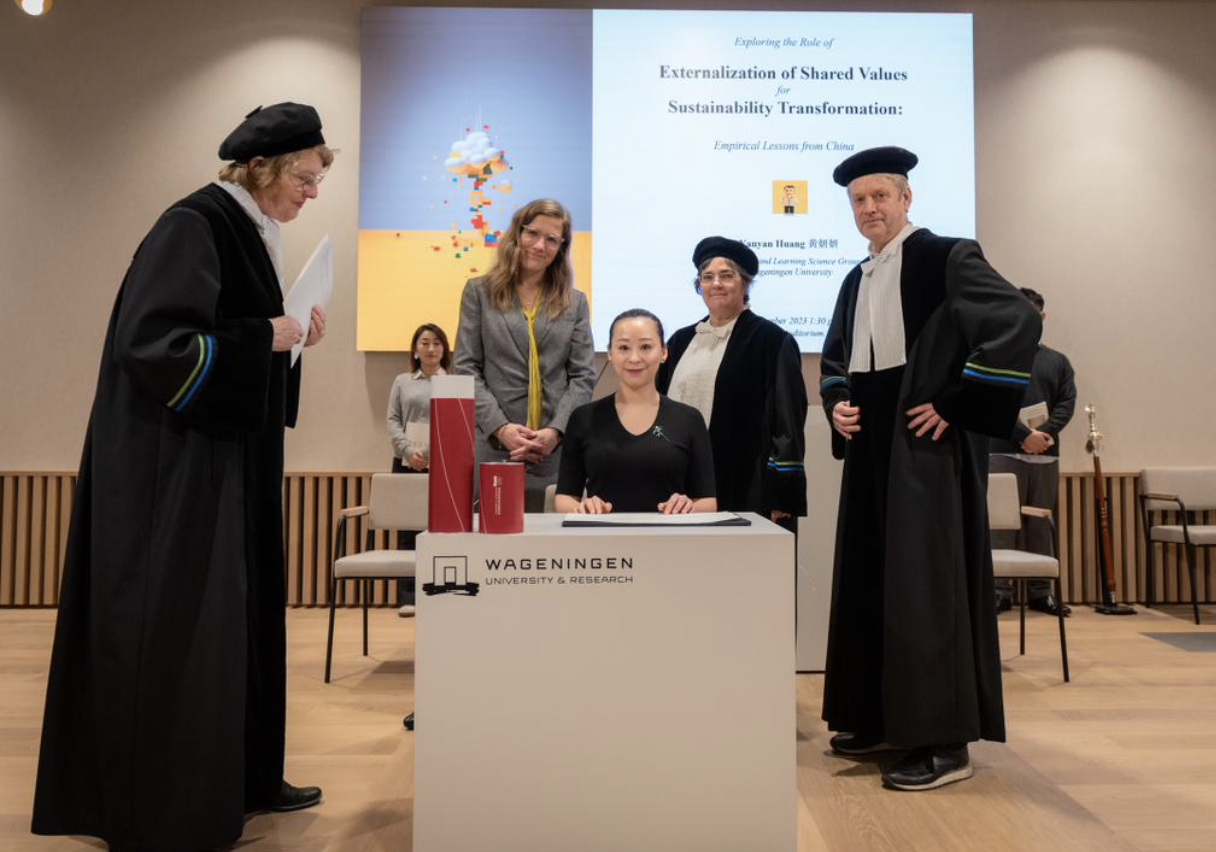
Yanyan Huang successfully defends her thesis ´Exploring the Role of Externalization of Shared Values for Sustainability Transformation´

Yanyan Huang receving her PhD degree with on her side second promotor Prof Marie Harder of Fudan University, Co-promotor Dr. Renate W<esselink and myself.

On December 19th Yanyan Huang successfully defended her thesis in the aula of Wageningen university. Her thesis presents an in-depth exploration to unravel the roles/potential of the externalization of shared values in facilitating sustainability transformation. Although the need for sustainability transformation is increasing globally and the profound influence of values for sustainability transformation is already established, there is still not sufficient understanding in how to purposefully navigate values for sustainability transformation. This thesis strives to fill this gap by introducing a new perspective: conceptualizing values as tacit knowledge and leveraging the SECI model from the Knowledge Creation Theory. Synthesizing results from empirical data collected from cases conducted in Shanghai, China, this thesis identifies the roles of externalization of shared values with respect to its outcome (shared values) and the procedure (externalization) for sustainability transformation. Further, this thesis presents discussions of the underlying mechanism through which shared values, when externalized, facilitate substantial sustainability transformations, and reflections on the implication for researchers from the field of sustainability science. For those who aim to promote sustainability transformation, this thesis not only enhances the understanding of the dynamic interplay between shared values and sustainability transformation, but also provides a specific roadmap to unleash the potential of the externalization of shared values for sustainability transformation to respond to the above- mentioned gap. With its new perspective, this thesis also underscores the necessity of considering the procedures through which values/shared values are involved.

The entire thesis can be downloaded via the Wageningen University Library.

Learning in, with, and through the Territory: Territory-Based Learning as a Catalyst for Urban Sustainability in Porto Alegre, Brazil

TaquaraCollage

Some readers of my blog of might call me a hypocrite – and I cannot really blame you – but despite strong reservations I continue to co-author work that is submitted to Sustainability – the journal, and mainly its publisher’s (MDPI’s) business model, I have critiqued in the past for mass and fast-publishing (find my critique here as well as the response of Paul Vazquez, CEO of MDPI) which can be found here). Sometimes the people I work with do need a quick-turn around time for their manuscripts and still wish to have work published in a recognized journal that has high impact and is open access (when paying the fee… which for the paper I am sharing here was discounted at 50% to acknowledge that lack of means of some of the contributing institutions, here in Brazil). As I stated in my critique, some work is of high quality and has been properly reviewed by two or more people which is the case in the paper I am sharing here which was just published.

Led by former PhD-student Daniele Tubino Sousa, this paper focuses on learning in the context of territorial problems such as the socio-ecological degradation of urban rivers represent a great challenge to achieving sustainability in cities. This issue demands collaborative efforts and the crossing of boundaries determined by actors that act from diverse spheres of knowledge and systems of practice. Based on an integrative territory notion and the boundary approach, the goal of this paper is to comprehend the boundary crossings that take place in multi-actor initiatives towards the resolution of this problem and what type of territorial transformation is produced as an outcome. Our analysis is built on participatory research on the Taquara Stream case, a degraded watercourse in a socio-ecologically vulnerable area, in southern Brazil. Our data analysis applied a visual chronological narrative and an interdisciplinary theoretical framework of analysis that combined concepts related to the territory (geography) and the boundary approach (education). We verified that local territorial issues functioned as boundary objects, fostering and facilitating dialogical interaction among involved actors, knowledge co-production, and collaborative practical actions that led to changes in the territory in terms of practices, comprehensions, and physical concrete transformations. We framed this study as one of territory-based learning meant to advance the understanding of territorial intervention processes towards urban sustainability.

The advantage of Open Access, indeed is that anyone (with a computer and access to the Internet, that is)  can download it here: https://www.mdpi.com/2071-1050/12/7/3000/htm

Keywords: urban sustainabilityvulnerable communitiesterritoryboundary crossingboundary objectsbrokerssocial learningknowledge co-production