







Last Fall a consortium of which I am proud to be a part, along with the Education & Learning Sciences Group of Wageningen University received funding from the UK-government to a so-called GCRF Network Plus on Transforming Education for Sustainable Futures. The network is co-ordinated out of the University of Bristol and includes partners in India, Rwanda, Somalia/Somaliland, South Africa, the United Kingdom and the Netherlands. TESF undertakes collaborative research to Transform Education for Sustainable Futures. We have just released an introductory video (see above) and just released a timely paper:
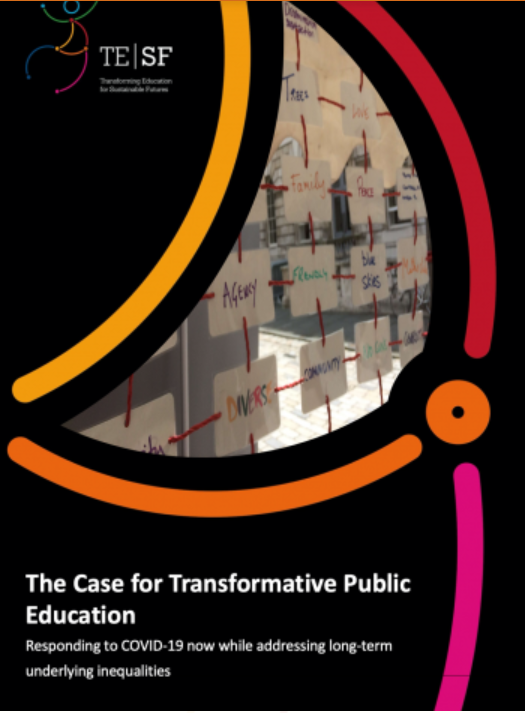
Here is the link to the briefing paper:
This paper addresses the following topics:
On the TESF website you will also find other resources you may find of interest. Have a look here TESF Home Page
This is TESF’s first response to the C-19 situation, and we would like to see it widely distributed, given the timely nature of this topic. Please do all you can to share it widely across your networks. https://tesf.network/resource/transformative-public-education/

Cornell University’s Civic Ecology Lab is starting a new online course on Climate Action during a time where the topic is more urgent then ever but also, when many people, the forunate ones, are locked-down into there home environment with access to technology and lots of time on their hands. Here is the basic info. You can also go straight to their website!
Overview. Many of us want to do something about climate change, but individual actions can feel inadequate in the face of the looming crisis. In the Network Climate Action: Scaling up your Impact online course, you will learn what the latest research says about how to scale up your individual actions through your social networks. You will choose a greenhouse gas mitigation action you take yourself and apply social influence research to persuade your family, friends, social media followers, or other social network to also take that action. You will be part of a unique online community that is applying innovative, exciting, and evidence-based approaches to fight climate change!
Participants. Environment, climate, and education professionals, volunteers, university students, or other climate concerned citizen from any country. Discussions will be in English. This is NOT a course about climate science, but rather about how you can take effective action to help address the climate crisis.
Cost. $60 fee. Most participants pay this fee.
Options available to pay a higher fee ($120) to sponsor another student, or pay a lower or no fee if you are unable to pay or live in countries without internationally accepted payment systems (e.g., Afghanistan, Iran).
Educational approach. The course is based on two principles: (1) Learning is social: participants learn by discussing ideas and sharing resources; (2) Learning should lead to action: participants will apply course content to implementing a climate action of their choice and by persuading one of their social networks to take that action alongside them.
Technology. Edge edX for readings, pre-recorded lectures, and discussion questions (asynchronous). We will also use Facebook and WhatsApp for optional informal discussions and sharing. We will host one webinar each week (Thursdays 8am NY time) and one “office hours” webinar for participants to ask questions each week (Wednesdays 8am NY time). Webinars will be recorded if participants are unable to attend in person.
Certificates. Participants who complete the course are awarded a Cornell University certificate (PDF). Weekly assignments include lectures, readings, and discussion questions. Participants are required to participate in a minimum of one course webinar in person or by watching the recorded webinar. Required course project is a one-page report on the climate action you took with your network.
Learning outcomes. Participants will:
Describe the feasibility and effectiveness of actions to mitigate greenhouse gases across different countries and contexts.
Implement an action to reduce greenhouse gases themselves and among their social network.
Critically reflect on the results of their network climate action and write a one-page report of their action and reflections.
Participate actively in a global online community of climate-concerned citizens.
Topics. Topics. Week 1: Climate Solutions to reduce greenhouse gas emissions from www.drawdown.org. Week 2: Social Networks and spread of climate behaviors; Week 3: Social Mobilization; Week 4: Social Norms; Week 5: Social Marketing and Social Media.
Work load. 5 weeks (4-5 hours of work per week). Throughout the course, you will be working on your network climate action. During the last week, you will complete and submit a final report on your project to persuade one of your social networks to take a climate action.
Dates. April 7 – May 12, 2020. Assignments must be completed no later than May 19, 2020.
Instructors. An experienced and dynamic team from Cornell University Civic Ecology Lab: Marianne Krasny (Professor), Alex Kudryavtsev (Research Associate), Yue Li (Research Associate), Kim Snyder (Course Administrator), Melanie Quinones Santiago (Spanish language assistant), Wanying Wu (Chinese language assistant), plus 10 Chinese language teaching assistants.
Webinar Schedule. We provide two weekly webinars. You can watch them live or the recorded version.
Wednesdays, 8am NY time, “Office Hours” question/answer with instructor Marianne Krasny
8, 15, 22, and 29 April, 6 May
Thursdays, 8am NY time, Plant-rich Diet: Persuading family and friends (This webinar series also open to the public
26 March: Where’s the beet? How diet is a climate game changer; Jennifer Wilkins, Syracuse University
2 April: Harnessing Peer Pressure to Parry the Climate Threat; Robert H Frank, Cornell University
9 April: Menus of Change: Bringing the principles of health and wellness to life; Brendan Walsh,
Culinary Institute of America
16 April: Sustainable Diets and the EAT Lancet Report; Elizabeth Fox, Cornell University
23 April: Cornell Dining: Menus of Change principles reflected in our culinary program;
Lisa Zehr and Michelle Nardi, Cornell University
30 April: How Climate Behaviors Spread in Networks; Damon Centola, University of Pennsylvania
7 May: “Sustainable Tapas” Project: Complex behaviors and social mobilization approaches to climate action;
Fátima Delgado, Universitat Politècnica de Catalunya

A new paper just came out in ‘Policy Futures in Education’ that I co-authored with Robert Stratford critiquing evidence-based approaches to policy making in the context of (re)orienting education towards sustainability in times of post-truth and alternative facts. In the aper we pose that there is a rational assumption built into some research projects that policy contexts are influenced by the quality of the evidence. This is, at best, only somewhat true some of the time. Through policy ethnographies, two education researchers working in the context of sustainability discuss their experiences with evidence-based policy. Central to both accounts is how critical messages about such issues as race, wellbeing and sustainability can become diluted and even lost. In the existing ‘politics of unsustainability’, and at a time of ‘post-truth’ politics, these accounts also show the limits of evidence-based policy.
We argue that those working with ‘the evidence’ need to be open about how evidence-based approaches can end up supporting the ‘status quo’. Moreover, while approaches such as knowledge mobilisation emphasise the relational qualities of policy contexts, and the importance of simple compelling narratives for decision-makers, they, like many other practices, do not sufficiently theorise the power structures surrounding knowledge and the policy context. In addition to the careful use of evidence, we argue that there needs to be greater emphasis on building healthy policy ecologies – including far more emphasis on building critical and creative policy alternatives, especially in areas like sustainability and education.
The paper can be found/downloaded here: Healthy Policy Ecologies Paper
Wageningen UR is one of the partners in the Transforming Education for Sustainable Futures (TESF) Network. TESF is a GCRF funded Network Plus, co-ordinated out of the University of Bristol, working with partners in India, Rwanda, Somalia/Somaliland, South Africa, the United Kingdom and the Netherlands. The network undertakes collaborative research to Transform Education for Sustainable Futures.
TESF just released a short video outlining the mission and way of working of the network. The coming months the four hub countries will launch their innovation grant scheme which will allow local partners to apply for funding to engage in educational reform towards sustainable development at different levels of education. Please go to the TESF-website for more information.


A new paper was published in the journal Local Environment this month led by one of my recently graduated PhD-students, Daniele Souza. The paper investigates community-based initiatives and collective learning practices in sustainability transition processes. This paper presents the results of a participatory study that investigated a local initiative in the community of Lomba do Pinheiro in south Brazil to examine social learning processes in the context of socio-ecological vulnerability. In this community, a group composed of local residents and members representing the public sector and local educational institutions has promoted several learning-oriented actions aimed at restoring a degraded local watershed and improving residents’ livelihoods.
The study used social learning as a lens through which the initiative enacted by this group may be understood, and analysed how local conditions, determined by a context of vulnerability, have influenced local processes. We applied a multi-dimensional analytical framework that included individual, collective, and territorial dimensions. The analysis focused on the leading group, the individuals who comprise it, and their actions in the territory, while considering local constraints. Our findings highlight the importance of (1) shared values, mutual trust, and affective bonds for group cohesion as well as concerted action, equalisation of diverse languages within the group, knowledge integration, and initiative persistence; (2) a practical-reflexive approach based on a sequence of actions that catalyses group learning and facilitates advancement within the wider community; and (3) the role of inter-sectoral articulations and the establishment of partnerships to support actions.
This paper raises questions about the limits of an exclusively bottom-up approach to solve complex problems in the context of extremely precarious conditions.
The full reference is: Souza Tubino, D., Wals, A.E.J., Jacobi, P. (2019) Learning-based transformations towards sustainability: a relational approach based on Humberto Maturana and Paulo Freire, Environmental Education Research, 25 (x), 1-15.
A link to the journal here!

This new book published by Brill just came out and I am pleased to have been ablte contribute to its contents together with one of my colleagues from the University of Gothenburg, Anne Algers. Our chapter is part of a rich collection of chapters focusing on ways of opening education to allow for more dynamic forms of learning to emerge in a world that is trying to grapple with many of the existential and ecological crises that, both ironically and sadly, humanity itself has created. The chapter that Anne and I wrote (have look at the pre-print here: Sustainability_orientedOpenLearningAlgersWals2020) asks the question of “How can open education play a role in making academia more responsive and responsible in addressing ill-defined and ambiguous, but ever so urgent, sustainable development challenges?” In our chapter, a case study from the field of sustainable development of food systems provides a narrative that illustrates the possible impact of open education; and the value of a culture of openness to individuals, to a community, and to society.
First, we provide a contextual background on the implications of openness in higher education. Second, we introduce the subject of sustainable development (SD) of our global food systems; and third, we discuss the concept of education for sustainable development (ESD). Fourth, by means of thick description (Geertz, 1973), we report a case study on open education which we discuss in light of learning theory, critical pedagogy, and sustainable development.
In the end we argue for a radical interpretation of open education which we refer to as transformative sustainability-oriented open education, where ”open” refers to inviting and expressing critique and marginalized perspectives in controversial societal issues, while transformative refers to enabling learners to bring about change.
Suggested citation: Algers, A. & Wals, A. J. (2020). Transformative Sustainability-Oriented Open Education. In: Conrad, D. & Prinsloo, P. (Eds.). Open(ing) Education. (pp. 103-120). Leiden, The Netherlands: Brill | Sense. doi.org/10.1163/9789004422988_006
This work is licensed under the Creative Commons Attribution 4.0 International License.
 Ecologies for Learning and Practice edited by Ronald Barnett and Andrew Jackson, provides the first systematic account of the ideas of learning ecologies and ecologies of practice and locates the two concepts within the context of our contemporary world. It focuses on how individuals and society are being presented with all manner of learning challenges arising from fluidities and disruptions, which extend across all domains of life. This book examines emerging ways of understanding and living purposively in these new fluidities and provides fresh perspectives on the way we learn and achieve in such dynamic contexts.
Providing an insight into the research of a range of internationally renowned contributors, this book explores diverse topics from the higher education and adult learning worlds. These include:
With its proposals for individual and institutional learning in the 21st century and concerns for our sustainability in a fragile world, Ecologies for Learning and Practice is an essential guide for all who seek to encourage and facilitate learning in a world that is fundamentally ecological in nature.
In the chapter I contributed I argue that the current sustainability crisis demands a radical re-orientation of the way we learn. I consider sustainability to be an emergent property of an ecology of learning that is reflexive purposeful cocktail of actors, perspectives, forms or learning, connections and support mechanisms, driven by an ethical concern for the wellbeing of people and planet both now and in the future. Sustainability-oriented learning then becomes an organic and relational process of continuous framing, reframing, tuning and fine-tuning, disruption and accommodation, and action and reflection, which is guided by a moral compass inspired by an ethic of care. Such learning implies or even demands a certain freedom to explore alternative paths of development and new ways of thinking, valuing and doing.
The chapter introduces sustainability-oriented ecologies of learning as a blended learning space where multiple actors, often having different backgrounds, co-create sustainability organically using a variety of tools, relations, and forms of learning. The concept of whole school or whole institution approaches is introduced as a way to enact such ecologies of learning in a systemic way (see the figure below from the 2016 Global Education Monitor Report published by UNESCO).
Full reference: Wals, A.E.J. (2019) Sustainability-oriented Ecologies of Learning as a response to systemic global dysfunction In: Learning Ecologies: Sightings, possibilities, and emerging practices Ronald Barnett and Norman Jackson (Eds.), London: Taylor & Francis. p. xx-xxx
Here is a link to the book on the publisher’s website!
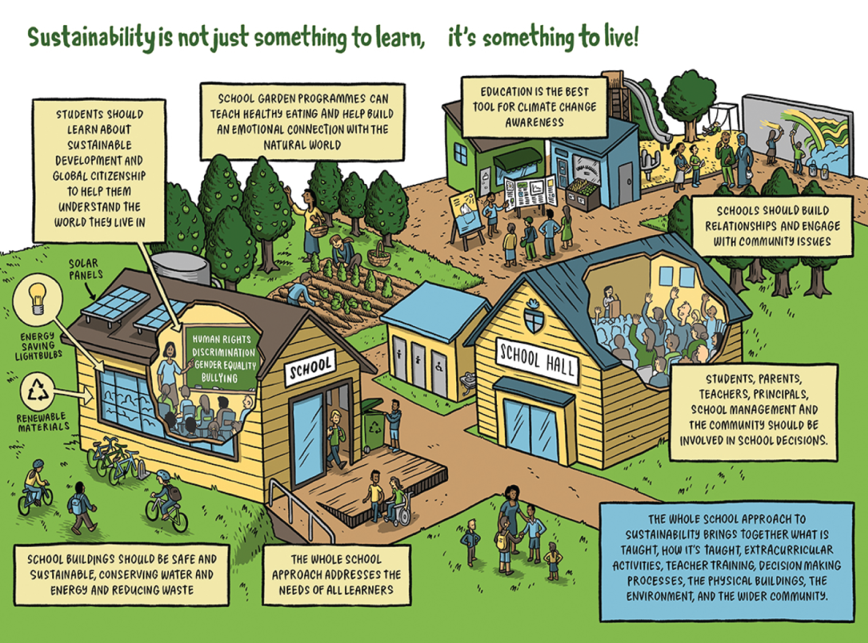
An ecology of learning created by a whole school approach to sustainability (source Global Education Monitoring Report, UNESCO, 2016)
Recently I have been receiving messages that the short two-minute pitch Wageningen UR recorded a few years ago and which generated quite some interest, could no longer be found or reached when looking for it on the Internet via a browser or on YouTube. Strangely, I had no problem when clicking on the link I had stored in my laptop which is why initially I did not give it much attention until a few weeks ago I received three messages about this in one day. I could not figure out what the problem was but at last someone figured out that the two-minute pitch’s status was changed by the account manager of Wageningen UR’s YouTube channel (or someone with access to the account) from ‘public’ to ‘private’. Hopefully it works again for everybody… you can click on the image or the link above to check.
It appears that the clip is public again and can be used to help advocate the importance of re-orienting teaching and learning towards sustainability, which is needed today even more that 4 years ago when this was taped… Feel free to share or comment!
IF YOU FIND IT IS STILL NOT ACCESSIBLE – SEND ME A MESSAGE IN THE COMMENT BOX!

Last month I attended the European Conference on Educational Research (ECER in Hamburg this year. Around 3000 participants from over 60 countries attended the conference. Since the overall theme was ‘Education in an Era of Risk – the Role of Educational Research for the Future’ I had the honor of being asked as one of the plenary keynote speakers, as was my good colleague and friend Heila Lotz-Sisitka from Rhodes University in South Africa who, like myself, is a member of ECER/EERA’s subnetwork on Environmental and Sustainability Education (Network 30), one of the youngest and rapidly expanding networks.
The title of my talk was: Should and Can Education Save the Planet? In the talk I outlined the current global sustainability challenges form a learning perspective and I introduced the concept of sustainability-oriented ecologies of learning. I also introduced the notion of sustainability Bildung in which Biesta’s three tasks of education are reconfigured with Planet in mind to become eco-subjectification, eco-socialization and eco-qualification.
You can watch the full keynote here (also understandable for the deaf and hearing impaired as the talk was kindly supported with sign language).
Here is the official ECER2019 abstract of the keynote.
Education unwillingly has become a key mechanism for fostering economic development, innovation and growth. In the meantime, humanity is facing a range of sustainability issues that include: rising inequity, loss of democracy, runaway climate change and mass extinction. These issues can be so overwhelming that they can easily lead to apathy and despair which will only make them bigger. We appear to be at a tipping point where the decisions we make about how to live together will be crucial for the future of our planet. There is no better time than now to ask: What is education for? What if education would serve people and planet rather than just or mainly economic interests? Is this a role education should play? And, if so, what does such an education look like?
Based on emerging research and practices from around the world, I will sketch forms of education and learning that are: responsive, responsible and transformative in light of global sustainability challenges. Sustainability here is not seen as another subject to be added to an overcrowded curriculum, but rather as a continuous quest for finding ways to live more equitably, meaningfully and healthier on the Earth without compromising planetary boundaries and the futures of the coming generations. Such a quest requires a more relational pedagogy that can help establish deeper connections with people, places and other species. Such a pedagogy not only invites reflection on values and ethics, and the utilization of diversity, but also the critiquing and transgressing of the structures and systems that make living unsustainably easy and living sustainably hard.
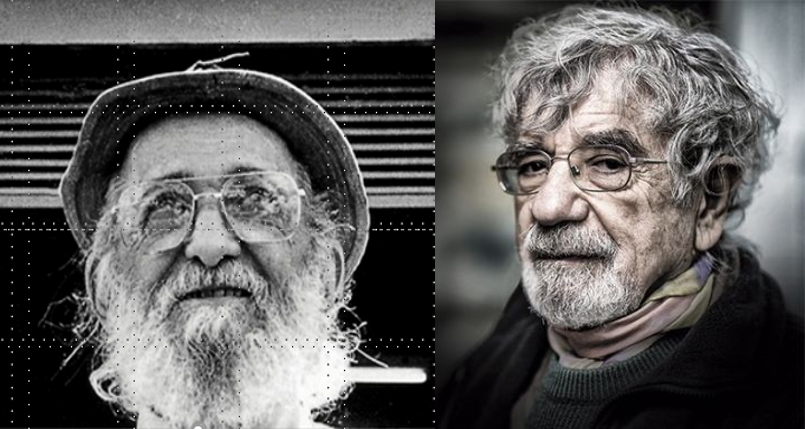
Recently a new paper I co-authored with lead author Daniele Tubino Souza and second co-author Pedro Jacobi appeared in Environmental Education Research – see: https://doi.org/10.1080/13504622.2019.1641183 or click: Relational Pedagogy Freire & Maturana
Here is the abstract. This paper is a part of Daniele’s PhD work at the University of Sao Paulo in Brazil which Pedro and I co-supervise. The paper is a first attempt to link the thinking of Paulo Freire and Humberto Maturana to each other and to emancipatory sustainability-oriented transformations in urban area’s.
Abstract
This article investigates the relevance of the work of the Latin-American thinkers Humberto Maturana and Paulo Freire to learning-based transformations towards sustainability. This analysis was inspired by a case study of a Brazilian urban community seeking to develop pathways towards sustainable living and was informed by a review of their key works. The paper aims to obtain a better conceptualization of learning-based transformations and provide insights into collective learning processes focused on advancing sustainable practices. We present notions of the transformative social learning approach that underpins the case study, using the concepts of Maturana and Freire as a lens. Our results indicate the importance of a relational approach in fostering collective learning processes. Finally, we derive three principles that can guide such processes: (1) facilitating transformative interactions between people and places, (2) enabling dialogic interaction within a climate of mutual acceptance, and (3) creating space for ontological pluralism.

Please send your abstract of 250-500 words, along with references and a brief bio, to both Helena Pedersen and Beniamin Knutsson, University of Gothenburg.
Final article manuscripts will be approx. 6000 words.
Link to the publisher’s website is here!

My last two blog posts have been raising some critical questions about the viability and legitimacy of the scientific ‘enterprise’ in neo-liberal times. The Publish AND Perish blog post led to a lot of responses from colleagues within academic but also from the publishing ‘industry,’ including from the CEO of MDPI, Paul Vazquez. Coincidentally, a few weeks later, Ghent University in Belgium released a statement in which the university declared to go – what I would call – ‘off-the-grid’ of commodification, marketization and economic globalization by turning towards, autonomy, (local) relevance, responsibility towards people and, hopefully planet as well, by creating spaces for transdisciplinarity, boundary-crossing and collaborative action (perhaps I am filtering the statement using my own lens – apologies if I do so). Below some excerpts form the statement which can be found here as well: Ghent University’s New Pathway
Here is the message from Ghent’s Vice Chancellor Rik van de Walle
(17-12-2018)
Our university should once again belong to the academics, rather than the bureaucracy, writes the rector of Ghent University, Rik Van de Walle.
Ghent University is deliberately choosing to step out of the rat race between individuals, departments and universities. We no longer wish to participate in the ranking of people.
We opt for a radically new model: those who perform well will be promoted, with a minimum of accountability and administrative effort and a maximum of freedom and responsibility. At the same time, we want to pay more attention to well-being at work: the evaluations of the supervisors will explicitly take into account the way in which they manage and coach their staff. The model must provide a response to the complaint of many young professors that quantitative parameters are predominant in the evaluation process. The well-known and overwhelming ‘publication pressure’ is the most prominent exponent of this. Ghent University is deliberately choosing to step out of the rat race between individuals, departments and universities. We no longer wish to participate in the ranking of people.
I am absolutely convinced that in a few years’ time we will see that this new approach has benefited the overall quality of our university and its people.
Rik Van de Walle, rector.
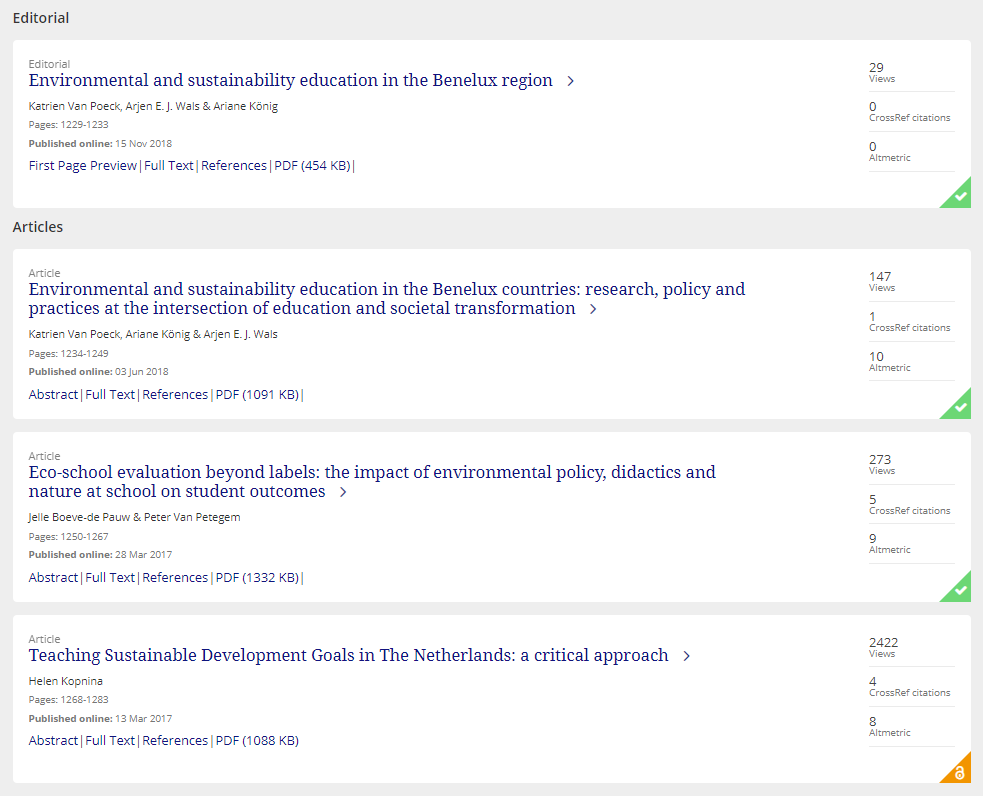
The journal Environmental Education Research recently published its third regional special issue covering trends and research in environmental and sustainability education in the BeNeLux countries. Together with Katrien van Poeck (UofGhent, Belgium) and Katrien van Poeck (UofLuxembourg, Luxembourg, I was a co-editor. Earlier regional special issues focussed on the Nordic countries (Scandinavia) and on Germany. Here you find a link to the introductory paper we wrote: BeNeLux Special Issue and here is a link to the Special Issue itself: Routledge Link to SI
Below some more information.

Table of Contents


 The Global Environmental Education Partnership (website) has created a pledge for reinvigorating Environmental Education world-wide in light of urgent sustainability challenges. In the pledge the global environmental education community is asked to work toward three visionary goals:
A pledge letter can be found here. By signing it you are endorsing these long-term goals and committing to do your part to achieve them. This website highlights 10 suggested areas for action. Hundreds of educators around the world have vetted these actions and helped outline key areas of focus for the field. Over time, GEEP will provide resources and support, including ongoing campaigns and activities, to help inspire action to move our collective agenda forward. By signing the pledge, you can stay connected to this global network.

