
Transformative learning

Learning and change within people and society towards a more sustainable world

Transformative learning

Analysing farmers’ learning for socio-ecological stewardship in Eastern Uganda: A transformative learning ecology perspective

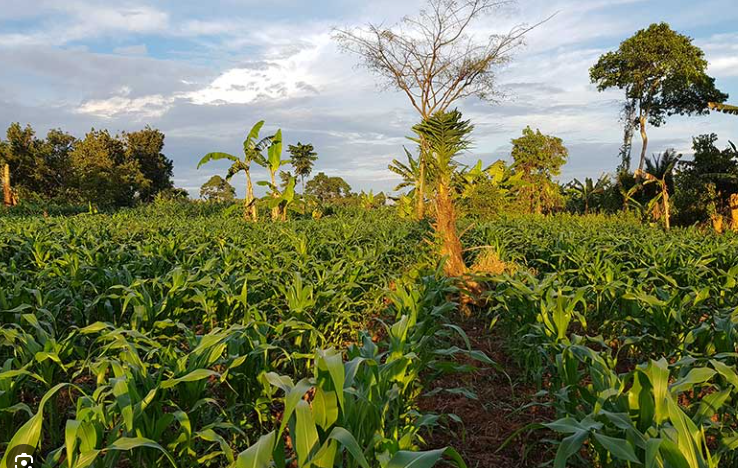
This paper stems from the research of PhD Candidate Doreen Misanya. It analyses how smallholder farmers are learning for socio-ecological stewardship in a specific case study context in Eastern Uganda. The case under analysis is a watershed management project that uses an integrated farm planning (PIP) approach to strengthen farmers’ stewardship capacities within the Manafwa watershed through interactive and dialogic ways of engaging and teaching farmers. Utilizing a transformative learning ecology (TLE) perspective, this study investigated features of the PIP approach that support transformative learning for socio-ecological stewardship in a rural context. Data was collected by interviewing eighteen farmers from different villages and PIP generations and all three PIP trainers of the project, and by observing training sessions as well as sensitisation workshops. As a main result, the study yielded new insights that can help enhance PIP-like learning configurations consisting of interconnected learning tenets, dimensions and processes. This enhanced learning configurating comprises an organic learning system that facilitates farmers to change their mindsets and redefine their values, perspectives, routines, and practices towards those that encourage socio-ecological stewardship. The TLE fostered by the PIP approach represents a useful heuristic that can guide and inspire both scholars and educators engaged in processes of cultivating socio-ecological stewardship in similar contexts.

The paper can be found here https://www.tandfonline.com/doi/full/10.1080/27685241.2023.2191795

Full citation:

Misanya, D., Tassone, V. C., Kessler, A., Kibwika, P., & Wals, A. E. J. (2023). Analysing farmers’ learning for socio-ecological stewardship in Eastern Uganda: A transformative learning ecology perspective. NJAS: Impact in Agricultural and Life Sciences95(1). https://doi.org/10.1080/27685241.2023.2191795

The research took place within the Manafwa Watershed Restoration (MWARES) Project in Bududa District, Eastern Uganda. A Baseline Report of the project appeared in 2020. It outlines the starting position of the PIP farmers in the region. This report can be found here.
New: The interplay between social learning and adaptive capacity in climate change adaptation

ClimatChangeVietnamCChangeVietnam2

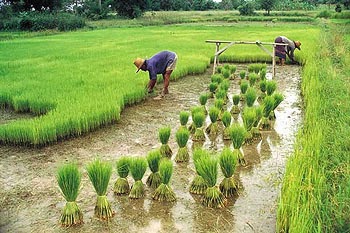
Pics source: www.knowledgebank.irri.org

One of my PhD students, Le Thi Hong Phuong from Vietnam, just had her review article (with me and Robbert Biesbroek of Wageningen UR as humble co-authors) published in NJAS . In the paper she maintains that successful implementation climate change adaptation depends to a large extent on the capabilities of individuals, organizations, and communities to create and mobilize the adaptive capacity (AC) of their socio-ecological system. In the paper, creating and mobilizing AC is seens as a continuous process that requires social learning (SL). Although rich with empirical cases, the literature theorizing and empirically investigating the relationship between AC and SL is highly fragmented. This paper aims to critically examine the peer-reviewed literature that focusses on SL and AC in the context of climate change adaptation (CCA).

Special attention is paid to the interplay between the two. Understanding this interplay can help improve our understanding of how CCA takes place in practice and advances theoretical debates on CCA. Systematic review methods are used to analyse 43 papers (1997–2016). The findings reveal three perspectives that each play an important role in different contexts: an AC-focused perspective, a SL-focused perspective, and a hybrid perspective. These differences in conceptualizations of the relationship between SL and AC may seem trivial at first, but they have consequences for the design of learning-based interventions aimed at helping communities respond to climate change. It appears that such interventions need to be preceded by an analysis of the climate change context in order to decide whether to emphasize AC, SL or both simultaneously.

You can find the paper here: The interplay between social learning and adaptive capacity in climate change adaptation or request a copy by emailing me at arjen.wals@wur.nl The DOI is: https://doi.org/10.1016/j.njas.2017.05.001

Highlights

  • Social learning (SL) & adaptive capacity (AC) are critical in climate change adaptation.
  • Social learning does not necessarily build adaptive capacity and vice versa.
  • Three interplays between SL and AC emerge: SL-focused, AC-focused and hybrid.
  • The effectiveness of an interplay depends on the climate adaptation context.
  • This has implications for governance to help communities to adapt to climate change.