Whole School Approaches to Sustainability

Education Renewal in Times of Distress

LInk to the book: https://link.springer.com/book/10.1007/978-3-031-56172-6

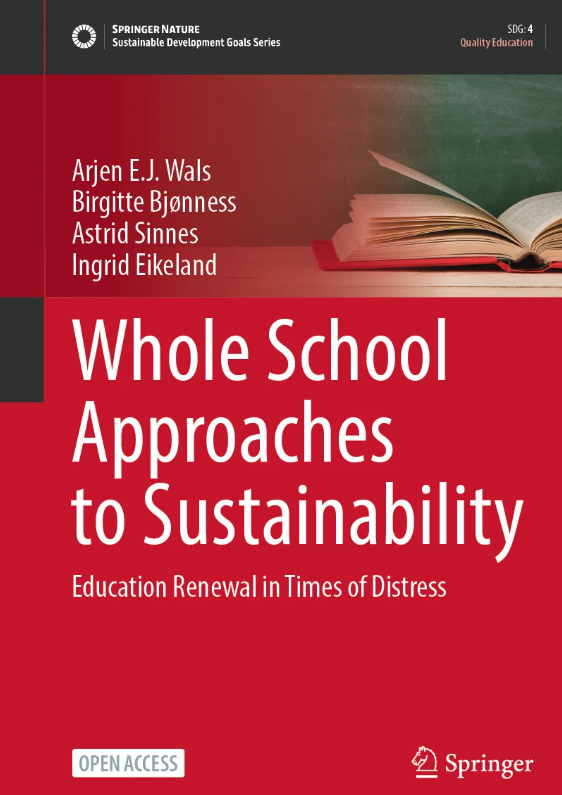
At last – the edited volume on ‘Whole School Approaches to Sustainability – Educational renewal in times of distress’ has come out. Together with co-editors, Birgitte Bjønness, Astrid Sinnes and Ingrid Eikeland, and managing editor Stine Marie FyskeHaraldsen, we have worked with authors from around the world to create this rich picture of principles, practices and prospects of school working more systemically and holistically with sustainability, rather than treating it like another subject to be added to an already overcrowded curriculum.

The book has been made Open Acess and all 24 (!) chapters can be downloaded for free thanks to a grant provided through the Dutch Government-Supported Programme for Learning for Sustainable Development (LvDO).

We wish to acknowledge Roel van Raaij who has been an advocate of Education for Sustainable Development, both nationally and internationally, from within the Dutch government for decades, and Ellen Leusink who facilitates and supports ESD through the LvDO program and paved the way for the open access.

We also want to acknowledge the Department of Educational Science at
the Norwegian Life Science University (NMBU led by Hans Erik Lefdal together with Akershus county municipality (the school district South of Oslo) for the support to establish and run the University—School partnership for the last 6 years or so, continuing to this
day. The partnership with schools, especially the collaboration with school
coordinators and principals, have supported the development of the Whole
School Approach through research and praxis. Without this foundation and
support, we would not have had the knowledge, time, and confidence to work
on this book.

Here is the link to the book: https://link.springer.com/book/10.1007/978-3-031-56172-6

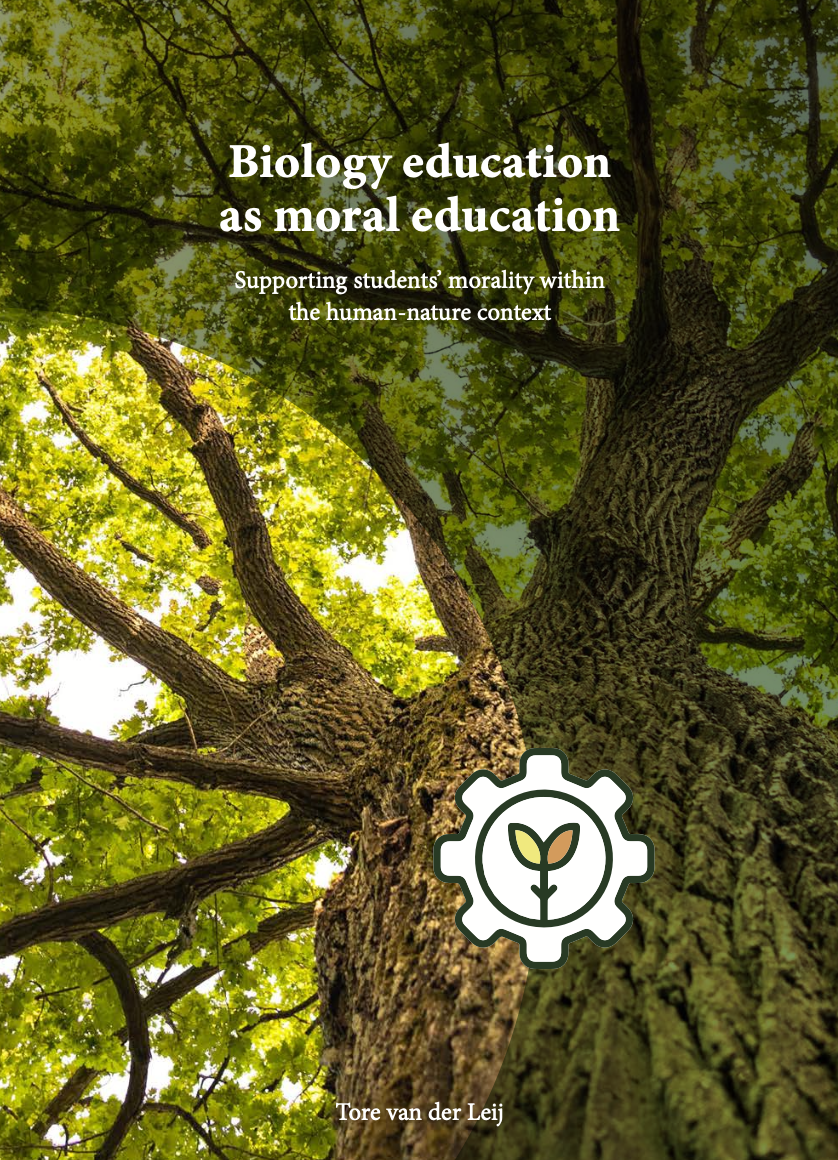
Tore vd Leij successfully defends: ´Biology education as moral education: Supporting students’ morality within the human- nature context´

On this day, February 13th, one of my first Masters students during my tenure at Wageningen University (in the mid-1990s!), Tore van der Leij, defended his PhD on ´Biology Education as a moral education´. He did so in the Aula of the University of Groningen which hosted his research. Tore is a Biology Teacher at Hondsrug College Secondary School in Emmen in the North of the Netherlands. Under the mentorshop of Prof. Martin Goedhart (RUG), Prof. Lucy Avraamidou (RUG) and myself, Tore worked, over a period of 7 years (COVID19 inclusive) with secondary school students and fellow teachers in two schools in figuring out how their morality can best be developed within the human-nature context. He developed a series of lessons to help trigger students´morality (all available in Dutch in the appendix). Tore had all four of his empirical chapters published in high quality journals. As an appetiser for his excellent work, I am sharing the Epilogue of his thesis below. The entire thesis can be downloaded via the University of Groningen´s Library System.

Epilogue

“As I described in the introduction to this chapter, many biology teachers in the Netherlands consider supporting students in developing skills related to morality important (e.g., CvTE, 2019; SLO, 2021; Van Maanen, 2021). Unfortunately, most teachers do not get around to it, mainly because of the overloaded exam programme (CvTE, 2019; SLO, 2021). In addition, the skills are not tested in the central exams, but only in the school exams. As a result, supporting students in developing skills related to morality are not teachers’ priority.

All this notwithstanding, the outlined urgency of the context in which supporting students’ morality should take place is evident. Above that, given that many biology teachers do consider supporting students’ morality important, it is my hope that the results from this research project provide a valuable practical interpretation of biology education aimed at supporting students’ morality in the human-nature context.

When I started this PhD journey in 2016, an important motive for conducting this research project was my concern about the socio-ecological challenges, both globally and locally, in which the negative impact of human actions on ‘other-than-human’ beings, and future generations have become increasingly prominent. I felt, and still feel, that education should respond to this urgency by providing our students with the necessary ‘free space’, ‘skolè’, to develop, form and reflect upon these challenges, and give them opportunities to act in relation to the constantly changing world around them.

The fact that Gretha Thunberg (a 15-year old student at the time) with her ‘Skolstrejk för klimatet’ in 2018 (about two years after the start of this research project) chose not to go to school, is perhaps illustrative for education’s challenge to offer our students the valuable and meaningful education, that meets the big challenges of our time. In any case, the following that Gretha has received since then – for instance, the Climate Strikes in which tens of thousands of young people participated – shows that there is plenty of commitment, need and motivation among young people to engage with these moral dilemmas.”