Arjen Wals is a Professor of Social Learning and Sustainable Development. He also is a UNESCO Chair in the same field. Wals has worked at Wageningen University since 1992 in various departments. He is a guest professor at IDPP at Gothenburg University since 2014. His research focuses on learning processes that contribute to a more sustainable world. A central question in his work is how to create conditions that support new forms of learning that take full advantage of the diversity, creativity and resourcefulness that is all around us, but so far remains largely untapped in our search for a world that is more sustainable than the one currently in prospect. Wals has been involved in a number of projects in Africa that seek to make curricula more responsive to current societal and labour market needs and challenges posed by (un)sustainability. Popular books include: 'Higher Education and the Challenge of Sustainability (Kluwer Academic, 2004) and Social Learning towards a Sustainable World (Wageningen Academic, 2007).
An impression of Tamera EcoVillage in Portugal, one of the cases that was part of the study
Here is the latest paper on a research project led by PhD Candidate Siri Pisters that appeared in the Journal of Transformative Education. Thie article explores learning processes that underpin ecovillages as place based ‘sustainability initiatives’. Through the theoretical lens of place- based transformative learning (PBTL), developed in earlier work led by Siri as well (Pisters et al., 2019, 2020), empirical data from life-story interviews and photovoice sessions from three ecovillages is analysed and discussed. The results support, illustrate and deepen the meaning of the four dimensions of the theoretical framework: connection to place, compassionate connection, creativity and transgression (Figure 1, below). They show how the co-existence of ‘community’ and ‘disruption’ is essential in PBTL where community brings connection, cohesion and stability to a change process whereas disruption paves the way for disrupting old structures and experiment with new ones. This article shows how a change in inner consciousness is related to alternative practices and structures that re-define relationships with ourselves, other humans and the material, more-than-human world.
A Four dimensional model of place-based transformative learning (Source: Pisters et al., 2022)
Pisters SR, Vihinen H, Figueiredo E, Wals AEJ. ‘We Learned the Language of the Tree’ Ecovillages as Spaces of Place-Based Transformative Learning. Journal of Transformative Education. March 2022. doi:10.1177/15413446211068550
This 5 minute video was recorded at WEEC 2022 in Prague by Alex Kudryavtsev – a research associate at Cornell University for the “Environmental Education & Community Engagement” online course by Cornell and NAAEE. I introduce transdisciplinary, transgressive and transformative learning in the context of citizens monitoring air pollution s a form of citizen science. I use the city of Rotterdam in The Netherlands as an example (althoughI do some justice to the city of Rotterdam as my example is somewhat dated:. it is a short video and much more is to be said about Rotterdam as the city government now pro-actively works with citizens in an air quality monitoring network. ‘Luchtbrug’ see: https://www.themayor.eu/en/a/view/rotterdam-citizens-concerned-with-air-quality-form-a-club-8089
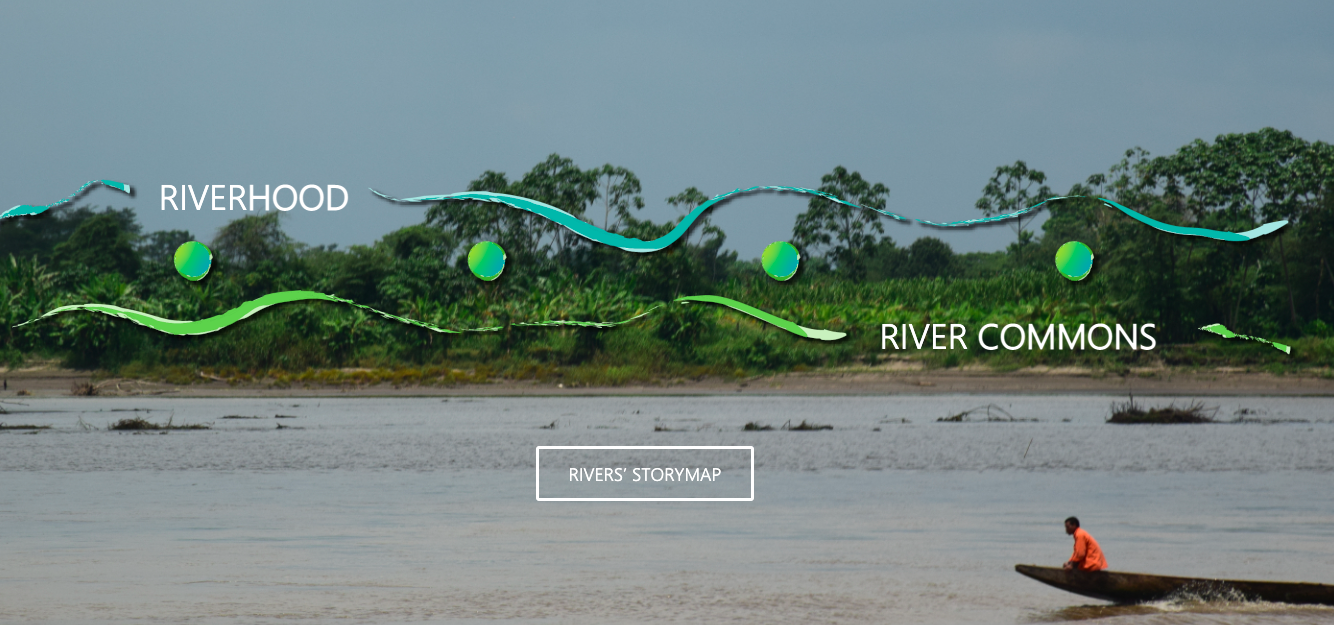
I feel very privileged to be part of one of the two major International River Research projects led by Wageningen UR colleague Prof. Rutgerd Boelens: Riverhood and RiverCommons. Riverhood and River Commons are both 5-year research projects that focus on enlivening rivers, river co-governance initiatives, and new water justice movements.
Riverhood is funded by the European Research Council (ERC) (Grant Agreement No 101002921) and aims to build groundbreaking transdisciplinary concepts and methodological tools to analyze and support new water justice movements’ institutions, strategies and practices for equitable and sustainable water governance. It does so through comparing initiatives in Latin America (Ecuador and Colombia) and Europe (Netherlands and Spain). The focus will be on movements promoting novel concepts and practices such as Rights of Nature, new water cultures or nature-inclusive hydraulics, to name just a few.
RiverCommons is funded by Wageningen University’s Interdisciplinary Research and Education Fund (INREF) and unites chair groups from the social and natural sciences, as well as partners worldwide. Its objective is to develop transdisciplinary concepts and methods for research, education, and multi-stakeholder interactions to understand and support river co-governance initiatives and sustainable socio-ecological river systems in Asia, Africa, Latin America and Europe.
While each of the projects has its specific objectives, activities, regions, and partners, there is immense potential for synergies and cross-pollination. Riverhood and River Commons will therefore be integrated in multiple ways, to together build a diverse and wide network of river scholars, activists, and institutions that commonly aim to understand and strengthen river co-governance around the world.
Both projects are united by a common framework that illuminates the different facets and complexities of river systems. The framework encompasses four dimensions: River-as-Ecosociety, River-as-Territory, River-as-Subject, and River-as-Movement. You can find more information about it in Concepts.
Another important component of both projects is the development of Environmental Justice Labs (Riverhood) and River Co-governance Labs (River Commons) to be organized in the case study sites to co-create knowledge and mobilize and exchange ideas for change.
World’s rivers are fundamental to social and natural well-being but profoundly affected by mega-damming and pollution. In response to top-down and technocratic approaches, in many places riverine communities practice forms of ‘river co-governance’, integrating ecological, cultural, political, economic and technological dimensions. In addition, new water justice movements (NWJMs) have emerged worldwide to creatively transform local ideas for ‘enlivening rivers’ into global action and vice versa. The Summer School aims to provide PhD students who conduct research on these ‘river commons’ and NWJMs with transdisciplinary concepts and approaches for studying their emerging ideas, concepts, proposals and strategies. The training thereby focuses on conceptualizing river systems in all senses, and capacity-building for (understanding and supporting) river knowledge co-creation and democratisation from the bottom up.
“It’s the economy, stupid!” was a slogan Bill Clinton used in his successful campaign against George W. Bush to point out that in the end it is the economy that matters most to voters. Now 30 years later this slogan has new meaning as we come to see the moral and planetary bankruptcy of old-style market and growth driven economic thinking that normalises unsustainability. Sadly, much higher (business) education still echoes and reproduces dysfunctional old-style economic thinking, even in universities that claim to have sustainability at the heart of their operations… even the SDG related to the economy – SDG 8 – seems to do so as it focuses on realizing ‘economic GROWTH and decent work’. It is hight time that alternative economic thinking takes root in our education – varying from distributive economic thinking to regenerative economic thinking to circular economic thinking to a letting go of economic thinking altogether to make room for alterative value propositions.What are the implications of such alternatives for how and what we teach? how students learn? how we connect with stakeholders around the university?
These and other questions will be addressed at the Higher Education Summit 2022 from 6-8 September 2022 in Hasselt, Belgium! Under the theme “Daring to transform learning for a future-proof economy” the summit will bring together those who wish to transform higher education for the benefit of a “safe and just space for humanity” (Raworth, 2017): people who study, teach, research, and contribute to governance at higher education institutions, and representatives of the business world, government, and civil society.
The organisers invite you to join us to rethink the role of higher education institutions in shaping the economy. Whether we prefer to call it a doughnut economy, circular economy, or regenerative economy – we all aspire for a world in which humans can flourish in close harmony with a thriving planet. And we know that learning is key to driving this transformation (Berlin Declaration on Education for Sustainable Development, 2021).
We are looking forward to celebrating your wonder! The Call for Contributions is open! Proposals are welcome until 15 March 2022. We will let you know by 29 April 2022 whether your proposal has been accepted. Your proposal should not exceed 1 A4 page, including references. You may include pictures or other visual representations. Proposals will be assessed by the scientific committee based on the following principles:
Potential for (societal and/or economic) transformation
Academic or other relevant quality for theory, practice or policy
Thematic relevance
Originality and level of innovativeness
Adequateness of mode of presentation, including the degree of co-creation with the audience
This is a wonderful podcast about a guy who unintentionally starts-up a counter ‘actual conspiracy’ movement during a ‘women against Trump’ protest that was escalating when ‘women for Trump also showed up. He wondered – what will happen if I would hold up a poster about a totally different ludicrous position? He wrote on the back of an old poster: ‘Birds Aren’t Real! Listen to what happened. Worth every minute of it. Here is the link.
Tomorrow afternoon the ESD group of the Faculty of Education of Gothenburg University is hosting a seminar on Education for Sustainable Development in the ‘Capitalocene’ which is based on a Special Issue that just appeared inEducational Philosophy and Theory 54(3), 2022: Here you find the link Educational Philosophy and Theory: Vol 54, No 3 (Current issue) (tandfonline.com). During the seminar editors and contributors – including someone I have always greatly admired and had the pleasure to work with for more that 30 (!) years now: Bob Jickling. as well as other wonderful invited experts will discuss questions like:
– What urgent future research trajectories do we see for Education for sustainable development in the Anthro-Capitalocene?
– What does the Anthropo-Capitalocene mean for educational practice? “As educators, working within these multiple tipping points, where do we stand?” (Do we still believe in education?)
Below you find the program and the Zoom-link:
Monday, 7th February at 3:15 – 5:00 p.m. (CET) on Zoom:
Prof. Em. Bob Jickling, Lakehead University (Canada)
Senior Lecturer Nick Peim, University of Birmingham (UK)
Prof. Jason Wallin, University of Alberta (Canada)
Seminar schedule:
3:15-3:25: Welcome and introduction (Helena Pedersen)
3:25-3:35: Bob Jickling paper presentation
3:35-3:45: Jason Wallin paper presentation
3:45-3:55: Nick Peim paper presentation
3:55-4:05: Short break
4:05-4:30: Keri Facer response & discussion with authors, the ESD Research Group/editorial team, and seminar participants
4:30-4:55: What next? Discussion questions (Keri Facer, authors & all):
– What urgent future research trajectories do we see for Education for sustainable development in the Anthro-Capitalocene?
– What does the Anthropo-Capitalocene mean for educational practice? “As educators, working within these multiple tipping points, where do we stand?” (Do we still believe in education?)
4:55-5:00: Wrapping up & closing of seminar (Helena Pedersen)
On 8 February 2022 SPARK the Movement organizes an interactive online meeting with regional, national and European educators around the question:
How can we mobilize the imaginative power of the region, thus learning together how to take up global challenges and focus on the local impact we can make?
SPARK’s conviction is that sustainability needs to be a part of the ‘everyday fabric of life’. The scale of a region seems to be a most suitable level to examine and enact sustainability in day-to-day life and in everyday business. The meeting is organised by United Nation’s supported Regional Centre of Expertise ‘Fryslan’ in The Netherlands. I will give a short introduction to the Whole School Approach as a key driver of sustainability.
It is my pleasure to share two calls for contributions in relation to the development of a Whole School Approach (WSA) to Sustainability. The first one relates to an international hybrid conference organized by the Dutch government that will take place in The Netherlands and partially online late March of 2022, the second one relates to an edited Volume on the topic in the Springer SDG4 Series on Quality Education.
Call for exemplary practices of a Whole School Approach to Sustainable Development
The Dutch Ministry of Economic Affairs and Climate Policy have commissioned a report to provide practical examples of how a Whole Institution/ Whole School Approach (WSA) is being used in practice around the world to engage with SDG4 – Quality Education, especially in relation to sustainable development issues as covered by the other SDGs. The reports aim is to highlight different aspects of a WSA – curriculum development, pedagogical innovation, school management and leadership, school-community relationships, professional development of staff, and the school as a ‘living laboratory’ for experimenting with healthy, equitable, democratic, and ecologically sustainable living – especially how these aspects can be integrated to mutually strengthen each other.
We are particularly interested in so-called critical case-studies that do not only highlight best-practice strategies and success stories, but also share the struggles, set-backs and challenges underneath and ways to overcome them. The report will be published as part of the WSA International Conference happening in The Netherlands on the 30th-31st March.
If you know of such a school (primary, secondary, or vocational) from your country that can be used as an exemplary example of a WSA in action, or want further details, please contact Rosalie Mathie via email. rosalie.mathie@nmbu.no before February 15th so she can still contact people connected to the exemplary case.
2 Call for Abstracts Springer SDG4 Series Whole School Approaches to Sustainability – Principles, Practices and Prospects
Ingrid Eikeland, Brigitte Bjønness, Astrid Sinnes and Arjen Wals (Eds)
Schools across the globe are seeking to respond to emerging topics like; climate change, biodiversity loss, healthy food and food security, and global citizenship. They are increasingly encouraged to do so by educational policies that recognize the importance of these topics and by the Sustainable Development Goals (SDGs).
While there is recognition that such topics should not be added on to an already full curriculum, but rather require more systemic and integrated approaches, doing so in practice has proven to be difficult. This edited Volume seeks to engage educators, school leaders, educational policy-makers and scholars of sustainability in education in key principles, critical perspectives, generative processes and tools that can help realize a Whole School Approach to Sustainability. The book will contain three sections: 1) Principles & Perspectives, 2) Critically Reflexive Contextual Case Studies (Early Childhood, Primary, Secondary and Vocational Education) and 3) Synthesis: Challenges and Prospects.
The editors are inviting abstracts (no more than 500 words) of potential chapters. Contributions can be research-based (spanning different genres of research) but can also be more conceptual in the form of critically reflexive essays. Abstracts should indicate a best fit with one of the sections and need to be accompanied with short bios of the author(s) and, if possible, references to prior publications that relate to the topic.
Please send your initial ideas for a contribution or any queries you may have to: ingrid.eikeland@nmbu.no before March 1st. All abstracts will be reviewed by the editors and a selection will be made for further development into a full manuscript to be published by the end of 2022.
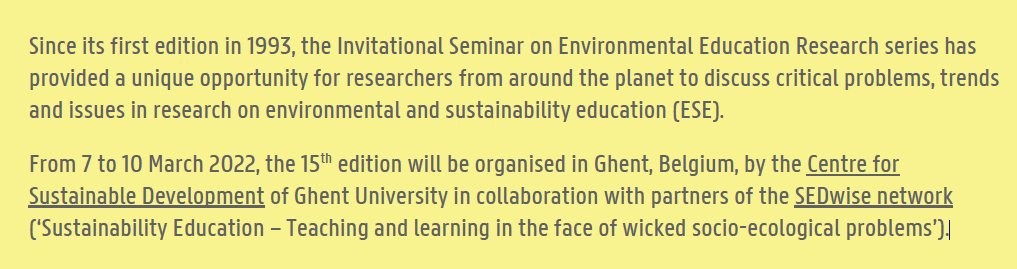
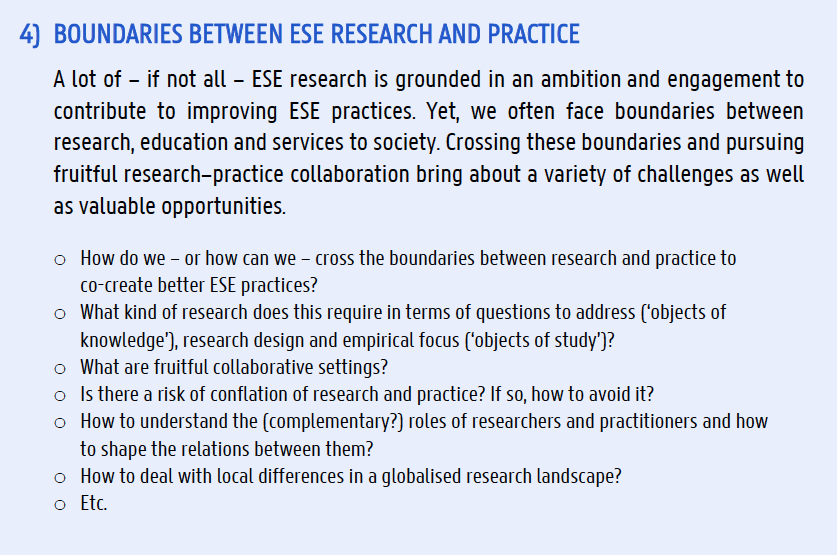
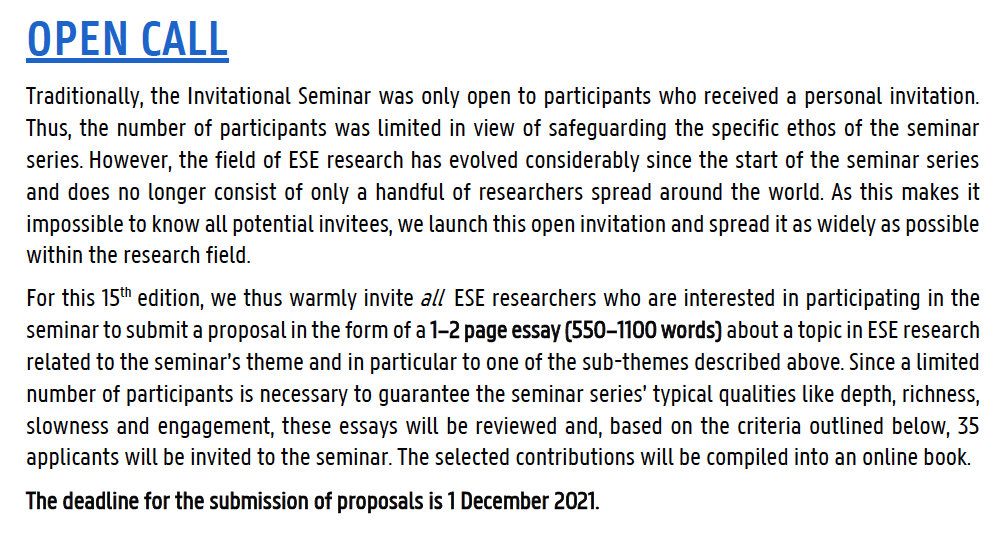
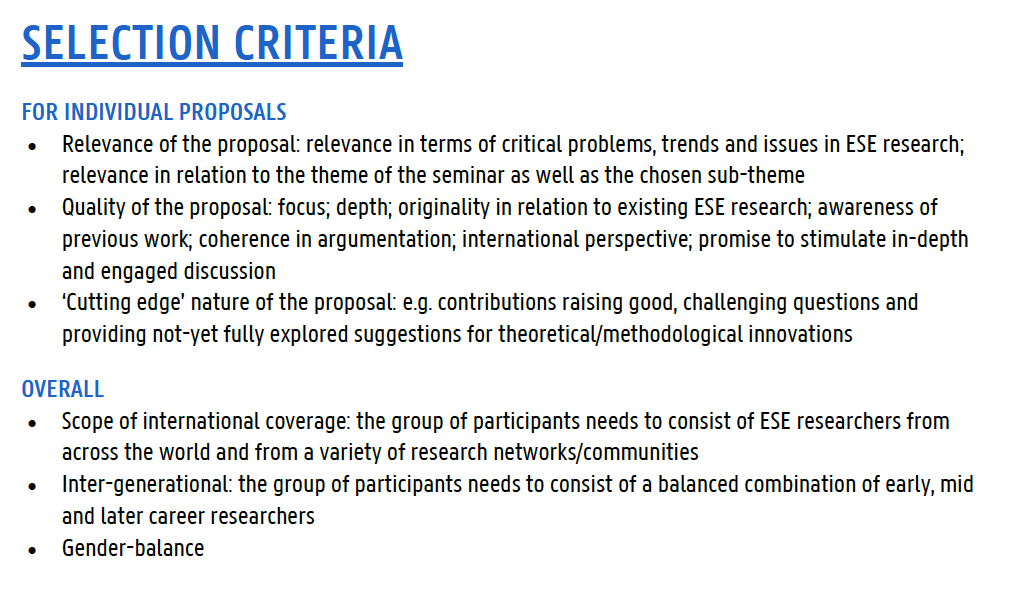
I have posted about this seminar before. Originally the seminar was going to take place in March but it has been rescheduled to June 13-16. The deadline for submission has shifted as well to February 15th. This is a unique seminar with some great people in the field of environmental and sustainability participating. Have a look here for the key info. https://www.cdo.ugent.be/news/call-proposals-15th-invitational-seminar-ese-research
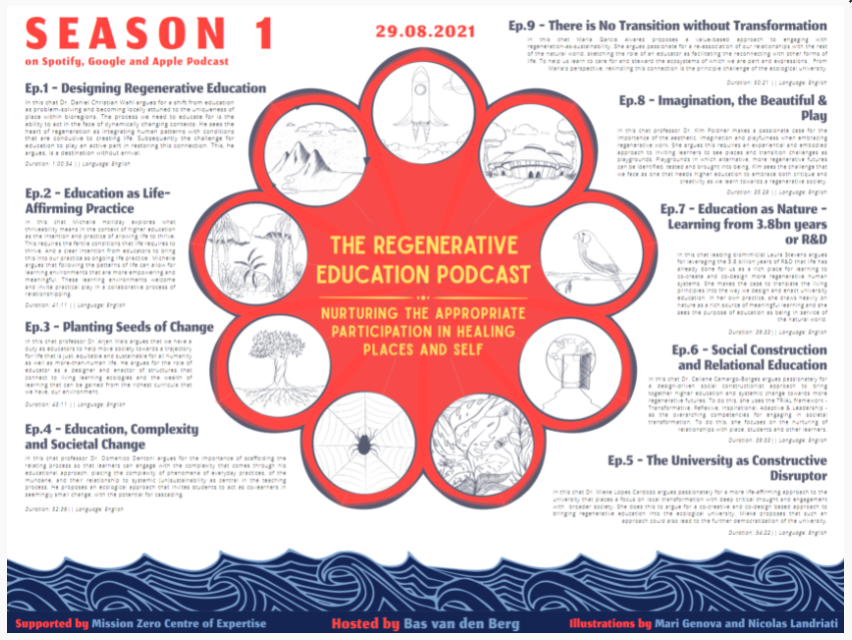
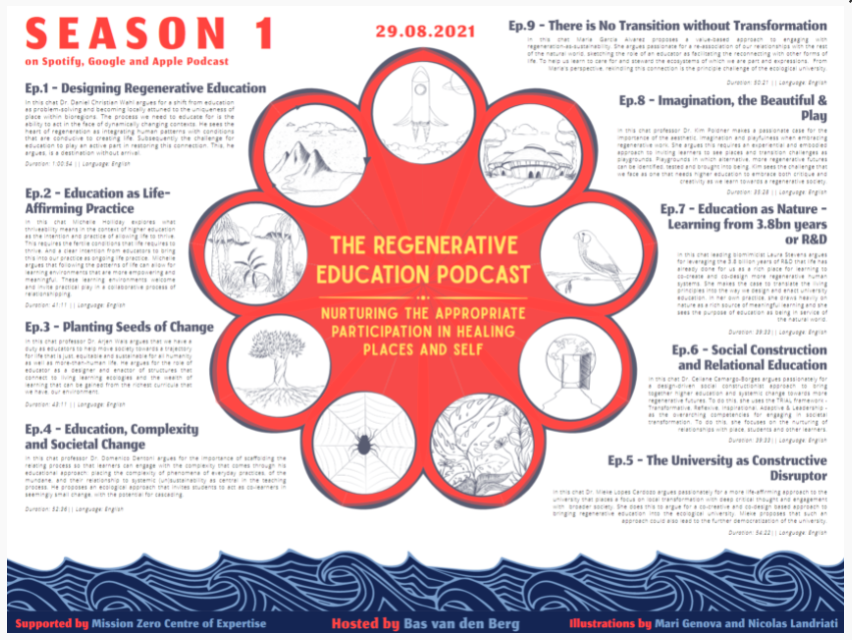
Last month the first of three microseasons of The Regenerative Education Podcast has been published on Apple Podcasts, Spotify, and Google Podcasts. In each episode, one om my PhDs, Bas van den Berg who is director of education of the Mission Zero centre of expertise at The Hague University of Applied Sciences, engages with a leading practitioner, professor, teacher, and/or activist that is trying to connect their educational practice to making the world a more equitable, sustainable and regenerative place.
The podcast aims to discover the design dispositions and elements of a regenerative education for the ecological university. An ecological approach to education that nurtures the appropriate participation in the healing of places and self in times of socio-ecological crisis. Bas van de Berg did a remarkeable job in pooling together a great group of people who provide wonderful insights in how to create cultures and forms of education, teaching…
Last week our editorial introducing the Special Issue for Educational Philosophy and Theory (EPAT) on Education for Sustainable Development in the ‘Capitalocene’ finally appeared. Together with Gothenburg University colleagues, Helena Pedersen, Sally Windsor, Beniamin Knutsson, Dawn Sanders and Olof Franck, we found 8 excellent contributions from some great scholars, after a careful selection and review process. I encourage you to explore the entire SI. Here are the opening lines of our editorial to wet your appetite.
When the thought of this Special Issue began to take shape 3 years ago, we had no clear idea of how it would develop. We wanted to address what we saw as the inability, or even impossibility, of our education system in general, and ESD in particular, to respond to the current climate and environmental crises. We began the call for contributions to the SI with the question ‘Has Education for Sustainable Development (ESD) reached an impasse?’ and referred to Moran and Kendall’s (2009) argument that our various research approaches produce nothing but illusions of education and that education does not exist beyond its simulation. Moran and Kendall continue to argue, drawing on the work of Baudrillard, that current movements in education constitute an ‘improvement agenda’ where more interventions are produced and critiques are repeated ‘over and over’ to foster improvements, ‘pursued as if they were possible’ (Moran & Kendall, 2009, p. 329, italics added). In the call text we used Moran and Kendall’s position on education as a springboard for thinking around ESD and capitalism. In the messy terrain of the debates concerning the ‘Anthropocene’ (Crutzen & Stoermer, 2000) and the ‘Capitalocene’ (Malm & Hornborg, 2014), how does education emerge? Since its conception, the ESD field has been criticised for its hidden and problematic normativity (Jickling, 1992). Regardless of how valid such a critique is, the core idea of ESD is, arguably, a grandiose ‘improvement agenda’ – not only of education, but of the planetary condition as such. There is an assumption that if we can find the appropriate way of ‘doing’ ESD, a sustainable world is within reach.
Yet while working on the Special Issue, one overwhelming real (i.e. not simulated) global event and disaster after the other has occurred: The Fridays for Future strikes; the catastrophic wildfires, hurricanes and flooding across the globe; the heatwaves in the Arctic circle and Pacific Northwest, and, of course, the COVID-19 pandemic – to name a few. Extinction numbers are now at critical levels (IPBES, 2019), climate change impacts are here and increasing in magnitude and frequency (IPCC, 2021), and human-made materials, such as plastic and concrete now outweigh the living biomass of the planet (Elhacham et al., 2020).
How, then, is it at all possible to educate in the midst of this harsh reality, if education itself, and educational critique, cannot be conceived beyond its own illusive patterns of simulation and repetition? As educators, working within these multiple tipping points, where do we stand? Are schools and universities and even ESD, becoming an extension of the globalizing economy and unwillingly accelerating unsustainability (Huckle & Wals, 2015) by equipping people merely to be more effective vandals of the earth? (Orr, 1994). Does the temporality of assumptions held about education (Facer, 2021) impede our ability to respond to the current crisis with urgency? Can educational institutions ever cultivate multi-species approaches to knowledge and justice in a time of mass environmental pillage (e.g. Pedersen, 2021)? And what does this all mean for an individual teacher attempting to nurture hope, and stave off despair (e.g. Ojala et al., 2021), in the face of widespread inequality and lack of access to meaningful biopolitical actions (e.g. Knutsson, 2021)?”
This is just a suggested title for an essay I have started to write notes for. The idea of “enstranglement” popped-up in my head during one of the transformative dialogues sessions at Wageningen University https://www.pe-rc.nl/node/22296 organized by some very inspiring and dedicated colleagues.
At the moment I am ‘defining’ it as such:
Enstranglement – noun – refers to maladaptive destructive forms of entanglement where one is trapped in entrenched and dysfunctional systems that erode the well-being of people and planet…
But I am still playing around with it. This post is merely to get people to respond to the term and to invite people to write a paper with the above (temporary) title, together. You can respond in the blog or in another way that will get to me (no pun intended).
Some journals are truly hidden gems – Airea is a peer-reviewed journal on Arts & Interdisciplinary Research. Together with wonderful colleague Anke de Vrieze of Wageningen UR and Åse Bjurström of University of Gothenburg, former PhD and MSc-student of mine, Natalia Eernstman and current PhD Kelli Rose Pearson, we contributed a paper to a Special Issue on ‘Interdisciplinary relationships within spaces and bodies of collaboration‘. Our paper is titled:
A nice feature of this special journal is that it is fully open access: all wonderful papers can be freely downloaded from the journal’s website here! Please find below the abstract of our paper:
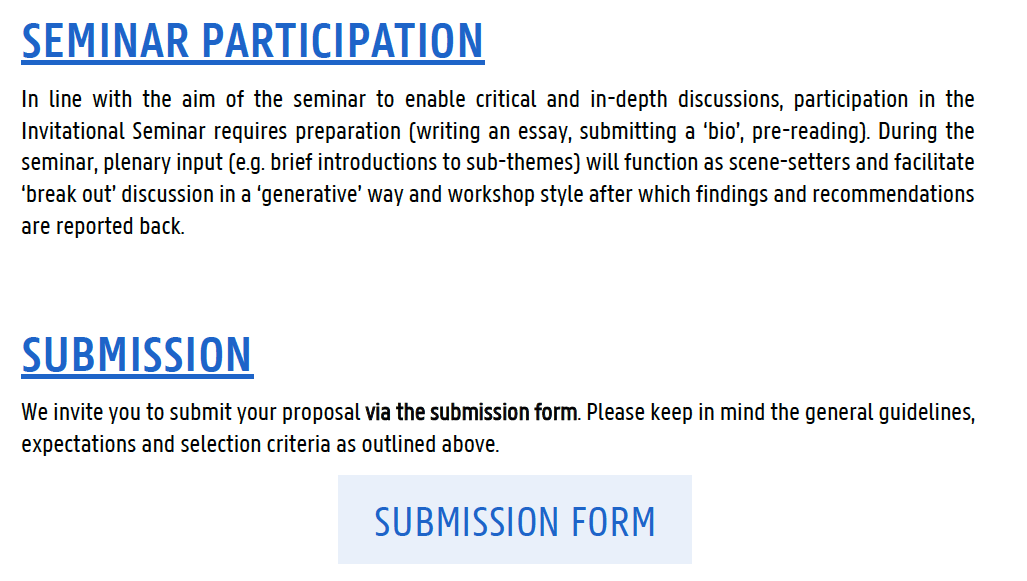
I am happy to announce the return of the infamous Invitational Research Seminars on Environmental & Sustainability Education. As one of the co-organisers I have the privileged to be part of an excellent group led this tim by Katrien van Poeck of Ghent University in Belgium. These are relatively small seminars. While they are no longer ‘by invitation only’ and open to anyone with a strong, insightful, creative, provocative, etc, proposal, spaces will be limited. Have a look a the key info, the theme and the wonderful sub-themes below or go directly to the Centre for Sustainable Development at Ghent University https://www.cdo.ugent.be/news/call-proposalshttps://forms.office.com/pages/responsepage.aspx?id=3hyB1-_sbEmPkaF4YkG5nAXy6iDz_itPuL2K0IeXr0VUOFA5NUdJTzNPVkZHRTRLQVNGMVRRN0c5Ni4u
Last month the first of three microseasons of The Regenerative Education Podcast has been published on Apple Podcasts, Spotify, and Google Podcasts. In each episode, one om my PhDs, Bas van den Berg who is director of education of the Mission Zero centre of expertise at The Hague University of Applied Sciences, engages with a leading practitioner, professor, teacher, and/or activist that is trying to connect their educational practice to making the world a more equitable, sustainable and regenerative place.
The podcast aims to discover the design dispositions and elements of a regenerative education for the ecological university. An ecological approach to education that nurtures the appropriate participation in the healing of places and self in times of socio-ecological crisis. Bas van de Berg did a remarkeable job in pooling together a great group of people who provide wonderful insights in how to create cultures and forms of education, teaching and learning that can help create a world that is more sustainable than the one currenty in prospect.
Bas interviewed me in the third podcast of season one, titled planting the seeds of change. This link will take you to the 40 minute interview that took place in July via Zoom: https://open.spotify.com/episode/3QgZ7K2xGlBf6FGON3AU1t
You can also visit any of the sites below for the entire Podcast Series













 Transformative learning