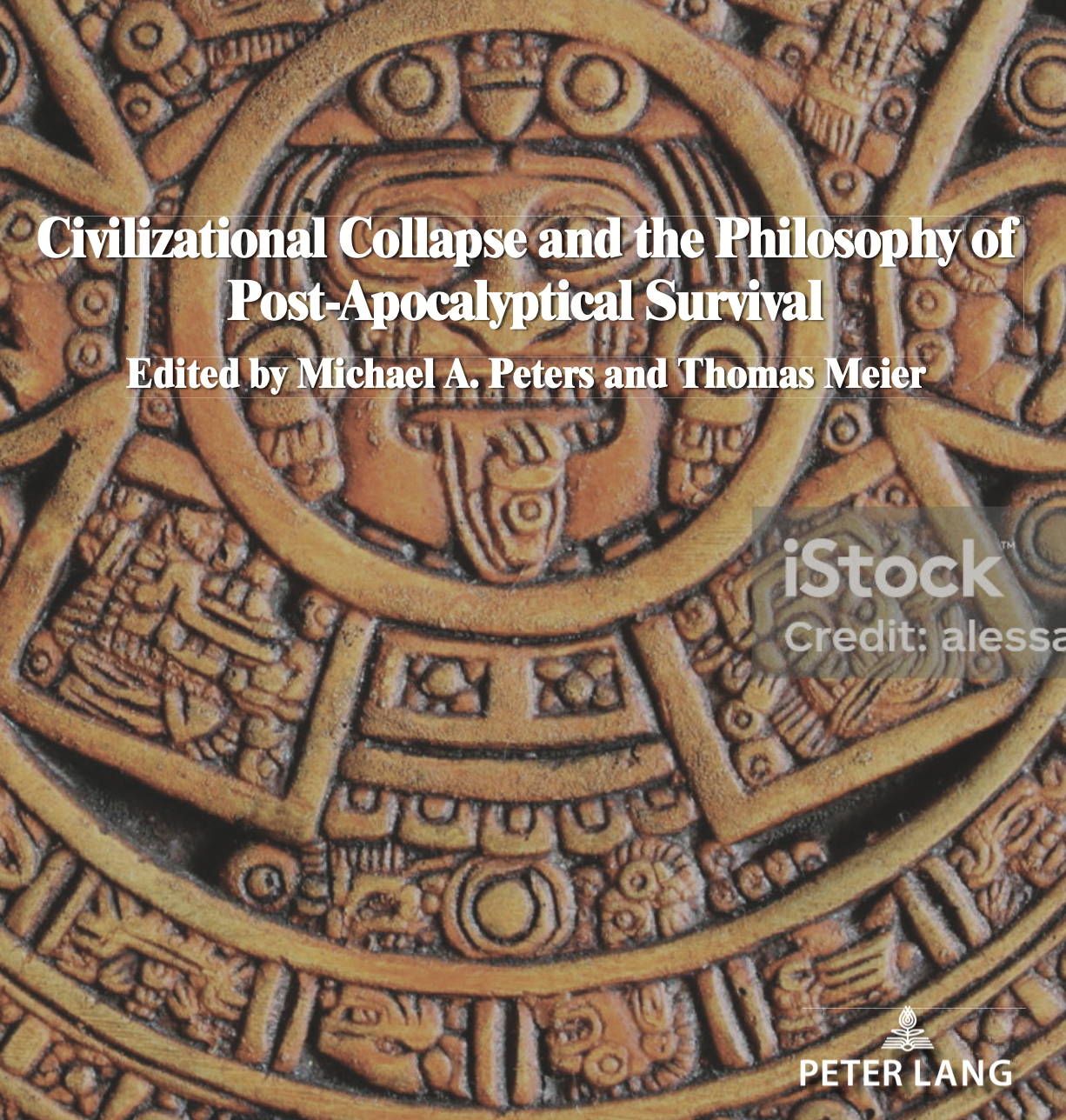
“Collapse” “The end of the world as we know it” “Amargeddon” “Dystopian Futures” “Maintaining hope on a dying planet” – words, concepts, phrases, pointing at the serious state of Earth. This remarkeable book with a range of perspectives on what to do, is a must read for educators, activitsts, researchers and composites thereof. From the back cover:
“The collapse of civilization, the end of the world as we know it, has long been a cultural imaginary, but has rarely been as topical as it is today. Beyond the phantasmagoria of violence, depression and despair, the conviction of being doomed has always been present It can be a challenge to imagine a new, post-apocalyptic world, be it utopian or dystopian. Beyond questions of immediate survival, there is a growing concern about how to educate humanity for a new life after the end of this world. In this volume, the editors, Michael A. Peters and Thomas Meier, renowned scholars of educational and apocalyptic studies, have brought together 31 contributions that offer a diversity of perspectives on such post-apocalyptic education, from abstract philosophical reflections to applied studies, from historical and political analyses of how we got into the current situation of global devastation to decolonial perspectives and essayistic explorations.”
I was invited to contribute a chapter on what I have dubbed ´Earth-centered education´: Earth Centred Education: An Invitation to Relational Transgressive Learning as a Counter-Hegemonic Force in Times of Systemic Global Dysfunction Have a look at the ToC and consider getting a copy of the book from Peter Lang here
I am providing a link to the table of contents of the book and the typeset version of my chapter here.
Two papers I co-authored with different colleagues came out in the same Special Issue of the Australian Journa of Environmental Education published by Cambridge University Press. Both papers are published with open access.
The first paper led by PhD-candidate at Wageningen University, Reineke van Tol is on the potential of Wilde Pedagogies for renewing and reorienting higher education towards a posthumanist and relational perspective.
Citation: van Tol RS, Wals A. Wild Pedagogies in Practice: Inspiration for Higher Education. Australian Journal of Environmental Education. Published online 2025:1-23. doi:10.1017/aee.2025.16
The second paper led by Koen Arts is on Embedding Outdoor Relational Education in Academia and the barriers and opportunities we are running into in our home instiution: Wageningen University in The Netherlands.
Citation: Arts K, Roncken P, Buijs A, Wals A. Embedding Outdoor Relational Education in Academia: Perceived Barriers and Opportunities at a Dutch University. Australian Journal of Environmental Education. Published online 2025:1-21. doi:10.1017/aee.2025.24
In the first paper (van Tol and Wals, 2025) Wild Pedagogies (WP) are introduced as a critical, relational alternative to current, often unsustainable learning practices. WP aim to offer a way of learning in, with, through and for nature, embracing a post-humanist, relational perspective. So far, WP have mainly been explored theoretically. Increasingly, educators both within and outside of formal education, are inspired and apply WP in their education. Throughout the world, examples of learning that fit into WPs’ living definition, are emerging. However, concrete inspiration for how to bring WP theory into practice, is still largely lacking. In this paper, we explore three emerging approaches at Wageningen University (The Netherlands), that are inspired by wild pedagogies. Empirically, we combine formative evaluations of course designs with participant observation in a collective case study setting over three years. The empirical research is embedded in an explorative literature review that led us to four explorative areas of WP, namely (1) Wild and caring learning spaces (2) Learning from self-will and wonder (3) Relational learning with the world and (4) Disruptive learning for the world. Eventually we present concrete inspiration on those four areas for implementing WP in formal higher education. You can find the full paper here.
In the second paper (Arts et a., 2025) a common denominator of these more relational approaches is an emphasis on learning outdoors. This paper investigates the budding concept and practice of outdoor relational education at a university, specifically Wageningen University (WU) in the Netherlands. Based on 31 semi-structured interviews with protagonists and other stakeholders involved in or affiliated with outdoor relational education at WU, we identify associations, key elements and perceived benefits. Our research provides insight into what outdoor relational education and associated concepts are perceived to be in this context, how they are engaged and what the key experienced opportunities and barriers are to implement outdoor relational education further at WU. Complementary to theorisations of wild pedagogies and related approaches, our results offer empirical illustrations of wild pedagogies “in action” in an institutional academic setting that is not necessarily conducive to such developments. You can find the full paper here.
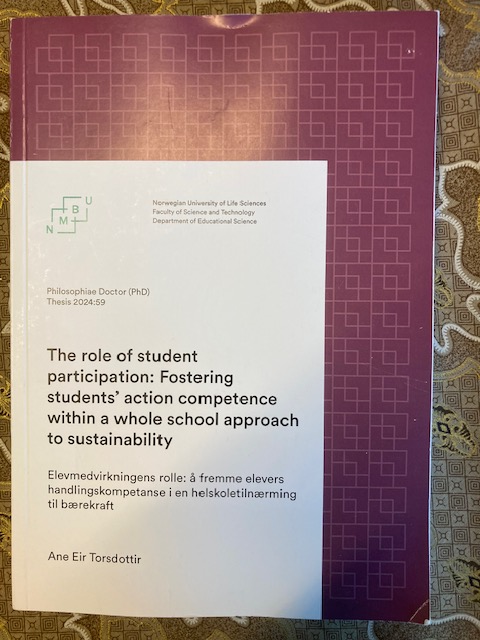
On Friday November 1st one of my Norwegian PhD Candidates successfully defended her dissertation. Over the past few years I have been working with colleagues both at Wageningen University and at the Norwegian Life Sciences University (NMBU) on researching the potential merits of so-called Whole School and/or Whole Institution Approaches (WSA/WIA) to sustainability. At NMBU there are currently four PhD-candidates doing research related to this, Ane Eir Thorsdottir is or rather, was one of them. Her work focusses on one aspect of the WSA which is critically important: students participation. In addition to myself, Prof Astrid Sinnes of NMBU and Dr. Daniel Olsson of Karlstad University in Sweden were her supervisors. Jan Cincera and Elin Saether (Olso Univerity) were her ‘ opponents’ .She has published three articles that are central in the dissertation: two in Environmental Education Research and one in Global Environmental Research.
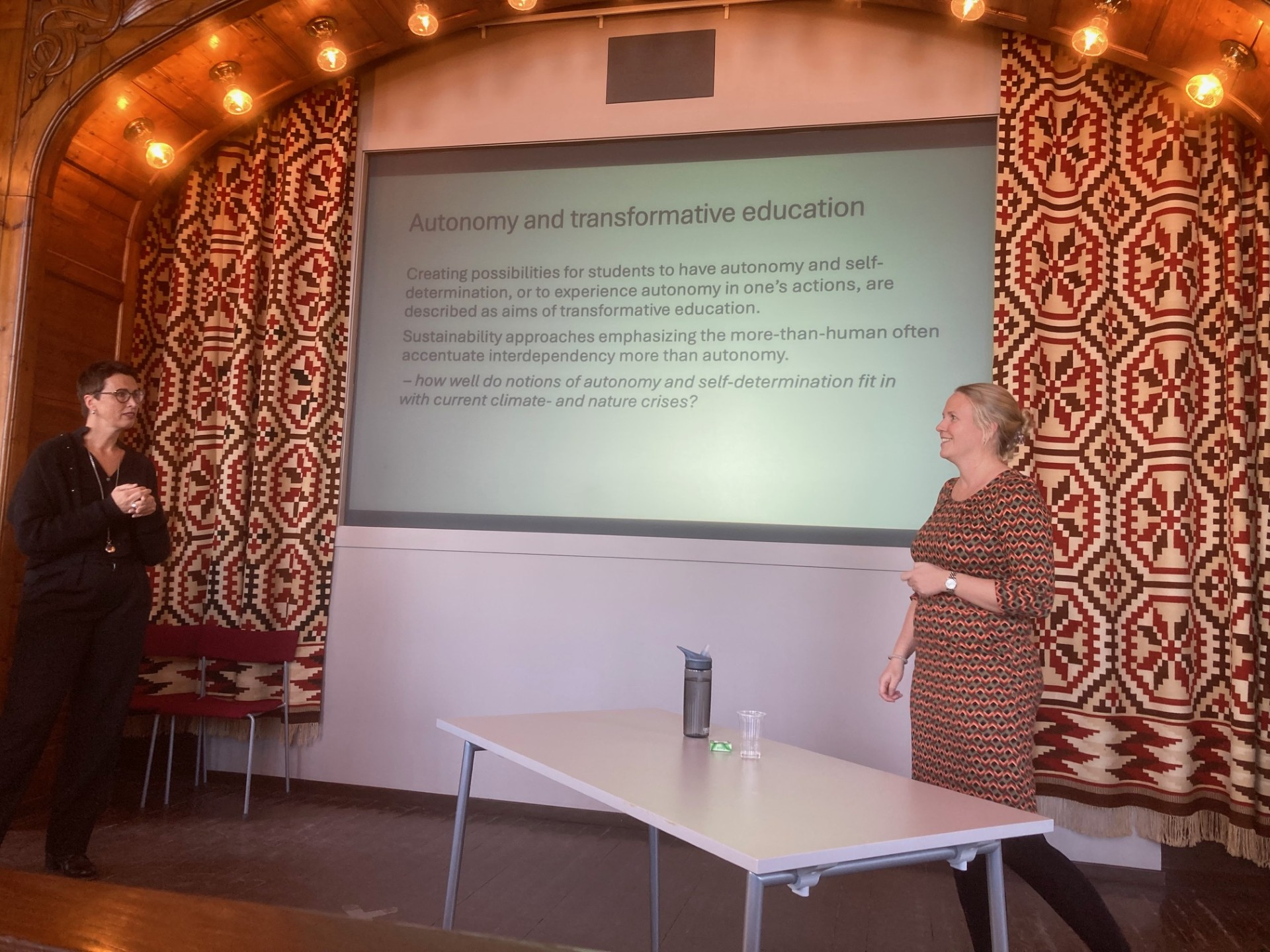
Elin Seather (left) having a dialogue with Ane (right) during the defence – posing an interesting question about autonomy and self-determination as pedagogical principles in a world that requires a decentering of ‘ self’ and opening up for ‘ other’ as well.
This paper appeared online in 2022 and was a part of the wonderful dissertation of Koen Wessels which was later published by Springer Nature as a book within the publisher´s SDG 4 ´Quality Education´ Series. Now has been formally published in open-access form as a part of the latest issue of Pedagogy, Culture and Society. Full citattion: Wessels, K. R., Bakker, C., Wals, A. E. J., & Lengkeek, G. (2024). Rethinking pedagogy in the face of complex societal challenges: helpful perspectives for teaching the entangled student. Pedagogy, Culture & Society, 32(3), 759–776. View and download here: https://doi.org/10.1080/14681366.2022.2108125
Here is the abstract to give you a bit of a flavor of the paper:
Today, the first article from Ane Torsdottir’s PhD Research on High School student’s partcipation in schools trying to work within a Whole School Approach in Southern Norway, was published in Environmental Education Research. The article, co-authored by her supervising team with Daniel Olsson, Astrid Sinnes and myself, demonstrates how a questionnaire gauging students’ experiences of participation in decision-making at their school can operationalise student participation in a whole school approach (WSA) to education for sustainable development model.
Some 902 students in three upper secondary schools participated in the study by giving their answers to Likert-scale items developed to tap into their experience of participation in the decision-making at their school.
The students identified four distinct pathways of participation:
(i) School and Leadership,
(ii) Teaching and Learning,
(iii) Community Connections, and
(iv) Student Council.
The results are discussed in the light of focus group interviews with eleven of the participants. The student WSA participation questionnaire proved to be a reliable and valid instrument that, together with the student WSA participation model, can be used by school leaders wanting to increase student participation, and by researchers investigating student participation throughout the whole school.
Full citation:Torsdottir A.E, Sinnes A, Olsson D. & Wals, A. (2023) Do students have anything to say? Student participation in a whole school approach to sustainability, Environmental Education Research, DOI: 10.1080/13504622.2023.2213427
Regenerative forms of higher education are emerging, and required, to connect with some of the grand transition challenges of our times. This paper explores the lived experience of 21 students learning to navigate a regenerative form of higher education in the Mission Impact course at The Hague University of Applied Sciences. This semester-length course ran for two iterations with the intention of connecting the students with local transitions towards a more circular society, one where products are lasting and have multiple lives when they are shared, refurbished, or become a source for a new product. At the end of each iteration, the students reflected on their experience using the Living Spiral Framework, which served as basis for an interpretative phenomenological analysis of their journey navigating this transformative course. The results of this study include four themes; (1) Opting in—Choosing RHE, (2) Learning in Regenerative Ways, (3) Navigating Resistance(s), and (4) Transformative Impacts of RHE. These themes can be used by practitioners to design and engage with regenerative forms of higher education, and by scholars to guide further inquiry. View Full-Text
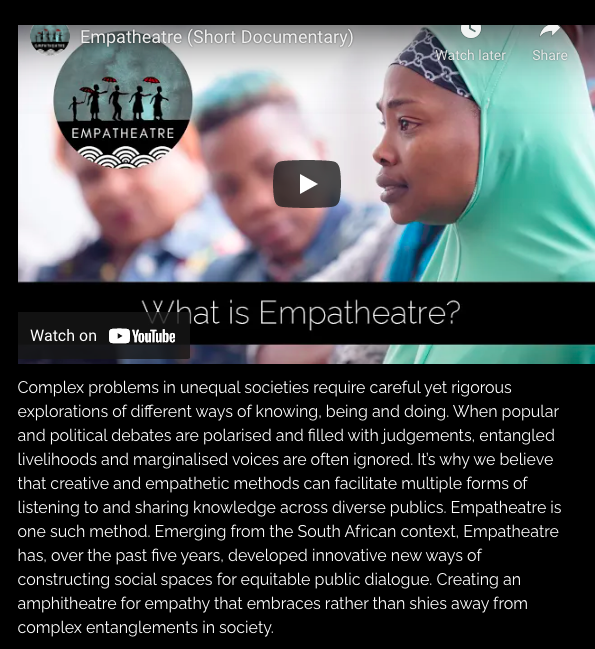
Empatheatre is one example from South Africa showing how drama can educate towards empathy and social and environmental justicehttps://www.empatheatre.com/about
One of the Swedish PhD-Candidates I have been working with over the last few years, Julia Fries, based at Stockholm University, is co-organising two fascinating workshops focusing on drama-based approaches in higher education for sustainability.
Below you find an invitation to participate in two international workshops on new formats for Sustainability teaching, funded by the Swedish Research Council and organised by Stockholm Resilience Center and the Department for Teaching and Learning at Stockholm University.
The project explores how drama-based methods can support reflective, embodied and transformative learning about sustainability amongst higher education students. The research ambition is to further current understanding of the role of experiential learning and how these methods support such learning. The format designed will allow to both support pedagogic development in participants academic teaching practice, and address the research questions.
Two international workshops will bring together drama educators and educators in fields related to sustainability, to share different drama-based, interactive methods and explore what these can bring to education in sustainability sciences or sustainability in other subject areas.
Quote from project description:
This project concerns teaching and learning for Sustainability in Higher Education. The cross-disciplinary field of sustainability can be characterised as extremely unsettled and value-loaded, a challenging academic subject for both teachers and students. Consequently, adequate teaching methods has to be developed in order to tackle sustainability issues in a creative and inclusive way. This has been recognised in relation to primary and secondary education but not so much at university level. Attempts are made to achieve this, by adopting a less traditional teaching approach and relation to the world outside the university. Based on this, we propose two explorative workshops for university teachers/researchers. The purpose of the first workshop is to introduce and explore a set of highly interactive teaching approaches to a group of university teachers/researchers in Scandinavia and Europe. After the first workshop, these teaching approaches will be applied, tried out and documented, as part of the participants ongoing teaching at their universities. The purpose of the second workshop is to evaluate these interactive approaches, by sharing teaching experiences and learning outcomes among students in higher education. The overarching aim is to explore and compare a set of interactive teaching approaches, in terms of applicability and student impact in Higher Education for Sustainability. Based on the outcome, scientific papers will be presented and/or a book will be published.
Practicalities: The first workshop will be in Stockholm 6-9 Sept. 2022 and the second in May or June 2023. Thanks to a grant from the Swedish Research Council we are able to offer 15 participants free meals and accommodation, but travel expenses are not included in the offer. Participants are expected to take part in both workshops. A detailed program for the first event will be presented later this spring. Questions can be directed to eva.osterlind@su.se or t.wall@ ljmu.ac.uk
Handmade painting by a student on “Empowerment – a rising sensation that liberates you from ‘sinking’ into negativity” – using artistic forms of evaluation of learning, helped both subjectification and creating a sense of community in the course
This paper recently appeared in International Journal of Sustainability in Higher Education. It explores students’ sense of community and belonging in an online course on environmental and sustainable education during times of physical distancing as a result of the COVID-19 pandemic. Using a case study approach, the results show that students perceived a sense of community that was collectively build during the four week program. Sense of community was linked to and facilitated by the learning environment and the educators’ and students’ role throughout the course. Prominent factors here are interaction and inclusion created with mutual effort by design, the educator and student.
This research arose after the course ELS-31806 Environmental Education and Learning for Sustainability[1] was converted as an ‘offline’ course into an online course due to COVID-19. The original content of the course enables students to systematically discuss important concerns in the development of an effective curriculum and/or operation for the environment and sustainable development using a range of instrumental and emancipatory approaches. But foremost ELS-31806 is a course that has always been, well appreciated and highly valued by participants for its highly experiential and hands-on approach.
However, due to COVID-19 this year’s course (2020) was changed into a less experiential on-line format mediated by Zoom for interaction and by Brightspace for course structure and organisation. This somewhat ad-hoc and sudden departure from the traditional successful format, lowered the instructors, and probably also, the students’ expectations about the course’ ability to create a vibrant learning community. Yet, contrary to pre-course expectations, ‘something’ (i.e. a sense) arose over the course of four weeks online education that both students and staff considered to be special or meaningful. These hunches got confirmed several weeks after by Wageningen UR’s student evaluation system PACE which revealed that the students highly valued the course.
We were intrigued by the question of how this online edition evoked similar, or nearly similar outcomes to its offline counterpart. After first checking whether our hunches were right about the course and what might explain the high evaluation marks, we centre in the paper’s main question:
What are key characteristics of an online course that fosters subjectification (personal development and inner-sustainability in relation to others and the other) and creates a sense of community?
The paper was led by former MsC student Robbert Hesen and co-authored by myself and ELS Postdoc Rebekah Tauritz.
This new book published by Brill just came out and I am pleased to have been ablte contribute to its contents together with one of my colleagues from the University of Gothenburg, Anne Algers. Our chapter is part of a rich collection of chapters focusing on ways of opening education to allow for more dynamic forms of learning to emerge in a world that is trying to grapple with many of the existential and ecological crises that, both ironically and sadly, humanity itself has created. The chapter that Anne and I wrote (have look at the pre-print here: Sustainability_orientedOpenLearningAlgersWals2020) asks the question of “How can open education play a role in making academia more responsive and responsible in addressing ill-defined and ambiguous, but ever so urgent, sustainable development challenges?” In our chapter, a case study from the field of sustainable development of food systems provides a narrative that illustrates the possible impact of open education; and the value of a culture of openness to individuals, to a community, and to society.
First, we provide a contextual background on the implications of openness in higher education. Second, we introduce the subject of sustainable development (SD) of our global food systems; and third, we discuss the concept of education for sustainable development (ESD). Fourth, by means of thick description (Geertz, 1973), we report a case study on open education which we discuss in light of learning theory, critical pedagogy, and sustainable development.
In the end we argue for a radical interpretation of open education which we refer to as transformative sustainability-oriented open education, where ”open” refers to inviting and expressing critique and marginalized perspectives in controversial societal issues, while transformative refers to enabling learners to bring about change.
Suggested citation: Algers, A. & Wals, A. J. (2020). Transformative Sustainability-Oriented Open Education. In: Conrad, D. & Prinsloo, P. (Eds.). Open(ing) Education. (pp. 103-120). Leiden, The Netherlands: Brill | Sense. doi.org/10.1163/9789004422988_006
This work is licensed under the Creative Commons Attribution 4.0 International License.
Ecologies for Learning and Practice edited by Ronald Barnett and Andrew Jackson, provides the first systematic account of the ideas of learning ecologies and ecologies of practice and locates the two concepts within the context of our contemporary world. It focuses on how individuals and society are being presented with all manner of learning challenges arising from fluidities and disruptions, which extend across all domains of life. This book examines emerging ways of understanding and living purposively in these new fluidities and provides fresh perspectives on the way we learn and achieve in such dynamic contexts.
Providing an insight into the research of a range of internationally renowned contributors, this book explores diverse topics from the higher education and adult learning worlds. These include:
The challenges faced by education systems today
The concept of ecologies for learning and practice
The role and responsibility of higher education institutions in advancing ecological approaches to learning
The different eco-social systems of the world—local and global, economic, cultural, practical, technological, and ethical
How adult learners might create and manage their own ecologies for learning and practice in order to sustain themselves and flourish
With its proposals for individual and institutional learning in the 21st century and concerns for our sustainability in a fragile world, Ecologies for Learning and Practice is an essential guide for all who seek to encourage and facilitate learning in a world that is fundamentally ecological in nature.
In the chapter I contributed I argue that the current sustainability crisis demands a radical re-orientation of the way we learn. I consider sustainability to be an emergent property of an ecology of learning that is reflexive purposeful cocktail of actors, perspectives, forms or learning, connections and support mechanisms, driven by an ethical concern for the wellbeing of people and planet both now and in the future. Sustainability-oriented learning then becomes an organic and relational process of continuous framing, reframing, tuning and fine-tuning, disruption and accommodation, and action and reflection, which is guided by a moral compass inspired by an ethic of care. Such learning implies or even demands a certain freedom to explore alternative paths of development and new ways of thinking, valuing and doing.
The chapter introduces sustainability-oriented ecologies of learning as a blended learning space where multiple actors, often having different backgrounds, co-create sustainability organically using a variety of tools, relations, and forms of learning. The concept of whole school or whole institution approaches is introduced as a way to enact such ecologies of learning in a systemic way (see the figure below from the 2016 Global Education Monitor Report published by UNESCO).
Full reference: Wals, A.E.J. (2019) Sustainability-oriented Ecologies of Learning as a response to systemic global dysfunction In: Learning Ecologies: Sightings, possibilities, and emerging practices Ronald Barnett and Norman Jackson (Eds.), London: Taylor & Francis. p. xx-xxx
Here is a link to the book on the publisher’s website!
An ecology of learning created by a whole school approach to sustainability (source Global Education Monitoring Report, UNESCO, 2016)
Last month I attended the European Conference on Educational Research (ECER in Hamburg this year. Around 3000 participants from over 60 countries attended the conference. Since the overall theme was ‘Education in an Era of Risk – the Role of Educational Research for the Future’ I had the honor of being asked as one of the plenary keynote speakers, as was my good colleague and friend Heila Lotz-Sisitka from Rhodes University in South Africa who, like myself, is a member of ECER/EERA’s subnetwork on Environmental and Sustainability Education (Network 30), one of the youngest and rapidly expanding networks.
The title of my talk was: Should and Can Education Save the Planet? In the talk I outlined the current global sustainability challenges form a learning perspective and I introduced the concept of sustainability-oriented ecologies of learning. I also introduced the notion of sustainability Bildung in which Biesta’s three tasks of education are reconfigured with Planet in mind to become eco-subjectification, eco-socialization and eco-qualification.
You can watch the full keynote here (also understandable for the deaf and hearing impaired as the talk was kindly supported with sign language).
Here is the official ECER2019 abstract of the keynote.
Education unwillingly has become a key mechanism for fostering economic development, innovation and growth. In the meantime, humanity is facing a range of sustainability issues that include: rising inequity, loss of democracy, runaway climate change and mass extinction. These issues can be so overwhelming that they can easily lead to apathy and despair which will only make them bigger. We appear to be at a tipping point where the decisions we make about how to live together will be crucial for the future of our planet. There is no better time than now to ask: What is education for? What if education would serve people and planet rather than just or mainly economic interests? Is this a role education should play? And, if so, what does such an education look like?
Based on emerging research and practices from around the world, I will sketch forms of education and learning that are: responsive, responsible and transformative in light of global sustainability challenges. Sustainability here is not seen as another subject to be added to an overcrowded curriculum, but rather as a continuous quest for finding ways to live more equitably, meaningfully and healthier on the Earth without compromising planetary boundaries and the futures of the coming generations. Such a quest requires a more relational pedagogy that can help establish deeper connections with people, places and other species. Such a pedagogy not only invites reflection on values and ethics, and the utilization of diversity, but also the critiquing and transgressing of the structures and systems that make living unsustainably easy and living sustainably hard.






 Ecologies for Learning and Practice edited by Ronald Barnett and Andrew Jackson, provides the first systematic account of the ideas of learning ecologies and ecologies of practice and locates the two concepts within the context of our contemporary world. It focuses on how individuals and society are being presented with all manner of learning challenges arising from fluidities and disruptions, which extend across all domains of life. This book examines emerging ways of understanding and living purposively in these new fluidities and provides fresh perspectives on the way we learn and achieve in such dynamic contexts.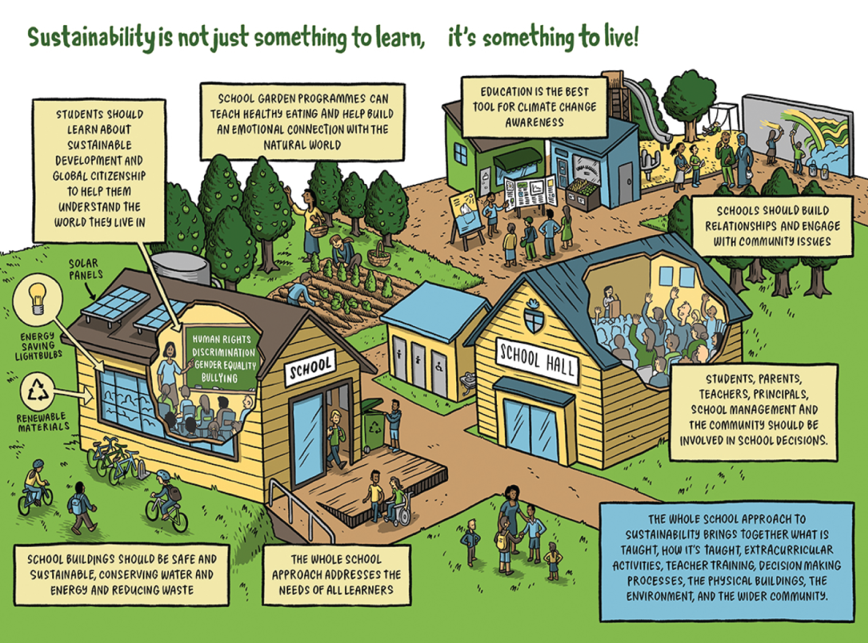

 Transformative learning