We are about to end the first year of an EU-funded project on developing LivingLabs for Nature-Based Solutions and will soon ‘implement’ / unfold 7 LivingLabs in the participating countries. Below some basic information that you can also find on the ENABLS Website. Together with Mieke de Wit, ouise van der Stok and Lian Kasper, I am representing Education & Learning Sciences of Wageningen University in this major project.
This paper led by ELS-WUR PhD-candidate Marlies van der Wee – Bedeker was published earlier this Fall. The paper is the first peer reviewed article based on her research that is grounded in the City of Rotterdam using her home institute Hogeschool Rotterdam as a base. Below a summary of the main fiindings. The full paper can be found here!
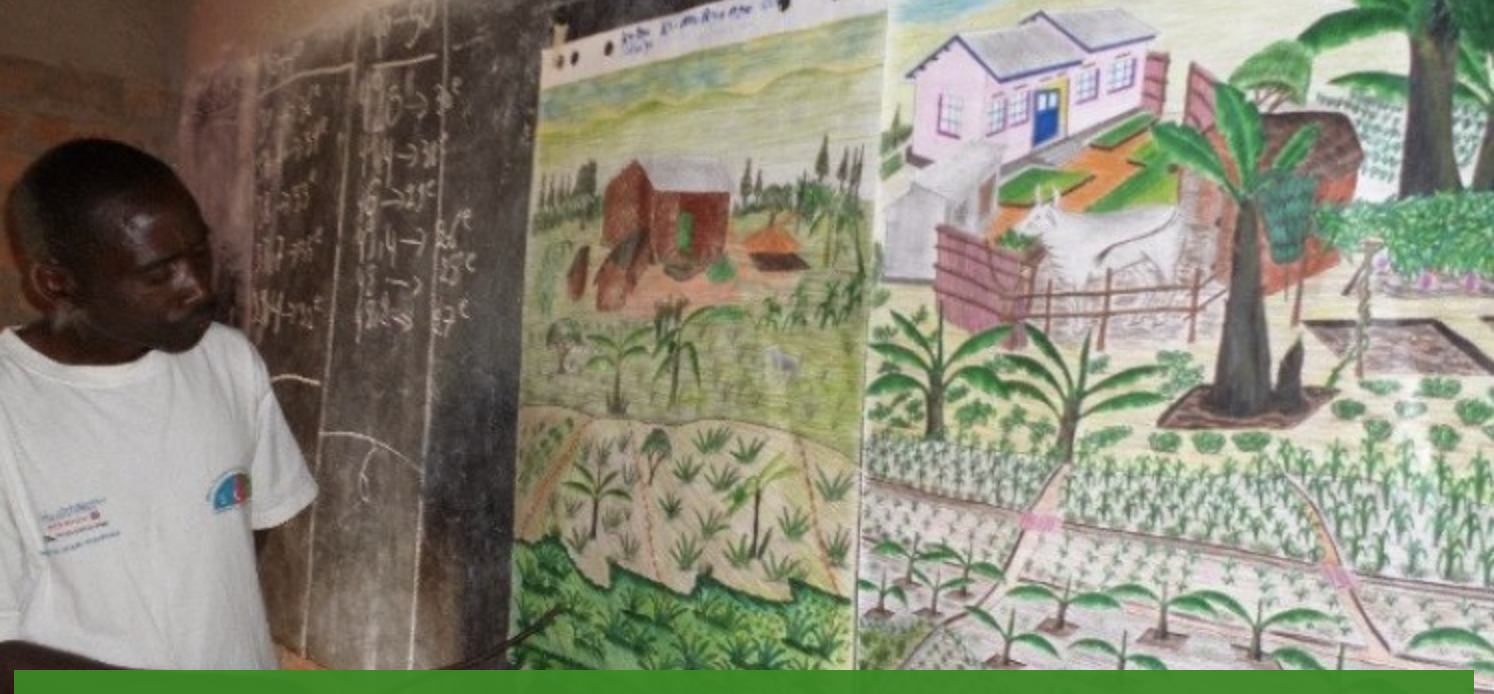
A new paper reporting on a study led by PhD-Candidate Doreen Misanya was published today in the Journal of Agricultural Education and Extension. The paper titled ´Competences for socio-ecological stewardship: a qualitative assessment of the transformative potential of farmers’ learning processes in Eastern Uganda´, identifies socio-ecological stewardship competences that smallholder farmers in the Manafwa watershed in Eastern Uganda, developed by participating in a project founded on the Participatory Integrated Planning approach (PIP – see image above).
The study identified socio-ecological stewardship competences comprising different sustainability-related dimensions including: ‘environmental knowledge’ as environmental systems, action-related, effectiveness, social, and ethical knowledge; ‘connection with nature’ as establishing an identity with nature, appreciating the value of nature, social, and ethical attitudes; and ‘ecological behaviour’ as conservation and restoration, social, and ethical actions.The study also shows that Competence dimensions are interconnected thus requiring learning environments that develop them simultaneously. Additionally, social and ethical competences are relevant for supporting stewardship action.
Theoretically, this study expands Roczen’s environmental competence model by including social, ethical, and conservation and restoration action competences. This study is one of the first to identify socio-ecological stewardship competences and the learning processes that can foster these competences.
Full citation:
Misanya, D., Tassone, V. C., Kessler, A., Wals, A. E. J., & Kibwika, P. (2024). Competences for socio-ecological stewardship: a qualitative assessment of the transformative potential of farmers’ learning processes in Eastern Uganda. The Journal of Agricultural Education and Extension, 1–21. https://doi.org/10.1080/1389224X.2024.2403597
This paper stems from the research of PhD Candidate Doreen Misanya. It analyses how smallholder farmers are learning for socio-ecological stewardship in a specific case study context in Eastern Uganda. The case under analysis is a watershed management project that uses an integrated farm planning (PIP) approach to strengthen farmers’ stewardship capacities within the Manafwa watershed through interactive and dialogic ways of engaging and teaching farmers. Utilizing a transformative learning ecology (TLE) perspective, this study investigated features of the PIP approach that support transformative learning for socio-ecological stewardship in a rural context. Data was collected by interviewing eighteen farmers from different villages and PIP generations and all three PIP trainers of the project, and by observing training sessions as well as sensitisation workshops. As a main result, the study yielded new insights that can help enhance PIP-like learning configurations consisting of interconnected learning tenets, dimensions and processes. This enhanced learning configurating comprises an organic learning system that facilitates farmers to change their mindsets and redefine their values, perspectives, routines, and practices towards those that encourage socio-ecological stewardship. The TLE fostered by the PIP approach represents a useful heuristic that can guide and inspire both scholars and educators engaged in processes of cultivating socio-ecological stewardship in similar contexts.
Misanya, D., Tassone, V. C., Kessler, A., Kibwika, P., & Wals, A. E. J. (2023). Analysing farmers’ learning for socio-ecological stewardship in Eastern Uganda: A transformative learning ecology perspective. NJAS: Impact in Agricultural and Life Sciences, 95(1). https://doi.org/10.1080/27685241.2023.2191795
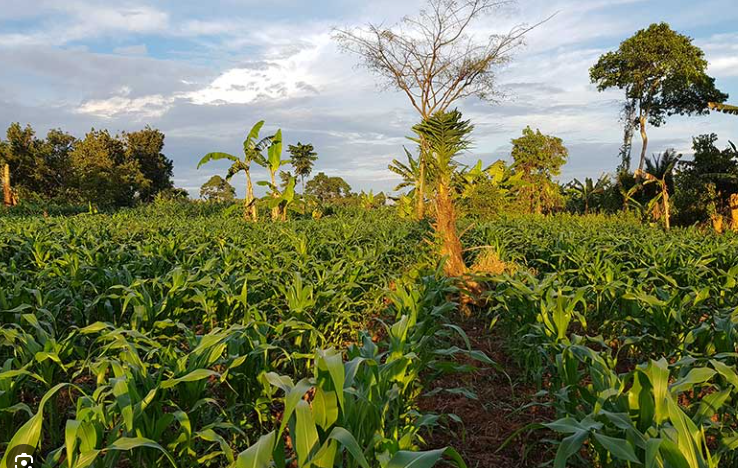
The research took place within the Manafwa Watershed Restoration (MWARES) Project in Bududa District, Eastern Uganda. A Baseline Report of the project appeared in 2020. It outlines the starting position of the PIP farmers in the region. This report can be found here.
On December 12th Marieke Versteijlen of Avans Hogeschool successfully defended her thesis at the Wageningen University. Marieke was co-supervised by myself and Transportation Scientist Prof. Bert van Wee of Delft University in the aula of Wageningen University. The thesis was approved and discussed by a committee consisting of Prof. Taeke Tillema of Groningen University, Prof. Arnold Brecht, Dean of Educaiton, Wageningen University, Dr. Sally Windsor of Gothenburg University in Sweden and Dr. Wim Lambrechts of the Open University of The Netherlands.
Marieke’s research addresses the high environmental impact of students commuting to the higher educational institution (HEI) by exploring the potential of digital technology to lower the travel movements of students.
The research explores how on-campus and online education can be balanced in a blended learning design to decrease student commute without compromising educational quality. By applying a form of Educational Design Research (EDR), involving key HEI stakeholders, guidelines and principles were found that can support the design of blended education to simultaneously meet these environmental and educational requirements.
The three stages of EDR were followed to design the sustainable blended intervention, exploration, construction and reflection. In the exploration stage, the environmental impact of students commuting to and from campus was explored across several Dutch HEIs and compared with international research on HEIs’ carbon footprint, confirming its large contribution. Also showing that only a few Dutch sustainability and ICT professionals recognized the potential of online learning to lower carbon emissions due to student commute.
After establishing the environmental impact of student travel, the considerations and (de)motivators of Dutch students influencing their travel mode choices and their decisions about whether to travel to their institution or to study online were explored. Their travel mode choice is mostly based on habit and influenced by travel-regulating measures of the Dutch government (a free public transport permit) and HEIs (high parking costs). Their decision to make a trip to campus seems to be a reasoned choice, influenced by the number and time of the day of their scheduled classes, the type of learning activity and their perceived study abilities.
In the construction stage, design principles and associated recommendations were developed to design sustainability-oriented blended education through a realist review and by cooperating with a team of eight educational professionals to design a blended study programme. Lecturers can use these design principles to guide and assess the quality of a blended learning unit. The acquisition of sustainability competencies by the students was considered one of the aspects of educational quality. The implementation of the prototype was severely impacted by the COVID-19 pandemic in 2020. The government restrictions changed the intended blend to mainly online education. Instead of measuring student travel emissions as a result of the design, a possible attitude change of students toward online learning and commuting that might have been caused by going through a period of primarily online learning due to COVID-19 restrictions, was studied. The students experienced that online meetings can be productive and efficient, and less time is lost in travel. Both were appreciated by the students.
This research adds a sustainable perspective and a step toward a detailed pedagogical framework to what is already known about blended learning. Although we could not measure the impact of a blended learning design on student travel emissions due to COVID-19, there are strong indicators that a blended learning design can be used to decrease its environmental impact by reducing student commute. The findings of this study can contribute to a whole-institution approach embedding sustainability in all aspects of the institution.
The entire thesis is available through open access through the Wageningen Library as are the four peer reviewed papers that all have been published.




 Transformative learning