Transformative learning

Learning and change within people and society towards a more sustainable world

Transformative learning

Deconstructing a Happy Meal – making everyday life routine practices a source of transformative learning – indeed: food for thought!

“Today we’re going to study the food pyramid for healthy living!” the High School Social Science teacher Mark told his class. Mark was excited about launching a healthy food project that would enable kids to analyze their diets. He was well-prepared and had collected a number of teaching resources from government agencies, NGO’s and food-companies concerned with youth obesity and increasing health costs. One of his students called out: ”Food pyramids?” Boring! Why can’t we go to McDonalds?” This idea got the whole class excited, but frustrated Mark. After all, he had thought of something new that was hands-on and seemed very relevant. Later that evening Mark asked himself how he could motivate his students and engage them in an exciting learning process that would teach them something about health issues. He got an idea.

The next day Mark said to his class: “Today we’re going to McDonalds!” The whole class cheered. They couldn’t believe it.  Their teacher was actually going to take the whole class to the McDonalds near the mall across the street. “But…, there’s one condition. We will only buy one happy meal for the whole class”.  This got the students a little less excited, but they went anyway, just to get out of school. The class bought one cheeseburger happy meal and took it back to the classroom. Mark told the class that “unfortunately we are not going to eat the happy meal, we are going to carefully study it instead”.  He wrote down two questions on the blackboard:

What is in it?

Where did it come from?

They first dissected the meal: a plain bread bun, a slice of melted cheese, a grilled beef burger, salt, mustard, ketchup, pickles, French fries, diet cola, and, finally, a nice toy.

Then Mark divided the class in six groups of four students. One group got the bread bun, another group the salted French fries, another group the diet soda, another group got the burger, another group the accessories; ketchup, mustard and pickles and the last group got the plastic bagged happy meal toy.

“You have the remaining social science hours of the week to answer the two questions. Next week I want a short presentation with your findings from each of the groups. You can use the internet, the school library, the telephone in my office, and, if you need to ask questions across the street at the restaurant you can do so with my permission.”

All the groups went to work and the more they found out, the more interested they got. The group investigating the french fries found out that fast food chains need enormous volumes of potatoes and demand a certain type of potato that guarantees a consistent quality. As a result potato farmers around the world have reduced the number of potato varieties greatly. This has led to a loss of crop-biodiversity, making the remaining crops more vulnerable to pests and leading to an increase of pesticide use. A common response to this vulnerability is use genetically modified crops that are resistant to these pests. However the students also found out that McDonalds, pressured by concerned consumers, decided not to use Monsanto’s GM new leaf potato. The group’s investigation led to an interesting discussion about the pro’s and con’s of GM-foods. Most students were not aware that they were already consuming GM-foods. In fact the group studying the diet Cola found out that the sweeteners contained GM corn.  When presenting their finding students used a provocative quote from the internet to start a classroom-wide discussion:

Giant agribusiness, chemical and restaurant companies like Cargill, Monsanto and McDonalds dominate the world’s food chain, building a global dependence on unhealthy and genetically dangerous products. These companies are racing to secure patents on every plant and living organism and their intensive advertising seeks to persuade the world’s consumers to eat more and more sweets, snacks, burgers, and soft drinks.

Meanwhile the group investigating the happy meal toy learnt some things they didn’t expect to learn either. The discovered that the toys served cross-marketing purposes. Meaning that they bring parents and their children to the restaurant but they also promote things like Disney movies.  Most of the toys were made of plastic and not used by the children for a very long time. They went back to the McDonalds and studied how and for how long kids played with the toy and asked parents to estimate for how long the toy would remain in use. They estimated that the effective play time would be less than 10 minutes. Perhaps the most interesting finding they got by using the Internet. They found many sites – mostly activist  sites – that suggested that the happy meal toys were made in China. They came upon an article that stated that “.. a happy meal toy manufacturer, China-based City Toys Limited, employed children as young as 13 to assemble the “Happy Meal” toys.” These young teenagers were reportedly forced to work 16 hour days, seven days a week, and lived in crowded, on-site dormitories for a salary of less than 3 dollars a day. As a result of these revelations made in the Summer of 2000, McDonalds quickly responded by denying to have any knowledge about these conditions. The company distanced itself from City Toys Limited and moved its operations elsewhere. Since McDonalds was, at the time, not required to disclose information about its overseas contractors, it was difficult for the students to trace where they moved the operations and what the working conditions are at the new facilities. When this group presented their results to the class the were discussions about child-labour, children’s rights, ethics of moving jobs to countries with different standards and laws, but also about the consequences of McDonalds using a ‘cut-and-run’ strategy for the children in China working for City Toys, whose income might have been crucial for their families. The teacher also raised the issue of the reliability of the information of provided on the internet. Who put the information there? With what purpose? Is it based on fact?

The other groups too, found interesting information and point of discussion related to a happy meal (varying from beef imports, hormones in meat, clear cutting of rainforest to the sweeteners used in Diet-coke). One group was interested in figuring out ‘how many miles a happy meal has travelled to get to the local McDonalds? They didn’t get a chance to figure it out but they guessed tens of thousand of miles. The whole excersise was transformative in that they view of fast food in general and of a happy meal had changed. Mark’s concern was that, even though the students learnt a lot about food-related sustainability issues (health, environment, equity, economics), gathering information, presenting information, critical thinking, debating, etc., the project may have resulted in a rather bleak picture of something they really enjoyed: eating a nice juicy cheeseburger at McDonalds. He wanted the students to think about viable alternatives. So he asked the students a third question:

Can you design a happy meal that makes everybody happy?

The same groups started thinking about alternative buns, cheese, beef, mustard, pickles, soda, and even an alternative toy. This took another week of investigations but in the end they designed a happy meal that was more organic, healthier, socially-responsible and used up less energy. They cooked the happy meal themselves in the school kitchen for all junior high students and did a taste survey which demonstrated that the meal was a least as tasty as a McDonalds happy meal.  There was one problem: the new happy meal was far more expensive that the McDonald’s version. This raised another issue in the classroom: are we willing and/or able to pay more for meals that are healthier, more equitable, have less environmental impact? Some argued that consumers should demand this kind of food so that big corporations will change their own policies and practices, making alternative foods more affordable as demand increases.

“When McDonalds, Pringles, and the other major potato buyers decided not to sell Monsanto’s GM New Leaf potato, for example, it was soon taken off the market. McDonalds and others doomed Monsanto’s potato because they wanted to satisfy consumer demands. We have that power.” “In the U.S., Whole Foods Market, Wild Oats, and Trader Joe’s announced that GMOs would be removed from their store brands. Gerber baby foods, as well as scores of health food products, have similarly changed their ingredients.”

“When a store or brand removes GM ingredients, it has a ripple effect through the industry. After a supermarket chain commits to eliminate GMO’s, they usually send out a letter to their suppliers who in turn contact their suppliers and so on. A store may have hundreds of food items, each with a list of ingredients. Hundreds or thousands of businesses can be affected, right back to the farm level.

Others pointed out that their parents make decisions about what to buy, since they are the ones going to the grocery store.

The deconstructing of a happy meal became a transformative learning experience for all those involved, including Mark, the teacher. The happy meal brought out issues, tensions, dissonance, north-south relationships, health issues, ethics, the role of corporations, consumerism, economics, crop-biodiversity, etc.  It made an ordinary activity (going to McDonalds), somewhat unordinary and raised many critical questions that demanded some serious reflection. It developed a range of competencies in the students: asking questions, finding reliable information using a variety of sources, analysing data, presenting information, critical thinking, etc., etc.

Mark’s point of it all was not that students would reject going to McDonalds but that they would become aware of range of food-related issues: ethical ones with respect to using GMO-food or not, or with respect to children making toys for children, or which also raises questions about animal-well in relation to industrial agriculture, ecological ones, for instance, with respect to the potential loss of agro-biodiversity, environmental ones, for instance, with respects to the use of batteries in toys, the use of plastics or the energy used in food miles travelled or in ‘producing meat’ , and then there are economic ones, as well, for instance, with respect of the economies of scale of mass-production and consumption but also with respect to the shortening of food-chains and going local, when factoring in so-called “hidden” environmental costs.

Obviously, students can still choose, having considered all aspects and given their own situation, socially and economically and so on, to go to McDonalds but in all likelihood, having done an activity like this will have transformed the way they look at (fast) food. How this episode of transformative learning will affect who they are, who they’d like to become and how they will behave in the future cannot be known or measured shortly after the activity or even months of years later. This will depend on future experiences and circumstances, but what we do know is that having a learning experience like this will make learners a bit more conscious of what they eat and how this may impact themselves and the world around them.

Post-script:

Deconstructing a Happy Meal is a composite example based on a number of stories and ideas from critical teachers engaged with transformative learning and problem-posing-based teaching. The Happy Meal represents many forms of fast food and just as easily could have been built around other meals. The activity is meant to be educational and not prescriptive in that it tells people what to think and how to behave. It should be recognized that McDonalds, like many multi-nationals, are aware of their ecological footprints and have a range of sustainability and environmental-oriented policies and guidelines. Whether these efforts are genuine driven by a deep concern about the well-being of people and planet or driven by purely economic interests is in the eyes of the beholder.

The Happy Meal case has been presented at several international meetings on Education for Sustainable Development. For references to this example and type of learning please go to:

Wals, A.E.J. (2010) Mirroring, Gestaltswitching and Transformative Social Learning: stepping stones for developing sustainability competence. International Journal of Sustainability in Higher Education, (11(4), 380-390.

Sriskandarajah, N, Tidball, K, Wals, A.E.J., Blackmore, C. and  Bawden, R. (2010) Resilience in learning systems: case studies in university education. Environmental Education Research, 16(5/6), 559-573.
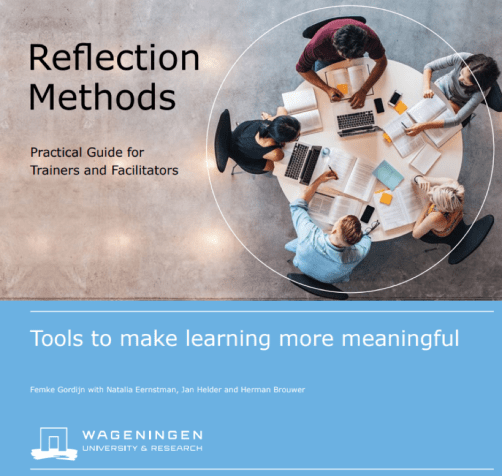
Reflection methods: tools to make learning more meaningful – new open access guide

CoverReflectionLearning

This guide for trainers, educators and facilitators, compiled/written by Femke Gordijn, Natalia Eernstman, Jan Helder, Herman Brouwer and published by Wageningen UR’s Centre for Development Innovation (CDI), summarises methods that can be used to facilitate the process of reflection on the knowledge and experiences people acquire during a capacity development trajectory or training event. The authors believe that by explicitly integrating reflection in the learning process the learning will become clearer and better articulated and will contribute more strongly to meaningful change. They advise facilitators to deliberately include reflective learning sessions in their process design and implementation. This handbook can inspire you to do so and provides many methods which help to facilitate this. I was asked to write a Preface in which where I suggest that dealing with complex and even ’wicked’ sustainability challenges, above all, calls for learning individuals, learning organisations, learning networks and even a learning society.

“But not just any kind of learning, the kind of learning that is able to make explicit and question our assumptions, values and ways of seeing the world, learning that invites us to continuously reflect on the tensions and contradictions between them, learning that reveals the powers and inequities that tend to keep things the way they are or force us in directions we may not want to go. In other words, learning that questions the taken for granted, the normalised, the hegemonic and the routine. But also learning that enables us to make change and to transform others, and ourselves while learning from trying to do so.” (From the Preface, p6)

The book which can be downloaded here:

Link to the Open Access PDF is accompanied by 7 online videos of reflection methods.

You will find them here: Videos and other resources

CDI

Help shape a global action plan for environmental education by providing feedback on the Call for Action from the GEEP

TheGEEP

I am fortunate to be one of the advisors to the Global Environmental Education Partnership (GEEP). The GEEP – which has been initiated a few years ago by the Environmental Protection Agency of Taiwan and the USA and coordinated by the NAAEE- is focused on building capacity for environmental education and sustainability around the world and using the power of education to help address global environmental and social problems. Its advisors are made up of researchers, policymakers, education practitioners, and others who represent government and non-governmental sectors from countries and regions around the world.

As environmental educators, we know that environmental education informs, inspires, and enlightens. It builds human capacity, provokes questions, enhances skills and shapes values and attitudes. It galvanizes individuals, families and communities to make informed decisions about the environment that lead to a sustainable society. Even more, it helps people connect deeply with each other, their communities, and the natural world.

Given the unprecedented challenges we face as a global society—from climate change and biodiversity loss to decreasing access to nature and a growing gap between the rich and poor—there has never been a more important time to scale up our environmental education efforts. Global leaders must make better use of education and capacity-building as strategies to improve the environment, along with tools of governance, regulation, economic and community incentives, and technology.

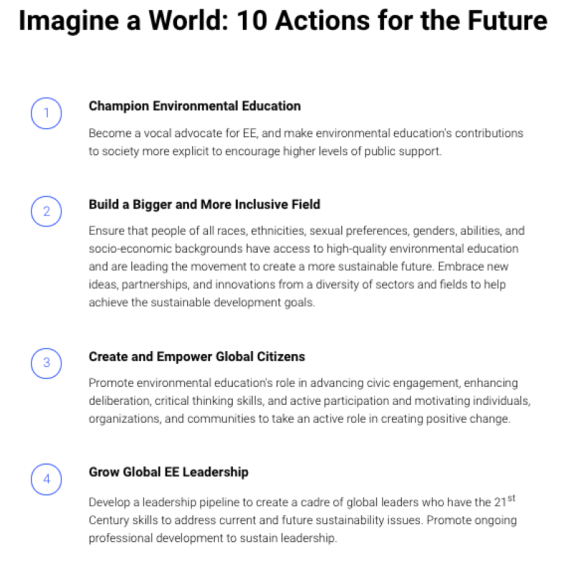
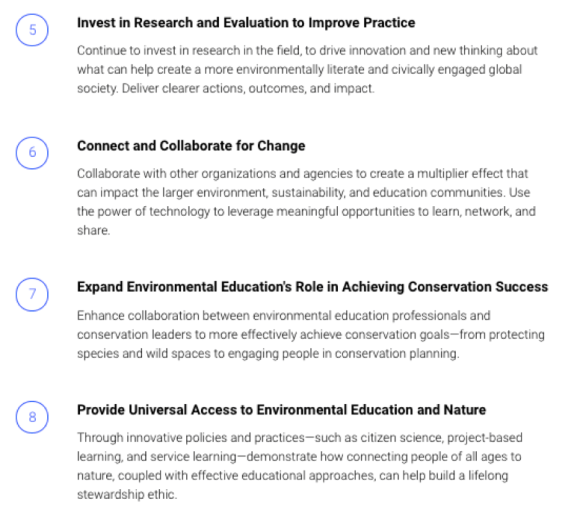
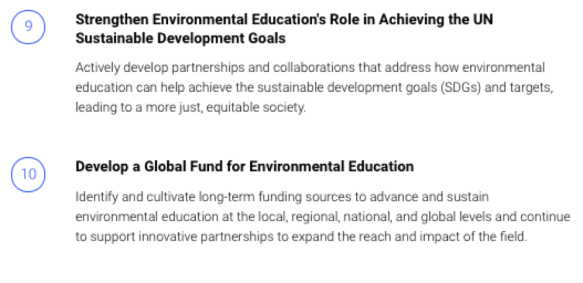
This Call for Action is asking the international environmental education community to take stock of where we are as a field and think ahead to the future. It includes ten draft actions, crafted with input from GEEP leaders from around the world, and is designed to get input from educators working in this field about our key priorities for the next decade.

You can help shape the future agenda by letting us know what you think. Which actions are most important? What’s missing? Visit ActNowForEE.org and cast your vote for your top three priorities and let us know what you think matters most. Your input will help create a global action plan for the next 10 years. Below you find the 10 proposed actions and here is a link to the brief survey where you can provide your input: express your ideas here!

Call_1

Call_2

Call_3

New book – Sustainability Science: Key issues


SustScienceSustainability Science Key Issues Edited by Ariane König (Université du Luxembourg, Luxembourg) and Jerome Ravetz (Oxford University, UK) is a comprehensive textbook for undergraduates and postgraduates from any disciplinary background studying the theory and practice of sustainability science. Each chapter takes a critical and reflective stance on a key issue of sustainability from contributors with diverse disciplinary perspectives such as economics, physics, agronomy and ecology. This is the ideal book for students and researchers engaged in problem and project based learning in sustainability science.

I co-authored Chapter 2 with Michael A Peters titled: Flowers of resistance: Citizen science, ecological democracy and the transgressive education paradigm. Here’s a short intro to our joint effort. “When democracy can be hijacked, power corrupts and capitalism penetrates deeply into society, including into our schools, what prospects still exist for education for a more sustainable world? Democracy is painfully slow and open to manipulation: the question must be asked whether it is up to the task in the new global environment where action is through agreement of interest-based states. And yet in a post-truth world there are important issues that yoke science as empirical truth with democracy that we might christen ecological democracy which provides the warrant and justification for civil action, and demonstrates the new power of citizen science groups that can act autonomously in the interest of their local communities. In this paper we seek comfort, inspiration and support from emerging forms of ecological democracy, civic science and transgressive education.  The latter invites conflict and disruption as mechanisms to break with stubborn, unsustainable routines, that encourage people to leave their comfort zone. The resulting discomfort can be generative when it invites people to explore other options, to build new alliances or to re-think what they always thought to be normal or true. Learning on the edge of one’s comfort zones amidst a plurality of ideas, can help us interrogate and rethink the way we frame – or are made to frame – our experiences, as well as our cultural narratives and associated encultured and embodied ontological pre-dispositions.”

Full reference: Wals, A.E.J. and Peters, M.A. (2017) Flowers of Resistance: Citizen science, ecological democracy and the transgressive education paradigm König, A. & Ravetz, J. (ed.). 2017.  Sustainability Science: Key Issues.  London: Earthscan/Routledge.

Here’s the link to the book: Sustainability Science: Key Issues

(Re-)designing higher education curricula in times of systemic dysfunction: a responsible research and innovation perspective

A new paper coming out of the EnRRich network LivingKnowledge & EnRRich seems ti get a lot of attention considering the number of paper downloads within the first 10 days the paper has appeared online. This is probably because many universities are struggling to find a good way to make education more relevant, responsive, responsible and reflexive in light of global sustainability challenges.

TassoneetAl

Here is the abstract and a link to Redesigning HE (open access, freely downloadable):

There is an urgent need to address the grand sustainability challenges of our time, and to explore new and more responsible ways of operating, researching, and innovating that enable society to respond to these challenges. The emergent Responsible Research and Innovation (RRI) policy agenda can act as a catalyst towards the development of new and more responsible research and innovation efforts. Inevitably, higher education needs to be closely attuned to this need and agenda, by preparing students to engage in RRI efforts. This paper makes a first step towards guiding the embedding of RRI within higher education. It does so by bringing together academic knowledge with phronesis or practical knowledge about what should be done in an ethical, political, and practical sense. It draws on a literature review and on the reflective practices of partners in the European Commission funded project EnRRICH (Enhancing Responsible Research and Innovation through Curricula in Higher Education), as well as on interviews and case studies gathered as part of the project. The paper suggests elements, especially design principles and a competence framework, for (re)designing curricula and pedagogies to equip higher education students to be and to become responsible actors, researchers, and innovators in a complex world, and to address grand sustainability challenges. In addition, this paper proposes that contemporary higher education teaching and learning policies and strategies, especially those promoting neoliberal agendas and marketized practices, need to adopt a more responsible and responsive ethos to foster the renewal of higher education in times of systemic dysfunction.

Keywords

Higher education Responsible research and innovation Grand sustainability challenges Curricula Competence 


Critical case-studies of non-formal and community learning for sustainable development

Together with UNESCO’s Alexander Leicht and Yoko Mochizuki I co-edited a special issue in the journal International Review of Education on Non-formal and Community Learning for Sustainable Development. Here you find a link to our introductory article.

CriticalCaseStdies

I am pasting the final two paragraphs of the editorial introduction below:

“If there is any overall conclusion or pattern which might be drawn from all the contributions to this special issue, it is that boundary crossing is becoming a critical element of learning for, within and from sustainable development. This connects well with Vare and Scott’s (2007) notion of ESD 2, but also with the future directions for environmental and sustainability education highlighted in a recent edited volume on this topic by Peter Corcoran et al. (2017). By moving between perspectives, navigating force fields, handling diversity and stepping in and out of one’s comfort zone, new possibilities emerge for rethinking how we work, live, connect and organise our lives. This also implies working on topics and themes in more integrated ways, covering the nexus of, say, water, energy, food, health, equity and climate, rather than trying to zoom in on “just” one of those aspects. Similarly, the SDGs can only be meaningfully addressed when viewed in their relationship with each other. Boundary crossing between forms of learning will be necessary as well, blending formal, non-formal and informal forms of learning on the one hand, and, for instance, experiential, social, place-based and ICT-supported learning on the other. The result might be a learning ecology or an ecology of learning, a concept used by George Siemens (2005) which requires the integration of principles explored by chaos, network, complexity and self-organisation theories.”

“As the target year for the achievement of the 2030 Agenda with its 17 SDGs is approaching, new forms of governance, education, learning and capacity-building will need to be supported which will enable blended forms of learning in vital partnerships between societal actors seeking to live more lightly and equitably on Earth, using their own context (historically, culturally, economically, socially and ecologically) as a starting point. This also means investing in capacity building for boundary-crossing, brokering relationships and building trust and social cohesion, as these processes and properties seem critical for social learning and transformation within communities. The cases featured in this special issue are only a few of many that exist around the world, but most are not researched, documented and shared very well, and herein lies another challenge: making learning towards sustainability in communities more visible and explicit, and finding better mechanisms for sharing them, not just through special issues in a peer-reviewed journal, but also in ways which can more directly inform, or rather, engage, policy and practice.”

International Masters in Education for Sustainable Development approved in Sweden

Last month the Faculty of Education of Gothenburg University approved an On-line/Blended Learning-based Intl. Masters on ESD. It is one of the the first of its kind in the world. During my guest-professorship at Gothenburg University that started in 2014 and will continue for another year, a was part of a team of staff from the Education Faculty, Natural Science Faculty, Business Faculty and the Humanities Faculty, as well as representatives from Chalmers University that co-designed the Masters.

The Master’s  centers on the question of how education can be a positive force for transformation and change towards a more sustainable future. Throughout the programme, students  will critically analyse the relationship between humans and other species. 

I anticipate I will continue to support the Masters in the years to come by setting up a collaboration with the Education and Learning Sciences Group of my main employer, Wageningen University.

The program will start in September 2018 and is tuition-free for qualifying European Citizens within the EU. Here’s a link to the Masters: Gothenburg ESD Masters Web-page

1658989_esdmasterwebb460

You can also contact the program coordinator Helena Pedersen at: helena.pedersen@gu.se

Online MSc-level Course on Education for Sustainable Development (15ECTS) starts in November at Gothenburg University

GUESD100
Last year IDPP at Gothenburg University in Sweden, with support from ECS  at Wageningen University in The Netherlands, pilotted an on-line Masters Course on ESD. The course has been designed to become the the starter course for a whole MSc-degree in ESD that is currently under construction which we hope to launch in September of 2018. This November we will run the course again, not only because the course received positive evaluations but also because we think we can do even better having had the benefit of the feedback we received from students and our own reflections.

The course is of interest if you:

  • Want to work for increased public awareness, knowledge and action competence in sustainable development and responding to the UN’s Sustainable Development Goals (SDGs);
  • Are interested in supporting learning for sustainable development among diverse groups;
  • Are involved in social movements for people, animals, and the environment, and want to learn more about the role of education in creating a more equitable, peaceful, and ecologically viable world;
  • Are a teacher/educator looking for ideas and strategies to better integrate education for sustainable development in your classrooms or in community settings.

What is the role and responsibility of education to not only respond to sustainability problems, but also to prevent them and create more sustainable futures?

This question is at the core of the web-based course in Education for Sustainable Development. In this 15 credit MSc-level Master’s course you will critically and actively explore central concepts and perspectives in the field of education for sustainable development. The course content will be related to your own interests and prior experiences. You will be among other Master students from different parts of the world with different backgrounds (e.g. environmental sciences, social sciences, economics, arts and humanities).

It is a distance course, all teaching will be carried out online. Course language is English.

More information: Info about GU-ESD100 course at Gothenburg University

Or paste  www.idpp.gu.se/ESD100 into your browser.

Alternatively send an email to Sally.Windsor@gu.se or to me: Arjen.Wals@gu.se or

Note: For most European students the course is free. Non-EU citizens likely will have to pay a tuition fee.

GothWagCombined

Environmental Education in Asia – Special Issue in the Japanese Journal of EE

header_en

This special issue edited by Shinichi Furihata and Sachi Ninomiya-Lim from Tokyo University of Agriculture and Technology and Tokai University respectively,  is the result of a 2-year collaborative project involving environmental education (EE) societies/ associations from Japan, Korea, Taiwan, North America, and Australia. In the editorial introduction the following is stated:

“The aim of the project was to create a platform to share ideas, practices, and theories of EE in the Asian region, with English as the common language. The discussion was organized around five core themes: 1) Development, current situation, and challenges of EE in formal education; 2) Development, current situation, and challenges of EE in non-formal education; 3) Research trends in EE; 4) Insights for EE in Asia from outside of Asia; 5) Review, comparison, and synthesis of findings to go beyond a presentation of EE in various countries and instead highlight the recurring transversal issues. We hope this special issue will contribute to furthering dialogue among EE scholars and practitioners in Asia, and to building bridges between EE in Asia and other regions.

The Japanese Journal of Environmental Education (JJEE), published by the JSOEE/JSFEE since 1991, has provided EE researchers and practitioners with an important space to share their ideas, thoughts, methods, and evaluative analyses, and to participate in theoretical discussions, etc., similar to many EE journals published in other countries and regions. However, since most of JJEE articles are written in Japanese (with summaries in English), its readership is essentially limited to Japanese language users, most of whom reside in Japan. Thus, although the JJEE has become a critical platform for communication among Japanese EE researchers and practitioners, there is a need to expand these discussions to a wider, global network, so that Japanese EE professionals may participate in international and transnational debates on issues of wider relevance in EE. Similarly, EE research in different journals published in Asian countries, including Korea and Taiwan, is mostly written in the local language and is therefore largely inaccessible to people who do not read these languages. The aim of this special issue, therefore, was to create a space where such discussions may be shared and connected. In addition, we decided to invite several prominent international researchers to provide their insights, ideas, and suggestions on developing EE in Asia, increasing Asian participation in the global EE arena, and promoting collaboration on EE with different countries and regions around the world.”

I was asked to write a reflective response paper together with Peter Blaze Corcoran and Joseph Weakland in which we look ahead to the future of EE in the region and beyond. Our paper titles “Preparing for the Ecocene: Envisioning futures for environmental and sustainability education” is based on the introduction to the recent book we edited for Wageningen Academic Publishers (see elsewhere in this blog). All papers are available as open-access and can be found here: Link to the entire Special Issue  You can find our closing paper in which we introduce the notion of the imaginary Ecocene here: Preparing for the Ecocene: Envisioning futures for environmental and sustainability education

Sustainability by Default: Co-creating Care and Relationality Through Early Childhood Education

ECEMOOC

The above illustration comes from the new Harvard MOOC on Early Childhood Development and Sustainability

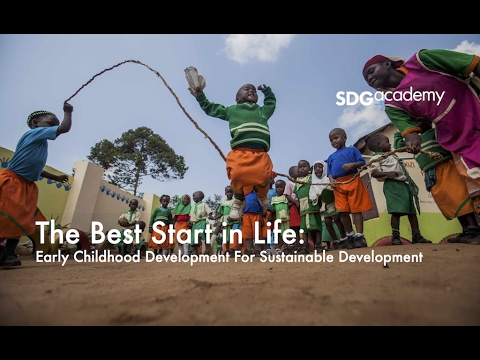
This new paper will be part of a special issue on early childhood education and sustainable development. I wrote the piece  based on a keynote address presented at the 68th OMEP World Assembly and International Conference held in Seoul in July 2016. In the paper I argue that children are more in tune with sustainability than most adults and that both adults and children can benefit from intergenerational dialogue and expanded learning opportunities in so-called ecologies of learning. First the idea of growing up in the Anthropocene, the new geological epoch that is shaped by one single species, home sapiens, is introduced. What does growing up in the Anthropocene mean for today’s children? A short critique is provided of the neoliberal forces that increasingly influence what happens in education and care settings and that essentially make unsustainability the default in our society. Drawing on Martin Buber’s ideas of relational ways of being in the world; Nell Nodding’s notions of care; and George Siemen’s ideas about learning ecologies, some suggestions are offered for co-creating early childhood education and care with people and the planet in mind.

The paper ends with the following: “What seems critical is that children encounter a multiplicity of different worlds by crossing boundaries, both individually and together, and having bodily experiences that strengthen their relationality with the human, the non-human and the material. It is through these encounters that agency, care and empathy can develop. All three of these qualities are foundational for a world that is more sustainable than the one currently in prospect.

Citation: Wals, A.E.J. (2017) Sustainability by default: Co-creating Care and Relationality Through Early Childhood Education, International Journal of Early Childhood Education doi:10.1007/s13158-017-0193-5

Note that this is an open access publication that can be downloaded for free here: Sustainability by default

New: The interplay between social learning and adaptive capacity in climate change adaptation

ClimatChangeVietnamCChangeVietnam2

Pics source: www.knowledgebank.irri.org

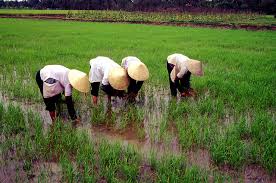
One of my PhD students, Le Thi Hong Phuong from Vietnam, just had her review article (with me and Robbert Biesbroek of Wageningen UR as humble co-authors) published in NJAS . In the paper she maintains that successful implementation climate change adaptation depends to a large extent on the capabilities of individuals, organizations, and communities to create and mobilize the adaptive capacity (AC) of their socio-ecological system. In the paper, creating and mobilizing AC is seens as a continuous process that requires social learning (SL). Although rich with empirical cases, the literature theorizing and empirically investigating the relationship between AC and SL is highly fragmented. This paper aims to critically examine the peer-reviewed literature that focusses on SL and AC in the context of climate change adaptation (CCA).

Special attention is paid to the interplay between the two. Understanding this interplay can help improve our understanding of how CCA takes place in practice and advances theoretical debates on CCA. Systematic review methods are used to analyse 43 papers (1997–2016). The findings reveal three perspectives that each play an important role in different contexts: an AC-focused perspective, a SL-focused perspective, and a hybrid perspective. These differences in conceptualizations of the relationship between SL and AC may seem trivial at first, but they have consequences for the design of learning-based interventions aimed at helping communities respond to climate change. It appears that such interventions need to be preceded by an analysis of the climate change context in order to decide whether to emphasize AC, SL or both simultaneously.

You can find the paper here: The interplay between social learning and adaptive capacity in climate change adaptation or request a copy by emailing me at arjen.wals@wur.nl The DOI is: https://doi.org/10.1016/j.njas.2017.05.001

Highlights

  • Social learning (SL) & adaptive capacity (AC) are critical in climate change adaptation.
  • Social learning does not necessarily build adaptive capacity and vice versa.
  • Three interplays between SL and AC emerge: SL-focused, AC-focused and hybrid.
  • The effectiveness of an interplay depends on the climate adaptation context.
  • This has implications for governance to help communities to adapt to climate change.

Radical ruralities in practice: Negotiating buen vivir in a Colombian network of sustainability – new article!

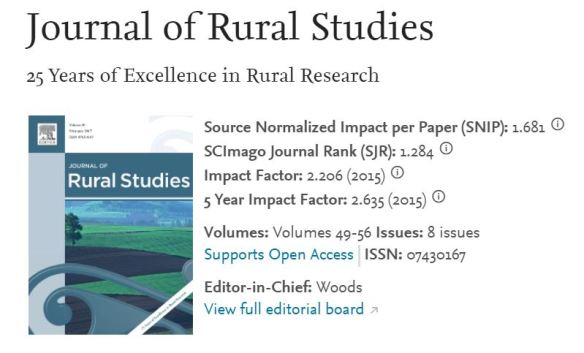
The Journal of Rural Studies just released a new paper on the conceptualisation and realization of buen vivit in a Colombian sustainability network. Martha Chaves as a part of her PhD-work (see earlier blog posts on this) led a team of authors that also included Thomas Macintyre, Gerard Verschoor and myself.

JRScover

This paper explores the emerging concept of buen vivir –  interpreted as integrative and collective wellbeing  – as it is being envisioned and practiced by a network of sustainability initiatives in Colombia. As an example of a transition narrative currently taking place in Latin America and beyond, buen vivir represents a turn towards a more biocentric, relational and collective means of understanding and being in the world. Yet despite the many discourses into buen vivir (many of which tout it as an alternative to neoliberal models of development), there is a general lack of research into its varied forms of application, especially in terms of lived experiences. Drawing on the new ruralities literature, this paper explores the extent to which buen vivir visions and practices represent radical new ruralities e so-called alternatives to development. Data were collected from individuals and ecological communities in predominantly rural areas who are members of the Council of Sustainable Settlements of the Americas (CASA), a
network which promotes many of the principles of buen vivir. Through participatory methods, results demonstrate that CASA visions are based on constructing territorial relations through intercultural knowledge exchange and experimentation into alternative lifestyles. Despite the substantial challenges and contradictions of putting these visions into practice, we argue that lived experiences promote processes of self-reflection on what buen vivir really is or could be. We hold that the inclusive nature of buen vivir offers opportunities for diverse peoples to cohere around shared meanings of the ‘good life,’
while providing the freedom to live variations depending on social and ecological context.

Here’s the DOI: //dx.doi.org/10.1016/j.jrurstud.2017.02.007

For a sneak preview you can also have a look here: Chavesetal2017RadicalRuralities

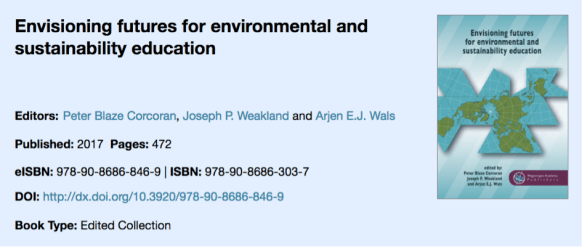
Envisioning Futures for Environmental and Sustainability Education – now available

bookcoverfutures

Last month the fifth book in the Wageningen Academic Publishers Series on Education in the context of Sustainable Development, that started almost 10 years ago with Social learning towards a Sustainable World, appeared. Envisioning Futures for Environmental and Sustainability Education invited educational practitioners and theorists to speculate on – and craft visions for – the future of environmental and sustainability education. The book, I co-edited with Peter Blaze Corcoran and Joe Weakland, explores what educational methods and practices might exist on the horizon, waiting for discovery and implementation. A global array of authors imagines alternative futures for the field and attempts to rethink environmental and sustainability education institutionally, intellectually, and pedagogically. These thought leaders chart how emerging modes of critical speculation might function as a means to remap and redesign the future of environmental and sustainability education today.

Previous volumes within this United Nations Decade of Education for Sustainable Development series have responded to the complexity of environmental education in our contemporary moment with concepts such as social learning, intergenerational learning, and transformative leadership for sustainable futures. ‘Envisioning Futures for Environmental and Sustainability Education’ builds on this earlier work – as well as the work of others. It seeks to foster modes of intellectual engagement with ecological futures in the Anthropocene; to develop resilient, adaptable pedagogies as a hedge against future ecological uncertainties; and to spark discussion concerning how futures thinking can generate theoretical and applied innovations within the field.

The future of environmental education is an urgent question in the larger context of the Anthropocene, the geological epoch in which human activities have become the dominant driver in the ongoing evolution of Earth’s biosphere. Our contemporary ecological moment is characterized by complexity, uncertainty, and ‘accelerating change’ (Wals and Corcoran 2012). While the global impact of anthropogenic climate change is undeniable, the pace of temperature and sea level rise depends on ecological feedback loops that are not fully understood – and which may be increasing the rate of biosphere destabilization (Hansen et al.2015). From a social perspective, the Anthropocene is an age of what humanities scholar Rob Nixon (2011) terms ‘slow violence,’ or ecological violence and environmental injustice that occurs on spatial and temporal scales that are hard to understand or represent, most often against the world’s poorest peoples. In light of such developments, educators need strategies for anticipatory engagement with changing socio-ecological realities – both in the present and future – in order to be effective within their various embodied contexts. This volume explores how environmental educators can engage in imaginative mapping concerning large scale global processes, as well as create useful, situated knowledge for dissemination within their respective socio-ecological contexts.

Keywords: sustainability education, environmental education, education, sustainable development, social learning, transformative leadership, intergenerational learning

The opening chapter is available here: introchapterenvisioningfutures for free as an open access publication or at the publisher’s website where the book can be purchased: http://www.wageningenacademic.com/doi/abs/10.3920/978-90-8686-846-9


Towards Transgressive Learning through Ontological Politics: Answering the “Call of the Mountain” in a Colombian Network of Sustainability

Just before the end of the year a fascinating paper appeared in the journal Sustainability authored by a multi-author team led by Martha Chaves who just completed het PhD in Wageningen last month.

Chaves, M., Macintyre, T, Verschoor, G & Wals, AEJ (2017)Towards Transgressive Learning through Ontological Politics: Answering the “Call of the Mountain” in a Colombian Network of Sustainability. Sustainability 2017, 9, 21; doi:10.3390/su9010021  Link to the paper.

Abstract: In line with the increasing calls for more transformative and transgressive learning in the context of sustainability studies, this article explores how encounters between different ontologies can lead to socio-ecological sustainability. With the dominant one-world universe increasingly being questioned by those who advocate the existence of many worlds—a so-called pluriverse—there lays the possibility of not only imagining other human–nature realities, but also engaging with them in practice. Moving towards an understanding of what happens when a multiplicity of worlds encounter one another, however, entails a sensitivity to the negotiations between often competing ontologies—or ontological politics. Based on an ethnographic methodology and narrative methods, data were collected from two consecutive intercultural gatherings called El Llamado de la Montaña (The Call of the Mountain), which take place for five days every year in different parts of Colombia. By actively participating in these gatherings of multiplicity, which address complex socio-ecological challenges such as food sovereignty and defence of territory, results show how encounters between different ontologies can result in transformative and potentially transgressive learning in terms of disrupting stubborn routines, norms and hegemonic powers which tend to accelerate un-sustainability. Although we argue that a fundamental part of the wicked sustainability puzzle lies in supporting more relational ontologies, we note that such learning environments also lead to conflicts through inflexibility and (ab)use of power which must be addressed if sustained socio-ecological learning is to take place. Keywords: ontological politics; transformative learning; transgressive learning; sustainability; Colombia; narrative methods.

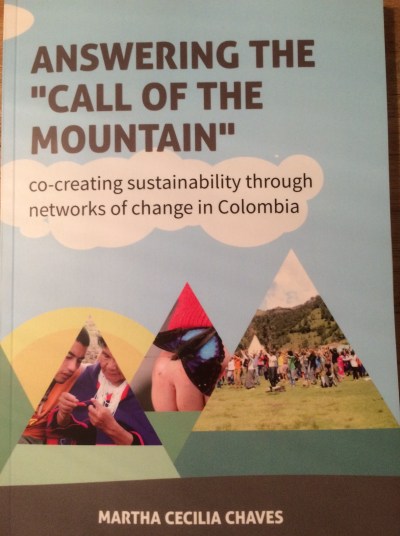
Here’s the cover of Martha Chaves’ PhD-thesis which can be downloaded from the Wageningen University Library system.

marthacover

Answering the “Call of the Mountain”: Co-creating Sustainability through Networks of Change in Colombia

It is one thing to talk about wanting to live in harmonious relations with people, nature and Planet or Mother Earth, but quite another to put this into practice.

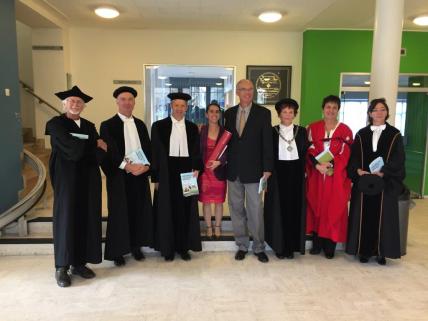
Today, Tuesday November 22nd, the day the FARC and the Colombian government are signing a new peace treaty, one of PhD students, Martha Chaves, successfully defended her dissertation. Martha’s thesis represents a systematic attempt to investigate individuals, communities, networks and gatherings of networks that seek to develop a more relational and caring way of living and of being in the world. In her native Colombia she studied what is it like to attempt to bring the principles of buen vivir such as; reconnecting to ancestral wisdom, questioning values of competition and individuality, and forming new relations to place and territory, into practice. Below you see a happy group of people who all played a role in the ceremony.

marthacover

Her research unveils the tensions between the dominant ontology or (ways of being) of modernity, and other marginalized more relational and cosmological ones such as those of Indigenous Andean communities. Her thesis also re-affirms the importance of plurality in creating the ‘dissonance’ that invites continuous learning that is sometimes at the edges of people’s comfort zones. More so, she shows how intercultural encounters between different ontological positions can lead to more a confronting and overcoming of our unsustainable habits. As such the thesis can help inform socio-ecological niches and movements across the globe that seek to provide a counter narrative to economic globalization, modernity and the neo-liberal agenda.

marthadefense1

After the defence – from left to right: Prof. Danny Wildemeersch, Prof. Rutgerd Boelens, myself, Dr. Martha Chaves, Dr. Gerard Verschoor, Deputy Rector Prof. Francine Govers, Prof. Heila Lotz-Sisitka and Prof. Noelle Aarts.

Furthermore, her results show or at least suggest that encounters between different ontologies can result in transformative and potentially ‘transgressive’ learning in terms of disrupting stubborn routines, norms and hegemonic powers which tend to accelerate unsustainablity. This finding connects well with here future work within the ISSC-funded project on T-learning (www.transgressivelearning.org) that I blogged about in the post below this one.

Afterwards there was a WASS seminar Symposium “Disruptive Networks of Change: Can ‘Transgressive’ learning alter the status quo?” where some critical follow-up questions were asked such as: What types of learning are needed to disrupt ingrained unsustainable behaviour? And how can learning-based change be upscaled? With invited speakers from the fields of environmental education and social learning, and building on the ISSC funded T-learning project which addresses issues of transformative/transgressive learning, we will set out to explore these questions, and possible paths towards more sustainable futures. Martha Chaves first presented here work briefly (presentation-for-defense-22-nov-2016), followed by responding presentations by Prof. Heila Lotz-Sisitka of Rhodes University in South Africa (issc-tkn-seminar-wageningenn) and by Prof. Danny Wildemeersch (paper-presentation-maynooth) of the University of Leuven in Belgium.