Transformative learning

Learning and change within people and society towards a more sustainable world

Transformative learning

Duurzaam voortgezet onderwijs – special in “Van twaalf tot achttien”

Duurzameschoolspecial.png

This post is a rare post in Dutch!

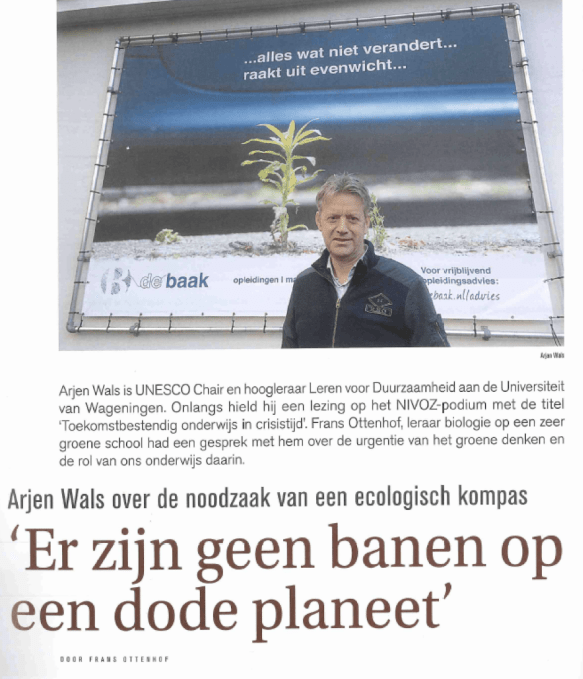
Onlangs verscheen een speciaal nummer uit in “Van twaalf to achttien” – een van de oudste onderwijsbladen voor het voortgezet onderwijs – met daarin fraaie praktijkbeschrijvingen en vergezichten van de wijze waarop onderwijs leerlingen actief, betekenisvol en hoopvol kan betrekken bij lokale en mondiale duurzaamheidsvraagstukken. Het is een fraai vormgegeven nummer dat niet alleen inspireert maar waarin ook concrete adviezen staan. Ik hoop dat het ook digitaal beschikbaar komt binnenkort. Frans Ottenhof interviewde mij over mijn visie op duurzaam onderwijs. Ik heb een scan gemaakt van het resultaat – (zie onderaan deze post!)

DuurzameschoolInterview.png

Hier is het hele interview te lezen! InterviewDuurzaamOnderwijsSpecial_2018

Act Now for Environmental Education – A renewed global pledge for strengthening education and learning for a more sustainable world

GlobalActionThe Global Environmental Education Partnership (website) has created a pledge for reinvigorating Environmental Education world-wide in light of urgent sustainability challenges. In the pledge the global environmental education community is asked to work toward three visionary goals:

Every nation has an environmentally informed, empowered, and active populace and         
   workforce.
The leadership of every government, business, NGO, and educational institution uses
    environmental education to achieve environmentally sustainable outcomes.
Every educational institution incorporates environmental literacy into its mission, goals,
   and activities.
A tall order? Yes. But goals should be tall to keep them in sight as we advance step-by-incremental-step towards attaining them.

pledge letter  can be found here. By signing it you are endorsing these long-term goals and committing to do your part to achieve them. This website highlights 10 suggested areas for action. Hundreds of educators around the world have vetted these actions and helped outline key areas of focus for the field. Over time, GEEP will provide resources and support, including ongoing campaigns and activities, to help inspire action to move our collective agenda forward. By signing the pledge, you can stay connected to this global network.

Groundbreaking Network ENSI hands over the baton with a great collection to accelerate sustainability in schools

ENSIBook

Last week a wonderful collection of contributions recognizing the work of the Environment and School Initiatives network (ENSI) became available as a free online open-access pdf. In 32 chapters people who have played a role in the network reflect on history, trends and prospects of education engaging with sustainable development in a meaningful way. Below a part of the introduction by one of the editors and driver of ENSI Christine Affolter. Here you find the link to the book.ENSI Final Book

ENSI – 30 Yearof Engagement for Educatioand School Development

by Christine Affolter

ENSI has been an independent, self-managed network of experts drawn from the fields of Environmental Education (EE) and Education for Sustainable Development (ESD) and financed by member countries and individual members. During the life time of the organisation ENSI often anticipated upcoming themes and new demands and through analyses, reflection, and participative debates drew up an annual working programme to meet these needs.

Often ENSI was the forerunner of themes and developments and as a result its work had a significant impact on schools in Europe, Asia and Australia through curriculum development, teacher education, and quality indicators. But having the favourable status of a self-managed network also involved a permanent challenge to find appropriate financing and over three decades ENSI had to find a balance between the professional quality of its work and the available funding resources.

Thanks to the commitment of the ENSI experts the network gained a high international reputation. Initially ENSI was founded by OECD/CERI in 1986 and aimed to respond to two related triggers (Elliott, 2018):

The increasing pressure from ‘grassroot-groups’ concerned about the impact of economically driven developments on the environment that were asking for school programmes to support students and teachers in the development of new competences such as critical thinking, dealing with complexity, and reflectivity.

Governments and schools that had to deal with the educational implications of the increasing social complexity resulting from rapid economic and social change. Schools needed to find answers in their local environment realising that centralized curricula couldn’t completely fulfil the needs of the local communities.


The chapter I wrote (see below) can be found here: Wals_Lessons_from_the_ENSI_Network-split-merge (1).

Pendulum.png


Socio-Psychological Perspectives on the Potential for Serious Games to Promote Transcendental Values in IWRM Decision-Making – new review paper

Water2018

water-10-01097-g001

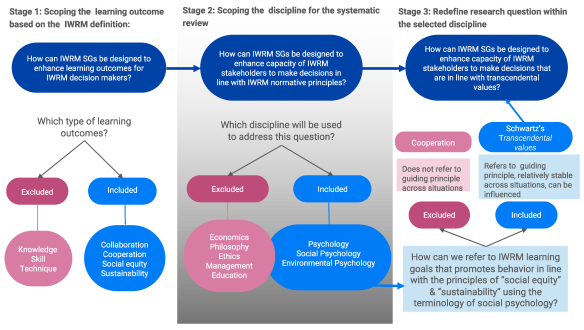
I was fortunate to be part of a comprehensive review paper identifying design principles for serious games that seek to move participants beyond improving their understanding of complex water management issues to also include discussions on values and ethics which are often forgotten or, worse, ignored in such games. Much applies also to the use and design of serious gaming in other sustainability related challenges. Special thanks to Diana Marini and Wietske Medema for initiating this paper and doing the bulk of the hard work to realise it. The article is part of a Special Issue in Water called Understanding Game-based Approaches for Improving Sustainable Water Governance: The Potential of Serious Games to Solve Water Problems which I am co-editing with some of the authors of this paper (led by Wietske Medema). Here is a link to that emerging SI: Gaming and Water Governance

Keywords: serious games (SGs); water management; value change; transcendental values; social equity; sustainability; Schwartz’s Value Survey (SVS); Integrated Water Resource Management (IWRM); psychosocial perspectives; decision-making processes

Abstract: Modern day challenges of water resource management involve difficult decision-making in the face of increasing complexity and uncertainty. However, even if all decision-makers possessed perfect knowledge, water management decisions ultimately involve competing values, which will only get more prominent with increasing scarcity and competition over resources. Therefore, an important normative goal for water management is long-term cooperation between stakeholders.

According to the principles of integrated water resource management (IWRM), this necessitates that managerial decisions support social equity and intergenerational equity (social equity that spans generations). The purpose of this discussion is to formulate preliminary recommendations for the design of serious games (SGs), a potential learning tool that may give rise to shared values and engage stakeholders with conflicting interests to cooperate towards a common goal. Specifically, this discussion explores whether SGs could promote values that transcend self-interest (transcendental values), based on the contributions of social psychology.

The discussion is organized in the following way. First, an introduction is provided as to why understanding values from psychological perspectives is both important for water management and a potential avenue for learning in SGs. Second, a review of the description of values and mechanisms of value change from the field of social psychology is presented.

This review highlights key psychological constraints to learning or applying values. Based on this review, recommendations are made for SGs designers to consider when developing games for water management, in order to promote transcendental values.

Overall, the main conclusions from exploring the potential of value change for IWRM through SGs design are as follows: 1-SGs design needs to consider how all values change systematically; 2-SGs design should incorporate the many value conflicts that are faced in real life water management, 3-SGs could potentially promote learning by having players reflect on the reasoning behind value priorities across water management situations, and 4-value change ought to be tested in an iterative SGs design process using the Schwartz’s Value Survey (SVS) (or something akin to it). Keywords: serious games (SGs); water management; value change; transcendental values; social equity; sustainability; Schwartz’s Value Survey (SVS); Integrated Water Resource Management (IWRM); psychosocial perspectives; decision-making processes

You can find a copy of the paper here for your own use: Personal PDF but you can of course also get the paper at MDPI’s website for the journal WATER here: Link to the paper on MDPI’s Water Website

Open on-line course – Civic Ecology: Reclaiming Broken Places – Registration now open

CivicEcology2018

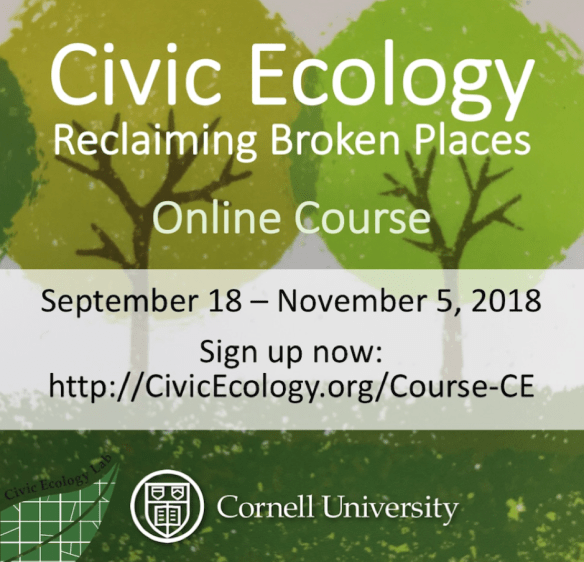
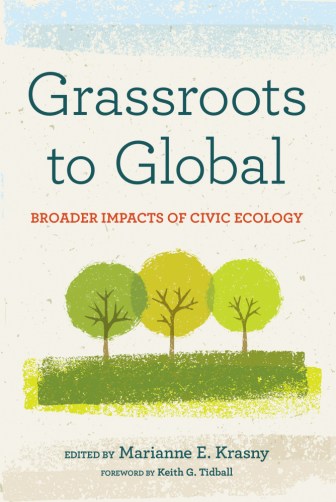
In September the Cornell Open On-line Course “Civic Ecology: Reclaiming Broken Places” will run again. Participants of this online course explore the people, places, and practices that restore nature and revitalize neighborhoods. Colleague and environmental educator Marianne Krasny and her team at Cornell University have been running this course successfully for a few years now and the topic is more timely then ever. The content connects with a some excellent publications which Krasny and her team have put together recently and published with Cornell University Press. Including – just out – Grassroots to Global: the broader impact of civic ecology More info and Urban Environmental Education Review (edited by Krasny and Russ). More info!

Course Dates: Sept 18 – Nov 5, 2018
Register: Registration Form

View Course Trailer

Just out: Serious games as a catalyst for boundary crossing, collaboration and knowledge co-creation in a watershed governance context

GamingBoundaryCrossing

Thanks to the wonderful work mainly of Steven Jean and Wietske Medema I am glad to be part of the above paper that appeared in the latest issue of the Journal of Environmental Management (Jean et al., 2018, JEMA, 223, 1010-1022). You can have a look here: Serious Gaming, Boundary Crossing and Water Governance

ABSTRACT

Novel methods for enhancing collaboration and interactions are required to ensure that stakeholders and governments are able to develop a shared vision that supports sustainable watershed governance. Particular attention must be placed on integrating stakeholders who would otherwise have limited decision-making power. By crossing professional, ideological and jurisdictional boundaries, stakeholders’ perspectives are more likely to change than when staying within those boundaries. This process, known as boundary crossing, requires boundary objects; either artifacts, people, or institutions that play a bridging role between different boundary spaces. For this study, serious games powered by scientific models are identified as potentially effective boundary objects. A serious game simulation called Aqua Republica was used to organize game simulation events allowing stakeholders to connect in an in-person, informal and novel setting. This exploratory research aims to study the role and impact of serious games as boundary objects to enhancing collaboration and knowledge co-creation. The following research questions are addressed: (1) Do interactions increase over the course of a game simulation event? (2) Does the quality of interactions change over the course of a game simulation event? (3) Are the quantity and quality of interactions affected by pre-existing relationships? And if so, how? (4) How does the relationship between participants change over the course of a game simulation event? As part of this study, four game simulation events were organized that included students, professionals and diverse stakeholder groups working in watershed management contexts across Eastern Canada with 40 participants in total. Participants were divided into teams of 3–5 members and were surveyed and their interactions recorded. An interaction and social network analysis of the audiovisual recordings of each game simulation event indicates that interactions between participants increase in both quantity and quality as the game progresses. The analysis shows that serious game simulations provide an intervention platform not only to facilitate cross-boundary interactions, but also to strengthen relationships between diverse stakeholders, as expressed by an increase in mutual trust and empathy, as well as an improved understanding among the participants of the watershed system and the complex issues at stake.

“Sustainability” in higher education: from doublethink and newspeak to critical thinking and meaningful learning

Orwel

In times of systemic global dysfunction, post-truth, alternative facts, cultivated doubt and the erosion of meaning, I found it useful to turn back, once again, to George Orwell’s infamous “1984”.  Well over 10 years ago, in 2004, I co-authored a paper on the danger of ‘doublespeak’ and ‘Newspeak’ in relation to the integration of sustainability in higher education. Back then this was an emerging trend, nowadays, it sometimes signifies a transition in education but more often little more than rethoric and green gloss. For me this is a good reason to re-introduce this paper here with Orwell’s cautionary tale but also with some ideas about how to move forward responsibly. Below an excerpt from the paper which you can find here in its totality:  Jickling and Wals Orwell’s Cautionary Tale

Wals, A.E.J. & Jickling, B. (2002). “Sustainability” in Higher Education from doublethink and newspeak to critical thinking and meaningful learning. Higher Education Policy, vol. 15, 121-131.  SustinHEOrwellsCautionaryTale

“Sustainability talk can, when used by advocates with radically different ideas about what should be sustained, mask central issues under the false pretense of a shared understanding, set of values and common vision of the future.

However, critical thought depends on transcendent elements in ordinary language, the words and ideas that reveal assumptions and worldviews, and the tools to mediate
differences between contesting value systems. And worse still, sustainability talk can
lead us in the direction of Orwell’s (1989) famously satirical notion of “doublethink”
whereby ordinary citizens can increasingly hold in their minds contradictory meanings
for the same term and accept them both (Orwell, 1989, p. 223).

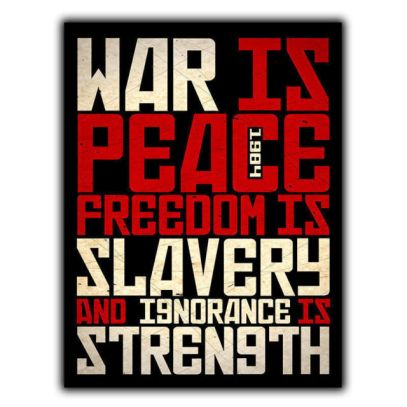
The power of universal discourse in reducing meaning to a minimum is such that, as in “1984”, antagonistic concepts can be conjoined in a single phrase (“war is peace”, “peace is war”) or concept (i.e. “sustainable growth”) (Jickling, 2001). Big Brother’s “Newspeak” was designated not to extend but to diminish the range of thought, and this purpose was
indirectly assisted by cutting down the choice of words to a minimum (Orwell, 1989,
p. 313).

In Newspeak concepts capable of opposing, contradicting or transcending
the status quo were liquidated. As a result of this devaluation of language the people
in “1984” found themselves in a state of linguistic dysfunction which was exactly
what Big Brother wanted (Jickling, 2001).

Seen this way sustainability tends to blur the very distinctions required to evaluate an issue thoughtfully. When comparing the sustaining of ecological processes with the sustaining of consumerism we immediately see inconsistencies and incompatibilities of values, yet many people, conditioned to think that sustainability is inherently good, will promote both at the same time.”

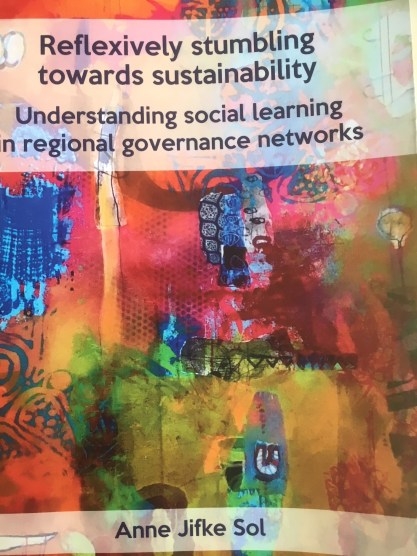
Reflexively Stumbling towards Sustainability – understanding social learning in regional governance networks

JifkeProefschrift

This afternoon of June 8th, one of my PhD students, co-supervised with Dr. PJ Beers of DRIFT in Rotterdam and Prof Peter Feindt of the Humbolt University in Berlin, successfully here beautiful dissertation in the Aula of Wageningen University. You can download the dissertation and the 4 published papers that are a part of the work via the Wageningen University Library shortly. You can also watch the defense still via WUR-TV Getting to the defense and the thesis

Using a social learning configuration to increase Vietnamese smallholder farmers’ adaptive capacity to respond to climate change

LocEnvPaper

Link to the T&F site for the article

My former PhD-student Le Thi Hong Phuong now has a fourth paper from her dissertation which she only defended a few months ago, accepted in Local Environment a T&F journal on justice and sustainability (one of the oldest journals in this area!). Here is the abstract:
ABSTRACT

Social learning is crucial for local smallholder farmers in developing countries to improve their adaptive capacity and to adapt to the current and projected impacts of climate change. While it is widely acknowledged that social learning is a necessary condition for adaptation, few studies have systematically investigated under which conditions particular forms of social learning are most successful in improving adaptive capacity of the most vulnerable groups. This study aims to design, implement and evaluate a social learning configuration in a coastal community in Vietnam. We make use of various methods during four workshop-based interventions with local smallholder farmers: interviews with key farmers and commune leaders, farmer-to-farmer learning, participatory observations and focus group discussions. The methods for evaluation of social learning configuration include in-depth interviews, focus group discussions and structured survey interviews. Our findings show that the social learning configuration used in this study leads to an increased problem ownership, an enhanced knowledge-base with regard to climate change impacts and production adaptation options, improved ability to see connections and interdependencies and finally, strengthened relationships and social cohesion. The results suggest that increased social learning in the community leads to increase in adaptive capacity of smallholder farmers and improves both their economic and environmental sustainability. We discuss the key lessons for designing learning configurations that can successfully enhance adaptive capacity and smallholder farmers’ agency and responsiveness to the challenges posed by climate change impacts.


Grassroots to Global Broader Impacts of Civic Ecology

GrassrootsToGlobal

Together with my former PhD-student, friend and colleague in the T-Learning project (www.transgressivelearning.org)  Martha Chaves I co-authored a chapter on the Nature of Transformative Learning for Social-Ecological Sustainability for this new book edited by Cornell University colleague Marianne Krasny. The vignette from the publisher’s webpage featuring the book states:

Addressing participatory, transdisciplinary approaches to local stewardship of the environment, Grassroots to Global features scholars and stewards exploring the broad impacts of civic engagement with the environment.

Chapters focus on questions that include: How might faith-based institutions in Chicago expand the work of church-community gardens? How do volunteer “nature cleaners” in Tehran attempt to change Iranian social norms? How does an international community in Baltimore engage local people in nature restoration while fostering social equity? How does a child in an impoverished coal mining region become a local and national leader in abandoned mine restoration? And can a loose coalition that transforms blighted areas in Indian cities into pocket parks become a social movement? From the findings of the authors’ diverse case studies, editor Marianne Krasny provides a way to help readers understand the greater implications of civic ecology practices through the lens of multiple disciplines.

Contributors:
Aniruddha Abhyankar, Martha Chaves, Louise Chawla, Dennis Chestnut, Nancy Chikaraishi, Zahra Golshani, Lance Gunderson, Keith E. Hedges, Robert E. Hughes, Rebecca Jordan, Karim-Aly Kassam, Laurel Kearns, Marianne E. Krasny, Veronica Kyle, David Maddox, Mila Kellen Marshall, Elizabeth Whiting Pierce, Rosalba Lopez Ramirez, Michael Sarbanes, Philip Silva, Traci Sooter, Erika S. Svendsen, Keith G. Tidball, Arjen E. J. Wals, Rebecca Salminen Witt, Jill Wrigley

Here’s a link to Grassroots to Local

Research as mining, as learning and as activism…

Recently NAAEE started a very nice resource for researchers and practitioners (somewhat of a false binary in light of two of the research strands presented here) called EELearn. Tamarack Media produces some of the video-resources for the online courses that are freely available. One of them is about research. I was asked to reflect briefly on different modes of research that are around. I referred to three that Justin Dillon and I wrote about in a paper that you can find here (DillonWals2006) on the dangers of blurring methods, methodologies and ideologies. Here’s the 2,5 min video where I introduce the three strands of research. I should state there are many more from arts-based to post-qualitative ones but the distinguishing features still apply.

Here’s the link toNAAEE’s EELearn site: https://naaee.org/eepro/learning/eelearn EELearn


As sea levels rise… research of Wageningen PhD Mahmuda Mutahara featured in Science Magazine

TidalRiver1

It is not often that the research of one of our PhD students is featured in Science Magazine but in the last issue it was! Mahmuda Mutahara who recently finished her dissertation titled “Turning the Tide? The role of Participation and Learning in Strengthening Tidal River Management in the Bangladesh Delta” was interviewed by Warren Cornwall who wrote an excellent piece about the challenges of tidal river management in times unrest, poor governance and, indeed, climate change.

“To understand why some citizens turn against TRM projects, Mahmuda Mutahara, a Bangladeshi who recently earned her Ph.D., has spent much of the past 5 years traversing the region’s pothole-riddled roads, often on the back of a motorcycle. Questioning residents, government officials, and others, she found government agencies disconnected from locals, spawning distrust and anger that have derailed controlled flooding attempts, sometimes spectacularly.”

It was a honour to be Mahmuda’s promotor/chair along with co-promotors Jeroen Warner (Wageningen UR), Flip Wester (ICIMOD, Nepal) and Shah Alam Khan from the Bangladesh University of Engineering and Technology, Dhaka

You can find the article with wonderful illustrations and photos here: article featuring Mahmuda’s Tidal River Management study

Towards transformative social learning on the path to 1.5 degrees – new paper on learning in times of runaway climate change

TLearningCoSuS

This paper provides insights into learning orientations and approaches that encourage change and transformation on the path to achieving the 1.5 degree C target. This literature review of the climate change and education/learning interface positions relevant literature in a heuristic tool, and reveals different learning approaches to addressing climate change. We highlight that although traditional lines of departure for achieving climate targets are usually technocratic in nature, especially if a zero emissions pathway is aimed for, there is an increasing realisation that climate issues are complex, deeply intertwined with unsustainable development and cultural change, and require collective engagement. Through considering the 1.5 degree C target as a metaphor for the fundamental changes needed in society, we argue that a wide range of learning orientations, including more inclusive and transformative social learning approaches, are needed to address the colossal challenges facing society. The review paper is published in: Current Opinion in Environmental Sustainability 2017, 31:80–87 and is part of a Special Issue on Sustainability governance and transformation, edited by Bronwyn Hayward and Linda Sygna

Find the pdf here or download a personal copy here: TLearningClimateChangeCoSuSpaper2018

Perhaps one of the most interesting elements of the paper is the distinction made between four types of learning:

FourTypesofLearning

CoSuSFigure

Find the pdf here or download a personal copy here: TLearningClimateChangeCoSuSpaper2018

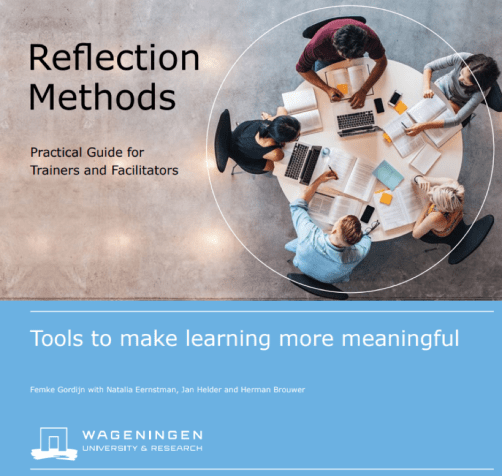
Reflection methods: tools to make learning more meaningful – new open access guide

CoverReflectionLearning

This guide for trainers, educators and facilitators, compiled/written by Femke Gordijn, Natalia Eernstman, Jan Helder, Herman Brouwer and published by Wageningen UR’s Centre for Development Innovation (CDI), summarises methods that can be used to facilitate the process of reflection on the knowledge and experiences people acquire during a capacity development trajectory or training event. The authors believe that by explicitly integrating reflection in the learning process the learning will become clearer and better articulated and will contribute more strongly to meaningful change. They advise facilitators to deliberately include reflective learning sessions in their process design and implementation. This handbook can inspire you to do so and provides many methods which help to facilitate this. I was asked to write a Preface in which where I suggest that dealing with complex and even ’wicked’ sustainability challenges, above all, calls for learning individuals, learning organisations, learning networks and even a learning society.

“But not just any kind of learning, the kind of learning that is able to make explicit and question our assumptions, values and ways of seeing the world, learning that invites us to continuously reflect on the tensions and contradictions between them, learning that reveals the powers and inequities that tend to keep things the way they are or force us in directions we may not want to go. In other words, learning that questions the taken for granted, the normalised, the hegemonic and the routine. But also learning that enables us to make change and to transform others, and ourselves while learning from trying to do so.” (From the Preface, p6)

The book which can be downloaded here:

Link to the Open Access PDF is accompanied by 7 online videos of reflection methods.

You will find them here: Videos and other resources

CDI

Help shape a global action plan for environmental education by providing feedback on the Call for Action from the GEEP

TheGEEP

I am fortunate to be one of the advisors to the Global Environmental Education Partnership (GEEP). The GEEP – which has been initiated a few years ago by the Environmental Protection Agency of Taiwan and the USA and coordinated by the NAAEE- is focused on building capacity for environmental education and sustainability around the world and using the power of education to help address global environmental and social problems. Its advisors are made up of researchers, policymakers, education practitioners, and others who represent government and non-governmental sectors from countries and regions around the world.

As environmental educators, we know that environmental education informs, inspires, and enlightens. It builds human capacity, provokes questions, enhances skills and shapes values and attitudes. It galvanizes individuals, families and communities to make informed decisions about the environment that lead to a sustainable society. Even more, it helps people connect deeply with each other, their communities, and the natural world.

Given the unprecedented challenges we face as a global society—from climate change and biodiversity loss to decreasing access to nature and a growing gap between the rich and poor—there has never been a more important time to scale up our environmental education efforts. Global leaders must make better use of education and capacity-building as strategies to improve the environment, along with tools of governance, regulation, economic and community incentives, and technology.

This Call for Action is asking the international environmental education community to take stock of where we are as a field and think ahead to the future. It includes ten draft actions, crafted with input from GEEP leaders from around the world, and is designed to get input from educators working in this field about our key priorities for the next decade.

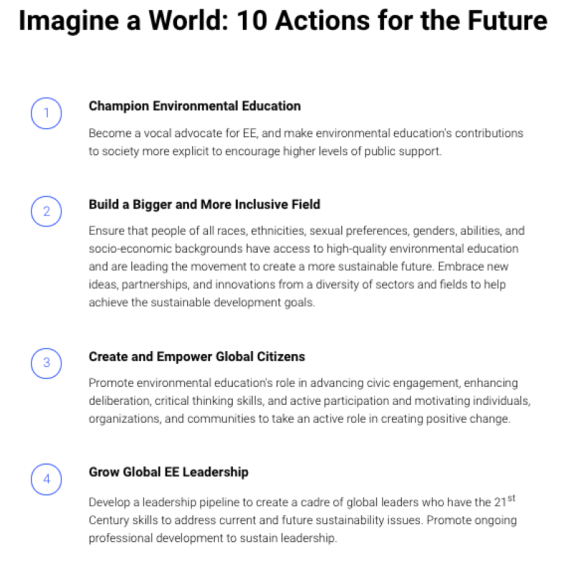
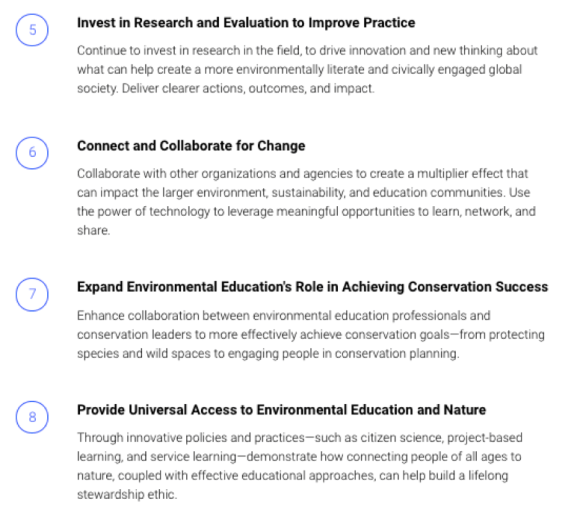
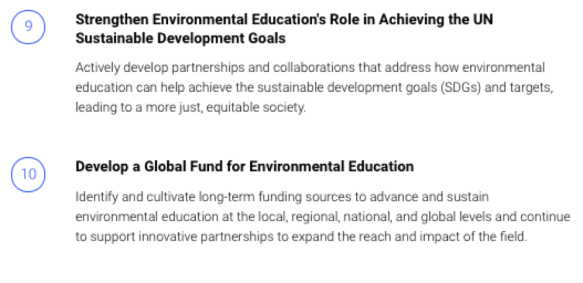
You can help shape the future agenda by letting us know what you think. Which actions are most important? What’s missing? Visit ActNowForEE.org and cast your vote for your top three priorities and let us know what you think matters most. Your input will help create a global action plan for the next 10 years. Below you find the 10 proposed actions and here is a link to the brief survey where you can provide your input: express your ideas here!

Call_1

Call_2

Call_3