New Open Access Paper: River Co-Learning Arenas: principles and practices for transdisciplinary knowledge co-creation and multi-scalar (inter)action

This collaborative multi-authored paper develops the methodological concept of river co-learning arenas (RCAs) and explores their potential to strengthen innovative grassroots river initiatives, enliven river commons, regenerate river ecologies, and foster greater socio-ecological justice. The integrity of river systems has been threatened in profound ways over the last century. Pollution, damming, canalisation, and water grabbing are some examples of pressures threatening the entwined lifeworlds of human and non-human communities that depend on riverine systems. Finding ways to reverse the trends of environmental degradation demands complex spatial–temporal, political, and institutional articulations across different levels of governance (from local to global) and among a plurality of actors who operate from diverse spheres of knowledge and systems of practice, and who have distinct capacities to affect decision-making. In this context, grassroots river initiatives worldwide use new multi-actor and multi-level dialogue arenas to develop proposals for river regeneration and promote social-ecological justice in opposition to dominant technocratic-hydraulic development strategies. This paper conceptualises these spaces of dialogue and action as RCAs and critically reflects on ways of organising and supporting RCAs while facilitating their cross-fertilisation in transdisciplinary practice. By integrating studies, debates, and theories from diverse disciplines, we generate multi-faceted insights and present cornerstones for the engagement with and/or enaction of RCAs. This encompasses five main themes central to RCAs: (1) River knowledge encounters and truth regimes, (2) transgressive co-learning, (3) confrontation and collaboration dynamics, (4) ongoing reflexivity, (5) transcultural knowledge assemblages and translocal bridging of rooted knowledge.

Citation:

De Souza, D. T., Hommes, L., Wals, A., Hoogesteger, J., Boelens, R., Duarte-Abadía, B., … Joy, K. J. (2024). River co-learning arenas: principles and practices for transdisciplinary knowledge co-creation and multi-scalar (inter)action. Local Environment, 1–23. https://doi.org/10.1080/13549839.2024.2428215

The full paper can be downloaded here!
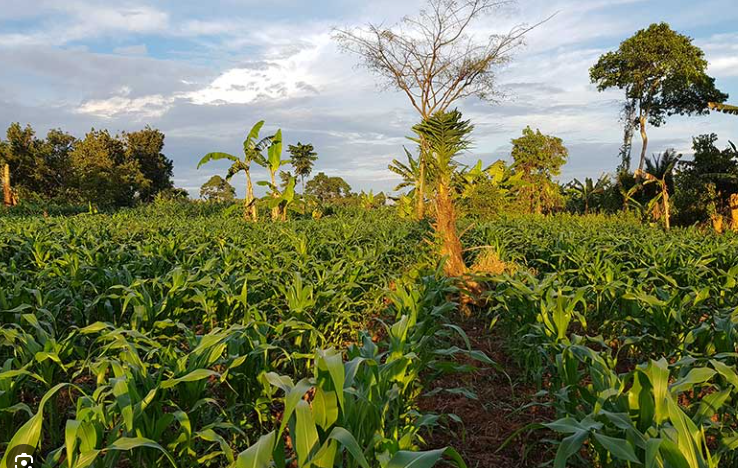
Competences for socio-ecological stewardship: a qualitative assessment of the transformative potential of farmers’ learning processes in Eastern Uganda

Theoretically, this study expands Roczen’s environmental competence model by including social, ethical, and conservation and restoration action competences. This study is one of the first to identify socio-ecological stewardship competences and the learning processes that can foster these competences.

Full citation:

Misanya, D., Tassone, V. C., Kessler, A., Wals, A. E. J., & Kibwika, P. (2024). Competences for socio-ecological stewardship: a qualitative assessment of the transformative potential of farmers’ learning processes in Eastern Uganda. The Journal of Agricultural Education and Extension, 1–21. https://doi.org/10.1080/1389224X.2024.2403597

Analysing farmers’ learning for socio-ecological stewardship in Eastern Uganda: A transformative learning ecology perspective

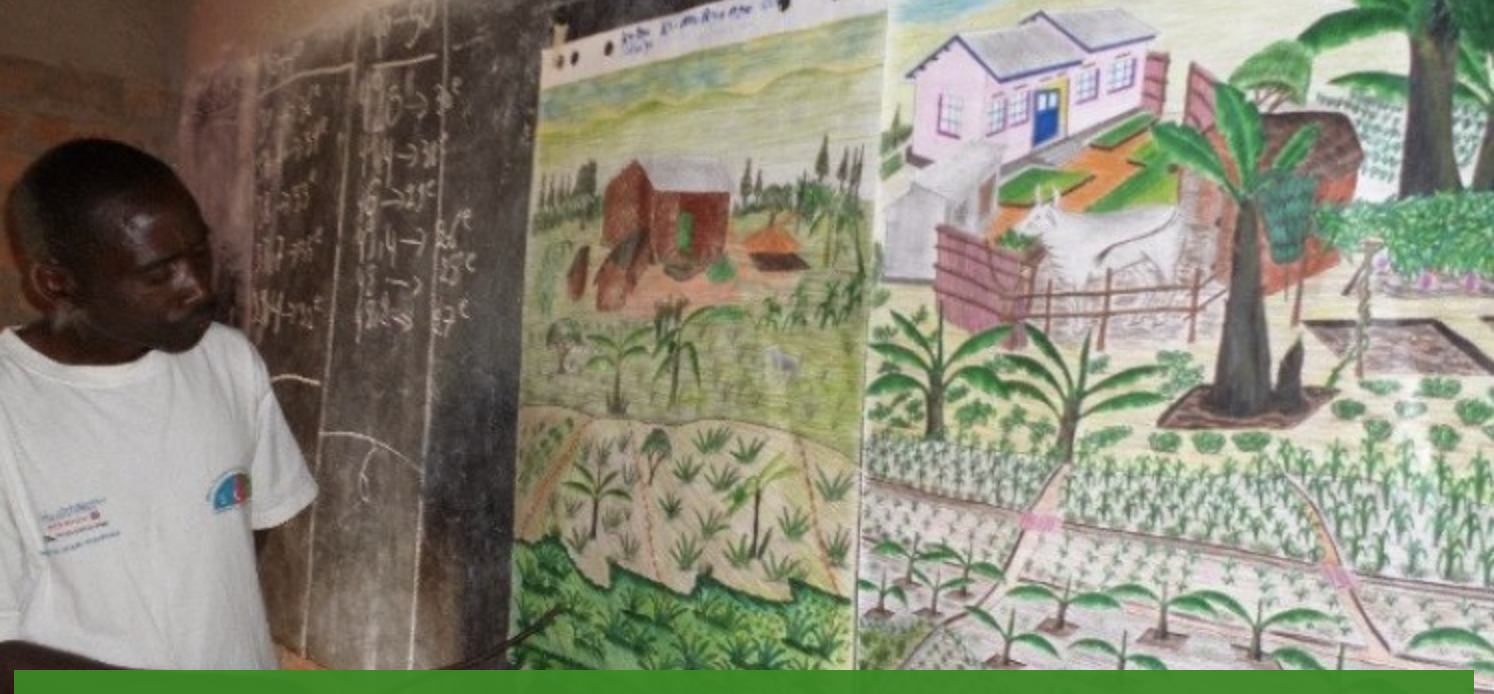
This paper stems from the research of PhD Candidate Doreen Misanya. It analyses how smallholder farmers are learning for socio-ecological stewardship in a specific case study context in Eastern Uganda. The case under analysis is a watershed management project that uses an integrated farm planning (PIP) approach to strengthen farmers’ stewardship capacities within the Manafwa watershed through interactive and dialogic ways of engaging and teaching farmers. Utilizing a transformative learning ecology (TLE) perspective, this study investigated features of the PIP approach that support transformative learning for socio-ecological stewardship in a rural context. Data was collected by interviewing eighteen farmers from different villages and PIP generations and all three PIP trainers of the project, and by observing training sessions as well as sensitisation workshops. As a main result, the study yielded new insights that can help enhance PIP-like learning configurations consisting of interconnected learning tenets, dimensions and processes. This enhanced learning configurating comprises an organic learning system that facilitates farmers to change their mindsets and redefine their values, perspectives, routines, and practices towards those that encourage socio-ecological stewardship. The TLE fostered by the PIP approach represents a useful heuristic that can guide and inspire both scholars and educators engaged in processes of cultivating socio-ecological stewardship in similar contexts.

The paper can be found here https://www.tandfonline.com/doi/full/10.1080/27685241.2023.2191795

Full citation:

Misanya, D., Tassone, V. C., Kessler, A., Kibwika, P., & Wals, A. E. J. (2023). Analysing farmers’ learning for socio-ecological stewardship in Eastern Uganda: A transformative learning ecology perspective. NJAS: Impact in Agricultural and Life Sciences95(1). https://doi.org/10.1080/27685241.2023.2191795

The research took place within the Manafwa Watershed Restoration (MWARES) Project in Bududa District, Eastern Uganda. A Baseline Report of the project appeared in 2020. It outlines the starting position of the PIP farmers in the region. This report can be found here.

Summer School River Lives and Living Rivers: Towards a transdisciplinary conceptualization

I feel very privileged to be part of one of the two major International River Research projects led by Wageningen UR colleague Prof. Rutgerd Boelens: Riverhood and RiverCommons. Riverhood and River Commons are both 5-year research projects that focus on enlivening rivers, river co-governance initiatives, and new water justice movements.

Riverhood is funded by the European Research Council (ERC) (Grant Agreement No 101002921) and aims to build groundbreaking transdisciplinary concepts and methodological tools to analyze and support new water justice movements’ institutions, strategies and practices for equitable and sustainable water governance. It does so through comparing initiatives in Latin America (Ecuador and Colombia) and Europe (Netherlands and Spain). The focus will be on movements promoting novel concepts and practices such as Rights of Nature, new water cultures or nature-inclusive hydraulics, to name just a few.

RiverCommons is funded by Wageningen University’s Interdisciplinary Research and Education Fund (INREF) and unites chair groups from the social and natural sciences, as well as partners worldwide. Its objective is to develop transdisciplinary concepts and methods for research, education, and multi-stakeholder interactions to understand and support river co-governance initiatives and sustainable socio-ecological river systems in Asia, Africa, Latin America and Europe.

While each of the projects has its specific objectives, activities, regions, and partners, there is immense potential for synergies and cross-pollination. Riverhood and River Commons will therefore be integrated in multiple ways, to together build a diverse and wide network of river scholars, activists, and institutions that commonly aim to understand and strengthen river co-governance around the world.

Both projects are united by a common framework that illuminates the different facets and complexities of river systems. The framework encompasses four dimensions: River-as-Ecosociety, River-as-Territory, River-as-Subject, and River-as-Movement. You can find more information about it in Concepts.

Another important component of both projects is the development of Environmental Justice Labs (Riverhood) and River Co-governance Labs (River Commons) to be organized in the case study sites to co-create knowledge and mobilize and exchange ideas for change.

One exciting immediate prospect and possibility for PhD’s from around the world is our Summer School “River Lives and Living Rivers: Towards a transdisciplinary conceptualization”

Here is the short introduction to the course:

World’s rivers are fundamental to social and natural well-being but profoundly affected by mega-damming and pollution. In response to top-down and technocratic approaches, in many places riverine communities practice forms of ‘river co-governance’, integrating ecological, cultural, political, economic and technological dimensions. In addition, new water justice movements (NWJMs) have emerged worldwide to creatively transform local ideas for ‘enlivening rivers’ into global action and vice versa. The Summer School aims to provide PhD students who conduct research on these ‘river commons’ and NWJMs with transdisciplinary concepts and approaches for studying their emerging ideas, concepts, proposals and strategies. The training thereby focuses on conceptualizing river systems in all senses, and capacity-building for (understanding and supporting) river knowledge co-creation and democratisation from the bottom up.

Towards a Framework for Designing and Assessing Game-Based Approaches for Sustainable Water Governance – New paper (open-access)

WaterCombined

Together with Alice Aubert and Wietske Medema I co-authored a review paper on the designng and assessing of game-based approaches for sustainable water governance. In the paper we try to map these approaches using a heuristic that is derived from work Bob Jickling and I did well over 10 years ago on the positioning of sustainability-oriented education and learning. The resulting paper you can find below. Here is the abstratc. Disclosure: The paper appears in the journal Water which is part of MDPI whose publishing model I critiqued in an earlier blog post.

Abstract 

Most of the literature on serious games and gamification calls for a shift from evaluating practices to using theories to assess them. While the former is necessary to justify using game-based approaches, the latter enables understanding “why” game-based approaches are beneficial (or not). Based on earlier review papers and the papers in this special issue of Water entitled “Understanding game-based approaches for improving sustainable water governance: the potential of serious games to solve water problems”, we show that game-based approaches in a water governance context are relatively diverse. In particular, the expected aims, targeted audience, and spatial and temporal scales are factors that differentiate game-based approaches. These factors also strongly influence the design of game-based approaches and the research developed to assess them. We developed a framework to guide and reflect on the design and assessment of game-based approaches, and we suggest opportunities for future research. In particular, we highlight the lack of game-based approaches that can support “society-driven” sustainable water governance.
Here is the link to the full paper which is freely downloadable.

Just out: Serious games as a catalyst for boundary crossing, collaboration and knowledge co-creation in a watershed governance context

GamingBoundaryCrossing

Thanks to the wonderful work mainly of Steven Jean and Wietske Medema I am glad to be part of the above paper that appeared in the latest issue of the Journal of Environmental Management (Jean et al., 2018, JEMA, 223, 1010-1022). You can have a look here: Serious Gaming, Boundary Crossing and Water Governance

ABSTRACT

Novel methods for enhancing collaboration and interactions are required to ensure that stakeholders and governments are able to develop a shared vision that supports sustainable watershed governance. Particular attention must be placed on integrating stakeholders who would otherwise have limited decision-making power. By crossing professional, ideological and jurisdictional boundaries, stakeholders’ perspectives are more likely to change than when staying within those boundaries. This process, known as boundary crossing, requires boundary objects; either artifacts, people, or institutions that play a bridging role between different boundary spaces. For this study, serious games powered by scientific models are identified as potentially effective boundary objects. A serious game simulation called Aqua Republica was used to organize game simulation events allowing stakeholders to connect in an in-person, informal and novel setting. This exploratory research aims to study the role and impact of serious games as boundary objects to enhancing collaboration and knowledge co-creation. The following research questions are addressed: (1) Do interactions increase over the course of a game simulation event? (2) Does the quality of interactions change over the course of a game simulation event? (3) Are the quantity and quality of interactions affected by pre-existing relationships? And if so, how? (4) How does the relationship between participants change over the course of a game simulation event? As part of this study, four game simulation events were organized that included students, professionals and diverse stakeholder groups working in watershed management contexts across Eastern Canada with 40 participants in total. Participants were divided into teams of 3–5 members and were surveyed and their interactions recorded. An interaction and social network analysis of the audiovisual recordings of each game simulation event indicates that interactions between participants increase in both quantity and quality as the game progresses. The analysis shows that serious game simulations provide an intervention platform not only to facilitate cross-boundary interactions, but also to strengthen relationships between diverse stakeholders, as expressed by an increase in mutual trust and empathy, as well as an improved understanding among the participants of the watershed system and the complex issues at stake.