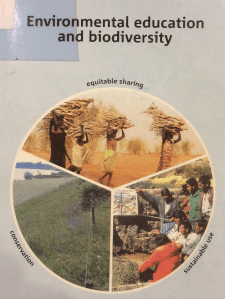
Loss of biodiversity is back on the agenda having faded somewhat during the last 15 years or so with the rise of new urgent issues such as runaway climate change, loss of food security, the rise of micro-toxins in waters and soils, etc. With the renewed attention for biodiversity it might be useful to go back to the nineties when the topic was high on the international policy agenda and some effort was spent on making biodiversity meaningful for ordinary citizens. Two publications that I was involved in back then seem very relevant today.
The first one appeared in the Canadian Journal of Environmental Education (I believe the only open-access EE journal): Dreyfus, A., Wals, A.E.J. and D. van Weelie (1999). The socio-scientific dispute character of environmental education. Canadian Journal of Environmental Education, 4, 155-176. Download here: Canadian Journal of EE[
The second one is a book commissioned by the Dutch government titled “Environmental Education and Biodiversity” which I recently updated slightly to make it suitable for open-access publication. Full reference: Wals, A.E.J., (Ed.) (1999). Environmental Education and Biodiversity. National Reference Centre for Nature Management, Wageningen, 107 p.Download here: Book Environmental Education & Biodiversity
The book is more elaborate than the article and contains concrete stepping stones for making biodiversity meaningful. Here’s a brief abstract of the book which also applies – in part – to the article.
Despite all the confusion about biodiversity, one thing is clear: there is no one single perspective or definition of biodiversity that accurately describes it in all situations or contexts. Biodiversity can have different meanings depending on the user and the context in which it is used. Even within the scientific arena a great number of biodiversity meanings and interpretations can be distinguished. It is not uncommon to find that scientific, political and symbolic meanings are used interchangeably by the same person. Both the knowledge base and the value base of biodiversity are variable and to a degree unstable and questionable.
Although these characteristics of biodiversity can render the concept useless or reduce it to a rhetorical instrument, they can also add to its strength when handled with care. Certainly from an environmental education perspective, but also from a policy-making perspective, these characteristics offer some worthwhile advantages: 1) Biodiversity brings together different groups in society that are searching for a common language to discuss nature conservation issues in relation to sustainability issues. 2) This dialogue allows the socio-scientific dispute character of “science-in-the-making” to surface. Participation in such a dispute is an excellent opportunity to learn about a highly relevant, controversial, emotionally charged and debatable topic at the crossroads of science, technology and society. 3) Making such a concept meaningful to the lives of citizens requires a procedure that could be utilised when developing educational programmes that focus on similar topics (i.e. education for sustainability).
This book provides a justification and rationale for developing biodiversity as a leading concept for environmental education for human development. Furthermore it proposes a stepping stone procedure that recognises the socio-scientific dispute character of biodiversity and provides a tool for turning biodiversity into a meaningful and existentially relevant issue. The procedure includes the following steps: analysing meanings of biodiversity, determining one or more perspectives based on the general learning goals of environmental education, setting specific learning objectives, selecting (sub)themes for learning, contextualising biodiversity and establishing the value of biodiversity. The procedure is intended to help curriculum developers, teachers, educational support staff and environmental educators give specific meaning to biodiversity and to help learners critically analyse the way biodiversity is used in science, technology and society. The procedure is an intermediate product that offers direction in developing and implementing specific learning activities and materials for various groups of learners.
Abstract of the article in French
Résumé
L’éducation relative à l’environnement dans un monde postmoderne devra être sensible à la nature mal définie des principaux concepts naissants, tels que la biodiversité et la durabilité. Malgré toute la confusion qui entoure ces concepts, une chose est claire : il y a plus d’une façon de considérer ces concepts ou de les définir. En d’autres termes, il n’existe pas une seule perspective ou définition de la biodiversité ou de la durabilité qui les décrive avec exactitude dans toutes les situations ou tous les contextes. Bien que cette définition approximative rende de tels concepts inutiles ou les réduise à un instrument rhétorique d’un point de vue moderne, elle les rend intéressants dans une perspective postmoderne. En reconnaissant la nécessité de respecter le pluralisme (respect des différentes façons de voir, d’évaluer, de comprendre, etc.), la présence constante d’éléments d’ambivalence et d’incertitude dans la prise de décision environnementale et la nécessité d’apprendre dans ce riche contexte, les éducateurs en environnement dans un monde postmoderne trouveront une valeur dans la nature mal définie de ces concepts naissants. En se servant de la biodiversité comme exemple, les auteurs illustrent l’attrait pédagogique de la définition approximative. La biodiversité réunit différents groupes de la société à la recherche d’un langage commun pour discuter de la conservation de la nature en relation avec les enjeux postmodernes de la durabilité. Le seul fait que ces groupes avec des antécédents divergents se concentrent sur un concept commun, bien que la signification du concept varie pour chacun des groupes, ouvre la porte au débat socioscientifique. Ce débat fournit une excellente occasion d’apprentissage sur un thème hautement pertinent, litigieux, émotif et discutable au carrefour des sciences, de la technologie et de la société. Une attention spéciale est accordée au rôle des connaissances scientifiques dans des débats de ce type.



 Transformative learning