New book on 50 years of Education and Learning for Sustainable Futures

We are pleased to share with you the publication of our new book, Education and Learning for Sustainable Futures: 50 years of learning and environmental change. This book explores fundamental questions about how the role of education has evolved over the decades since the pivotal 1972 Stockholm Conference, which brought environmental learning to the forefront of global awareness.

Co-authors, Daniella Tilbury and Thomas Macintyre and myself, have attempted to find some answers by tracking through the decades (1970-2020) the development of narratives, thinking, and practice of learning and education in support of the environment and sustainability. What is clear is that the profile and presence of learning and education for the environment has been elevated in today’s policy discourses and communities of practice. Yet, our analysis identified some clear differences in the way education and learning for the environment has been approached over time. 

In our new book, we trace these changes over the decades while looking ahead to the challenges and opportunities of the future.  A key wildcard in this journey is Artificial Intelligence (AI), which holds immense potential to bridge digital and green agendas, enabling smarter environmental management and driving innovation toward a sustainable future. However, we also address critical concerns: data privacy breaches, outsourcing human thinking to profit-driven algorithms, exacerbation of inequalities, and the environmental footprint of AI infrastructure.

This book provides a light way into the history, developments and prospects of the field of Environmental and Sustainability Education.

Full reference:

Macintyre, T., Tilbury, D., & Wals, A. (2024). Education and Learning for Sustainable Futures: 50 Years of Learning for Environment and Change (1st ed.). Routledge. https://doi.org/10.4324/9781003467007

Wish to read more? Our book is open access thanks to the funding of the Dutch Government that funded this publication: https://www.routledge.com/Education-and-Learning-for-Sustainable-Futures-50-Years-of-Learning-for-Environment-and-Change/Macintyre-Tilbury-Wals/p/book/9781032727912

Our thanks also go to Stakeholder Forum and to @JanGustav for his leadership role in the Stockholm+50 reflective dialogues, and to UNEP/ the Swedish Government for spurring us on to track the historical development of education and learning for the environment. We are also grateful to @Routledge for taking an interest in publishing the text.
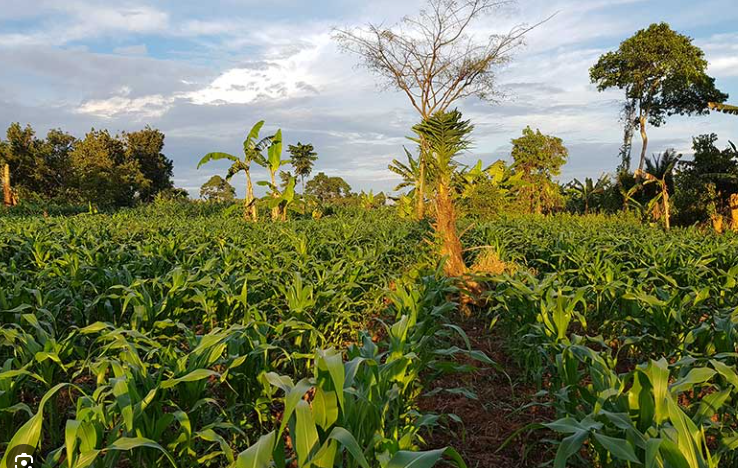
Competences for socio-ecological stewardship: a qualitative assessment of the transformative potential of farmers’ learning processes in Eastern Uganda

Theoretically, this study expands Roczen’s environmental competence model by including social, ethical, and conservation and restoration action competences. This study is one of the first to identify socio-ecological stewardship competences and the learning processes that can foster these competences.

Full citation:

Misanya, D., Tassone, V. C., Kessler, A., Wals, A. E. J., & Kibwika, P. (2024). Competences for socio-ecological stewardship: a qualitative assessment of the transformative potential of farmers’ learning processes in Eastern Uganda. The Journal of Agricultural Education and Extension, 1–21. https://doi.org/10.1080/1389224X.2024.2403597

Analysing farmers’ learning for socio-ecological stewardship in Eastern Uganda: A transformative learning ecology perspective

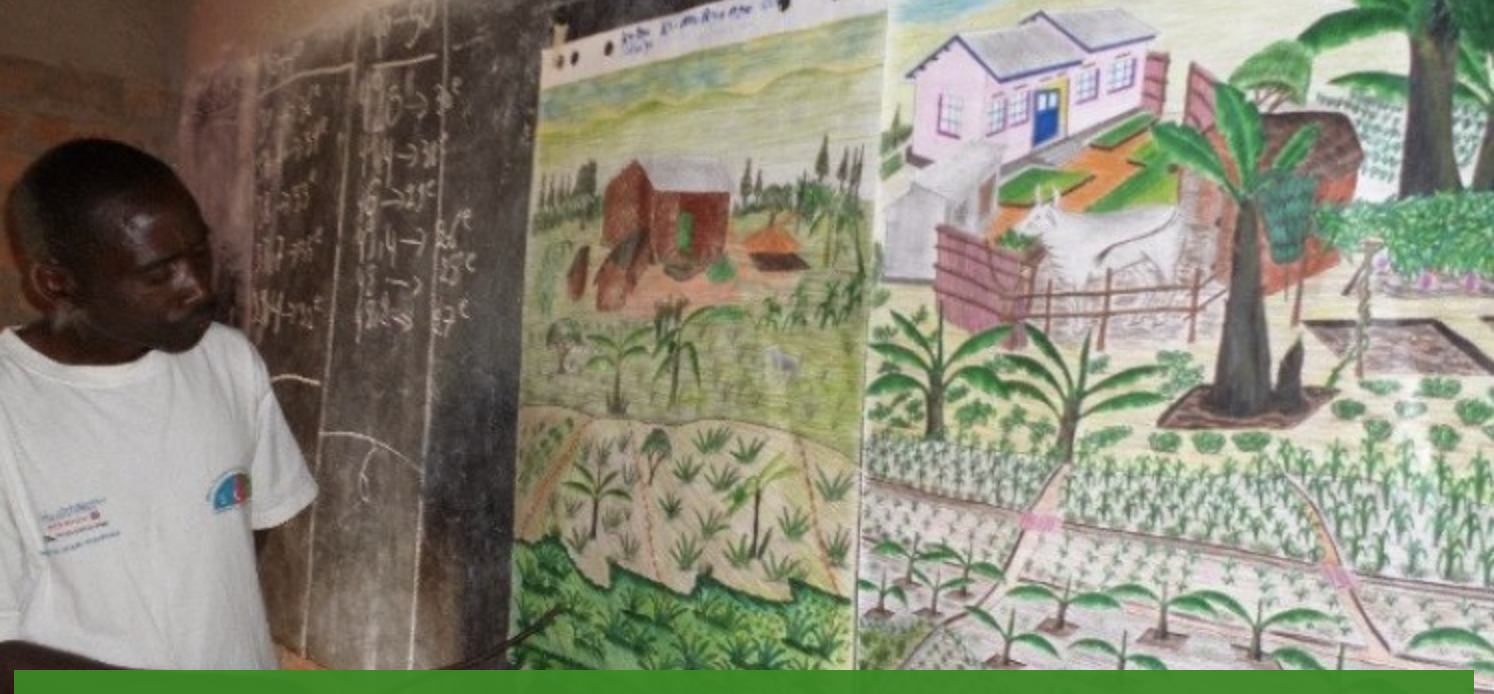
This paper stems from the research of PhD Candidate Doreen Misanya. It analyses how smallholder farmers are learning for socio-ecological stewardship in a specific case study context in Eastern Uganda. The case under analysis is a watershed management project that uses an integrated farm planning (PIP) approach to strengthen farmers’ stewardship capacities within the Manafwa watershed through interactive and dialogic ways of engaging and teaching farmers. Utilizing a transformative learning ecology (TLE) perspective, this study investigated features of the PIP approach that support transformative learning for socio-ecological stewardship in a rural context. Data was collected by interviewing eighteen farmers from different villages and PIP generations and all three PIP trainers of the project, and by observing training sessions as well as sensitisation workshops. As a main result, the study yielded new insights that can help enhance PIP-like learning configurations consisting of interconnected learning tenets, dimensions and processes. This enhanced learning configurating comprises an organic learning system that facilitates farmers to change their mindsets and redefine their values, perspectives, routines, and practices towards those that encourage socio-ecological stewardship. The TLE fostered by the PIP approach represents a useful heuristic that can guide and inspire both scholars and educators engaged in processes of cultivating socio-ecological stewardship in similar contexts.

The paper can be found here https://www.tandfonline.com/doi/full/10.1080/27685241.2023.2191795

Full citation:

Misanya, D., Tassone, V. C., Kessler, A., Kibwika, P., & Wals, A. E. J. (2023). Analysing farmers’ learning for socio-ecological stewardship in Eastern Uganda: A transformative learning ecology perspective. NJAS: Impact in Agricultural and Life Sciences95(1). https://doi.org/10.1080/27685241.2023.2191795

The research took place within the Manafwa Watershed Restoration (MWARES) Project in Bududa District, Eastern Uganda. A Baseline Report of the project appeared in 2020. It outlines the starting position of the PIP farmers in the region. This report can be found here.