Wild Pedagogies in Practice: Inspiration for Higher Education – two new papers!

Two papers I co-authored with different colleagues came out in the same Special Issue of the Australian Journa of Environmental Education published by Cambridge University Press. Both papers are published with open access.

The first paper led by PhD-candidate at Wageningen University, Reineke van Tol is on the potential of Wilde Pedagogies for renewing and reorienting higher education towards a posthumanist and relational perspective.

Citation: van Tol RS, Wals A. Wild Pedagogies in Practice: Inspiration for Higher Education. Australian Journal of Environmental Education. Published online 2025:1-23. doi:10.1017/aee.2025.16

The second paper led by Koen Arts is on Embedding Outdoor Relational Education in Academia and the barriers and opportunities we are running into in our home instiution: Wageningen University in The Netherlands.

Citation: Arts K, Roncken P, Buijs A, Wals A. Embedding Outdoor Relational Education in Academia: Perceived Barriers and Opportunities at a Dutch University. Australian Journal of Environmental Education. Published online 2025:1-21. doi:10.1017/aee.2025.24

In the first paper (van Tol and Wals, 2025) Wild Pedagogies (WP) are introduced as a critical, relational alternative to current, often unsustainable learning practices. WP aim to offer a way of learning in, with, through and for nature, embracing a post-humanist, relational perspective. So far, WP have mainly been explored theoretically. Increasingly, educators both within and outside of formal education, are inspired and apply WP in their education. Throughout the world, examples of learning that fit into WPs’ living definition, are emerging. However, concrete inspiration for how to bring WP theory into practice, is still largely lacking. In this paper, we explore three emerging approaches at Wageningen University (The Netherlands), that are inspired by wild pedagogies. Empirically, we combine formative evaluations of course designs with participant observation in a collective case study setting over three years. The empirical research is embedded in an explorative literature review that led us to four explorative areas of WP, namely (1) Wild and caring learning spaces (2) Learning from self-will and wonder (3) Relational learning with the world and (4) Disruptive learning for the world. Eventually we present concrete inspiration on those four areas for implementing WP in formal higher education. You can find the full paper here.

In the second paper (Arts et a., 2025) a common denominator of these more relational approaches is an emphasis on learning outdoors. This paper investigates the budding concept and practice of outdoor relational education at a university, specifically Wageningen University (WU) in the Netherlands. Based on 31 semi-structured interviews with protagonists and other stakeholders involved in or affiliated with outdoor relational education at WU, we identify associations, key elements and perceived benefits. Our research provides insight into what outdoor relational education and associated concepts are perceived to be in this context, how they are engaged and what the key experienced opportunities and barriers are to implement outdoor relational education further at WU. Complementary to theorisations of wild pedagogies and related approaches, our results offer empirical illustrations of wild pedagogies “in action” in an institutional academic setting that is not necessarily conducive to such developments. You can find the full paper here.

The art of arts-based interventions in transdisciplinary sustainability research

Led by PhD-Candidate Sophia-Marie Horvath of Department of Forest- and Soil Sciences, Institute of Forest Ecology, University of Natural Resources and Life Sciences in Vienna, a paper just came out in Sustainability Science on the contribution of arts-based interventions in transdisciplinary sustainability research. Transdisciplinary, co-creative research deals with complex real-world problems, with complexity being a common denominator of sustainability issues. It is often understood as an interplay of two dimensions, collaboration and creativity, that facilitates the integration of different forms of knowledge and the creation of transformative outcomes. In the end, it aims to find more holistic and systemic solutions to complex real-world problems. Increasingly, Arts-Based Interventions (ABIs) are proposed to support sustainability-oriented transdisciplinary research. However, little research has been done so far to gauge the extent to which adding arts to the mix actually benefits the transdisciplinary research process and outcomes. In the research project reported on in this article, we took a first step into the realm of the arts by including ABIs into transdisciplinary brainstorming sessions. You can find the full paper here: https://link.springer.com/article/10.1007/s11625-024-01614-2#citeas

Full citation: Horvath, SM., Payerhofer, U., Wals, A. et al. The art of arts-based interventions in transdisciplinary sustainability research. Sustain Sci (2025). https://doi.org/10.1007/s11625-024-01614-2

Characteristics and challenges of teaching and learning in sustainability-oriented Living Labs within higher education: a literature review – Open Access!

This paper led by ELS-WUR PhD-candidate Marlies van der Wee – Bedeker was published earlier this Fall. The paper is the first peer reviewed article based on her research that is grounded in the City of Rotterdam using her home institute Hogeschool Rotterdam as a base. Below a summary of the main fiindings. The full paper can be found here!

Full citation:

van der Wee, M.L.E.Tassone, V.C.Wals, A.E.J. and Troxler, P. (2024), “Characteristics and challenges of teaching and learning in sustainability-oriented Living Labs within higher education: a literature review”, International Journal of Sustainability in Higher Education, Vol. 25 No. 9, pp. 255-277. https://doi.org/10.1108/IJSHE-10-2023-0465

New book on 50 years of Education and Learning for Sustainable Futures

We are pleased to share with you the publication of our new book, Education and Learning for Sustainable Futures: 50 years of learning and environmental change. This book explores fundamental questions about how the role of education has evolved over the decades since the pivotal 1972 Stockholm Conference, which brought environmental learning to the forefront of global awareness.

Co-authors, Daniella Tilbury and Thomas Macintyre and myself, have attempted to find some answers by tracking through the decades (1970-2020) the development of narratives, thinking, and practice of learning and education in support of the environment and sustainability. What is clear is that the profile and presence of learning and education for the environment has been elevated in today’s policy discourses and communities of practice. Yet, our analysis identified some clear differences in the way education and learning for the environment has been approached over time. 

In our new book, we trace these changes over the decades while looking ahead to the challenges and opportunities of the future.  A key wildcard in this journey is Artificial Intelligence (AI), which holds immense potential to bridge digital and green agendas, enabling smarter environmental management and driving innovation toward a sustainable future. However, we also address critical concerns: data privacy breaches, outsourcing human thinking to profit-driven algorithms, exacerbation of inequalities, and the environmental footprint of AI infrastructure.

This book provides a light way into the history, developments and prospects of the field of Environmental and Sustainability Education.

Full reference:

Macintyre, T., Tilbury, D., & Wals, A. (2024). Education and Learning for Sustainable Futures: 50 Years of Learning for Environment and Change (1st ed.). Routledge. https://doi.org/10.4324/9781003467007

Wish to read more? Our book is open access thanks to the funding of the Dutch Government that funded this publication: https://www.routledge.com/Education-and-Learning-for-Sustainable-Futures-50-Years-of-Learning-for-Environment-and-Change/Macintyre-Tilbury-Wals/p/book/9781032727912

Our thanks also go to Stakeholder Forum and to @JanGustav for his leadership role in the Stockholm+50 reflective dialogues, and to UNEP/ the Swedish Government for spurring us on to track the historical development of education and learning for the environment. We are also grateful to @Routledge for taking an interest in publishing the text.

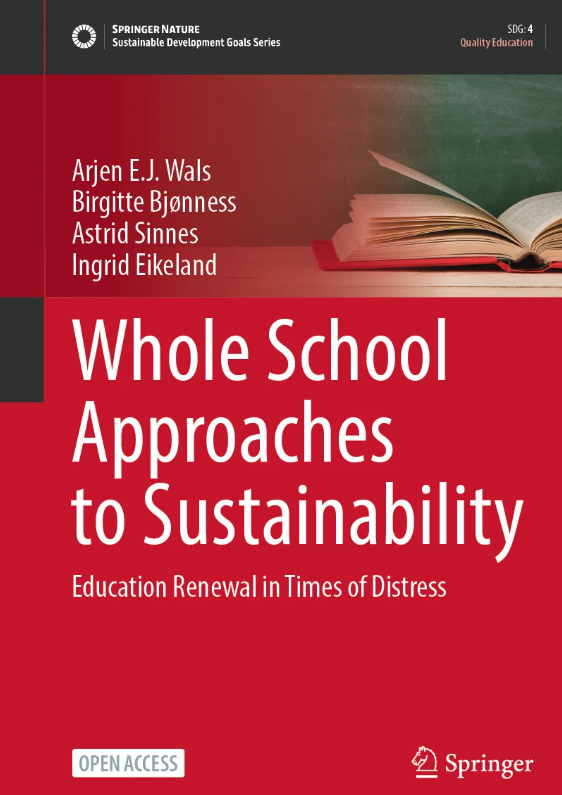
Whole School Approaches to Sustainability

Education Renewal in Times of Distress

LInk to the book: https://link.springer.com/book/10.1007/978-3-031-56172-6

At last – the edited volume on ‘Whole School Approaches to Sustainability – Educational renewal in times of distress’ has come out. Together with co-editors, Birgitte Bjønness, Astrid Sinnes and Ingrid Eikeland, and managing editor Stine Marie FyskeHaraldsen, we have worked with authors from around the world to create this rich picture of principles, practices and prospects of school working more systemically and holistically with sustainability, rather than treating it like another subject to be added to an already overcrowded curriculum.

The book has been made Open Acess and all 24 (!) chapters can be downloaded for free thanks to a grant provided through the Dutch Government-Supported Programme for Learning for Sustainable Development (LvDO).

We wish to acknowledge Roel van Raaij who has been an advocate of Education for Sustainable Development, both nationally and internationally, from within the Dutch government for decades, and Ellen Leusink who facilitates and supports ESD through the LvDO program and paved the way for the open access.

We also want to acknowledge the Department of Educational Science at
the Norwegian Life Science University (NMBU led by Hans Erik Lefdal together with Akershus county municipality (the school district South of Oslo) for the support to establish and run the University—School partnership for the last 6 years or so, continuing to this
day. The partnership with schools, especially the collaboration with school
coordinators and principals, have supported the development of the Whole
School Approach through research and praxis. Without this foundation and
support, we would not have had the knowledge, time, and confidence to work
on this book.

Here is the link to the book: https://link.springer.com/book/10.1007/978-3-031-56172-6

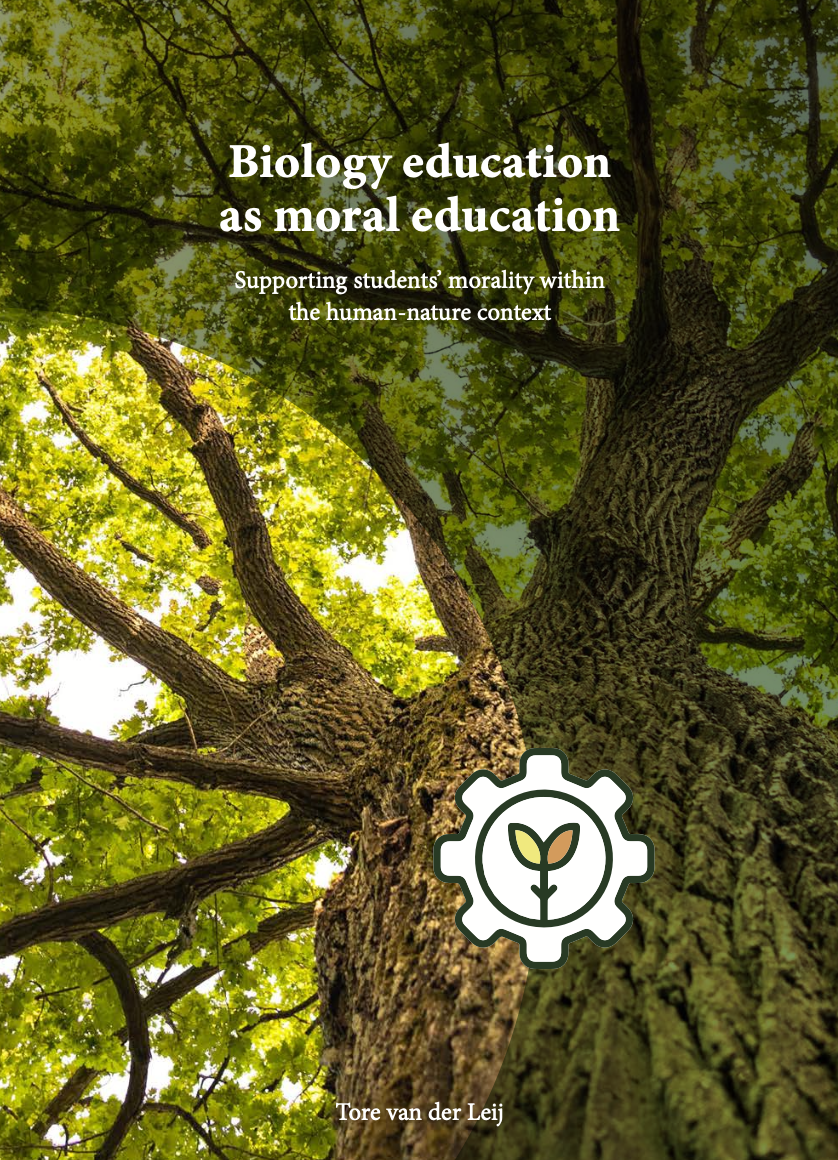
Tore vd Leij successfully defends: ´Biology education as moral education: Supporting students’ morality within the human- nature context´

On this day, February 13th, one of my first Masters students during my tenure at Wageningen University (in the mid-1990s!), Tore van der Leij, defended his PhD on ´Biology Education as a moral education´. He did so in the Aula of the University of Groningen which hosted his research. Tore is a Biology Teacher at Hondsrug College Secondary School in Emmen in the North of the Netherlands. Under the mentorshop of Prof. Martin Goedhart (RUG), Prof. Lucy Avraamidou (RUG) and myself, Tore worked, over a period of 7 years (COVID19 inclusive) with secondary school students and fellow teachers in two schools in figuring out how their morality can best be developed within the human-nature context. He developed a series of lessons to help trigger students´morality (all available in Dutch in the appendix). Tore had all four of his empirical chapters published in high quality journals. As an appetiser for his excellent work, I am sharing the Epilogue of his thesis below. The entire thesis can be downloaded via the University of Groningen´s Library System.

Epilogue

“As I described in the introduction to this chapter, many biology teachers in the Netherlands consider supporting students in developing skills related to morality important (e.g., CvTE, 2019; SLO, 2021; Van Maanen, 2021). Unfortunately, most teachers do not get around to it, mainly because of the overloaded exam programme (CvTE, 2019; SLO, 2021). In addition, the skills are not tested in the central exams, but only in the school exams. As a result, supporting students in developing skills related to morality are not teachers’ priority.

All this notwithstanding, the outlined urgency of the context in which supporting students’ morality should take place is evident. Above that, given that many biology teachers do consider supporting students’ morality important, it is my hope that the results from this research project provide a valuable practical interpretation of biology education aimed at supporting students’ morality in the human-nature context.

When I started this PhD journey in 2016, an important motive for conducting this research project was my concern about the socio-ecological challenges, both globally and locally, in which the negative impact of human actions on ‘other-than-human’ beings, and future generations have become increasingly prominent. I felt, and still feel, that education should respond to this urgency by providing our students with the necessary ‘free space’, ‘skolè’, to develop, form and reflect upon these challenges, and give them opportunities to act in relation to the constantly changing world around them.

The fact that Gretha Thunberg (a 15-year old student at the time) with her ‘Skolstrejk för klimatet’ in 2018 (about two years after the start of this research project) chose not to go to school, is perhaps illustrative for education’s challenge to offer our students the valuable and meaningful education, that meets the big challenges of our time. In any case, the following that Gretha has received since then – for instance, the Climate Strikes in which tens of thousands of young people participated – shows that there is plenty of commitment, need and motivation among young people to engage with these moral dilemmas.”

I couldn´t resist: A SWOT analysis of ChatGPT – implications for educational practice and research

Source: https://evaluationcomics.freshspectrum.com/comic/chatgpt-and-plagiarism/

After a very good impromptu explanation of how ChatGPT works and will affect the future of research and education by ELS colleague Auke Westerterp in a homemade videoclip (have a look here), a lively discussion started among colleagues about the pro´s and cons of ChatGPT.

I found myself on the side of being skeptical and, indeed, worried. But there were also colleagues who see AI and chatbots as inevitable and potentially beneficial. In fact, it turned out they were already using it in both research and education, and, upon asking around a bit, I found out that many students are using it to (re)write their papers and to save the time of reading (which apparently is seen as an inefficient activity).

I then tried it out myself and was perplexed by what ChatGPT can create in seconds. I out in key words we use in our RiverCommons project which focuses on things like ´rights to nature´, ´water justice,´ ´decolonization´ and sustainable development, social learning, etc. I put in these words and asked ChatGPT to write a 300-word paper, with references APA style. To convince the project leader – Prof Rutgerd Boelens of Wageningen University´s Water Resource Management Group, I also asked to refer to the work of Boelens in the. article. The result was impressive and could have easily fooled the reviewers of a bunch of journals. To top things off, I asked ChatGTP to include a 100 biography of Rutgerd Boelens.

In fact, a good colleague of mine, also active in sustainability in higher education, Debby Cotton based at the University of Plymouth, submitted a paper to a journal, together with colleagues, to a journal which had been written by ChatGTP. They told the editor beforehand. The editor was in for an experiment and the paper went through a proper review process and… was accepted and then published with a discussion of what happened and what might be possible implications of this. The paper – have a look here – got featured in major newspapers like the Guardian and the Washington Post.

In the meantime, my colleagues working on ICT-supported learning had already started working on a SWOT of the use of ChatGPT in education. When I showed my interest in the debate, they asked me to join. Given the magnitude of the phenomenon, I could not resist and agreed to join. The paper just got published in Innovations in Teaching International and can be downloaded here. Have a look and see what you think. One of my concerns, not highlighted in the paper, is that these technologies will only expand our screen time (videophilia) and further disconnect us from places and people and the relations between them. As such they serve Nasdaq-listed companies and their shareholders most, while further eroding life on this Earth (biophilia). Perhaps, now that the AI is becoming so powerful, it will lead to a new discussion about the purpose of education and people´s motivations to learn. That, in the end, might be the best outcome.

Full citation:

Farrokhnia, M., Seyyed Kazem Banihashem, Omid Noroozi & Arjen Wals (2023) A SWOT analysis of ChatGPT: Implications for educational practice and research, Innovations in Education and Teaching International, DOI: 10.1080/14703297.2023.2195846

High school biology students’ use of values in their moral argumentation and decision-making in times of polarization, confusion and unsustainability

Another paper based on PhD Tore van der Leij just appeared in the Journal of Moral Education. I took the liberty to add a few words to the title… ‘in times of polarization, confusion and unsustainability’ to emphasize the importance of this work.

In this qualitative case study Tore examined the impact of a specially-designed classroom intervention for a group of 15–16-year-old Dutch biology students’ use of values in contemplating five socioscientific issues in the human-nature context. The students worked in small groups to support various aspects of their morality. An ethical matrix was used as a heuristic to explore different arguments and moral values from different perspectives. The collected data consisted of written assignments, group conversations, and individual interviews. The results show that students’ use of values differed from one issue to another. The values they used in their moral decision-making indicated that the influence of the intervention activities, aimed at enhancing a relationship between moral agent (student) and moral object (topic), was limited. The study provides evidence that the intervention positively conduced to students’ cognition of the values that are personally relevant. Recommendations for further theorization, research and practice are discussed.

Here is the link: https://www.tandfonline.com/doi/full/10.1080/03057240.2023.2185595

Full citaton:Leij, Tote, van der, Martin Goedhart, Lucy Avraamidou & Arjen Wals (2023) High school biology students’ use of values in their moral argumentation and decision-making, Journal of Moral Education, DOI: 10.1080/03057240.2023.2185595

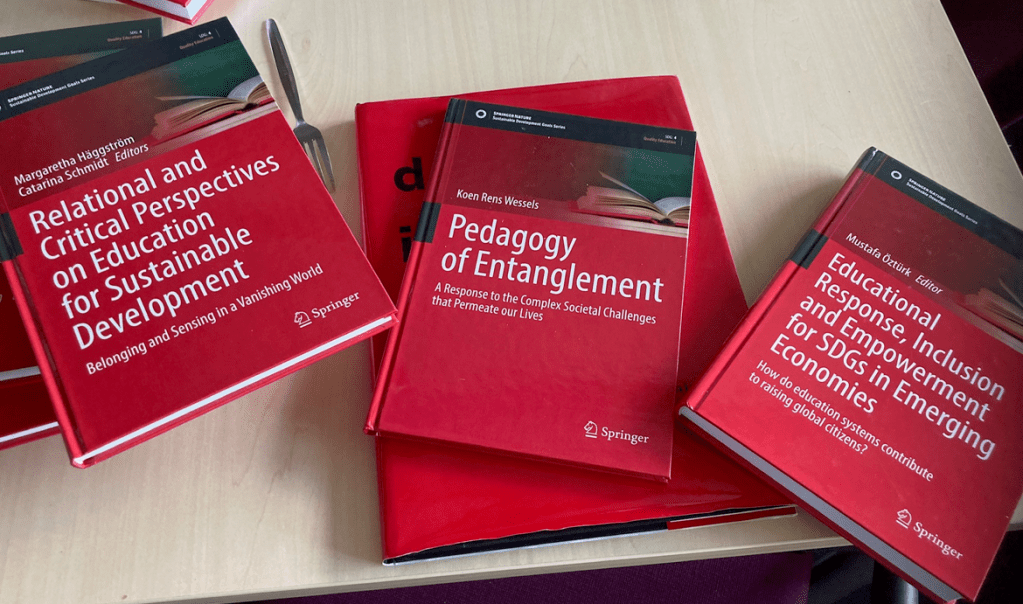
Pedagogy of Entanglement and other groundbreaking works – Springer SDG4-Series taking off

Recently, a few more titles appeared in the Springer SDG4 Series that are expanding horizons, addressing blind spots and offer guidelines for alternative ways of thinking and acting in and through education in light of pressing global sustainability challenges. One of them finally arrived on my desk today: Koen Wessel’s “Pedagogy of Entanglement: a response to complex societal challenges that permeate our lives”. This book is a real treasure that is based on Koen’s dissertation which he completed last year at Utrecht University (with joint supervision from Wageningen University).  You can find the book here.

The Springer Sustainable Development Goals Series aims to provide a comprehensive platform to the scientific, teaching and research communities studying issues in the fields of geography, earth sciences, environmental science, social sciences, engineering, policy, planning, and human geosciences in order to contribute knowledge toward achieving the current 17 Sustainable

Development Goals. Volumes in the series are organized by relevant goal and guided by an expert international panel of advisors.

The subseries that I am co-editing together with Nicole Ardoin of Standford University, focuses on SDG 4: Quality Education and more specifically on the following questions: What kind of quality or qualities must education have in order to be able to contribute to Sustainable Development as expressed by the SDGs? How can such education be developed, implemented and assessed in a wide range of contexts across the globe? How can quality education, that contributes to the well-being of all people and the whole planet, becomeaccessible for everyone?

Topics covered by the SDG 4 subseries include, but are to limited to: education policy and governance for ESD/ESE and Global Citizenship Education (GCE), conceptualizing sustainability competence other possible learning outcomes of ESD and GCE, pedagogical approaches to ESD/ESE and GCE, the role of teacher training/professional development in fostering ESD/ESE/GCE,

assessment of ESD/ESE and GCE-related learning, creating whole school or whole institution approaches to sustainability, making ESD/ESE and GCE accessible and relevant for all learners in a wide range of context across the globe.

Should you be interested in writing or editing a book for this Series, contact Zachary Romano in Springer’s New York office or drop me or Nicole a line!

Rethinking pedagogy in the face of complex societal challenges: helpful perspectives for teaching the entangled student

Another most interesting paper just came out in the journal Pedagogy, Culture and Society. This time led by – now former PhD candidate – Koen Wessels who received his PhD last June. Here is some key info on the paper and its key concept ‘pedagogy of entanglement’ which is at the heart of Koen’s research.

Confronted by myriad interconnected societal challenges, this paper asks: what kind of pedagogy does justice to the experience and challenge of living in a complex world? Departing from a critical reading of a preparative-logic to education, this paper emphasises students’ entangledness: more-or-less consciously, students are uniquely shaped-by and shapers-of complex societal challenges in a here-and-now sense. Utilising this premise, the paper develops a set of pedagogical perspectives that might inspire and help teachers to design their own responses to particular complex societal challenges in their unique teaching contexts. Drawing on emerging outcomes from a narrative diffractive inquiry with 12 teachers as co-researchers and engaging with complexity thinking, six perspectives are presented and discussed: entanglement-orientedness, entanglement-awareness, hopeful action, inquiry within complex societal challenges, practicing perceptiveness, and practicing integrity. Together, these perspectives offer a heuristic for embracing complexity in education.

You can get to the paper via this link: https://www.tandfonline.com/doi/full/10.1080/14681366.2022.2108125

Full citation: Koen R. Wessels, Cok Bakker, Arjen E.J. Wals & George Lengkeek (2022) Rethinking pedagogy in the face of complex societal challenges: helpful perspectives for teaching the entangled student, Pedagogy, Culture & Society, DOI: 10.1080/14681366.2022.2108125

Creating a sense of community and space for subjectification in an online course on sustainability education during times of physical distancing

Handmade painting by a student on “Empowerment –
a rising sensation that liberates you from ‘sinking’ into negativity” – using artistic forms of evaluation of learning, helped both subjectification and creating a sense of community in the course

This paper recently appeared in International Journal of Sustainability in Higher Education. It explores students’ sense of community and belonging in an online course on environmental and sustainable education during times of physical distancing as a result of the COVID-19 pandemic. Using a case study approach, the results show that students perceived a sense of community that was collectively build during the four week program. Sense of community was linked to and facilitated by the learning environment and the educators’ and students’ role throughout the course. Prominent factors here are interaction and inclusion created with mutual effort by design, the educator and student.

This research arose after the course ELS-31806 Environmental Education and Learning for Sustainability[1] was converted as an ‘offline’ course into an online course due to COVID-19. The original content of the course enables students to systematically discuss important concerns in the development of an effective curriculum and/or operation for the environment and sustainable development using a range of instrumental and emancipatory approaches. But foremost ELS-31806 is a course that has always been, well appreciated and highly valued by participants for its highly experiential and hands-on approach.

However, due to COVID-19 this year’s course (2020) was changed into a less experiential on-line format mediated by Zoom for interaction and by Brightspace for course structure and organisation. This somewhat ad-hoc and sudden departure from the traditional successful format, lowered the instructors, and probably also, the students’ expectations about the course’ ability to create a vibrant learning community. Yet, contrary to pre-course expectations, ‘something’ (i.e. a sense) arose over the course of four weeks online education that both students and staff considered to be special or meaningful. These hunches got confirmed several weeks after by Wageningen UR’s student evaluation system PACE which revealed that the students highly valued the course.

We were intrigued by the question of how this online edition evoked similar, or nearly similar outcomes to its offline counterpart. After first checking whether our hunches were right about the course and what might explain the high evaluation marks, we centre in the paper’s  main question:

What are key characteristics of an online course that fosters subjectification (personal development and inner-sustainability in relation to others and the other) and creates a sense of community?

The paper was led by former MsC student Robbert Hesen and co-authored by myself and ELS Postdoc Rebekah Tauritz.


Citation

Hesen, R.Wals, A.E.J. and Tauritz, R.L. (2022), “Creating a sense of community and space for subjectification in an online course on sustainability education during times of physical distancing”, International Journal of Sustainability in Higher Education, Vol. 23 No. 8, pp. 85-104. https://doi.org/10.1108/IJSHE-07-2021-0270

Triggered by these results we decided to investigate what might explain these results.


[1] A course within the Education and Learning Sciences (ELS) chair group at Wageningen University & Research (UR):  https://ssc.wur.nl/Handbook/Course/ELS-31806

Whole School Approaches (WSA) to Sustainability – Principles, Practices and Prospects – Call for Contributions

It is my pleasure to share two calls for contributions in relation to the development of a Whole School Approach (WSA) to Sustainability. The first one relates to an international hybrid conference organized by the Dutch government that will take place in The Netherlands and partially online late March of 2022, the second one relates to an edited Volume on the topic in the Springer SDG4 Series on Quality Education.

  1. Call for exemplary practices of a Whole School Approach to Sustainable Development

The Dutch Ministry of Economic Affairs and Climate Policy have commissioned a report to provide practical examples of how a Whole Institution/ Whole School Approach (WSA) is being used in practice around the world to engage with SDG4 – Quality Education, especially in relation to sustainable development issues as covered by the other SDGs. The reports aim is to highlight different aspects of a WSA  – curriculum development, pedagogical innovation, school management and leadership, school-community relationships, professional development of staff, and the school as a ‘living laboratory’ for experimenting with healthy, equitable, democratic, and ecologically sustainable living – especially how these aspects can be integrated to mutually strengthen each other.

We are particularly interested in so-called critical case-studies that do not only highlight best-practice strategies and success stories, but also share the struggles, set-backs and challenges underneath and ways to overcome them. The report will be published as part of the WSA International Conference happening in The Netherlands on the 30th-31st March.

If you know of such a school (primary, secondary, or vocational) from your country that can be used as an exemplary example of a WSA in action, or want further details, please contact Rosalie Mathie via email. rosalie.mathie@nmbu.no before February 15th so she can still contact people connected to the exemplary case.

2 Call for Abstracts Springer SDG4 Series
Whole School Approaches to Sustainability – Principles, Practices  and Prospects


Ingrid Eikeland, Brigitte Bjønness, Astrid Sinnes and Arjen Wals (Eds)

Schools across the globe are seeking to respond to emerging topics like; climate change, biodiversity loss, healthy food and food security, and global citizenship. They are increasingly encouraged to do so by educational policies that recognize the importance of these topics and by the Sustainable Development Goals (SDGs).

While there is recognition that such topics should not be added on to an already full curriculum, but rather require more systemic and integrated approaches, doing so in practice has proven to be difficult. This edited Volume seeks to engage educators, school leaders, educational policy-makers and scholars of sustainability in education in key principles, critical perspectives, generative processes and tools that can help realize a Whole School Approach to Sustainability. The book will contain three sections:  1) Principles & Perspectives, 2) Critically Reflexive Contextual Case Studies (Early Childhood, Primary, Secondary and Vocational Education) and 3) Synthesis: Challenges and Prospects.

The editors are inviting abstracts (no more than 500 words) of potential chapters. Contributions can be research-based (spanning different genres of research) but can also be more conceptual in the form of critically reflexive essays. Abstracts should indicate a best fit with one of the sections and need to be accompanied with short bios of the author(s) and, if possible, references to prior publications that relate to the topic.

Please send your initial ideas for a contribution or any queries you may have to: ingrid.eikeland@nmbu.no before March 1st. All abstracts will be reviewed by the editors and a selection will be made for further development into a full manuscript to be published by the end of 2022.

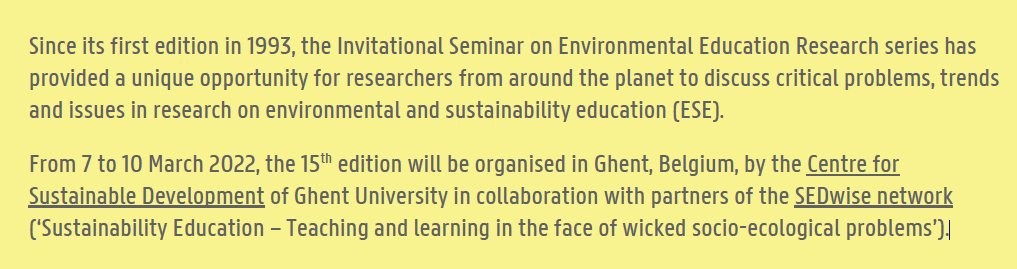
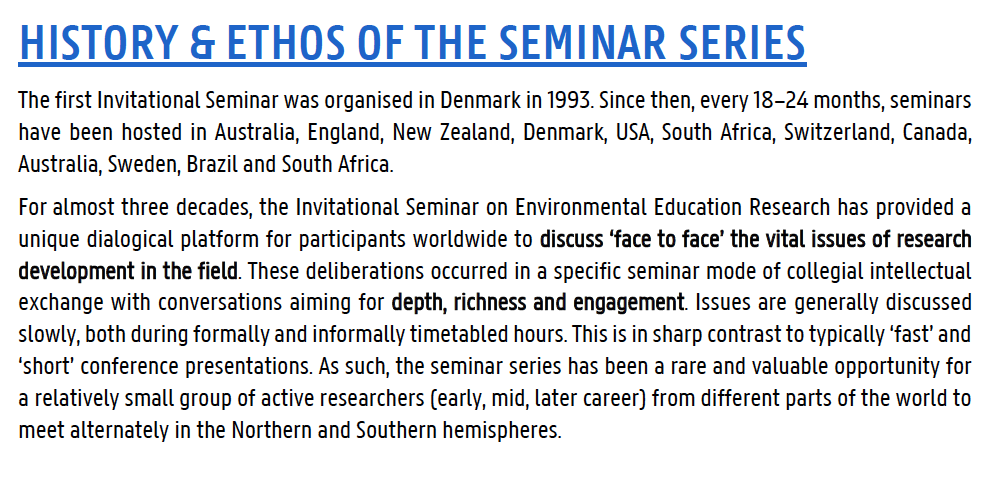
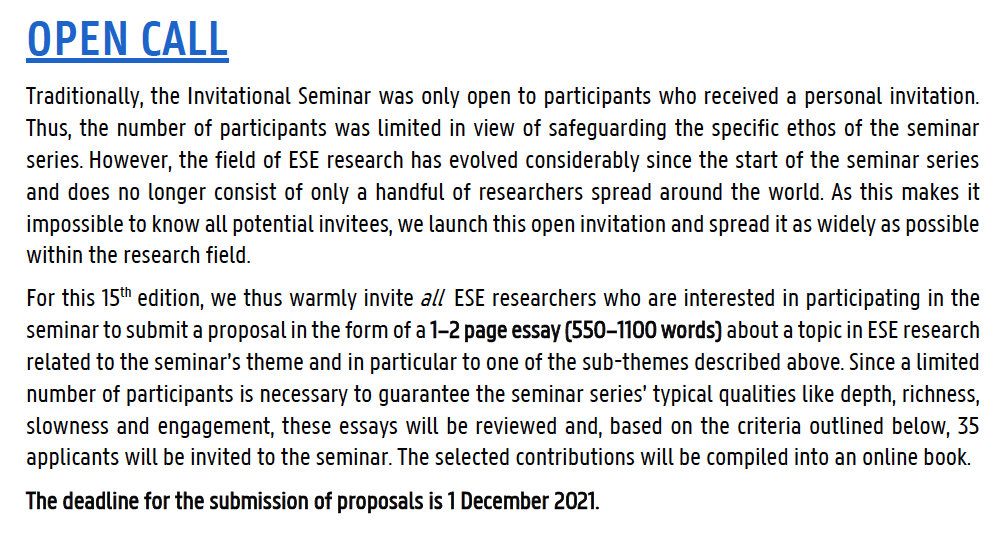
Invitational Research Seminar – SUSTAINABILITY EDUCATION RESEARCH  IN TIMES OF CLIMATE CRISIS – Gent, Belgium

I have posted about this seminar before. Originally the seminar was going to take place in March but it has been rescheduled to June 13-16. The deadline for submission has shifted as well to February 15th. This is a unique seminar with some great people in the field of environmental and sustainability participating. Have a look here for the key info. https://www.cdo.ugent.be/news/call-proposals-15th-invitational-seminar-ese-research

Invitational Research Seminar – SUSTAINABILITY EDUCATION RESEARCH  IN TIMES OF CLIMATE CRISIS

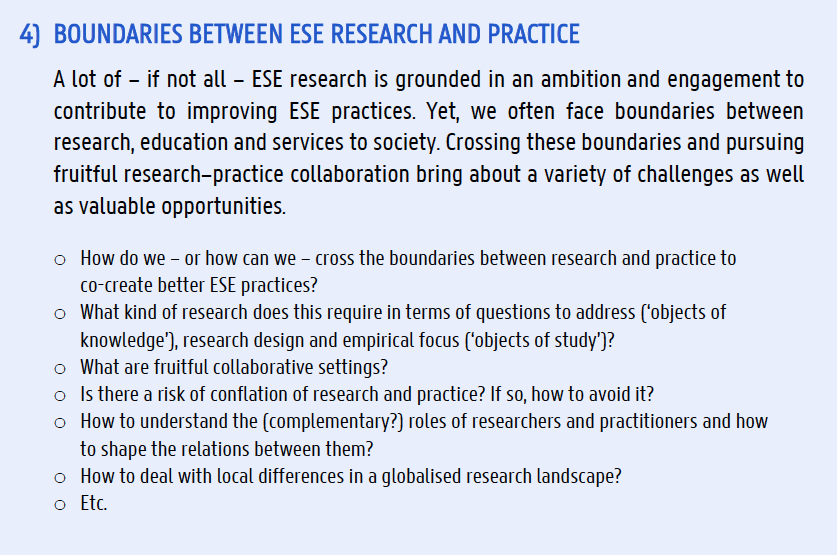
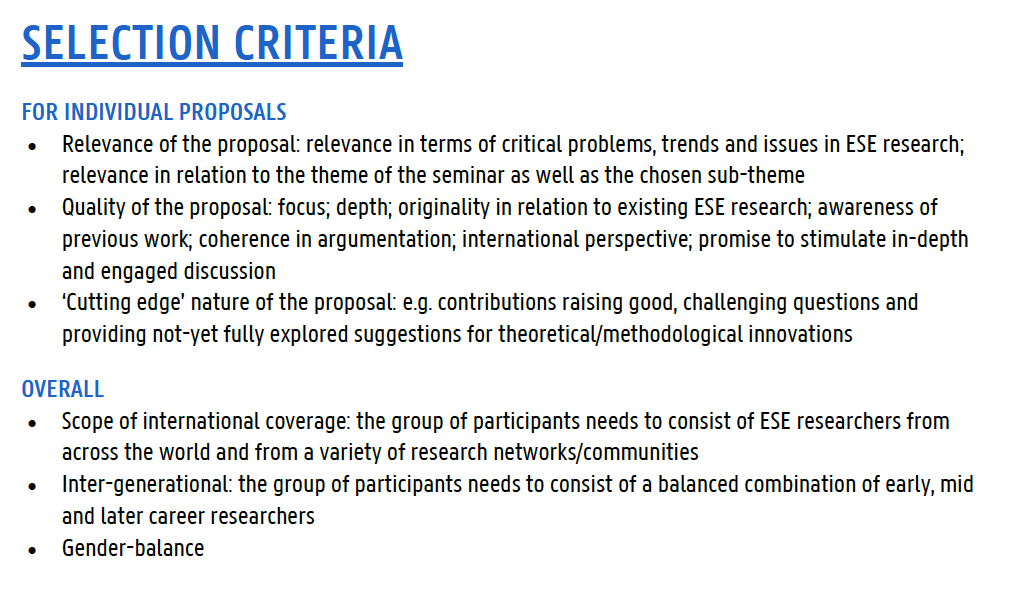
I am happy to announce the return of the infamous Invitational Research Seminars on Environmental & Sustainability Education. As one of the co-organisers I have the privileged to be part of an excellent group led this tim by Katrien van Poeck of Ghent University in Belgium. These are relatively small seminars. While they are no longer ‘by invitation only’ and open to anyone with a strong, insightful, creative, provocative, etc, proposal, spaces will be limited. Have a look a the key info, the theme and the wonderful sub-themes below or go directly to the Centre for Sustainable Development at Ghent University https://www.cdo.ugent.be/news/call-proposals
https://forms.office.com/pages/responsepage.aspx?id=3hyB1-_sbEmPkaF4YkG5nAXy6iDz_itPuL2K0IeXr0VUOFA5NUdJTzNPVkZHRTRLQVNGMVRRN0c5Ni4u

The Case for Transformative Public Education: Responding to Covid-19 now while addressing long-term underlying inequalities

Last Fall a consortium of which I am proud to be a part, along with the Education & Learning Sciences Group of Wageningen University received funding from the UK-government to a so-called GCRF Network Plus on Transforming Education for Sustainable Futures. The network is co-ordinated out of the University of Bristol and includes partners in India, Rwanda, Somalia/Somaliland, South Africa, the United Kingdom and the Netherlands. TESF undertakes collaborative research to Transform Education for Sustainable Futures. We have just released an introductory video (see above) and just released a timely paper:

TESFBriefing

Here is the link to the briefing paper:

The Case for Transformative Public Education: Responding to Covid-19 now while addressing long-term underlying inequalities

This paper addresses the following topics:

  • What is Transformative Public Education
  • Why Transformative Public Education matters to the COVID-19 response
  • Why Transformative Public Education matters for addressing long-term underlying risks to communities
  • Examples of Transformative Public Education responses to COVID-19
  • Suggestions for governments and state welfare actors seeking to work with Transformative Public Education
  • Suggestions for community leaders working with Transformative Public Education
  • Transformative Public Education in times of physical distancing
  • Key readings and resources

On the TESF website you will also find other resources you may find of interest. Have a look here TESF Home Page

This is TESF’s first response to the C-19 situation, and we would like to see it widely distributed, given the timely nature of this topic.  Please do all you can to share it widely across your networks. https://tesf.network/resource/transformative-public-education/