
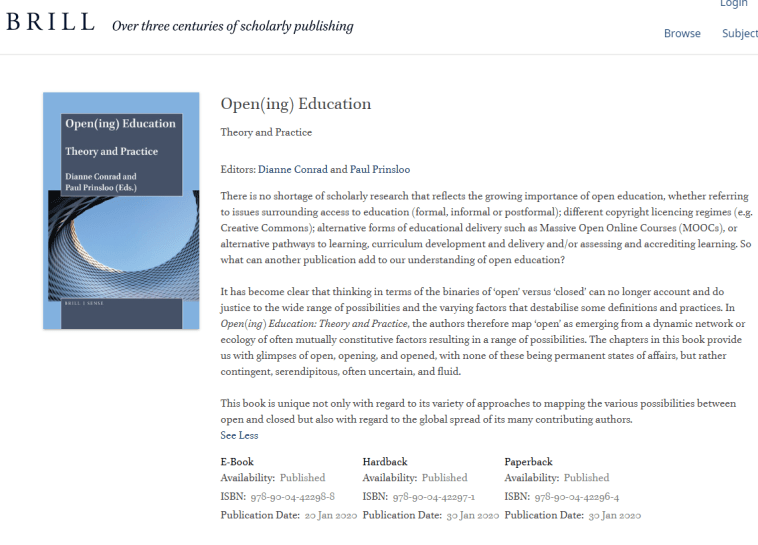
This new book published by Brill just came out and I am pleased to have been ablte contribute to its contents together with one of my colleagues from the University of Gothenburg, Anne Algers. Our chapter is part of a rich collection of chapters focusing on ways of opening education to allow for more dynamic forms of learning to emerge in a world that is trying to grapple with many of the existential and ecological crises that, both ironically and sadly, humanity itself has created. The chapter that Anne and I wrote (have look at the pre-print here: Sustainability_orientedOpenLearningAlgersWals2020) asks the question of “How can open education play a role in making academia more responsive and responsible in addressing ill-defined and ambiguous, but ever so urgent, sustainable development challenges?” In our chapter, a case study from the field of sustainable development of food systems provides a narrative that illustrates the possible impact of open education; and the value of a culture of openness to individuals, to a community, and to society.
First, we provide a contextual background on the implications of openness in higher education. Second, we introduce the subject of sustainable development (SD) of our global food systems; and third, we discuss the concept of education for sustainable development (ESD). Fourth, by means of thick description (Geertz, 1973), we report a case study on open education which we discuss in light of learning theory, critical pedagogy, and sustainable development.
In the end we argue for a radical interpretation of open education which we refer to as transformative sustainability-oriented open education, where ”open” refers to inviting and expressing critique and marginalized perspectives in controversial societal issues, while transformative refers to enabling learners to bring about change.
Suggested citation: Algers, A. & Wals, A. J. (2020). Transformative Sustainability-Oriented Open Education. In: Conrad, D. & Prinsloo, P. (Eds.). Open(ing) Education. (pp. 103-120). Leiden, The Netherlands: Brill | Sense. doi.org/10.1163/9789004422988_006
This work is licensed under the Creative Commons Attribution 4.0 International License.

 Sustainability Science Key Issues Edited by Ariane König (Université du Luxembourg, Luxembourg) and Jerome Ravetz (Oxford University, UK) is a comprehensive textbook for undergraduates and postgraduates from any disciplinary background studying the theory and practice of sustainability science. Each chapter takes a critical and reflective stance on a key issue of sustainability from contributors with diverse disciplinary perspectives such as economics, physics, agronomy and ecology. This is the ideal book for students and researchers engaged in problem and project based learning in sustainability science.

 Transformative learning