Short video “Engaging Communities in Local Sustainability Issues through T-Learning and Citizen Science”

This 5 minute video was recorded at WEEC 2022 in Prague by Alex Kudryavtsev – a research associate at Cornell University for the “Environmental Education & Community Engagement” online course by Cornell and NAAEE. I introduce transdisciplinary, transgressive and transformative learning in the context of citizens monitoring air pollution s a form of citizen science. I use the city of Rotterdam in The Netherlands as an example (althoughI do some justice to the city of Rotterdam as my example is somewhat dated:. it is a short video and much more is to be said about Rotterdam as the city government now pro-actively works with citizens in an air quality monitoring network. ‘Luchtbrug’ see: https://www.themayor.eu/en/a/view/rotterdam-citizens-concerned-with-air-quality-form-a-club-8089

Summer School River Lives and Living Rivers: Towards a transdisciplinary conceptualization

I feel very privileged to be part of one of the two major International River Research projects led by Wageningen UR colleague Prof. Rutgerd Boelens: Riverhood and RiverCommons. Riverhood and River Commons are both 5-year research projects that focus on enlivening rivers, river co-governance initiatives, and new water justice movements.

Riverhood is funded by the European Research Council (ERC) (Grant Agreement No 101002921) and aims to build groundbreaking transdisciplinary concepts and methodological tools to analyze and support new water justice movements’ institutions, strategies and practices for equitable and sustainable water governance. It does so through comparing initiatives in Latin America (Ecuador and Colombia) and Europe (Netherlands and Spain). The focus will be on movements promoting novel concepts and practices such as Rights of Nature, new water cultures or nature-inclusive hydraulics, to name just a few.

RiverCommons is funded by Wageningen University’s Interdisciplinary Research and Education Fund (INREF) and unites chair groups from the social and natural sciences, as well as partners worldwide. Its objective is to develop transdisciplinary concepts and methods for research, education, and multi-stakeholder interactions to understand and support river co-governance initiatives and sustainable socio-ecological river systems in Asia, Africa, Latin America and Europe.

While each of the projects has its specific objectives, activities, regions, and partners, there is immense potential for synergies and cross-pollination. Riverhood and River Commons will therefore be integrated in multiple ways, to together build a diverse and wide network of river scholars, activists, and institutions that commonly aim to understand and strengthen river co-governance around the world.

Both projects are united by a common framework that illuminates the different facets and complexities of river systems. The framework encompasses four dimensions: River-as-Ecosociety, River-as-Territory, River-as-Subject, and River-as-Movement. You can find more information about it in Concepts.

Another important component of both projects is the development of Environmental Justice Labs (Riverhood) and River Co-governance Labs (River Commons) to be organized in the case study sites to co-create knowledge and mobilize and exchange ideas for change.

One exciting immediate prospect and possibility for PhD’s from around the world is our Summer School “River Lives and Living Rivers: Towards a transdisciplinary conceptualization”

Here is the short introduction to the course:

World’s rivers are fundamental to social and natural well-being but profoundly affected by mega-damming and pollution. In response to top-down and technocratic approaches, in many places riverine communities practice forms of ‘river co-governance’, integrating ecological, cultural, political, economic and technological dimensions. In addition, new water justice movements (NWJMs) have emerged worldwide to creatively transform local ideas for ‘enlivening rivers’ into global action and vice versa. The Summer School aims to provide PhD students who conduct research on these ‘river commons’ and NWJMs with transdisciplinary concepts and approaches for studying their emerging ideas, concepts, proposals and strategies. The training thereby focuses on conceptualizing river systems in all senses, and capacity-building for (understanding and supporting) river knowledge co-creation and democratisation from the bottom up.

Announcing: Higher Education Summit “Daring to Transform Learning for a Future Proof Economy” – Hasselt, Belgium, September 6-8

“It’s the economy, stupid!” was a slogan Bill Clinton used in his successful campaign against George W. Bush to point out that in the end it is the economy that matters most to voters. Now 30 years later this slogan has new meaning as we come to see the moral and planetary bankruptcy of old-style market and growth driven economic thinking that normalises unsustainability. Sadly, much higher (business) education still echoes and reproduces dysfunctional old-style economic thinking, even in universities that claim to have sustainability at the heart of their operations… even the SDG related to the economy – SDG 8 – seems to do so as it focuses on realizing ‘economic GROWTH and decent work’. It is hight time that alternative economic thinking takes root in our education – varying from distributive economic thinking to regenerative economic thinking to circular economic thinking to a letting go of economic thinking altogether to make room for alterative value propositions.What are the implications of such alternatives for how and what we teach? how students learn? how we connect with stakeholders around the university?

These and other questions will be addressed at the Higher Education Summit 2022 from 6-8 September 2022 in Hasselt, Belgium! Under the theme “Daring to transform learning for a future-proof economy” the summit will bring together those who wish to transform higher education for the benefit of a “safe and just space for humanity” (Raworth, 2017): people who study, teach, research, and contribute to governance at higher education institutions, and representatives of the business world, government, and civil society.  

The organisers invite you to join us to rethink the role of higher education institutions in shaping the economy. Whether we prefer to call it a doughnut economy, circular economy, or regenerative economy – we all aspire for a world in which humans can flourish in close harmony with a thriving planet. And we know that learning is key to driving this transformation (Berlin Declaration on Education for Sustainable Development, 2021).  

We are looking forward to celebrating your wonder! 
The Call for Contributions is open! Proposals are welcome until 15 March 2022. We will let you know by 29 April 2022 whether your proposal has been accepted. 
Your proposal should not exceed 1 A4 page, including references. You may include pictures or other visual representations. Proposals will be assessed by the scientific committee based on the following principles:

  • Potential for (societal and/or economic) transformation
  • Academic or other relevant quality for theory, practice or policy
  • Thematic relevance
  • Originality and level of innovativeness

Adequateness of mode of presentation, including the degree of co-creation with the audience

HERE IS THE LINK TO THE CONFERENCE WEBSITE AND REGISTRATION PAGE

The Imaginative Power of the Region. Learning for the SDGs together – February 8th (on-line)

On 8 February 2022 SPARK the Movement organizes an interactive online meeting with regional, national and European educators around the question:

How can we mobilize the imaginative power of the region, thus learning together how to take up global challenges and focus on the local impact we can make?

SPARK’s conviction is that sustainability needs to be a part of the ‘everyday fabric of life’. The scale of a region seems to be a most suitable level to examine and enact sustainability in day-to-day life and in everyday business. The meeting is organised by United Nation’s supported Regional Centre of Expertise ‘Fryslan’ in The Netherlands. I will give a short introduction to the Whole School Approach as a key driver of sustainability.

Anyone can join but you need to sign up here: https://sparkthemovement.nl/programma/

PROGRAMME

SIGN UP HERE (BEFORE THE 8TH OF FEBRUARY, 2022)

Whole School Approaches (WSA) to Sustainability – Principles, Practices and Prospects – Call for Contributions

It is my pleasure to share two calls for contributions in relation to the development of a Whole School Approach (WSA) to Sustainability. The first one relates to an international hybrid conference organized by the Dutch government that will take place in The Netherlands and partially online late March of 2022, the second one relates to an edited Volume on the topic in the Springer SDG4 Series on Quality Education.

  1. Call for exemplary practices of a Whole School Approach to Sustainable Development

The Dutch Ministry of Economic Affairs and Climate Policy have commissioned a report to provide practical examples of how a Whole Institution/ Whole School Approach (WSA) is being used in practice around the world to engage with SDG4 – Quality Education, especially in relation to sustainable development issues as covered by the other SDGs. The reports aim is to highlight different aspects of a WSA  – curriculum development, pedagogical innovation, school management and leadership, school-community relationships, professional development of staff, and the school as a ‘living laboratory’ for experimenting with healthy, equitable, democratic, and ecologically sustainable living – especially how these aspects can be integrated to mutually strengthen each other.

We are particularly interested in so-called critical case-studies that do not only highlight best-practice strategies and success stories, but also share the struggles, set-backs and challenges underneath and ways to overcome them. The report will be published as part of the WSA International Conference happening in The Netherlands on the 30th-31st March.

If you know of such a school (primary, secondary, or vocational) from your country that can be used as an exemplary example of a WSA in action, or want further details, please contact Rosalie Mathie via email. rosalie.mathie@nmbu.no before February 15th so she can still contact people connected to the exemplary case.

2 Call for Abstracts Springer SDG4 Series
Whole School Approaches to Sustainability – Principles, Practices  and Prospects


Ingrid Eikeland, Brigitte Bjønness, Astrid Sinnes and Arjen Wals (Eds)

Schools across the globe are seeking to respond to emerging topics like; climate change, biodiversity loss, healthy food and food security, and global citizenship. They are increasingly encouraged to do so by educational policies that recognize the importance of these topics and by the Sustainable Development Goals (SDGs).

While there is recognition that such topics should not be added on to an already full curriculum, but rather require more systemic and integrated approaches, doing so in practice has proven to be difficult. This edited Volume seeks to engage educators, school leaders, educational policy-makers and scholars of sustainability in education in key principles, critical perspectives, generative processes and tools that can help realize a Whole School Approach to Sustainability. The book will contain three sections:  1) Principles & Perspectives, 2) Critically Reflexive Contextual Case Studies (Early Childhood, Primary, Secondary and Vocational Education) and 3) Synthesis: Challenges and Prospects.

The editors are inviting abstracts (no more than 500 words) of potential chapters. Contributions can be research-based (spanning different genres of research) but can also be more conceptual in the form of critically reflexive essays. Abstracts should indicate a best fit with one of the sections and need to be accompanied with short bios of the author(s) and, if possible, references to prior publications that relate to the topic.

Please send your initial ideas for a contribution or any queries you may have to: ingrid.eikeland@nmbu.no before March 1st. All abstracts will be reviewed by the editors and a selection will be made for further development into a full manuscript to be published by the end of 2022.

Cultivating imaginative disruptions and light-heartedness in times of gravity

Some journals are truly hidden gems – Airea is a peer-reviewed journal on Arts & Interdisciplinary Research. Together with wonderful colleague Anke de Vrieze of Wageningen UR and Åse Bjurström of University of Gothenburg, former PhD and MSc-student of mine, Natalia Eernstman and current PhD Kelli Rose Pearson, we contributed a paper to a Special Issue on ‘Interdisciplinary relationships within spaces and bodies of collaboration‘. Our paper is titled:

Designing Collective Artist Residencies – Cultivating imaginative disruptions and light-heartedness in times of gravity

A nice feature of this special journal is that it is fully open access: all wonderful papers can be freely downloaded from the journal’s website here! Please find below the abstract of our paper:

Invitational Research Seminar – SUSTAINABILITY EDUCATION RESEARCH  IN TIMES OF CLIMATE CRISIS

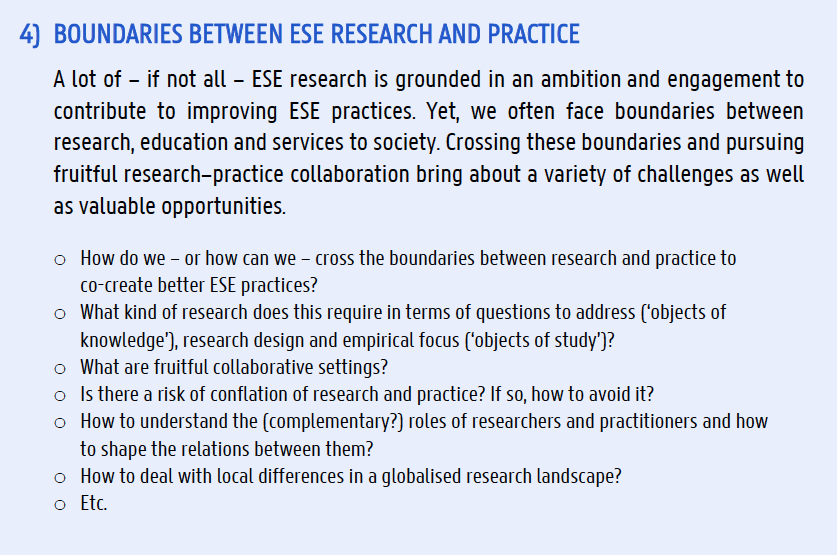
I am happy to announce the return of the infamous Invitational Research Seminars on Environmental & Sustainability Education. As one of the co-organisers I have the privileged to be part of an excellent group led this tim by Katrien van Poeck of Ghent University in Belgium. These are relatively small seminars. While they are no longer ‘by invitation only’ and open to anyone with a strong, insightful, creative, provocative, etc, proposal, spaces will be limited. Have a look a the key info, the theme and the wonderful sub-themes below or go directly to the Centre for Sustainable Development at Ghent University https://www.cdo.ugent.be/news/call-proposals
https://forms.office.com/pages/responsepage.aspx?id=3hyB1-_sbEmPkaF4YkG5nAXy6iDz_itPuL2K0IeXr0VUOFA5NUdJTzNPVkZHRTRLQVNGMVRRN0c5Ni4u

T-learning in Times of Transition Towards a Sustainable World – Keynote held for Learning for Sustainability Scotland

I was invited to give the closing keynote of the 2020 Annual General Meeting and Networking of Learning for Sustainability Scotland. The event was held online for the first time on 12th January 2021. More than 150 members gathered to explore the theme Building Forward Better: The role of Learning for Sustainability – What role does Learning for Sustainability play in making the world a better place, and how can we make this a reality? You can find a summary of the event and link to each of the programma elements here: https://learningforsustainabilityscotland.org/2021/01/28/report-from-the-lfs-scotland-jan-dec-2020-agm/

My talk titled ‘T-learning in Times of Transition Towards a Sustainable World’ presented an ultimately hopeful perspective on the role of new forms of learning and more ecological approaches of education in overcoming global systemic dysfunction – outlining some principles, perspectives and sharing international practice. You can see the 40 minute talk introduced generously by Rehema White, here: https://media.ed.ac.uk/media/1_gcmxxtyz The talk is followed up by some responses to questions raised by the participants.

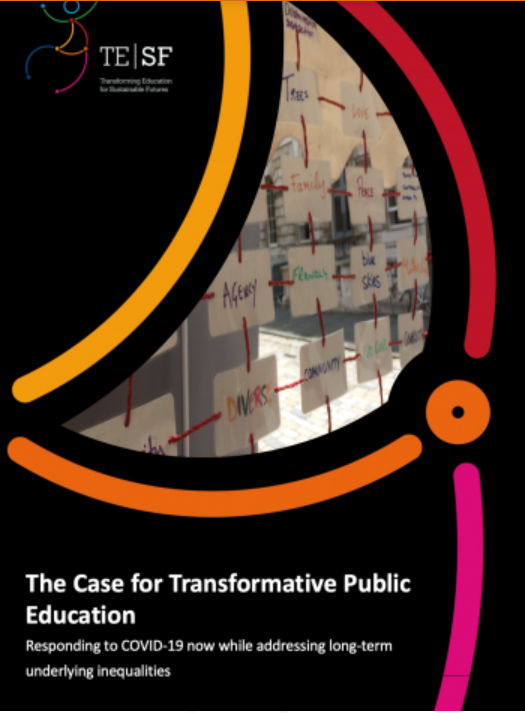
The Case for Transformative Public Education: Responding to Covid-19 now while addressing long-term underlying inequalities

Last Fall a consortium of which I am proud to be a part, along with the Education & Learning Sciences Group of Wageningen University received funding from the UK-government to a so-called GCRF Network Plus on Transforming Education for Sustainable Futures. The network is co-ordinated out of the University of Bristol and includes partners in India, Rwanda, Somalia/Somaliland, South Africa, the United Kingdom and the Netherlands. TESF undertakes collaborative research to Transform Education for Sustainable Futures. We have just released an introductory video (see above) and just released a timely paper:

TESFBriefing

Here is the link to the briefing paper:

The Case for Transformative Public Education: Responding to Covid-19 now while addressing long-term underlying inequalities

This paper addresses the following topics:

  • What is Transformative Public Education
  • Why Transformative Public Education matters to the COVID-19 response
  • Why Transformative Public Education matters for addressing long-term underlying risks to communities
  • Examples of Transformative Public Education responses to COVID-19
  • Suggestions for governments and state welfare actors seeking to work with Transformative Public Education
  • Suggestions for community leaders working with Transformative Public Education
  • Transformative Public Education in times of physical distancing
  • Key readings and resources

On the TESF website you will also find other resources you may find of interest. Have a look here TESF Home Page

This is TESF’s first response to the C-19 situation, and we would like to see it widely distributed, given the timely nature of this topic.  Please do all you can to share it widely across your networks. https://tesf.network/resource/transformative-public-education/

Sustainability-oriented Ecologies of Learning as a Response to Systemic Global Dysfunction – new book chapter

EcologiesofLearning.pngEcologies for Learning and Practice edited by Ronald Barnett and Andrew Jackson, provides the first systematic account of the ideas of learning ecologies and ecologies of practice and locates the two concepts within the context of our contemporary world. It focuses on how individuals and society are being presented with all manner of learning challenges arising from fluidities and disruptions, which extend across all domains of life. This book examines emerging ways of understanding and living purposively in these new fluidities and provides fresh perspectives on the way we learn and achieve in such dynamic contexts.

Providing an insight into the research of a range of internationally renowned contributors, this book explores diverse topics from the higher education and adult learning worlds. These include:

  • The challenges faced by education systems today
  • The concept of ecologies for learning and practice
  • The role and responsibility of higher education institutions in advancing ecological approaches to learning
  • The different eco-social systems of the world—local and global, economic, cultural, practical, technological, and ethical
  • How adult learners might create and manage their own ecologies for learning and practice in order to sustain themselves and flourish

With its proposals for individual and institutional learning in the 21st century and concerns for our sustainability in a fragile world, Ecologies for Learning and Practice is an essential guide for all who seek to encourage and facilitate learning in a world that is fundamentally ecological in nature.

In the chapter I contributed I argue that the current sustainability crisis demands a radical re-orientation of the way we learn. I consider sustainability to be an emergent property of an ecology of learning that is reflexive purposeful cocktail of actors, perspectives, forms or learning, connections and support mechanisms, driven by an ethical concern for the wellbeing of people and planet both now and in the future. Sustainability-oriented learning then becomes an organic and relational process of continuous framing, reframing, tuning and fine-tuning, disruption and accommodation, and action and reflection, which is guided by a moral compass inspired by an ethic of care. Such learning implies or even demands a certain freedom to explore alternative paths of development and new ways of thinking, valuing and doing.

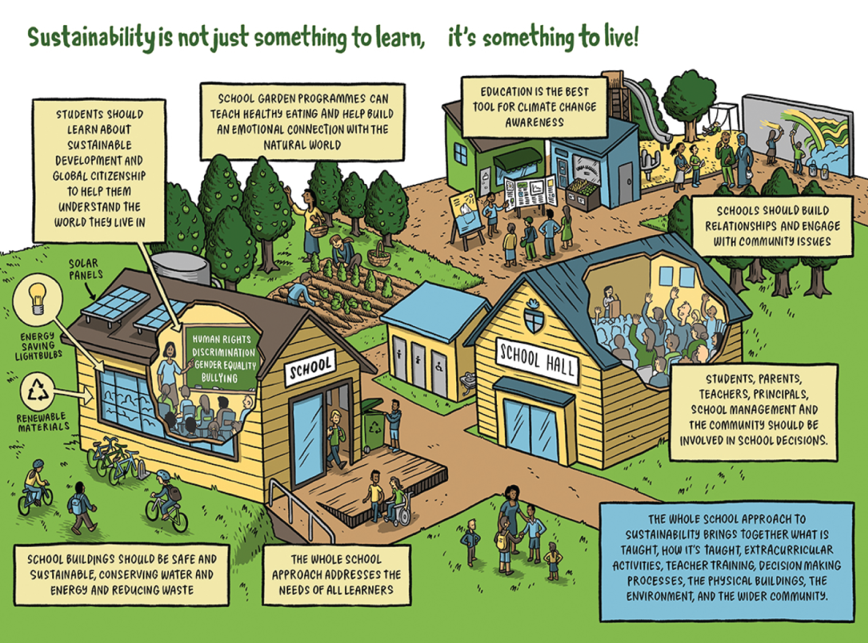
The chapter introduces sustainability-oriented ecologies of learning as a blended learning space where multiple actors, often having different backgrounds, co-create sustainability organically using a variety of tools, relations, and forms of learning. The concept of whole school or whole institution approaches is introduced as a way to enact such ecologies of learning in a systemic way (see the figure below from the 2016 Global Education Monitor Report published by UNESCO).

Full reference: Wals, A.E.J. (2019) Sustainability-oriented Ecologies of Learning as a response to systemic global dysfunction In: Learning Ecologies: Sightings, possibilities, and emerging practices Ronald Barnett and Norman Jackson (Eds.), London: Taylor & Francis. p. xx-xxx

Here is a link to the book on the publisher’s website!

WSA(2)

An ecology of learning created by a whole school approach to sustainability (source Global Education Monitoring Report, UNESCO, 2016)

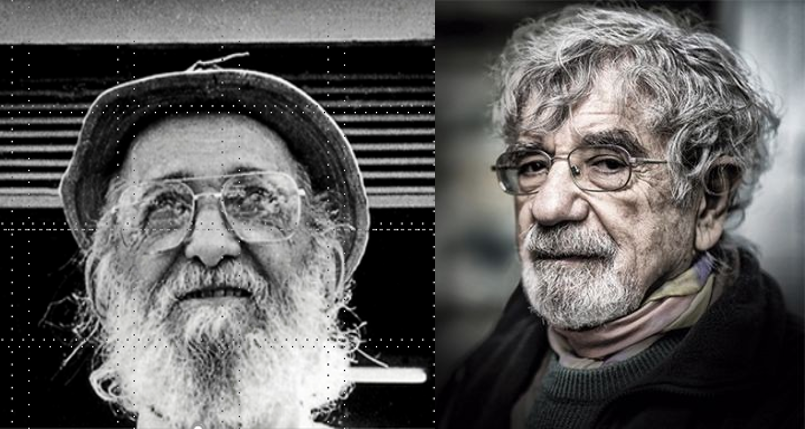
Learning-based transformations towards sustainability: a relational approach based on Humberto Maturana and Paulo Freire

FreireMaturanaPhoto

Recently a new paper I co-authored with lead author Daniele Tubino Souza and second co-author Pedro Jacobi appeared in Environmental Education Research – see: https://doi.org/10.1080/13504622.2019.1641183 or click:  Relational Pedagogy Freire & Maturana  

Here is the abstract. This paper is a part of Daniele’s PhD work at the University of Sao Paulo in Brazil which Pedro and I co-supervise. The paper is a first attempt to link the thinking of Paulo Freire and Humberto Maturana to each other and to emancipatory sustainability-oriented transformations in urban area’s.

Abstract

This article investigates the relevance of the work of the Latin-American thinkers Humberto Maturana and Paulo Freire to learning-based transformations towards sustainability. This analysis was inspired by a case study of a Brazilian urban community seeking to develop pathways towards sustainable living and was informed by a review of their key works. The paper aims to obtain a better conceptualization of learning-based transformations and provide insights into collective learning processes focused on advancing sustainable practices. We present notions of the transformative social learning approach that underpins the case study, using the concepts of Maturana and Freire as a lens. Our results indicate the importance of a relational approach in fostering collective learning processes. Finally, we derive three principles that can guide such processes: (1) facilitating transformative interactions between people and places, (2) enabling dialogic interaction within a climate of mutual acceptance, and (3) creating space for ontological pluralism.

One of the two key figures can be seen below – please go to the the publisher’s website to find the paper and the other figures!
FreireMaturana

Deconstructing a Happy Meal – making everyday life routine practices a source of transformative learning – indeed: food for thought!

“Today we’re going to study the food pyramid for healthy living!” the High School Social Science teacher Mark told his class. Mark was excited about launching a healthy food project that would enable kids to analyze their diets. He was well-prepared and had collected a number of teaching resources from government agencies, NGO’s and food-companies concerned with youth obesity and increasing health costs. One of his students called out: ”Food pyramids?” Boring! Why can’t we go to McDonalds?” This idea got the whole class excited, but frustrated Mark. After all, he had thought of something new that was hands-on and seemed very relevant. Later that evening Mark asked himself how he could motivate his students and engage them in an exciting learning process that would teach them something about health issues. He got an idea.

The next day Mark said to his class: “Today we’re going to McDonalds!” The whole class cheered. They couldn’t believe it.  Their teacher was actually going to take the whole class to the McDonalds near the mall across the street. “But…, there’s one condition. We will only buy one happy meal for the whole class”.  This got the students a little less excited, but they went anyway, just to get out of school. The class bought one cheeseburger happy meal and took it back to the classroom. Mark told the class that “unfortunately we are not going to eat the happy meal, we are going to carefully study it instead”.  He wrote down two questions on the blackboard:

What is in it?

Where did it come from?

They first dissected the meal: a plain bread bun, a slice of melted cheese, a grilled beef burger, salt, mustard, ketchup, pickles, French fries, diet cola, and, finally, a nice toy.

Then Mark divided the class in six groups of four students. One group got the bread bun, another group the salted French fries, another group the diet soda, another group got the burger, another group the accessories; ketchup, mustard and pickles and the last group got the plastic bagged happy meal toy.

“You have the remaining social science hours of the week to answer the two questions. Next week I want a short presentation with your findings from each of the groups. You can use the internet, the school library, the telephone in my office, and, if you need to ask questions across the street at the restaurant you can do so with my permission.”

All the groups went to work and the more they found out, the more interested they got. The group investigating the french fries found out that fast food chains need enormous volumes of potatoes and demand a certain type of potato that guarantees a consistent quality. As a result potato farmers around the world have reduced the number of potato varieties greatly. This has led to a loss of crop-biodiversity, making the remaining crops more vulnerable to pests and leading to an increase of pesticide use. A common response to this vulnerability is use genetically modified crops that are resistant to these pests. However the students also found out that McDonalds, pressured by concerned consumers, decided not to use Monsanto’s GM new leaf potato. The group’s investigation led to an interesting discussion about the pro’s and con’s of GM-foods. Most students were not aware that they were already consuming GM-foods. In fact the group studying the diet Cola found out that the sweeteners contained GM corn.  When presenting their finding students used a provocative quote from the internet to start a classroom-wide discussion:

Giant agribusiness, chemical and restaurant companies like Cargill, Monsanto and McDonalds dominate the world’s food chain, building a global dependence on unhealthy and genetically dangerous products. These companies are racing to secure patents on every plant and living organism and their intensive advertising seeks to persuade the world’s consumers to eat more and more sweets, snacks, burgers, and soft drinks.

Meanwhile the group investigating the happy meal toy learnt some things they didn’t expect to learn either. The discovered that the toys served cross-marketing purposes. Meaning that they bring parents and their children to the restaurant but they also promote things like Disney movies.  Most of the toys were made of plastic and not used by the children for a very long time. They went back to the McDonalds and studied how and for how long kids played with the toy and asked parents to estimate for how long the toy would remain in use. They estimated that the effective play time would be less than 10 minutes. Perhaps the most interesting finding they got by using the Internet. They found many sites – mostly activist  sites – that suggested that the happy meal toys were made in China. They came upon an article that stated that “.. a happy meal toy manufacturer, China-based City Toys Limited, employed children as young as 13 to assemble the “Happy Meal” toys.” These young teenagers were reportedly forced to work 16 hour days, seven days a week, and lived in crowded, on-site dormitories for a salary of less than 3 dollars a day. As a result of these revelations made in the Summer of 2000, McDonalds quickly responded by denying to have any knowledge about these conditions. The company distanced itself from City Toys Limited and moved its operations elsewhere. Since McDonalds was, at the time, not required to disclose information about its overseas contractors, it was difficult for the students to trace where they moved the operations and what the working conditions are at the new facilities. When this group presented their results to the class the were discussions about child-labour, children’s rights, ethics of moving jobs to countries with different standards and laws, but also about the consequences of McDonalds using a ‘cut-and-run’ strategy for the children in China working for City Toys, whose income might have been crucial for their families. The teacher also raised the issue of the reliability of the information of provided on the internet. Who put the information there? With what purpose? Is it based on fact?

The other groups too, found interesting information and point of discussion related to a happy meal (varying from beef imports, hormones in meat, clear cutting of rainforest to the sweeteners used in Diet-coke). One group was interested in figuring out ‘how many miles a happy meal has travelled to get to the local McDonalds? They didn’t get a chance to figure it out but they guessed tens of thousand of miles. The whole excersise was transformative in that they view of fast food in general and of a happy meal had changed. Mark’s concern was that, even though the students learnt a lot about food-related sustainability issues (health, environment, equity, economics), gathering information, presenting information, critical thinking, debating, etc., the project may have resulted in a rather bleak picture of something they really enjoyed: eating a nice juicy cheeseburger at McDonalds. He wanted the students to think about viable alternatives. So he asked the students a third question:

Can you design a happy meal that makes everybody happy?

The same groups started thinking about alternative buns, cheese, beef, mustard, pickles, soda, and even an alternative toy. This took another week of investigations but in the end they designed a happy meal that was more organic, healthier, socially-responsible and used up less energy. They cooked the happy meal themselves in the school kitchen for all junior high students and did a taste survey which demonstrated that the meal was a least as tasty as a McDonalds happy meal.  There was one problem: the new happy meal was far more expensive that the McDonald’s version. This raised another issue in the classroom: are we willing and/or able to pay more for meals that are healthier, more equitable, have less environmental impact? Some argued that consumers should demand this kind of food so that big corporations will change their own policies and practices, making alternative foods more affordable as demand increases.

“When McDonalds, Pringles, and the other major potato buyers decided not to sell Monsanto’s GM New Leaf potato, for example, it was soon taken off the market. McDonalds and others doomed Monsanto’s potato because they wanted to satisfy consumer demands. We have that power.” “In the U.S., Whole Foods Market, Wild Oats, and Trader Joe’s announced that GMOs would be removed from their store brands. Gerber baby foods, as well as scores of health food products, have similarly changed their ingredients.”

“When a store or brand removes GM ingredients, it has a ripple effect through the industry. After a supermarket chain commits to eliminate GMO’s, they usually send out a letter to their suppliers who in turn contact their suppliers and so on. A store may have hundreds of food items, each with a list of ingredients. Hundreds or thousands of businesses can be affected, right back to the farm level.

Others pointed out that their parents make decisions about what to buy, since they are the ones going to the grocery store.

The deconstructing of a happy meal became a transformative learning experience for all those involved, including Mark, the teacher. The happy meal brought out issues, tensions, dissonance, north-south relationships, health issues, ethics, the role of corporations, consumerism, economics, crop-biodiversity, etc.  It made an ordinary activity (going to McDonalds), somewhat unordinary and raised many critical questions that demanded some serious reflection. It developed a range of competencies in the students: asking questions, finding reliable information using a variety of sources, analysing data, presenting information, critical thinking, etc., etc.

Mark’s point of it all was not that students would reject going to McDonalds but that they would become aware of range of food-related issues: ethical ones with respect to using GMO-food or not, or with respect to children making toys for children, or which also raises questions about animal-well in relation to industrial agriculture, ecological ones, for instance, with respect to the potential loss of agro-biodiversity, environmental ones, for instance, with respects to the use of batteries in toys, the use of plastics or the energy used in food miles travelled or in ‘producing meat’ , and then there are economic ones, as well, for instance, with respect of the economies of scale of mass-production and consumption but also with respect to the shortening of food-chains and going local, when factoring in so-called “hidden” environmental costs.

Obviously, students can still choose, having considered all aspects and given their own situation, socially and economically and so on, to go to McDonalds but in all likelihood, having done an activity like this will have transformed the way they look at (fast) food. How this episode of transformative learning will affect who they are, who they’d like to become and how they will behave in the future cannot be known or measured shortly after the activity or even months of years later. This will depend on future experiences and circumstances, but what we do know is that having a learning experience like this will make learners a bit more conscious of what they eat and how this may impact themselves and the world around them.

Post-script:

Deconstructing a Happy Meal is a composite example based on a number of stories and ideas from critical teachers engaged with transformative learning and problem-posing-based teaching. The Happy Meal represents many forms of fast food and just as easily could have been built around other meals. The activity is meant to be educational and not prescriptive in that it tells people what to think and how to behave. It should be recognized that McDonalds, like many multi-nationals, are aware of their ecological footprints and have a range of sustainability and environmental-oriented policies and guidelines. Whether these efforts are genuine driven by a deep concern about the well-being of people and planet or driven by purely economic interests is in the eyes of the beholder.

The Happy Meal case has been presented at several international meetings on Education for Sustainable Development. For references to this example and type of learning please go to:

Wals, A.E.J. (2010) Mirroring, Gestaltswitching and Transformative Social Learning: stepping stones for developing sustainability competence. International Journal of Sustainability in Higher Education, (11(4), 380-390.

Sriskandarajah, N, Tidball, K, Wals, A.E.J., Blackmore, C. and  Bawden, R. (2010) Resilience in learning systems: case studies in university education. Environmental Education Research, 16(5/6), 559-573.

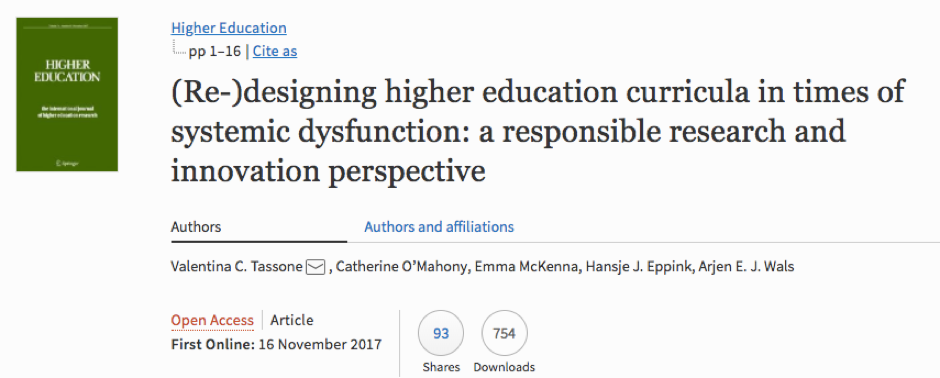
(Re-)designing higher education curricula in times of systemic dysfunction: a responsible research and innovation perspective

A new paper coming out of the EnRRich network LivingKnowledge & EnRRich seems ti get a lot of attention considering the number of paper downloads within the first 10 days the paper has appeared online. This is probably because many universities are struggling to find a good way to make education more relevant, responsive, responsible and reflexive in light of global sustainability challenges.

TassoneetAl

Here is the abstract and a link to Redesigning HE (open access, freely downloadable):

There is an urgent need to address the grand sustainability challenges of our time, and to explore new and more responsible ways of operating, researching, and innovating that enable society to respond to these challenges. The emergent Responsible Research and Innovation (RRI) policy agenda can act as a catalyst towards the development of new and more responsible research and innovation efforts. Inevitably, higher education needs to be closely attuned to this need and agenda, by preparing students to engage in RRI efforts. This paper makes a first step towards guiding the embedding of RRI within higher education. It does so by bringing together academic knowledge with phronesis or practical knowledge about what should be done in an ethical, political, and practical sense. It draws on a literature review and on the reflective practices of partners in the European Commission funded project EnRRICH (Enhancing Responsible Research and Innovation through Curricula in Higher Education), as well as on interviews and case studies gathered as part of the project. The paper suggests elements, especially design principles and a competence framework, for (re)designing curricula and pedagogies to equip higher education students to be and to become responsible actors, researchers, and innovators in a complex world, and to address grand sustainability challenges. In addition, this paper proposes that contemporary higher education teaching and learning policies and strategies, especially those promoting neoliberal agendas and marketized practices, need to adopt a more responsible and responsive ethos to foster the renewal of higher education in times of systemic dysfunction.

Keywords

Higher education Responsible research and innovation Grand sustainability challenges Curricula Competence 


Online Masters Course on Education in the context of Sustainable Development at Gothenburg University – starting November 1st

New Course: Education for sustainable development – an introduction

There is only one Earth. With global challenges such as climate change, mass extinction of species, rising inequity and a growing world population, the prospects for a quality life for all, forever seem rather bleak. Central in this new course is the question: What is the role and responsibility of education in not only responding to sustainability problems but also in preventing them and in creating more sustainable futures? But also what might such education look like? The course will take advantage of some of the materials and lessons learnt from the recently finished Global Environmental Education Course Gothenburg University supported – along with other universities and the US EPA- which was lead by Cornell University in association with the NAAEE’s EECapacity Program.

sutainabilitypie

In this 15 credit Master’s course you will critically and actively explore central concepts and perspectives in the field of education for sustainable development. The course content will be related to the participants’ own backgrounds, specific interests and prior experiences. Master students with different study backgrounds (e.g. environmental sciences, social sciences, economics, arts and humanities) can enrol in this course as long as you have an interest in both sustainable development and education.

The course is offered by Gothenburg University online at half time during the second half of autumn 2016 (Start: November 1 – Finish: March 22, 2017). The main course language is English. There are four blocks: 1) Understanding Sustainable Development, 2) Understanding Education in relation to SD, 3) Understanding learning environments, processes and outcomes conducive to SD and 4) Education in relation to your own SD-challenge (personal project). Each block is divided up in course weeks, each with short introductory videos, background literature, discussion questions and online discussion. Periodically there will be assignments that will be used in providing feedback and assessing the quality of your contributions. The new Global Education Monitor Report on Education for People and Planet: Creating Sustainable Futures for All will be one of the texts used in the course.

For the pilot course we are admitting a maximum of 50 students. You will need to formally register for the course through Gothenburg University via this link to the GU course web-page.

More information about course content contact me at: Arjen.wals@gu.se

More information about course logistics and registration can be found via the link to the course’s webpage (hyperlink).

Note: eligible students from European Union can participate without paying tuition to Gothenburg University. Students from outside the European Union will have to pay a tuition fee. It is assumed that participants have a bachelor degree or equivalent and have a proficient mastery of the English language (evidence of this may need to be provided).

Sustainability Citizenship in Cities: Theory and Practice – now available!

sustainability-citizenship-in-cities-theory-and-practice-by-ralph-horne-1317391071

Australian colleagues Ralphe Horne, John Fien, Beau Beza and Anitra Nelson edited a fascinating book on ‘sustainability citizenship’ to which I was priviledged to contribute a chapter together with Frans Lenglet. Urban sustainability citizenship situates citizens as social change agents with an ethical and self-interested stake in living sustainably with the rest of Earth. Such citizens not only engage in sustainable household practices but respect the importance of awareness raising, discussion and debates on sustainability policies for the common good and maintenance of Earth’s ecosystems.

The publisher’s website describes the book as follows:

Sustainability Citizenship in Cities seeks to explain how sustainability citizenship can manifest in urban built environments as both responsibilities and rights. Contributors elaborate on the concept of urban sustainability citizenship as a participatory work-in-progress with the aim of setting its practice firmly on the agenda. This collection will prompt practitioners and researchers to rethink contemporary mobilisations of urban citizens challenged by various environmental crises, such as climate change, in various socio-economic settings.

This book is a valuable resource for students, academics and professionals working in various disciplines and across a range of interdisciplinary fields, such as: urban environment and planning, citizenship as practice, environmental sociology, contemporary politics and governance, environmental philosophy, media and communications, and human geography.

The chapter Frans Lenglet and I wrote is titled: “Sustainability citizens: collaborative and disruptive social learning” and emphasizes the role of learning and cultivating diversity and generative conflict in co-determining what it means to be sustainable within the everyday realities people find themselves. It is argued that in order to brake with stubborn unstustainabel routines – that are heavily promoted and strenghtened in a market, growth and consumption-oriented society, citizens will also need to develop disruptive capacity and engage in transgressive learning (see my earlier post about transgressive learning and the work within the ICSS project on T-learning led by Prof. Heila Lotz-Sisitka from Rhodes Univerity in South Africa). If you want to have a look at our chapter you can find it here: SustainabilityCitizenshipWalsLenglet2016 (for personal use). The full reference is:

Wals, A.E.J. & F. Lenglet (2016). Sustainability citizens: collaborative and disruptive social learning. In: R. Horne, J. Fien, B.B. Beza & A. Nelson (Eds.) Sustainability Citizenship in Cities: Theory and Practice. London: Earthscan, p. 52-66.

If you want to get a hold of the entire book visit: https://www.routledge.com/Sustainability-Citizenship-in-Cities-Theory-and-practice/Horne-Fien-Beza-Nelson/p/book/9781138933637