This paper led by ELS-WUR PhD-candidate Marlies van der Wee – Bedeker was published earlier this Fall. The paper is the first peer reviewed article based on her research that is grounded in the City of Rotterdam using her home institute Hogeschool Rotterdam as a base. Below a summary of the main fiindings. The full paper can be found here!
This collaborative multi-authored paper develops the methodological concept of river co-learning arenas (RCAs) and explores their potential to strengthen innovative grassroots river initiatives, enliven river commons, regenerate river ecologies, and foster greater socio-ecological justice. The integrity of river systems has been threatened in profound ways over the last century. Pollution, damming, canalisation, and water grabbing are some examples of pressures threatening the entwined lifeworlds of human and non-human communities that depend on riverine systems. Finding ways to reverse the trends of environmental degradation demands complex spatial–temporal, political, and institutional articulations across different levels of governance (from local to global) and among a plurality of actors who operate from diverse spheres of knowledge and systems of practice, and who have distinct capacities to affect decision-making. In this context, grassroots river initiatives worldwide use new multi-actor and multi-level dialogue arenas to develop proposals for river regeneration and promote social-ecological justice in opposition to dominant technocratic-hydraulic development strategies. This paper conceptualises these spaces of dialogue and action as RCAs and critically reflects on ways of organising and supporting RCAs while facilitating their cross-fertilisation in transdisciplinary practice. By integrating studies, debates, and theories from diverse disciplines, we generate multi-faceted insights and present cornerstones for the engagement with and/or enaction of RCAs. This encompasses five main themes central to RCAs: (1) River knowledge encounters and truth regimes, (2) transgressive co-learning, (3) confrontation and collaboration dynamics, (4) ongoing reflexivity, (5) transcultural knowledge assemblages and translocal bridging of rooted knowledge.
Citation:
De Souza, D. T., Hommes, L., Wals, A., Hoogesteger, J., Boelens, R., Duarte-Abadía, B., … Joy, K. J. (2024). River co-learning arenas: principles and practices for transdisciplinary knowledge co-creation and multi-scalar (inter)action. Local Environment, 1–23. https://doi.org/10.1080/13549839.2024.2428215
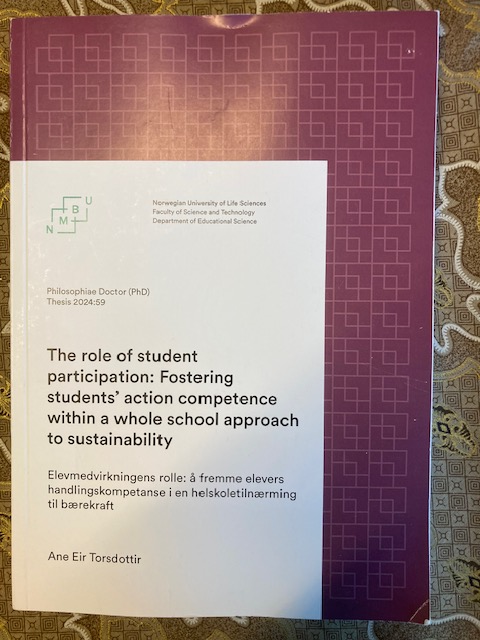
On Friday November 1st one of my Norwegian PhD Candidates successfully defended her dissertation. Over the past few years I have been working with colleagues both at Wageningen University and at the Norwegian Life Sciences University (NMBU) on researching the potential merits of so-called Whole School and/or Whole Institution Approaches (WSA/WIA) to sustainability. At NMBU there are currently four PhD-candidates doing research related to this, Ane Eir Thorsdottir is or rather, was one of them. Her work focusses on one aspect of the WSA which is critically important: students participation. In addition to myself, Prof Astrid Sinnes of NMBU and Dr. Daniel Olsson of Karlstad University in Sweden were her supervisors. Jan Cincera and Elin Saether (Olso Univerity) were her ‘ opponents’ .She has published three articles that are central in the dissertation: two in Environmental Education Research and one in Global Environmental Research.
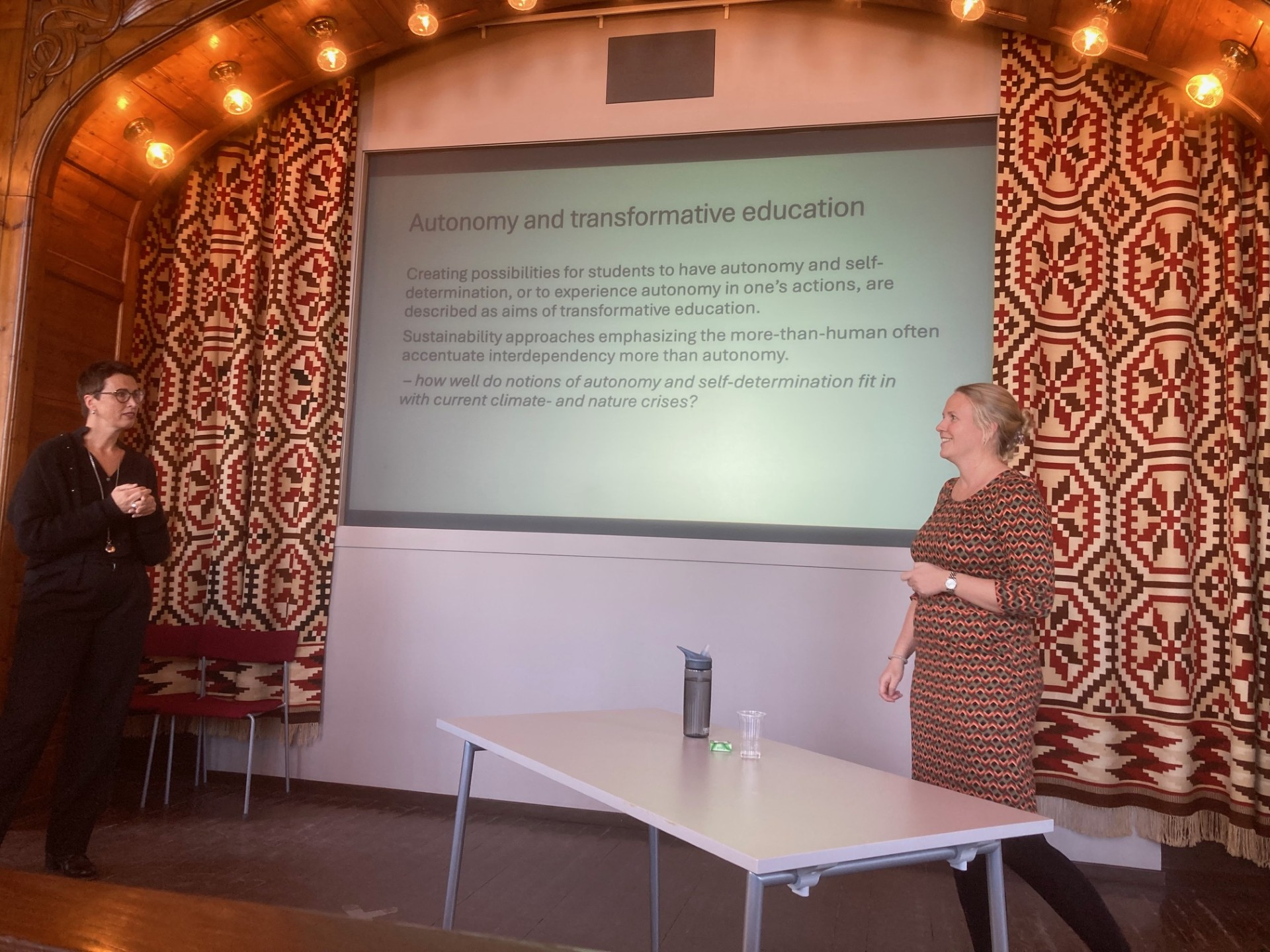
Elin Seather (left) having a dialogue with Ane (right) during the defence – posing an interesting question about autonomy and self-determination as pedagogical principles in a world that requires a decentering of ‘ self’ and opening up for ‘ other’ as well.
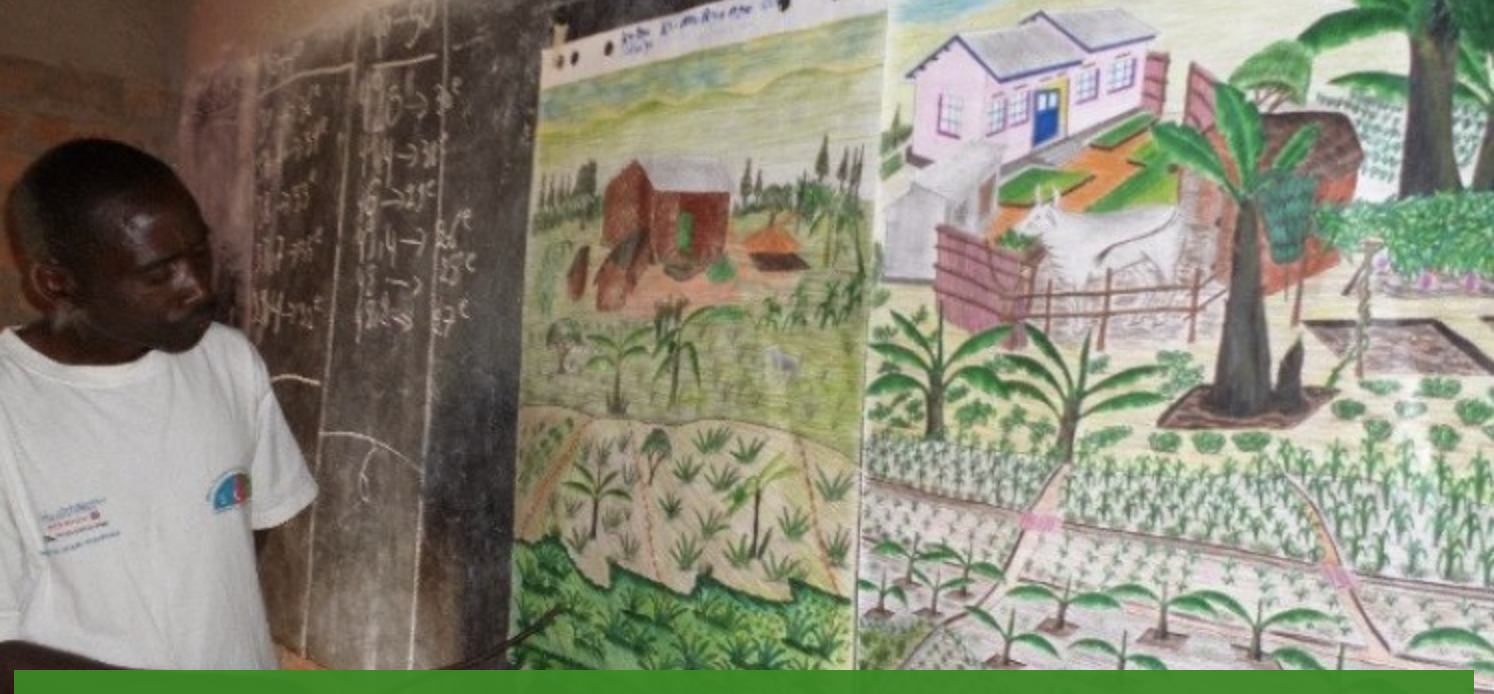
A new paper reporting on a study led by PhD-Candidate Doreen Misanya was published today in the Journal of Agricultural Education and Extension. The paper titled ´Competences for socio-ecological stewardship: a qualitative assessment of the transformative potential of farmers’ learning processes in Eastern Uganda´, identifies socio-ecological stewardship competences that smallholder farmers in the Manafwa watershed in Eastern Uganda, developed by participating in a project founded on the Participatory Integrated Planning approach (PIP – see image above).
The study identified socio-ecological stewardship competences comprising different sustainability-related dimensions including: ‘environmental knowledge’ as environmental systems, action-related, effectiveness, social, and ethical knowledge; ‘connection with nature’ as establishing an identity with nature, appreciating the value of nature, social, and ethical attitudes; and ‘ecological behaviour’ as conservation and restoration, social, and ethical actions.The study also shows that Competence dimensions are interconnected thus requiring learning environments that develop them simultaneously. Additionally, social and ethical competences are relevant for supporting stewardship action.
Theoretically, this study expands Roczen’s environmental competence model by including social, ethical, and conservation and restoration action competences. This study is one of the first to identify socio-ecological stewardship competences and the learning processes that can foster these competences.
Full citation:
Misanya, D., Tassone, V. C., Kessler, A., Wals, A. E. J., & Kibwika, P. (2024). Competences for socio-ecological stewardship: a qualitative assessment of the transformative potential of farmers’ learning processes in Eastern Uganda. The Journal of Agricultural Education and Extension, 1–21. https://doi.org/10.1080/1389224X.2024.2403597
Today, the first article from Ane Torsdottir’s PhD Research on High School student’s partcipation in schools trying to work within a Whole School Approach in Southern Norway, was published in Environmental Education Research. The article, co-authored by her supervising team with Daniel Olsson, Astrid Sinnes and myself, demonstrates how a questionnaire gauging students’ experiences of participation in decision-making at their school can operationalise student participation in a whole school approach (WSA) to education for sustainable development model.
Some 902 students in three upper secondary schools participated in the study by giving their answers to Likert-scale items developed to tap into their experience of participation in the decision-making at their school.
The students identified four distinct pathways of participation:
(i) School and Leadership,
(ii) Teaching and Learning,
(iii) Community Connections, and
(iv) Student Council.
The results are discussed in the light of focus group interviews with eleven of the participants. The student WSA participation questionnaire proved to be a reliable and valid instrument that, together with the student WSA participation model, can be used by school leaders wanting to increase student participation, and by researchers investigating student participation throughout the whole school.
Full citation:Torsdottir A.E, Sinnes A, Olsson D. & Wals, A. (2023) Do students have anything to say? Student participation in a whole school approach to sustainability, Environmental Education Research, DOI: 10.1080/13504622.2023.2213427




 Transformative learning