
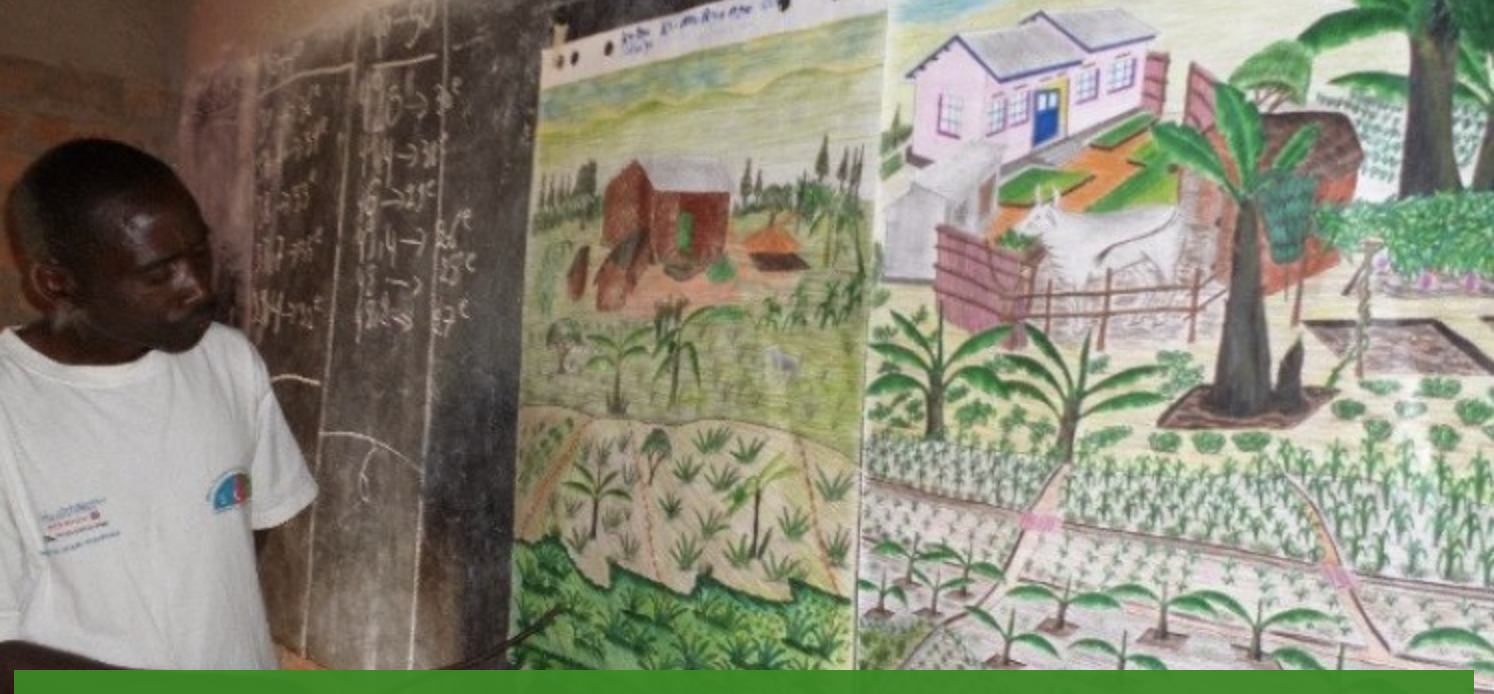
A new paper reporting on a study led by PhD-Candidate Doreen Misanya was published today in the Journal of Agricultural Education and Extension. The paper titled ´Competences for socio-ecological stewardship: a qualitative assessment of the transformative potential of farmers’ learning processes in Eastern Uganda´, identifies socio-ecological stewardship competences that smallholder farmers in the Manafwa watershed in Eastern Uganda, developed by participating in a project founded on the Participatory Integrated Planning approach (PIP – see image above).
The study identified socio-ecological stewardship competences comprising different sustainability-related dimensions including: ‘environmental knowledge’ as environmental systems, action-related, effectiveness, social, and ethical knowledge; ‘connection with nature’ as establishing an identity with nature, appreciating the value of nature, social, and ethical attitudes; and ‘ecological behaviour’ as conservation and restoration, social, and ethical actions.The study also shows that Competence dimensions are interconnected thus requiring learning environments that develop them simultaneously. Additionally, social and ethical competences are relevant for supporting stewardship action.
Theoretically, this study expands Roczen’s environmental competence model by including social, ethical, and conservation and restoration action competences. This study is one of the first to identify socio-ecological stewardship competences and the learning processes that can foster these competences.
Full citation:
Misanya, D., Tassone, V. C., Kessler, A., Wals, A. E. J., & Kibwika, P. (2024). Competences for socio-ecological stewardship: a qualitative assessment of the transformative potential of farmers’ learning processes in Eastern Uganda. The Journal of Agricultural Education and Extension, 1–21. https://doi.org/10.1080/1389224X.2024.2403597




 Transformative learning