Time for ‘T-learning’ – transformative, transgressive learning in times of climate change

transgressive

Still feeling very privileged and a bit lucky to be part of a very rich consortium of partners from 4 different continents – as one of 3 selected proposal out of more than 500 (!) original expressions of interest – to work on this ICSS-funded project on T-learning. The project just launched its website: http://transgressivelearning.org/ with the case studies form the 10 different countries. Here is what we are talking about:

Radical changes in society are needed for responding to climate change, and for transforming to sustainability. It is increasingly clear that people everywhere will need to learn to transform to sustainability in ways that are socially just, peaceful and ecologically sustainable.

It is now already widely known that transformations to sustainability can occur if people learn to make changes at niche level. This can drive wider social changes and regime shift transformations, especially if such forms of learning become more collective.

Transformations to sustainability do not come about easily because of ‘lock-ins’ in the system. Transformative, transgressive types of learning are needed to help ‘unlock’ the lock-ins and to strengthen wider forms of collective social learning.

Yet, we know little about the type of transformative, transgressive learning (t-learning) that enables such change.

Here’s the initial ‘academic’ paper we wrote: transgressiveSocialLearning (only to have a look, not for sharing with others).

Full reference: Lotz-Sisitka H, Wals AEJ, Kronlid D, McGarry D. (2015) ‘Transformative, transgressive social learning: rethinking higher education pedagogy in times of systemic global dysfunction’, Current Opinion in Environmental Sustainability , 16, 73-80, doi:10.1016/j.cosust.2015.07.018

Go visit the website! http://transgressivelearning.org/ or here: Join T-learning form

On-line Masters Course on Education in the Context of Sustainable Development at Gothenburg University

logueng_cen2rwageningenuniversityresearchlogo

New Course: Education for sustainable development – an introduction

With global challenges such as climate change, mass extinction of species, rising inequity and a growing world population, the prospects for a quality life for all, forever seem rather bleak. Central in this new course is the question: What is the role and responsibility of education in not only responding to sustainability problems but also in preventing them and in creating more sustainable futures? But also what might such education look like? The course will take advantage of some of the materials and lessons learnt from the recently finished Global Environmental Education Course Gothenburg University supported – along with Wageningen University & Research and other universities and the US EPA- which was lead by Cornell University in association with the NAAEE’s EECapacity Program.

sutainabilitypie

In this 15 credit Master’s course you will critically and actively explore central concepts and perspectives in the field of education for sustainable development. The course content will be related to the participants’ own backgrounds, specific interests and prior experiences. Master students / students who have completes their Bachelors with different study backgrounds (e.g. environmental sciences, social sciences, economics, arts and humanities) can enrol in this course as long as you have an interest in both sustainable development and education and meet the basic English proficiency requirement of Gothenburg University.

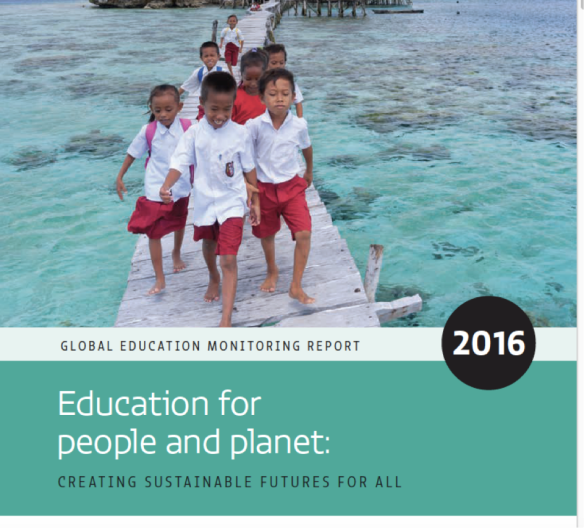
The course is offered  online at half time starting November 1 and finishing March 22, 2017). The main course language is English. There are four blocks: 1) Understanding Sustainable Development, 2) Understanding Education in relation to SD, 3) Understanding learning environments, processes and outcomes conducive to SD and 4) Education in relation to your own SD-challenge (personal project). Each block is divided up in course weeks, each with short introductory videos, background literature, discussion questions and online discussion. Periodically there will be assignments that will be used in providing feedback and assessing the quality of your contributions. The new Global Education Monitor Report on Education for People and Planet: Creating Sustainable Futures for All will be one of the texts used in the course.

For the pilot course we are admitting a maximum of 50 students. You will need to formally register for the course through Gothenburg University via this link to the GU course web-page.

More information about course content contact me at: Arjen.wals@gu.se

More information about course logistics and registration can be found via the link to the course’s webpage (hyperlink).

Note: eligible students from European Union can participate without paying tuition to Gothenburg University. Students from outside the European Union will have to pay a tuition fee. It is assumed that participants have a bachelor degree or equivalent and have a proficient mastery of the English language (evidence of this may need to be provided).

Does the GEM 2016 report signify a change from the dominant neo-liberal agenda that sees education as an extension and a driver of the globalizing economy and the its push for infinite growth, innovation and expansion?

Does the GEM 2016 report signify a change from the dominant neo-liberal agenda that sees education as an extension and a driver of the globalizing economy and the its push for infinite growth, innovation and expansion?

In a recent interview for EurActive.com  Environmental Education Professor and a dear colleague and critical friend of mine already for many years, Lucy Sauvé from Quebec, sees in the GEM 2016 report more evidence that there is no substantial change in the ‘language’ of the latest UN Report on education and sustainable development. She cherry picks some statements from the report to illustrate this. I agree, there are some or even many cherries to pick with a neo-liberal flavour. But I can also pick cherries with a different flavour – a flavour that was completely or mostly absent in the UN ESD world.

gem2916

I have both worked with the UNESCO DESD and the Global Education Monitor Team which operates separate from the DESD – even though it is located on the same floor in the UNESCO headquarters as the ESD-team – indeed as a critical friend in the sense that I am sympathetic to any attempt that can re-orient education towards planet and people, but that I am also cautious of co-optation of such efforts by that same neoliberal agenda.

So when I read about People-Planet-Profit (as the GEM team used initially) then I must ask ‘who or what got the P for Profit in there?’ Why not just People and Planet? If you need to have something more explicitly related to economy in there, then let us at least use the P of Prosperity.

When I read that education for all is important for all, because it will lead to economic development which is prerequisite for ecological and environmental sustainability then this logic must be questioned: is education there to serve the economy first and foremost? Is all education by definition good or can it be highly problematic? Etc.

When the ‘world of business’ jumps on the sustainable development, sustainability and ‘green’ bandwagon, then we must look critically at what the underlying motives are and what their efforts really entail. A car company promoting its hydride car using ‘sustainable excitement’ as its slogan, while at the same time manipulating its emission tests, needs to be questioned. Critical thinking is essential and asking disruptive questions is a part of that.

When we read about sustainable development we must also ask ‘must we always develop?’ Or can sustainability represent an alternative TO development? When we read UN DESD documents or the GEM2016 report we must also ask are there any references to ethics? the non-human world? Indigenous ways of knowing and being in the world? Etc.

Of course it is always easier to critique than it is to transform. Being near or within UNESCO circles I feel can have more impact in changing the dominant discourse than staying outside of it by raising the above questions from within in dialogue. Sure the UN is an enormous bureaucracy that doesn’t change overnight, but change does happen.

Working with the GEM Team for about 5 months has given me some insights in how such a comprehensive report is written: framing of the key issues, commissioning papers to mostly external experts, carefully selecting, re-organising and editing texts, distilling key messages as GEM reports are message-oriented, creating a coherent grand document, several rounds of ‘fact-checking’ and copy-editing.

The initial framing and the choice of experts who are to write about the key issues has a huge influence on the tone and direction of the narrative. When I came in, half a year before the report had to be finalized, the framing had been done and could not be changed much really (the thematic section, that I was involved in, is framed around 6 Ps: Planet, Prosperity, People, Places, Participation and Partnerships, whereas the second part of the report, the monitoring part, is framed around SDG 4 (Education) and 17 (Partnerships).

Where I could still have some influence was the tone and direction of the narrative, tweaking it towards a more critical perspective on the role of education and the current economy – with regards to gender, equity, indigenousness and participation the people from the GEM team working on those sections already had a rather critical perspective.

I should point out that initially I was surprised that the framing and selecting of experts was done without any consultation of the UNESCO ESD section. I asked the GEM Team why there was no or little interaction between the two sections. The response was that the Team wanted to write a more evidence-based report not using a potentially too rosy ESD lens but using a sober education lens to get a more accurate picture of the role of education in creating more sustainable futures for all. I also checked with the ESD section if this annoyed them but they were not. In fact they welcomed such an ‘independent’ attempt and hope it would lead to new insights and bring in new and more people into the conversation.

Now back to the initial question of this post: Does the GEM 2016 report signify a change from the dominant neo-liberal agenda that sees education as an extension and a driver of the globalizing economy and the its push for infinite growth, innovation and expansion?

If you are looking for confirmation of replication and affirmation of this agenda you will find it – as Lucy did, however, if you look for a shift in the common discourse, you will also find it. Below I have done some cherry-picking of my own by selecting some key messages that I think represent a counter narrative and a potential shift away from business as usual. Here are my cherries from the GEM2016 report, and believe me, some of them are quite radical and signify a departure form standard UN rhetoric:

  • Current models of economic growth cause environmental destruction
  • For education to be transformative in support of the new sustainable development agenda, ‘education as usual’ will not suffice.
  • Education cannot fight inequality on its own. Labour markets and governments must not excessively penalize lower income individuals. Cross sectoral cooperation can reduce barriers to gender equality.
  • A whole-school approach is needed to build green skills and awareness. Campaigns, companies, as well as community and religious leaders must advocate for sustainability practices. Non-formal education and research and development should also help solve global environmental challenges.
  • Expand education on global citizenship, peace, inclusion and resilience to conflict. Emphasize participatory teaching and learning especially in civic education. Invest in qualified teachers for refugees and displaced people, and teach children in their mother language. Incorporate education into the peacebuilding agenda.
  • Distribute public resources equitably in urban areas, involving the community in education planning.
  • Mobilize domestic resources, stop corporate tax evasion and eliminate fossil fuel subsidies to generate government revenue for fundamental needs such as education and health.
  • Include education in all discussions on urban development. Improve and fund urban planning programmes and curricula to include cross-sector engagement and develop locally-relevant solutions.
  • Promote the value of indigenous livelihoods, traditional knowledge and community-managed or -owned land through actions such as land conservation and locally relevant research.
  • Engage community elders in curricular development and school governance, produce appropriate learning materials and prepare teachers to teach in mother languages.
  • Incentivize universities to produce graduates and researchers who address large-scale systemic challenges through creative thinking and problem-solving.
  • Promote cooperation across all sectors to reduce policy-related obstacles to full economic participation by women or minority groups, as well as discrimination and prejudice that also act as barriers.
  • Support multistakeholder governance for the sustainable management of natural resources and of public and semi-public rural, urban and peri-urban spaces.

But there’s more – the GEM2016 has a somewhat different take on Sustainable Development than previous UN reports recognizing that there are different perspectives, including ones that critique the notion of continuous development (the quote below comes form page 4 of the report):

‘The different perspectives of sustainable development include viewing it as a model to improve current systems (endorsed by those focusing on viable economic growth), a call for major reforms (supported by those who advocate for a green economy and technological innovation) and an imperative for a larger transformation in power structures and embedded values of society (supported by transition movements). Some ecologists, such as deep ecologists, believe present-day human development focuses too much on people and ignores the plant, animal and spiritual parts of this world (Leonard and Barry, 2009). They believe humans must learn to be less self-interested and place the needs of other species alongside their own. Transformation advocates say societies should go back to ways of living that are locally sustainable – consuming and wasting less, limiting needs to locally available resources, treating nature with respect, and abandoning polluting technology that has become an integral part of modern society. Culture advocates believe sustainable living can happen only if communities truly embrace it as part of daily culture (Hawkes, 2001) so that it affects decisions about what to eat, how to commute to work and how to spend leisure time.

The South American buen vivir movement rejects development as materialistic and selfish, implying that living sustainably means finding alternatives to development (Gudynas, 2011). The buen vivir belief system comes directly from traditional values of indigenous people, and posits that collective needs are more important than those of the individual. In Ecuador, this concept is called sumak kawsay, the Quechua term for fullness of life in a community. It involves learning to live within boundaries, finding ways to reduce use or to do more with less, and exploring non-material values. Ecuador and the Plurinational State of Bolivia have incorporated buen vivir into their constitutions.

Most definitions of sustainable development challenge the status quo, believing human development lacks meaning without a healthy planet. This view requires people, communities and nations to reconsider basic values of daily living and change the way they think. Understanding one’s own values, the values of one’s community and society, and those of others around the world is a central part of educating for a sustainable future. This means education systems need to continuously evolve and change in order to identify what practices work best within a given context and how they need to change over time. Indeed, for many of its advocates in education, sustainable development is best understood as a journey, rather than a destination.’

So in short – yes it is easy to critique this report as an extension of hegemonic globalizing thinking and  as another attempt to hijack any efforts to change the dominant discourse, but I think that is too easy and not very generative. Rather I would look for the elements that represent a potential shift and a transition towards alternatives and help amplify them by highlighting and sharing them. Some of the texts above would have been unthinkable in mainstream UN-speak only 10 years ago. The glass is half full, not half empty this time.

Arjen Wals, September 14th, 2016

GEM2016 – Education for People and Planet: creating sustainable futures for all – now available (open access)

gem2916

On September 6th the new Global Education Monitor report was launched – and it comes highly recommended as a comprehensive report that can help re-orient education towards sustainability and helping education become more responsive, relevant and responsible in light of today’s global challenges. It was a pleasure for me to help the GEM2016 team in preparing this report – especially in the Introduction and the first two chapters. The full report can be downloaded at: http://gem-report-2016.unesco.org/en/home/ or by clicking gem2016educationforpeopleandplanet. The report – over 550 pages – will appear in multiple languages in due time and is also available in a summary form. It can be an useful text in higher education when read critically and properly discussed.

Below is a short introduction to the report from the GEM2016 website.

At the 70th Session of the United Nations General Assembly in September 2015, member states adopted a new global development agenda, Transforming our world: the 2030 Agenda for Sustainable Development. At its heart are 17 Sustainable Development Goals (SDGs), including SDG 4 on education. The SDGs establish development priorities to 2030 and succeed both the Millennium Development Goals and the Education for All (EFA) goals, whose deadlines expired in 2015.

Education will not deliver its full potential to catapult the world forward unless participation rates dramatically improve, learning becomes a lifelong pursuit and education systems fully embrace sustainable development

The Global Education Monitoring Report (GEM Report), which builds on the experience of the previous EFA Global Monitoring Report series, received a new mandate to assess the progress of education under the 2030 Agenda. The 2016 GEM Report, the first of the new 15-year series, explores the complex relationship between education and other facets of sustainable development, along with the monitoring implications for SDG 4. It shows that education will not deliver its full potential to catapult the world forward unless school participation rates dramatically improve, learning becomes a lifelong pursuit and education systems fully embrace sustainable development.

The thematic part of the report highlights evidence, practices and policies that demonstrate how education can serve as a catalyst for the overall sustainable development agenda. It presents compelling arguments for the types of education that are vital for achieving the goals of poverty reduction, hunger eradication, improved health, gender equality and empowerment, sustainable agriculture, resilient cities and more equal, inclusive and just societies.

The monitoring part tackles the many challenges concerning how to assess progress on SDG 4, including concrete recommendations for policy change. Each of the seven education targets and three means of implementation in SDG 4 are examined in turn. In addition, education finance and education systems are analysed, as is the extent to which education can be monitored in the other SDG goals. Building blocks and potential synergies for a more effective and efficient global education monitoring agenda over the next 15 years are identified at the national, regional and international levels.


Sustainability Citizenship in Cities: Theory and Practice – now available!

sustainability-citizenship-in-cities-theory-and-practice-by-ralph-horne-1317391071

Australian colleagues Ralphe Horne, John Fien, Beau Beza and Anitra Nelson edited a fascinating book on ‘sustainability citizenship’ to which I was priviledged to contribute a chapter together with Frans Lenglet. Urban sustainability citizenship situates citizens as social change agents with an ethical and self-interested stake in living sustainably with the rest of Earth. Such citizens not only engage in sustainable household practices but respect the importance of awareness raising, discussion and debates on sustainability policies for the common good and maintenance of Earth’s ecosystems.

The publisher’s website describes the book as follows:

Sustainability Citizenship in Cities seeks to explain how sustainability citizenship can manifest in urban built environments as both responsibilities and rights. Contributors elaborate on the concept of urban sustainability citizenship as a participatory work-in-progress with the aim of setting its practice firmly on the agenda. This collection will prompt practitioners and researchers to rethink contemporary mobilisations of urban citizens challenged by various environmental crises, such as climate change, in various socio-economic settings.

This book is a valuable resource for students, academics and professionals working in various disciplines and across a range of interdisciplinary fields, such as: urban environment and planning, citizenship as practice, environmental sociology, contemporary politics and governance, environmental philosophy, media and communications, and human geography.

The chapter Frans Lenglet and I wrote is titled: “Sustainability citizens: collaborative and disruptive social learning” and emphasizes the role of learning and cultivating diversity and generative conflict in co-determining what it means to be sustainable within the everyday realities people find themselves. It is argued that in order to brake with stubborn unstustainabel routines – that are heavily promoted and strenghtened in a market, growth and consumption-oriented society, citizens will also need to develop disruptive capacity and engage in transgressive learning (see my earlier post about transgressive learning and the work within the ICSS project on T-learning led by Prof. Heila Lotz-Sisitka from Rhodes Univerity in South Africa). If you want to have a look at our chapter you can find it here: SustainabilityCitizenshipWalsLenglet2016 (for personal use). The full reference is:

Wals, A.E.J. & F. Lenglet (2016). Sustainability citizens: collaborative and disruptive social learning. In: R. Horne, J. Fien, B.B. Beza & A. Nelson (Eds.) Sustainability Citizenship in Cities: Theory and Practice. London: Earthscan, p. 52-66.

If you want to get a hold of the entire book visit: https://www.routledge.com/Sustainability-Citizenship-in-Cities-Theory-and-practice/Horne-Fien-Beza-Nelson/p/book/9781138933637


Education for people and planet: Creating sustainable futures for all – GEM-2016 soon to be launched

global-education-monitoring-report-300x225

Starting in 2016 a new series of UNESCO reports, the Global Education Monitoring (GEM) Reports, will monitor the state of education in the new framework of the Sustainable Development Goals (SDGs). The new series replaces the earlier Global Monitoring Report (GMR) series. I was brought on board the GEM 2016 Team last December to provide input on the thematic part of the report – especially to provide feedback on the relationship between education and achieving sustainability.

The report has been titled: ‘Education for people and planet: Creating sustainable futures for all’. It is a very comprehensive and well-researched report that seeks to be geographically balanced in its analysis and examples. There are two parts: a thematic part and a monitoring part. My role was mainly limited to providing feedback to the thematic part which covers 5 ‘Ps’s: Planet, Prosperity, People, Place and Partnerships. The thematic Part 1 of the Report focuses on examining the complex interrelationships and links between education and key development sectors. It determines which education strategies, policies and programmes are most effectively linked to the economic, social, environmental and political priorities of the new sustainable development agenda.  Part 2 establishes a much needed a monitoring framework for education post-2015, and examine key financing and governance challenges for the post-2015 era.

You can read the concept note that underpins the report here. 

The GEM 2016 report will appear in multiple languages.

Sign up to receive the report in your inbox as soon as it’s released.


The relevance of Jane Jacobs and Elinor Ostrom to urban socio-ecology

jane+in+news+slideshowJane Jacobs and Elinor Ostrom were both giants in their impact on how we think about communities, cities, and common resources such as space and nature. But we don’t often put them together to recognize the common threads in their ideas.
Jacobs is rightly famous for her books, including The Death and Life of Great American Cities, and for her belief that people, vibrant spaces and small-scale interactions make great cities—that cities are “living beings” and function like ecosystems.

Ostrom won a Nobel Prize for her work in economic governance, especially as it relates to the Commons. She was an early developer of a social-ecological framework for the governance of natural resources and ecosystems.ostrombook

These streams of ideas clearly resonate together in how they bind people, economies, places and nature into a single ecosystem-driven framework of thought and planning, themes that deeply motivate The Nature of Cities. In this roundtable we ask sixteen people to talk about some key ideas that motivate their work, and how these ideas have roots in the ideas of either Jacobs or Ostrom, or both.

The natureofcities.com is a wonderful resource and platform for people interested in re-designing urban spaces to make them more liveable and sustainable. Every two months the site organises a Global Round Table that starts with input from scholars and practitioners from around the world. I was asked to provide an short input piece as well which can be found in the online discussion forum. In the past these roundtables  have been getting about 12,000+ readers, from 1000+ cities and 70+ countries and I encourage anyone to have go to visit and contribute at this roundtable by clicking on the link below.

Common threads: connections among the ideas of Jane Jacobs and Elinor Ostrom, and their relevance to urban socio-ecology

For more of their ideas, directly from them, good places to start are:

Jacobs, J. 1961. The Death and Life of Great American Cities. Random House, New York, USA.

Ostrom, E. 1990. Governing the commons: The evolution of institutions for collective action. Cambridge University Press, Cambridge, MA, USA

Transformative Learning for Sustainability: Special Issue

Ariane König and Nancy Budwig have edited a cutting edge Special Issue for the Journal Current Opinions of Environmental Sustainability on Transformative Learning for Sustainability and more specifically on ‘New requisites to universities in the 21st century’.

elseviercover_large

This Special Issue focuses on how universities engage in sustainability issues by staging transformative learning opportunities. The special issue features ten case papers from five continents illustrating the changing relationship of learning, research and practice in such programmes. The issue includes a paper on the Luxembourg Certificate in Sustainability and Social Innovation and an introductory overview by Dr König.to which I will contribute in May with a talk on “Sustainability transitions in society: changing science/citizen relations with citizen science for social learning“. The University of Luxembourg has made the entire special issue open access which means that anyone can download all the papers for free, including the one I co-authored with Heila Lotz-Sisitka, David Kronlid and Dylan McGary on Transgressive Learning which you can also download the paper here: transgressiveSocialLearning Transgressive Social Learning

Highlights from the paper are:

  • Pedagogies are required that are not constrained by current use of limited concepts, or by disciplinary decadence.
  • Concepts such as resilience are problematic if they hold unsustainable systems and patterns in place.
  • Disruptive capacity building and transgressive pedagogies are needed for a more sustainable world.
  • Transformative, transgressive forms of learning requires co-learning in multi-voiced and multi-actor formations.
  • Higher education should provide possibilities for engaged, lived experience of transformative praxis for students.

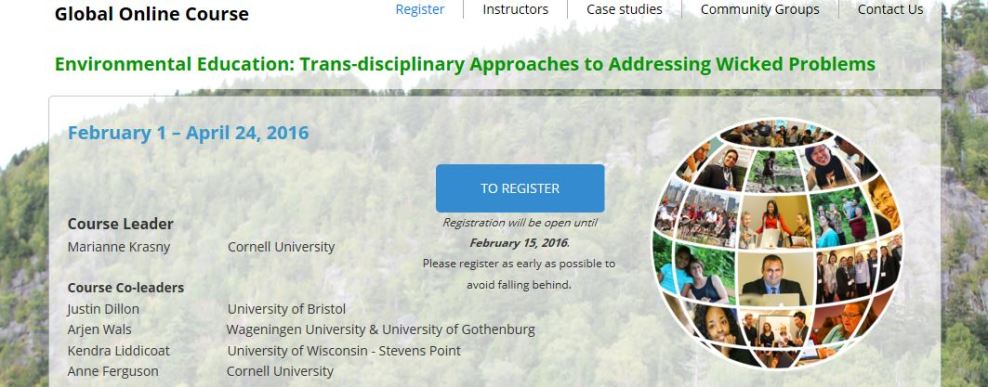
Global Environmental Education and Wicked Problems – free Online Course

GlobalEE

What a global response!

There is still one week to go to: http://www.globalee.net to register for this fascinating course that has already attracted more than 2500 students and professionals from over 130 countries. Just reading the short introductions of the participants on the Course’s Facebook site is educational and inspiring:

  https://www.facebook.com/groups/GlobalEE/

The registration closes on February 15th – have a look at the website to see how we are running the course – module one focuses on the meaning of wicked sustainability problems. Participants are sharing their own interpretations and examples of such problems.

Students who wish to take the course for credit can do so via the University of Wisconsin in Stevens Point – check out the website to find out how.

Course overview

The goal of this course is to create an environmental education “trading zone”—an online space where scholars and students gather to learn about multiple disciplines that shed light on how to improve environmental quality and change environmental behaviors. Each of the lectures, readings, discussions, and case studies will focus on the implications of a particular discipline for environmental education, as well as what environmental education has to contribute to related disciplines and sectors. Learn about how environmental education, environmental governance, environmental psychology, environmental sociology and other disciplines can work together to address ‘wicked problems,’ not readily addressed by working in disciplinary silos.

Some of the ideas I will be sharing can be found here in a nutshell: Sustainability & Education in Two Minutes

But if you have more time… then you can read a recent open-access publication based on an inaugural address I gave in December of 2015 titled: “Beyond Unreasonable Doubt: Education and learning for socio-ecological sustainability  in the anthropocene” which can now be downloaded here: 8412100972_RvB_Inauguratie Wals_Oratieboekje_v02Complete Text Beyond Unreasonable Doubt Complete Text Beyond Unreasonable Doubt

BeyondUnreasonableDoubtInvite


“Beyond unreasonable doubt – learning for socio-ecological sustainability…”

InauguralInvitationcomplete

As my ‘special professorship’ has been converted into a ‘personal professorship,’ (I know this is confusing to academics from around the world but I don’t want to use up valuable blog-space to explain it) I was invited to give a second inaugural address titled: Beyond unreasonable doubt –  education and learning for socio-ecological sustainability in the anthropocene in the Aula of the Wageningen University on December 17th 

The special day happened to be the warmest December 17th on record… quite fitting for the talk and the cover of the accompanying booklet (with people sitting on an terrace a cold Fall evening in Gothenburg under so-called ‘space heaters’).

A short introduction to the new Chair has been placed on youtube:

Transformative Learning for Socio-ecological Sustainability in less than 3 minutes

Here’s the back flap text of the booklet is now available:

‘For the first time in history one single species has succeeded in living in a way on planet Earth that disrupts major natural systems and forces in such a way that our survival is at stake. A transition is needed to break with resilient unsustainable systems and practices. Such a transition requires active civic engagement in sustainability. New forms of education and learning, including ‘disruptive capacity building’ and ‘transgressive’ pedagogies are urgently needed to foster such engagement.’


If you want to receive the booklet containing the accompanying text to the lecture then send an email to office.ecs@wur.nl with unreasonable doubt in the ‘subject’ and put your name and address in the body of the message and we will post you one.
 If you wish you can still attend, sort of,  the event by going to:
Here you can see the entire ceremony which starts at minute 9 with an introduction by our Vice-Chancellor (Rector Magnificus) Arthur Mol and with me starting the speech (battling the flu but hanging in there – I think/hope) at minute 15. Sometimes the animations I used do not fly-in on WURTV for some reason but fortunately they did in the auditorium). But it’s of good quality and you can advance the timer if you wish to.


Focus of the new Chair in transformative learning for socio-ecological sustainability

In short the new Chair in transformative learning for socio-ecological sustainability explores three important questions: 1) What sustain’abilities’ and responsibilities we need to develop in learners? 2) What learning spaces or ecologies of learning are most suitable in developing those abilities? and 3) How can the cultivation of these abilities, responsibilities and spaces be designed and supported? In other words, the main focus of the chair lies on understanding, designing and supporting learning processes that can help citizens understand complex socio-ecological issues through meaningful engagement and interactions with and within the social, physical and virtual realities of which people are part and the development of the capacities they need to contribute to their resolution.

The addition of ‘socio-ecological’ to sustainability is intentional, as much work done on sustainability nowadays tends to focus on economic sustainability, often without people and planet in mind. In a way sustainability has lost its transformative edge ‘sustainability’ during the last decade as the much of the private sector embraced it as a marketing opportunity. Adrian Parr (2009) even suggests that sustainability has been hijacked and neutered. While economics inevitably is part of the sustainability puzzle, the need to (re)turn to the ecological boundaries in which we have to learn to live together, as well as to the well-being and meaning of life issues for all, has prompted me to make the social-ecological more prominent in the description of this Chair. Therefore, I am particularly interested in understanding and supporting forms of learning that can lead to the engagement of seemingly unrelated actors and organizations in making new knowledge and in taking the actions necessary to address socio-ecological challenges.
Note 1: The booklet containing the inaugural address will be posted to you for free (as long as supplies last) when you email office.ecs@wur.nl with “Unreasonable doubt” in the subject area and your name and postal address in the body of the text).
Note 2: The inaugural address can be followed live via WURTV where it will also be archived: https://wurtv.wur.nl/P2G/cataloguepage.aspx


Education and citizen science; the missing pieces in the sustainability puzzle, Science Magazine article now available

Front page of Science Article

Front page of Science Article[/caption]

In May of 2014  ‘Science’ published a paper on the importance of creating synergies between science education and environmental education with the support of Citizen Science. The article, which I co-authored with Justin Dillon, Bob Stevenson and Michael Brody, is based on the trends emerging from the International Handbook of Environmental Education Research (Stevenson et al, 2013)*. The article is available through most university library systems in the world and can be obtained for personal use by clicking: ScienceWalsetall2014.

There are a number of lessons to be drawn from the article but essentially we emphasize the importance of: Connecting biophilia and videophilia: that is, study ways in which ever-present technologies and cyberspaces can be used to help people (re)gain a deeper and more empathetic contact with each other and with the world (presently these technologies and spaces tend to lead to the exact opposite). Creating spaces for hybrid learning: that is, hybridized environments and new spaces are needed for learning about the sustainability challenges of our time (e.g. climate change, malnutrition, loss of food security and biodiversity) that embraces the authenticity of multiple voices and cultural and theoretical perspectives, new forms of representation, and more change-oriented and community-based approaches. Strengthening community-engaged scholarship with a planetary conscience: that is, with the increasing complexity of societies, the interdisciplinary nature of people-society-environment relationships, the problems faced at local and global scale, and the uncertainty of their solutions or resolutions, there is a need for new spaces for collaborative and transformative approaches to research. Supporting emerging forms of ICT-supported Citizen Science: that is, the active involvement of citizens, young and old, in the monitoring of local socio-ecological issues by collecting real data and sharing those data with others doing the same elsewhere through social media and on-line platforms, as a catalyst for realizing the first three points. Furthermore we suggest that future research address: • the importance of acknowledging different ways of knowing into educational program(me)s; • the importance of place-based education; • the need for EE to focus on community-based activities that lead to • the individual and group empowerment; • the need to factor in issues of identity in EE; • the need for a convergence of science education and environmental education; • the need for EE to address issues of life-long learning • the need for practitioners and researchers to address policy issues; • the need for inter- and transdisciplinarity in EE practice and research. On a critical note, not so much stressed in the Science article but noted in the Handbook, we plea for stressing the importance of education serving people and planet rather than just serving the economy. The current push for innovation, competence, and a lifelong of learning for work and competitiveness, is resulting in the marginalization in education of people and by squeezing out place-based learning, arts, humanities and the development of values other than those driving consumerism and materialism. Wals, A.E.J., Brody, M., Dillon, J. and Stevenson, R.B. (2014) Convergence Between Science and Environmental Education, Science, 344, p. 583-584.  * Stephenson, B., Brody, M., Dillon, J. and Wals, A.E.J. (Eds.) (2013) International Handbook of Environmental Education Research. London: Routledge. Below you will find today’s press release by Wageningen University & Research Centre.

Here’s the press release of Wageningen University, no. 045, 9 May 2014 “Addressing climate change, requires a change of mind”

Sustainability needs link between theory and practice in education How can you ensure that people do not only spend time thinking about important global issues like climate change or world food supplies, but also roll up their sleeves and do something about them? Four researchers, including Professor Arjen Wals from Wageningen University, think that the education sector holds the key. Teaching processes around the world could be given more influence and meaning by making pure science subjects, such as biology and physics, complementary to lessons in nature, environment and sustainability. Their article on this new approach to teaching, which is based on citizen science, is published in the 9 May edition of Science. Throughout the world, ‘pure’ science subjects such as physics, chemistry, biology, maths, geography and general natural sciences, which traditionally aim to build up knowledge and understanding, are seen separately from subjects such as nature and the environment, which together with the latest branch ‘sustainability education’ take a more practical approach. Although this certainly makes scholars aware of the current condition of our planet, their lack of practical perspective evokes a sense of powerlessness. For example, what can you do to prevent or respond adequately to forthcoming climate shifts? Affinity with politics, society and the economy are essential in this respect. Conversely, education in nature, the environment and sustainability (aka ‘environmental education’) does not equip scholars with the scientific insight they need to back up their proposed remedies. Convergence When taught separately, natural sciences and environmental education give a disjointed answer to society’s demand for a truly sustainable society. “It’s time these two schools converged,” says Arjen Wals, Professor of Social Learning and Sustainable Development at Wageningen University. “If we cannot create a firm link between these two educational areas, scientific education is in jeopardy of becoming purely a vehicle for enhancing the innovative and competitive potential of a country’s economy”, he says. “At the same time, without a firm link with the sciences, environmental education will never be able to find a responsible and realistic way of dealing with the contradictions and uncertainties that are raised in the scientific debate surrounding questions of sustainability.” The authors of the article in Science give a number of examples of environmental education, which cover the area where science meets society. Among them is the American concept of Edible School Gardens, whereby schoolchildren grow their own food in an educational garden while simultaneously learning about the things they grow in science lessons. The Dutch version is known as Groene schoolpleinen (‘green school grounds’). Another good example is YardMap, based on IT and citizen science. Citizens, both young and old, analyse biodiversity in their own neighbourhood by means of digital photos, special apps and Google Maps. The aim is to identify the areas with the greatest potential for boosting biodiversity. Action plans designed to ensure that the YardMaps are kept fully up-to-date are drawn up and implemented on the basis of studies and in consultation with scientists and local partners (including the municipal authority, garden centres and an NGO). The various YardMaps are linked via social media. The Dutch Natuurkalender works in much the same way. Creating closer ties between citizen science, scientific education and environmental education will help citizens and scientists to take a meaningful and practical approach to the pursuit of sustainability. Wals: “It’s not just about linking up the content; it involves developing new competencies such as dealing with complexity, uncertainty and confusion, and devising and implementing meaningful local solutions”. This method of learning may also help to restore the damage to public confidence in science. The government will have to put more effort into stimulating and supporting the ‘hybrid teaching environments’ that blur the boundaries between science and society, school and neighbourhood, local and global, and shift the emphasis to the wellbeing of mankind and the planet. Transition Calls for transition and another way of thinking are becoming more urgent, says Professor Wals: “At the end of the day, the climate problem is as much in between our ears, as it is between the North and South Poles”. He backs this up with a remarkable conclusion: to his mind, the role of education and citizen involvement has been seriously underemphasised in the climate debate. In fact he wonders if we will ever be able to bring about a transition without committed, critical and competent citizens, who aspire to values that are not purely based on the material side of their existence but also on care for fellow human beings and, indeed, other species, here and elsewhere, now and in the future. Join in the discussion on #CitizenScience Publication Wals, A.E.J., Brody, M., Dillon, J. and Stevenson, R.B. (2014) Convergence Between Science and Environmental Education, Science, 344, p. 583-584. NOTE FOR EDITORS More information is available from Prof. Arjen Wals, Professor of Social Learning and Sustainable Development and Director of the Centre for Sustainable Development & Food Security, Wageningen University, tel. +31 (0)317 484184, arjen.wals@wur.nl or via Jac Niessen, science information officer at Wageningen UR, tel.+31 (0)317 485003, jac.niessen@wur.nl.

How to educate in a Changing World? Curriculum Innovation in Tertiary Agricultural Education (TAE)

Cover
Download the book here!

We live in turbulent times, our world is changing at accelerating speed. Information is everywhere, but wisdom appears in short supply when trying to address key interrelated challenges of our time such as; runaway climate change, the loss of biodiversity, the depletion of natural resources, the on-going homogenization of culture, and rising inequity. Living in such times has implications for education and learning.
(Wals, A.E.J. and Corcoran, P.B. (Eds.) (2012). Learning for Sustainability in Times of Accelerating Change, Wageningen: Wageningen Academic Publishers.)

The speed of change, physically, socially and culturally, is accelerating. Continued globalization and digitalization are not only affecting how we think, what we know, who to believe, how we act, they also affect the role of education in society. Higher education, for instance, and the science it produces, is no longer the sole authority of truth, if ever it was. Rather, science oftentimes represents just another point of view or an opinion in the public debate of controversial and ambiguous issues such as; the causes and impacts of climate change, the role of GMOs in food security, the use of biofuels, etc. Scientists can be found on different ends of the ongoing debates, although more might be found at one end than on the other. It is not easy to decide who is right, who is wrong, or who is more right than others, or what the best way to move forward might be.

What do we educate for in such a world when things change so fast and knowledge becomes obsolete before you know it? How do we prepare today’s graduate for the world of tomorrow? And more specifically, what are the implications for tertiary agricultural education (TAE) around the world? Again I would like to offer some thinking and reflection on existing practices that we did in the past that is still relevant today but now easily accessible thanks to open access and the digital age: Wals, A.E.J. (Ed.) (2005). Curriculum Innovations in Higher Agricultural Education. The Hague: Elsevier /Reed Business Information. In this book you will find contributions by Richard Bawden, Fabio Carporali, Paul Pace, Bill Slee and Sri Sriskandarajah. The opening section focusses on principles and stepping stones for curriculum development in a changing world, whereas the second part focusses on newly developed MSc programmes in a number of European Life Science Universities in the area of Integrated Rural Development.

You can download the book by clicking on the link below the book’s cover image above!

The educational appeal of vagueness: the case of biodiversity

Environmental Education & Biodiversity

Loss of biodiversity is back on the agenda having faded somewhat during the last 15 years or so with the rise of new urgent issues such as runaway climate change, loss of food security, the rise of micro-toxins in waters and soils, etc. With the renewed attention for biodiversity it might be useful to go back to the nineties when the topic was high on the international policy agenda and some effort was spent on making biodiversity meaningful for ordinary citizens. Two publications that I was involved in back then seem very relevant today.

The first one appeared in the Canadian Journal of Environmental Education (I believe the only open-access EE journal): Dreyfus, A., Wals, A.E.J. and D. van Weelie (1999). The socio-scientific dispute character of environmental education. Canadian Journal of Environmental Education, 4, 155-176. Download here: Canadian Journal of EE[

The second one is a book commissioned by the Dutch government titled “Environmental Education and Biodiversity” which I recently updated slightly to make it suitable for open-access publication. Full reference: Wals, A.E.J., (Ed.) (1999). Environmental Education and Biodiversity. National Reference Centre for Nature Management, Wageningen, 107 p.Download here: Book Environmental Education & Biodiversity

The book is more elaborate than the article and contains concrete stepping stones for making biodiversity meaningful. Here’s a brief abstract of the book which also applies – in part – to the article.

Despite all the confusion about biodiversity, one thing is clear: there is no one single perspective or definition of biodiversity that accurately describes it in all situations or contexts. Biodiversity can have different meanings depending on the user and the context in which it is used. Even within the scientific arena a great number of biodiversity meanings and interpretations can be distinguished. It is not uncommon to find that scientific, political and symbolic meanings are used interchangeably by the same person. Both the knowledge base and the value base of biodiversity are variable and to a degree unstable and questionable.

Although these characteristics of biodiversity can render the concept useless or reduce it to a rhetorical instrument, they can also add to its strength when handled with care. Certainly from an environmental education perspective, but also from a policy-making perspective, these characteristics offer some worthwhile advantages: 1) Biodiversity brings together different groups in society that are searching for a common language to discuss nature conservation issues in relation to sustainability issues. 2) This dialogue allows the socio-scientific dispute character of “science-in-the-making” to surface. Participation in such a dispute is an excellent opportunity to learn about a highly relevant, controversial, emotionally charged and debatable topic at the crossroads of science, technology and society. 3) Making such a concept meaningful to the lives of citizens requires a procedure that could be utilised when developing educational programmes that focus on similar topics (i.e. education for sustainability).

This book provides a justification and rationale for developing biodiversity as a leading concept for environmental education for human development. Furthermore it proposes a stepping stone procedure that recognises the socio-scientific dispute character of biodiversity and provides a tool for turning biodiversity into a meaningful and existentially relevant issue. The procedure includes the following steps: analysing meanings of biodiversity, determining one or more perspectives based on the general learning goals of environmental education, setting specific learning objectives, selecting (sub)themes for learning, contextualising biodiversity and establishing the value of biodiversity. The procedure is intended to help curriculum developers, teachers, educational support staff and environmental educators give specific meaning to biodiversity and to help learners critically analyse the way biodiversity is used in science, technology and society. The procedure is an intermediate product that offers direction in developing and implementing specific learning activities and materials for various groups of learners.

Abstract of the article in French
Résumé
L’éducation relative à l’environnement dans un monde postmoderne devra être sensible à la nature mal définie des principaux concepts naissants, tels que la biodiversité et la durabilité. Malgré toute la confusion qui entoure ces concepts, une chose est claire : il y a plus d’une façon de considérer ces concepts ou de les définir. En d’autres termes, il n’existe pas une seule perspective ou définition de la biodiversité ou de la durabilité qui les décrive avec exactitude dans toutes les situations ou tous les contextes. Bien que cette définition approximative rende de tels concepts inutiles ou les réduise à un instrument rhétorique d’un point de vue moderne, elle les rend intéressants dans une perspective postmoderne. En reconnaissant la nécessité de respecter le pluralisme (respect des différentes façons de voir, d’évaluer, de comprendre, etc.), la présence constante d’éléments d’ambivalence et d’incertitude dans la prise de décision environnementale et la nécessité d’apprendre dans ce riche contexte, les éducateurs en environnement dans un monde postmoderne trouveront une valeur dans la nature mal définie de ces concepts naissants. En se servant de la biodiversité comme exemple, les auteurs illustrent l’attrait pédagogique de la définition approximative. La biodiversité réunit différents groupes de la société à la recherche d’un langage commun pour discuter de la conservation de la nature en relation avec les enjeux postmodernes de la durabilité. Le seul fait que ces groupes avec des antécédents divergents se concentrent sur un concept commun, bien que la signification du concept varie pour chacun des groupes, ouvre la porte au débat socioscientifique. Ce débat fournit une excellente occasion d’apprentissage sur un thème hautement pertinent, litigieux, émotif et discutable au carrefour des sciences, de la technologie et de la société. Une attention spéciale est accordée au rôle des connaissances scientifiques dans des débats de ce type.

Sustainability in higher education in the context of the UN Decade of Education for Sustainable Development

Sustainability in higher education in the context of the UN DESD: a review of learning and institutionalization processes” is a paper that was published in a recent issue of the Journal of Cleaner Production Volume 62, Pages 1-138, January 2014) as a part of a theme issue on:

“Higher Education for Sustainable Development: Emerging Areas”. This special issue is edited by Maik Adomßent, Daniel Fischer, Jasmin Godemann, Christian Herzig, Insa Otte, Marco Rieckmann and Jana Timm of Leuphana University in Germany.

The paper I contributed is grounded empirically in a review of UN’s Decade of Education for Sustainable Development (UN DESD) I was commissioned to carry out by UNESCO. The review’s section on the learning processes taking place in the higher education arena forms the basis of this article. Particular attention is paid to the role of UNESCO ESD Chairs in advancing sustainability-oriented learning and competences in higher education.

The main conclusion that can be drawn is that Higher Education Institutions are beginning to make more systemic changes towards sustainability by re-orienting their education, research, operations and community outreach activities all simultaneously or, which is more often the case, a subset thereof. They are doing so amidst educational reforms towards efficiency, accountability, privatization, management and control that are not always conducive for such a re-orientation. Some universities see in sustainability a new way of organizing and profiling themselves. The UNESCO ESD Chairs mainly play a role in conceptualizing learning, competence and systems change.

The full reference is: Wals, A.E.J. (2013). Sustainability in higher education in the context of the UN DESD : a review of learning and institutionalization processes, Journal of Cleaner Production (www.sciencedirect.com/science/article/pii/S0959652613003880). A preview can be found here! SustainabilityinHigherEducationWalsJournalCleanerProduction13

Creating Transdisciplinary Dialogue & Phronesis in Pursuit of Sustainability

TradingZonesCover
This book is the result of a rather interesting writing process initiated by the editors about two years ago when they decided that the focus of the book, transdisciplinary dialogue, should also be its process… In order to realize this they invited about 30 scholars from quite different disciplinary backgrounds who did not know each other (most of them anyway) very well or at all, but all had an interest in trans- and interdisciplinarity and a shared concern about the well-being of people and planet. During a joint ‘thinkshop’ held at Cornell’s Field Station in upstate New York, the participants jointly conceptualized the book and created writing ‘duo’s’. I myself formed a duo with Science Historian Scott Peters and bonded with him around the concepts of phronesis, post-normal science and transformative learning (find a link to our chapter at the end of this post). Author-teams were also asked to include a piece of art in their work that somehow captures the spirit of their joint writing venture. On the publisher’s website the wonderful book that resulted is described as follows:

Environmental educators often adhere to a relatively narrow theoretical paradigm focusing on changing attitudes and knowledge, which are assumed to foster pro-environmental behaviors, which, in turn, leads to better environmental quality. This book takes a different approach to trying to understand how environmental education might influence people, their communities, and the environment. The authors view changing environmental behaviors as a «wicked» problem, that is, a problem that does not readily lend itself to solutions using existing disciplinary approaches. The book as a whole opens up new avenues for pursuing environmental education research and practice and thus expands the conversation around environmental education, behaviors, and quality. Through developing transdisciplinary research questions and conceptual paradigms, this book also suggests new practices beyond those currently used in environmental education, natural resources management, and other environmental fields.

Contents: Marianne E. Krasny: Introduction. Tales of a Transdisciplinary Scholar – Joseph E. Heimlich/Mary Miss: Art and Environmental Education Research: Reflections on Participation – Jeppe Læssøe/Marianne E. Krasny: Participation in Environmental Education: Crossing Boundaries under the Big Tent – Martha C. Monroe/Shorna Broussard Allred: Building Capacity for Community-Based Natural Resource Management with Environmental Education – Scott Peters/Arjen E. J. Wals: Learning and Knowing in Pursuit of Sustainability: Concepts and Tools for Transdisciplinary Environmental Research – Barbara A. Crawford/Rebecca Jordan: Inquiry, Models, and Complex Reasoning to Transform Learning in Environmental Education – Joseph E. Heimlich/Mary Miss: Art and Environmental Education Research: Reflections on Appreciation – John Fraser/Carol B. Brandt: The Emotional Life of the Environmental Educator – Leesa Fawcett/Janis L. Dickinson: Psychological Resilience, Uncertainty, and Biological Conservation: Junctures Between Emotional Knowledges, NatureExperiences, and Environmental Education – Joseph E. Heimlich/Mary Miss: Art and Environmental Education Research: Reflections on Place – Timon McPhearson/Keith G. Tidball: Disturbances in Urban Social-Ecological Systems: Niche Opportunities for Environmental Education – Richard C. Stedman/Nicole M. Ardoin: Mobility, Power, and Scale in Place-Based Environmental Education – Marianne E. Krasny/Megan K. Halpern/Bruce V. Lewenstein/Justin Dillon: Conclusion. Do «Arranged Marriages» Generate Novel Insights?

You find a sneak preview of the chapter I co-authored with Scott Peters – titled: Learning and Knowing in Pursuit of Sustainability: Concepts and Tools for Trans-Disciplinary Environmental Research here: FinalPeters&Wals2013<