The art of arts-based interventions in transdisciplinary sustainability research

Led by PhD-Candidate Sophia-Marie Horvath of Department of Forest- and Soil Sciences, Institute of Forest Ecology, University of Natural Resources and Life Sciences in Vienna, a paper just came out in Sustainability Science on the contribution of arts-based interventions in transdisciplinary sustainability research. Transdisciplinary, co-creative research deals with complex real-world problems, with complexity being a common denominator of sustainability issues. It is often understood as an interplay of two dimensions, collaboration and creativity, that facilitates the integration of different forms of knowledge and the creation of transformative outcomes. In the end, it aims to find more holistic and systemic solutions to complex real-world problems. Increasingly, Arts-Based Interventions (ABIs) are proposed to support sustainability-oriented transdisciplinary research. However, little research has been done so far to gauge the extent to which adding arts to the mix actually benefits the transdisciplinary research process and outcomes. In the research project reported on in this article, we took a first step into the realm of the arts by including ABIs into transdisciplinary brainstorming sessions. You can find the full paper here: https://link.springer.com/article/10.1007/s11625-024-01614-2#citeas

Full citation: Horvath, SM., Payerhofer, U., Wals, A. et al. The art of arts-based interventions in transdisciplinary sustainability research. Sustain Sci (2025). https://doi.org/10.1007/s11625-024-01614-2
Creating LivingLabs for Nature-Based Solutions – ENABLS Takes Off

We are about to end the first year of an EU-funded project on developing LivingLabs for Nature-Based Solutions and will soon ‘implement’ / unfold 7 LivingLabs in the participating countries. Below some basic information that you can also find on the ENABLS Website. Together with Mieke de Wit, ouise van der Stok and Lian Kasper, I am representing Education & Learning Sciences of Wageningen University in this major project.

ENABLS is also on LinkedIn and Instagram

Characteristics and challenges of teaching and learning in sustainability-oriented Living Labs within higher education: a literature review – Open Access!

This paper led by ELS-WUR PhD-candidate Marlies van der Wee – Bedeker was published earlier this Fall. The paper is the first peer reviewed article based on her research that is grounded in the City of Rotterdam using her home institute Hogeschool Rotterdam as a base. Below a summary of the main fiindings. The full paper can be found here!

Full citation:

van der Wee, M.L.E.Tassone, V.C.Wals, A.E.J. and Troxler, P. (2024), “Characteristics and challenges of teaching and learning in sustainability-oriented Living Labs within higher education: a literature review”, International Journal of Sustainability in Higher Education, Vol. 25 No. 9, pp. 255-277. https://doi.org/10.1108/IJSHE-10-2023-0465

New Open Access Paper: River Co-Learning Arenas: principles and practices for transdisciplinary knowledge co-creation and multi-scalar (inter)action

This collaborative multi-authored paper develops the methodological concept of river co-learning arenas (RCAs) and explores their potential to strengthen innovative grassroots river initiatives, enliven river commons, regenerate river ecologies, and foster greater socio-ecological justice. The integrity of river systems has been threatened in profound ways over the last century. Pollution, damming, canalisation, and water grabbing are some examples of pressures threatening the entwined lifeworlds of human and non-human communities that depend on riverine systems. Finding ways to reverse the trends of environmental degradation demands complex spatial–temporal, political, and institutional articulations across different levels of governance (from local to global) and among a plurality of actors who operate from diverse spheres of knowledge and systems of practice, and who have distinct capacities to affect decision-making. In this context, grassroots river initiatives worldwide use new multi-actor and multi-level dialogue arenas to develop proposals for river regeneration and promote social-ecological justice in opposition to dominant technocratic-hydraulic development strategies. This paper conceptualises these spaces of dialogue and action as RCAs and critically reflects on ways of organising and supporting RCAs while facilitating their cross-fertilisation in transdisciplinary practice. By integrating studies, debates, and theories from diverse disciplines, we generate multi-faceted insights and present cornerstones for the engagement with and/or enaction of RCAs. This encompasses five main themes central to RCAs: (1) River knowledge encounters and truth regimes, (2) transgressive co-learning, (3) confrontation and collaboration dynamics, (4) ongoing reflexivity, (5) transcultural knowledge assemblages and translocal bridging of rooted knowledge.

Citation:

De Souza, D. T., Hommes, L., Wals, A., Hoogesteger, J., Boelens, R., Duarte-Abadía, B., … Joy, K. J. (2024). River co-learning arenas: principles and practices for transdisciplinary knowledge co-creation and multi-scalar (inter)action. Local Environment, 1–23. https://doi.org/10.1080/13549839.2024.2428215

The full paper can be downloaded here!

New book on 50 years of Education and Learning for Sustainable Futures

We are pleased to share with you the publication of our new book, Education and Learning for Sustainable Futures: 50 years of learning and environmental change. This book explores fundamental questions about how the role of education has evolved over the decades since the pivotal 1972 Stockholm Conference, which brought environmental learning to the forefront of global awareness.

Co-authors, Daniella Tilbury and Thomas Macintyre and myself, have attempted to find some answers by tracking through the decades (1970-2020) the development of narratives, thinking, and practice of learning and education in support of the environment and sustainability. What is clear is that the profile and presence of learning and education for the environment has been elevated in today’s policy discourses and communities of practice. Yet, our analysis identified some clear differences in the way education and learning for the environment has been approached over time. 

In our new book, we trace these changes over the decades while looking ahead to the challenges and opportunities of the future.  A key wildcard in this journey is Artificial Intelligence (AI), which holds immense potential to bridge digital and green agendas, enabling smarter environmental management and driving innovation toward a sustainable future. However, we also address critical concerns: data privacy breaches, outsourcing human thinking to profit-driven algorithms, exacerbation of inequalities, and the environmental footprint of AI infrastructure.

This book provides a light way into the history, developments and prospects of the field of Environmental and Sustainability Education.

Full reference:

Macintyre, T., Tilbury, D., & Wals, A. (2024). Education and Learning for Sustainable Futures: 50 Years of Learning for Environment and Change (1st ed.). Routledge. https://doi.org/10.4324/9781003467007

Wish to read more? Our book is open access thanks to the funding of the Dutch Government that funded this publication: https://www.routledge.com/Education-and-Learning-for-Sustainable-Futures-50-Years-of-Learning-for-Environment-and-Change/Macintyre-Tilbury-Wals/p/book/9781032727912

Our thanks also go to Stakeholder Forum and to @JanGustav for his leadership role in the Stockholm+50 reflective dialogues, and to UNEP/ the Swedish Government for spurring us on to track the historical development of education and learning for the environment. We are also grateful to @Routledge for taking an interest in publishing the text.

Competences for socio-ecological stewardship: a qualitative assessment of the transformative potential of farmers’ learning processes in Eastern Uganda

Theoretically, this study expands Roczen’s environmental competence model by including social, ethical, and conservation and restoration action competences. This study is one of the first to identify socio-ecological stewardship competences and the learning processes that can foster these competences.

Full citation:

Misanya, D., Tassone, V. C., Kessler, A., Wals, A. E. J., & Kibwika, P. (2024). Competences for socio-ecological stewardship: a qualitative assessment of the transformative potential of farmers’ learning processes in Eastern Uganda. The Journal of Agricultural Education and Extension, 1–21. https://doi.org/10.1080/1389224X.2024.2403597

Analysing farmers’ learning for socio-ecological stewardship in Eastern Uganda: A transformative learning ecology perspective

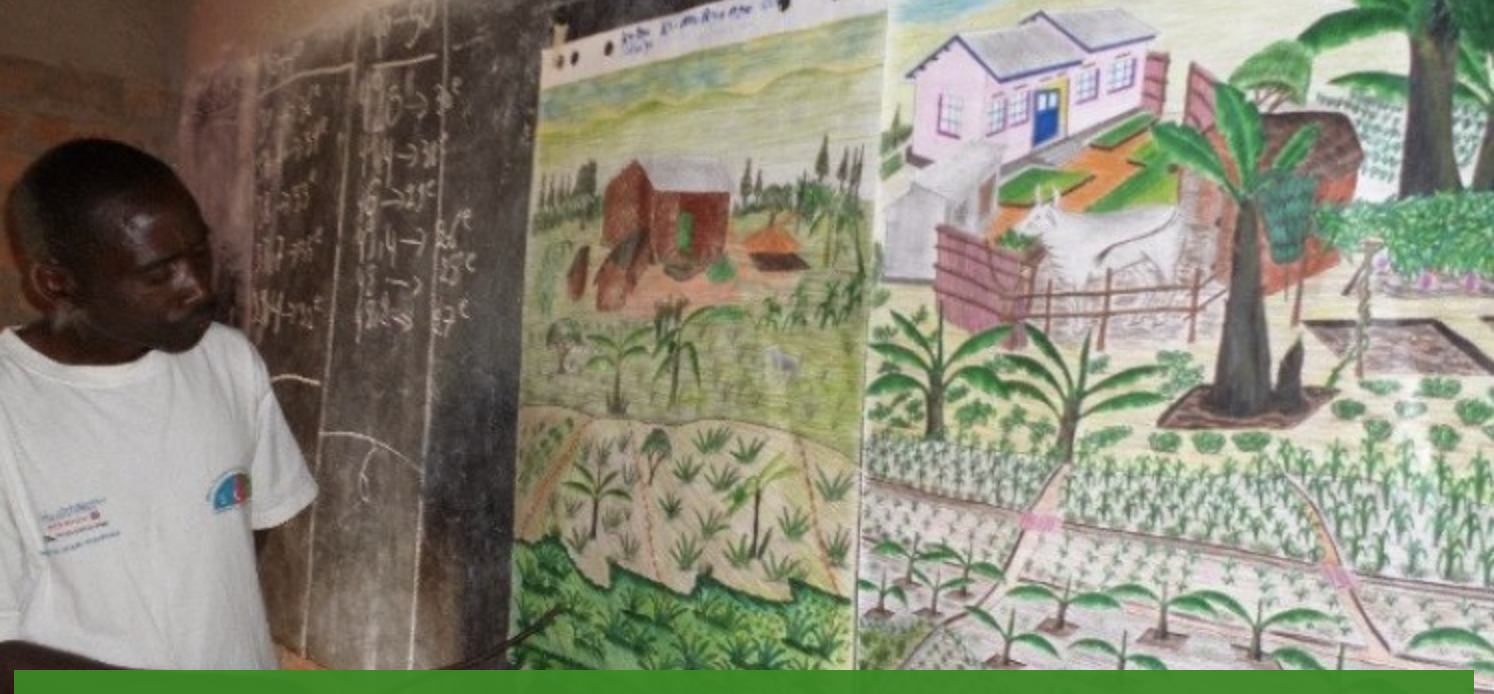
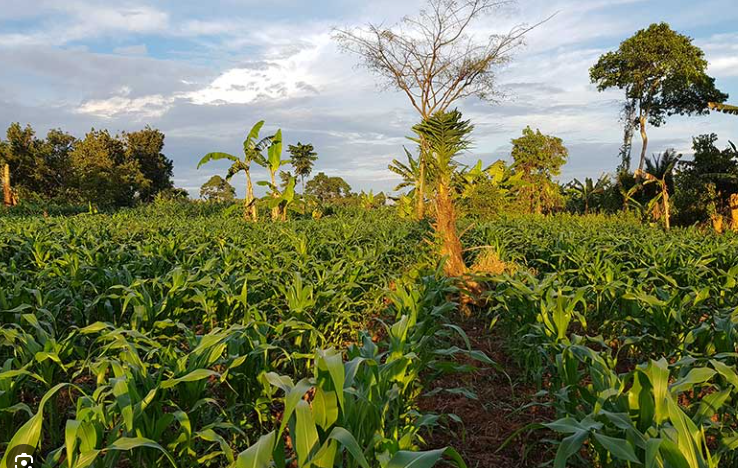
This paper stems from the research of PhD Candidate Doreen Misanya. It analyses how smallholder farmers are learning for socio-ecological stewardship in a specific case study context in Eastern Uganda. The case under analysis is a watershed management project that uses an integrated farm planning (PIP) approach to strengthen farmers’ stewardship capacities within the Manafwa watershed through interactive and dialogic ways of engaging and teaching farmers. Utilizing a transformative learning ecology (TLE) perspective, this study investigated features of the PIP approach that support transformative learning for socio-ecological stewardship in a rural context. Data was collected by interviewing eighteen farmers from different villages and PIP generations and all three PIP trainers of the project, and by observing training sessions as well as sensitisation workshops. As a main result, the study yielded new insights that can help enhance PIP-like learning configurations consisting of interconnected learning tenets, dimensions and processes. This enhanced learning configurating comprises an organic learning system that facilitates farmers to change their mindsets and redefine their values, perspectives, routines, and practices towards those that encourage socio-ecological stewardship. The TLE fostered by the PIP approach represents a useful heuristic that can guide and inspire both scholars and educators engaged in processes of cultivating socio-ecological stewardship in similar contexts.

The paper can be found here https://www.tandfonline.com/doi/full/10.1080/27685241.2023.2191795

Full citation:

Misanya, D., Tassone, V. C., Kessler, A., Kibwika, P., & Wals, A. E. J. (2023). Analysing farmers’ learning for socio-ecological stewardship in Eastern Uganda: A transformative learning ecology perspective. NJAS: Impact in Agricultural and Life Sciences95(1). https://doi.org/10.1080/27685241.2023.2191795

The research took place within the Manafwa Watershed Restoration (MWARES) Project in Bududa District, Eastern Uganda. A Baseline Report of the project appeared in 2020. It outlines the starting position of the PIP farmers in the region. This report can be found here.

Rethinking pedagogy in the face of complex societal challenges: helpful perspectives for teaching the entangled student

This paper appeared online in 2022 and was a part of the wonderful dissertation of Koen Wessels which was later published by Springer Nature as a book within the publisher´s SDG 4 ´Quality Education´ Series. Now has been formally published in open-access form as a part of the latest issue of Pedagogy, Culture and Society. Full citattion: Wessels, K. R., Bakker, C., Wals, A. E. J., & Lengkeek, G. (2024). Rethinking pedagogy in the face of complex societal challenges: helpful perspectives for teaching the entangled student. Pedagogy, Culture & Society32(3), 759–776. View and download here: https://doi.org/10.1080/14681366.2022.2108125

Here is the abstract to give you a bit of a flavor of the paper:

Pedagogy of Entanglement and other groundbreaking works – Springer SDG4-Series taking off

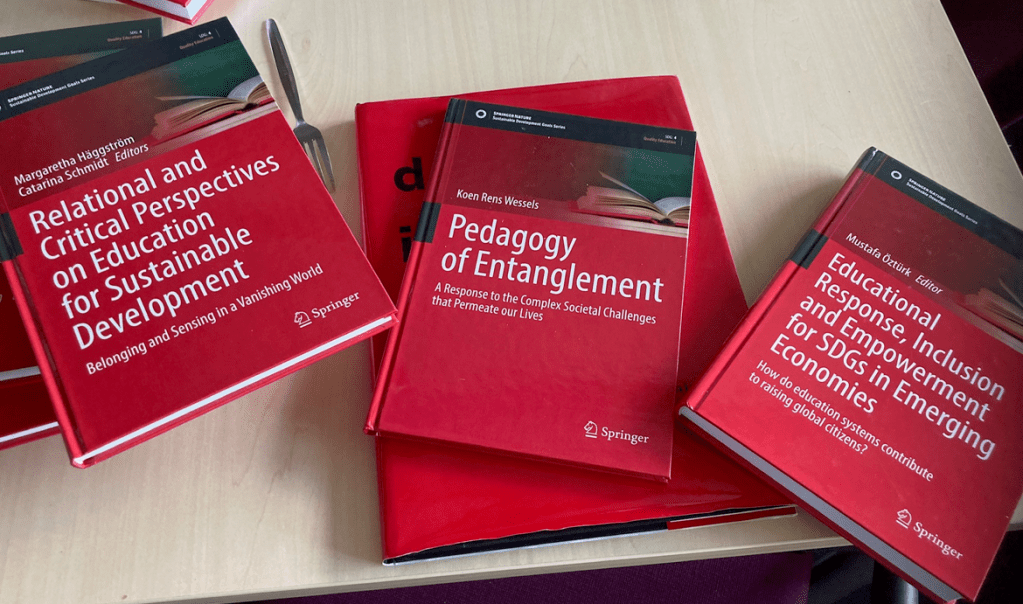
Recently, a few more titles appeared in the Springer SDG4 Series that are expanding horizons, addressing blind spots and offer guidelines for alternative ways of thinking and acting in and through education in light of pressing global sustainability challenges. One of them finally arrived on my desk today: Koen Wessel’s “Pedagogy of Entanglement: a response to complex societal challenges that permeate our lives”. This book is a real treasure that is based on Koen’s dissertation which he completed last year at Utrecht University (with joint supervision from Wageningen University).  You can find the book here.

The Springer Sustainable Development Goals Series aims to provide a comprehensive platform to the scientific, teaching and research communities studying issues in the fields of geography, earth sciences, environmental science, social sciences, engineering, policy, planning, and human geosciences in order to contribute knowledge toward achieving the current 17 Sustainable

Development Goals. Volumes in the series are organized by relevant goal and guided by an expert international panel of advisors.

The subseries that I am co-editing together with Nicole Ardoin of Standford University, focuses on SDG 4: Quality Education and more specifically on the following questions: What kind of quality or qualities must education have in order to be able to contribute to Sustainable Development as expressed by the SDGs? How can such education be developed, implemented and assessed in a wide range of contexts across the globe? How can quality education, that contributes to the well-being of all people and the whole planet, becomeaccessible for everyone?

Topics covered by the SDG 4 subseries include, but are to limited to: education policy and governance for ESD/ESE and Global Citizenship Education (GCE), conceptualizing sustainability competence other possible learning outcomes of ESD and GCE, pedagogical approaches to ESD/ESE and GCE, the role of teacher training/professional development in fostering ESD/ESE/GCE,

assessment of ESD/ESE and GCE-related learning, creating whole school or whole institution approaches to sustainability, making ESD/ESE and GCE accessible and relevant for all learners in a wide range of context across the globe.

Should you be interested in writing or editing a book for this Series, contact Zachary Romano in Springer’s New York office or drop me or Nicole a line!

White Paper on Regenerative Higher Education – Rethinking education in times of dysfunction and collapse

Regrettably this white paper is only available in Dutch. Some ot the ideas artuclated in the paper can also be found in The Regenerative Education Podcast Series created by PhD Bas van den Berg see: The Regenerative Education Podcasts – Planting the seeds of change

Ik maak sinds een paar jaar deeluit van een Nederlandse  Community of Practice rondom Regenerative Higher Education bestaande uit PhDs en medewerkers van verschillende universiteiten en hoge scholen. Dit White Paper is het resultaat van de samenwerking in de Community of Practice en is samengesteld door Martine de Wit en gebaseerd op interviews met Bas van den Berg, Daan Buijs, Mieke Lopes Cardozo, Marlies van der Wee en Arjen Wals. Met input van Nina Bohm, Linda de Greef, Michaela Hordijk, Naomie Tieks, Koen Wessels, Rosanne van Wieringen, en Roosmarijn van Woerden. De illustraties en vormgeving zijn verzorgd door Mari Genova.

Het paper vertrekt vanuit de vraag:

Onderwijs dat het beste haalt uit onszelf en onze studenten, op weg naar herstel van de aarde. Hoe komen we daar?

Lees hier ons verhaal en laat ons weten wat resoneert, schuurt of wat het anderzins losmaakt!

A regenerative decolonization perspective on Education for Sustainable Development (ESD) from Latin America – new research

Central Figure in the article:  Regenerative education through decolonial praxis.

Led by former Wageningen University PhD Dr. Thomas Macintyre and current Wageningen University Post-Doc, Dr Daniele Tubino de Souza, I was priviledged to collaborate on this new paper that appeared in the latest issue of Compare: A Journal of Comparative and International Education. This paper provides a Latin American perspective on ESD, with a focus on transformative and participatory learning in community contexts. With a long history of critical pedagogies, Latin America provides a fertile ground for exploring alternative forms of education as a means to address deep-rooted challenges in western traditional strands of education. We start by providing an overview of pertinent educational currents present in Latin America, then ground these perspectives in two case studies carried out by the authors – one from Colombia, the other from Brazil – which explore grassroots initiatives in community settings that utilise different forms of education and learning. We then propose an integrative model to foster alternative educational approaches that might lead to decolonial and regenerative praxis, finishing with a discussion on how Latin American-rooted regenerative decolonisation perspective and praxis can inform global ESD discourses.

You can find the full paper here: https://www.tandfonline.com/doi/full/10.1080/03057925.2023.2171262

Full citation: Macintyre, T. Tubino de Souza, D. & Wals, A.E.J. (2023) A regenerative decolonization perspective on ESD from Latin America, Compare: A Journal of Comparative and International Education, DOI: 10.1080/03057925.2023.2171262

 Education in Times of Climate Change – comprehensive NORRAG Special Volume

Climate change is not a new issue for education, but new levels of consensus and concern are emerging, suggesting that new policy developments may follow. This NORRAG Special Issue (NSI 07) addresses the question of how education is to equip learners to participate in climate action that would fundamentally disrupt existing problematic systems. This NSI has the potential to inform pedagogical praxis, co-learning, curriculum, climate action, policy formulation, frameworks for evaluating success, resourcing decisions and what we might consider educative acts for engaging with climate change and its multi-dimensional uncertainties, risks and opportunities. 

Edited by South African Professors Eureta Rosenberg and Heila Lotz-Sisitka, this is one of the most comprehensive and ground braking collections of papers available at the moment. The special issue is completely open access. You can find the full table of contents here.

I am very pleased to have found two wonderful Norwegian colleagues – Astrid Sinnes of the Norwegian Life Sciences University and Ole Andreas Kvamme of the University of Oslo who were willing to join in writing a contribution which is titled: School Strikes as Catalysts for Rethinking Educational Institutions, Purposes and Practices

I am also delighted to see two of my former PhD’s, Thomas Macintyre and Martha Chaves, based in Colombia in the special issue as well with a paper on Climate Change Resilience through Collaborative Learning in the Colombian Coffee Region – they co-authored with Tatiana Monroy who, like omas and Martha volunteers for Fundación Mentes en Transición, Colombia, South America

There will be an online launch of the NORRAG Special Issue 07 (NSI 07): Education in Times of Climate Change, will take place on 6 October 2022 at 16:00 – 17:30 CEST. For more information about the llaunch event have look here!

Transgressive learning, resistance pedagogy and disruptive capacitybuilding as levers for sustainability

Earlier this month the 8th Report from the Global University Network fir Innovation (GUNi) was published with a wealth of contributions critiquing current resilient modes and models of education and outlinig alternative one in light of the current systemic global dysfunction we find ourselves in. I was asked to contribute a chapter on transgressive learning. The link to the chapter is here

You can find the entire book at www.guni-call4action.org

The full citation for my chapter is: Wals, AEJ (2022) Transgressive learning, resistance pedagogy and disruptive capacity building as levers for sustainability. In: Higher Education in the World 8 – Special issue New Visions for Higher Education, Barcelona: Global University Network for Innovation (GUNi). Open access: www.guni-call4action.org, p216-222.

Short video “Engaging Communities in Local Sustainability Issues through T-Learning and Citizen Science”

This 5 minute video was recorded at WEEC 2022 in Prague by Alex Kudryavtsev – a research associate at Cornell University for the “Environmental Education & Community Engagement” online course by Cornell and NAAEE. I introduce transdisciplinary, transgressive and transformative learning in the context of citizens monitoring air pollution s a form of citizen science. I use the city of Rotterdam in The Netherlands as an example (althoughI do some justice to the city of Rotterdam as my example is somewhat dated:. it is a short video and much more is to be said about Rotterdam as the city government now pro-actively works with citizens in an air quality monitoring network. ‘Luchtbrug’ see: https://www.themayor.eu/en/a/view/rotterdam-citizens-concerned-with-air-quality-form-a-club-8089