COMPOSE – A transdisciplinary Masterclass in the Art of being a Researcher in turbulent times of fake news and climate change

Compose

In May I will be part of, what promises to be, and exciting one-day Masterclass in Gothenburg about the art of being a researcher  in turbulent times of fake news and climate change.

Climate scientists regularly emit dire warnings illustrating dangerous changes to the oceans and atmosphere. At the same time there’s a lack of connection between the facts drawn from climate science and the immediate motivations required to drive active prioritisation of climate action

This gap between fact and action is possibly most staggering at universities. As their academics publish one distressing fact after, universities largely continue with business as usual. This is arguably because climate science primarily originates from epistemologies that prioritise measurability and predictability of climate change rather than interpretative, subjective approaches that deal with people’s perceptions of change and their ability to respond. From a positivist position, scientists are expected to separate themselves from their subject. In the case of climate change, where the researcher is inherently part of the social and climatological system that they are researching, such assumed separation and exemption of action is proving to become fatal.

We invite academics of all stripes and disciplines to reinvent the role of the researcher to be reliable authors of facts, as well as pioneers in acting upon those facts. We will explore what it means to be impacted by and embedded in our research whilst retaining a degree of scientific distance and composure. How can we be a researcher/scientist, as well as a parent, community member and essentially human living in these increasingly complex and confusing times? What are the unique attributes that a researcher brings to this matter and what (new) epistemologies fit this reimagined position?

Hosted by former Carl Bennet Guest Professor in Education for Sustainable Development Arjen Wals and his international colleagues, the day aims to radically shift our perspectives and research practice. The session will draw from the results of the international research project Imaginative Disruptions, funded by The Seed Box.

The Masterclass is free and lunch will be provided, but places are limited and must be booked in advance here. We will take bookings until the 23rd of May.

For more information please contact Åse Bjurström on ase.bjurstrom@gu.se

In collaboration with the University of Gothenburg

Living Spiral Framework – Seeds of Sustainable Transitions

LivingSpiral

Over the past three years I have been fortunate to be a part of an ISSC supported Transformative Knowledge Network (TKN) called the T-Learning Network (see: T-Learning Network Website). The network has yielded several highly cited academic papers but, fortunately, also more practical ideas, concepts and tools. Three young and talented people in the network -Thomas Macintyre, Martha Chaves and Dylan McGary – co-created a lovely guide in both Spanish and English introducing one of the networks most exciting ideas: the Living Spiral Framework. This guide is targeted at researchers and practitioners interested in sharing their research into transformative and transgressive learning in the field of sustainability, climate change, and social and environmental justice.

In the introduction the guide states:

“We can understand transformative learning as transformations in beliefs, values and practices in a way that helps us live a more socially and ecologically responsible way. Delving deeper into the intricacies of transformation, we arrive at the emerging field of ‘transgressive learning,” a critical and action-oriented form of learning which challenges normalised systems which have become oppressive and detrimental to life.

We believe questioning our unsustainable beliefs, worldviews and practices as well as offering alternatives, is needed for such deeper learning to occur and transgress. To achieve this we need voices and narratives from actors within and outside of academia: from social learning facilitators, to indigenous shamen; from the city-based sustainability practitioners to the rural farmer, to have different perspectives on understanding transformation towards sustainability.

This guide provides a step-by-step guide for discovering how and to what extent, personal and collective learning journeys result in transformations towards sustainability, including the challenges and tensions experienced along the way. Moreover, it will allow you to follow the process cautiously to find your own indicators of transformation, unexpected results and opportunities, as well as other experiences along the way.” (Macintyre, Chaves, McGary, 2018 – p. 8).

Below you see the core of the framework which can be found here in its entirety Living Spiral Framework. If you want to more you can go http://www.transgressivelearning.org or email one of the authors: Thomas Macintyre <thomas.macintyre@gmail.com>

SpiralYou can also read our latest academic paper related to this work in the Journal of Action Research in its recent special issue on action research and climate change here: T-labs and climate change narratives: Co-researcher qualities in transgressive action–research

“We no longer wish to participate in the ranking of people” Ghent University wants to become a place where talent feels valued and nurtured

ghent

“A university is above all a place where everything can be questioned.”

My last two blog posts have been raising some critical questions about the viability and legitimacy of the scientific ‘enterprise’ in neo-liberal times. The Publish AND Perish blog post led to a lot of responses from colleagues within academic but also from the publishing ‘industry,’ including from the CEO of MDPI, Paul Vazquez. Coincidentally, a few weeks later, Ghent University in Belgium released a statement in which the university declared to go  – what I would call – ‘off-the-grid’ of commodification, marketization and economic globalization by turning towards, autonomy, (local) relevance, responsibility towards people and, hopefully planet as well, by creating spaces for transdisciplinarity, boundary-crossing and collaborative action (perhaps I am filtering the statement using my own lens – apologies if I do so). Below some excerpts form the statement which can be found here as well: Ghent University’s New Pathway

Here is the message from Ghent’s Vice Chancellor Rik van de Walle

‘We are transforming our university into a place where talent once again feels valued and nurtured’

(17-12-2018)

Our university should once again belong to the academics, rather than the bureaucracy, writes the rector of Ghent University, Rik Van de Walle.

Ghent University is deliberately choosing to step out of the rat race between individuals, departments and universities. We no longer wish to participate in the ranking of people.

It is a common complaint among academic staff that the mountain of paperwork, the cumbersome procedures and the administrative burden have grown to proportions that are barely controllable. Furthermore, the academic staff is increasingly put under pressure to count publications, citations and doctorates, on the basis of which funds are being allocated. The intense competition for funding often prevails over any possible collaboration across the boundaries of research groups, faculties and – why not – universities. With a new evaluation policy, Ghent University wants to address these concerns and at the same time breathe new life into its career guidance policy. Thus, the university can again become a place where talent feels valued and nurtured. We are transforming our university into a place where talent once again feels valued and nurtured.
With the new career and evaluation model for professorial staff, Ghent University is opening new horizons for Flanders. The main idea is that the academy will once again belong to the academics rather than the bureaucracy. No more procedures and processes with always the same templates, metrics and criteria which lump everyone together.
We opt for a radically new model: those who perform well will be promoted, with a minimum of accountability and administrative effort and a maximum of freedom and responsibility. The quality of the individual human capital is given priority: talent must be nurtured and feel valued.
This marks the end of the personalized objectives, the annual job descriptions and the high number of evaluation documents and activity reports. Instead, the new approach is based on collaboration, collegiality and teamwork. All staff members will make commitments about how they can contribute to the objectives of the department, the education programmes, the faculty and the university.
The evaluations will be greatly simplified and from now on only take place every five years instead of every two or four years. This should create an ‘evaluation break’. 


We opt for a radically new model: those who perform well will be promoted, with a minimum of accountability and administrative effort and a maximum of freedom and responsibility. At the same time, we want to pay more attention to well-being at work: the evaluations of the supervisors will explicitly take into account the way in which they manage and coach their staff. The model must provide a response to the complaint of many young professors that quantitative parameters are predominant in the evaluation process. The well-known and overwhelming ‘publication pressure’ is the most prominent exponent of this. Ghent University is deliberately choosing to step out of the rat race between individuals, departments and universities. We no longer wish to participate in the ranking of people.

Through this model, we are expressly taking up our responsibility. In the political debate on the funding of universities and research applications, a constant argument is that we want to move away from purely competitive thinking that leaves too little room for disruptive ideas. The reply of the policy makers is of course that we must first do this within the university itself. This is a clear step in that direction, and it also shows our efforts to put our own house in order.
With this cultural shift, Ghent University is taking the lead in Flanders, and we are proud of it. It is an initiative that is clearly in accordance with our motto: ‘Dare to Think’. Even more so, we dare to do it as well.
A university is above all a place where everything can be questioned.
Where opinions, procedures and habits are challenged. Where there is no place for rigidity.


I am absolutely convinced that in a few years’ time we will see that this new approach has benefited the overall quality of our university and its people.

Rik Van de Walle, rector.

Environmental and sustainability education in the Benelux countries: research, policy and practices at the intersection of education and societal transformation

The journal Environmental Education Research recently published its third regional special issue covering trends and research in environmental and sustainability education in the BeNeLux countries. Together with Katrien van Poeck (UofGhent, Belgium) and Katrien van Poeck (UofLuxembourg, Luxembourg, I was a co-editor. Earlier regional special issues focussed on the Nordic countries (Scandinavia) and on Germany. Here you find a link to the introductory paper we wrote: BeNeLux Special Issue and here is a link to the Special Issue itself: Routledge Link to SI

Below some more information.

SIBeneLux

Table of Contents

Toc_1

ToC_2

ToC_4

Open on-line course – Civic Ecology: Reclaiming Broken Places – Registration now open

CivicEcology2018

In September the Cornell Open On-line Course “Civic Ecology: Reclaiming Broken Places” will run again. Participants of this online course explore the people, places, and practices that restore nature and revitalize neighborhoods. Colleague and environmental educator Marianne Krasny and her team at Cornell University have been running this course successfully for a few years now and the topic is more timely then ever. The content connects with a some excellent publications which Krasny and her team have put together recently and published with Cornell University Press. Including – just out – Grassroots to Global: the broader impact of civic ecology More info and Urban Environmental Education Review (edited by Krasny and Russ). More info!

Course Dates: Sept 18 – Nov 5, 2018
Register: Registration Form

View Course Trailer

“Sustainability” in higher education: from doublethink and newspeak to critical thinking and meaningful learning

Orwel

In times of systemic global dysfunction, post-truth, alternative facts, cultivated doubt and the erosion of meaning, I found it useful to turn back, once again, to George Orwell’s infamous “1984”.  Well over 10 years ago, in 2004, I co-authored a paper on the danger of ‘doublespeak’ and ‘Newspeak’ in relation to the integration of sustainability in higher education. Back then this was an emerging trend, nowadays, it sometimes signifies a transition in education but more often little more than rethoric and green gloss. For me this is a good reason to re-introduce this paper here with Orwell’s cautionary tale but also with some ideas about how to move forward responsibly. Below an excerpt from the paper which you can find here in its totality:  Jickling and Wals Orwell’s Cautionary Tale

Wals, A.E.J. & Jickling, B. (2002). “Sustainability” in Higher Education from doublethink and newspeak to critical thinking and meaningful learning. Higher Education Policy, vol. 15, 121-131.  SustinHEOrwellsCautionaryTale

“Sustainability talk can, when used by advocates with radically different ideas about what should be sustained, mask central issues under the false pretense of a shared understanding, set of values and common vision of the future.

However, critical thought depends on transcendent elements in ordinary language, the words and ideas that reveal assumptions and worldviews, and the tools to mediate
differences between contesting value systems. And worse still, sustainability talk can
lead us in the direction of Orwell’s (1989) famously satirical notion of “doublethink”
whereby ordinary citizens can increasingly hold in their minds contradictory meanings
for the same term and accept them both (Orwell, 1989, p. 223).

The power of universal discourse in reducing meaning to a minimum is such that, as in “1984”, antagonistic concepts can be conjoined in a single phrase (“war is peace”, “peace is war”) or concept (i.e. “sustainable growth”) (Jickling, 2001). Big Brother’s “Newspeak” was designated not to extend but to diminish the range of thought, and this purpose was
indirectly assisted by cutting down the choice of words to a minimum (Orwell, 1989,
p. 313).

In Newspeak concepts capable of opposing, contradicting or transcending
the status quo were liquidated. As a result of this devaluation of language the people
in “1984” found themselves in a state of linguistic dysfunction which was exactly
what Big Brother wanted (Jickling, 2001).

Seen this way sustainability tends to blur the very distinctions required to evaluate an issue thoughtfully. When comparing the sustaining of ecological processes with the sustaining of consumerism we immediately see inconsistencies and incompatibilities of values, yet many people, conditioned to think that sustainability is inherently good, will promote both at the same time.”

Using a social learning configuration to increase Vietnamese smallholder farmers’ adaptive capacity to respond to climate change

LocEnvPaper

Link to the T&F site for the article

My former PhD-student Le Thi Hong Phuong now has a fourth paper from her dissertation which she only defended a few months ago, accepted in Local Environment a T&F journal on justice and sustainability (one of the oldest journals in this area!). Here is the abstract:
ABSTRACT

Social learning is crucial for local smallholder farmers in developing countries to improve their adaptive capacity and to adapt to the current and projected impacts of climate change. While it is widely acknowledged that social learning is a necessary condition for adaptation, few studies have systematically investigated under which conditions particular forms of social learning are most successful in improving adaptive capacity of the most vulnerable groups. This study aims to design, implement and evaluate a social learning configuration in a coastal community in Vietnam. We make use of various methods during four workshop-based interventions with local smallholder farmers: interviews with key farmers and commune leaders, farmer-to-farmer learning, participatory observations and focus group discussions. The methods for evaluation of social learning configuration include in-depth interviews, focus group discussions and structured survey interviews. Our findings show that the social learning configuration used in this study leads to an increased problem ownership, an enhanced knowledge-base with regard to climate change impacts and production adaptation options, improved ability to see connections and interdependencies and finally, strengthened relationships and social cohesion. The results suggest that increased social learning in the community leads to increase in adaptive capacity of smallholder farmers and improves both their economic and environmental sustainability. We discuss the key lessons for designing learning configurations that can successfully enhance adaptive capacity and smallholder farmers’ agency and responsiveness to the challenges posed by climate change impacts.


New book – Sustainability Science: Key issues


SustScienceSustainability Science Key Issues Edited by Ariane König (Université du Luxembourg, Luxembourg) and Jerome Ravetz (Oxford University, UK) is a comprehensive textbook for undergraduates and postgraduates from any disciplinary background studying the theory and practice of sustainability science. Each chapter takes a critical and reflective stance on a key issue of sustainability from contributors with diverse disciplinary perspectives such as economics, physics, agronomy and ecology. This is the ideal book for students and researchers engaged in problem and project based learning in sustainability science.

I co-authored Chapter 2 with Michael A Peters titled: Flowers of resistance: Citizen science, ecological democracy and the transgressive education paradigm. Here’s a short intro to our joint effort. “When democracy can be hijacked, power corrupts and capitalism penetrates deeply into society, including into our schools, what prospects still exist for education for a more sustainable world? Democracy is painfully slow and open to manipulation: the question must be asked whether it is up to the task in the new global environment where action is through agreement of interest-based states. And yet in a post-truth world there are important issues that yoke science as empirical truth with democracy that we might christen ecological democracy which provides the warrant and justification for civil action, and demonstrates the new power of citizen science groups that can act autonomously in the interest of their local communities. In this paper we seek comfort, inspiration and support from emerging forms of ecological democracy, civic science and transgressive education.  The latter invites conflict and disruption as mechanisms to break with stubborn, unsustainable routines, that encourage people to leave their comfort zone. The resulting discomfort can be generative when it invites people to explore other options, to build new alliances or to re-think what they always thought to be normal or true. Learning on the edge of one’s comfort zones amidst a plurality of ideas, can help us interrogate and rethink the way we frame – or are made to frame – our experiences, as well as our cultural narratives and associated encultured and embodied ontological pre-dispositions.”

Full reference: Wals, A.E.J. and Peters, M.A. (2017) Flowers of Resistance: Citizen science, ecological democracy and the transgressive education paradigm König, A. & Ravetz, J. (ed.). 2017.  Sustainability Science: Key Issues.  London: Earthscan/Routledge.

Here’s the link to the book: Sustainability Science: Key Issues

Online MSc-level Course on Education for Sustainable Development (15ECTS) starts in November at Gothenburg University

GUESD100
Last year IDPP at Gothenburg University in Sweden, with support from ECS  at Wageningen University in The Netherlands, pilotted an on-line Masters Course on ESD. The course has been designed to become the the starter course for a whole MSc-degree in ESD that is currently under construction which we hope to launch in September of 2018. This November we will run the course again, not only because the course received positive evaluations but also because we think we can do even better having had the benefit of the feedback we received from students and our own reflections.

The course is of interest if you:

  • Want to work for increased public awareness, knowledge and action competence in sustainable development and responding to the UN’s Sustainable Development Goals (SDGs);
  • Are interested in supporting learning for sustainable development among diverse groups;
  • Are involved in social movements for people, animals, and the environment, and want to learn more about the role of education in creating a more equitable, peaceful, and ecologically viable world;
  • Are a teacher/educator looking for ideas and strategies to better integrate education for sustainable development in your classrooms or in community settings.

What is the role and responsibility of education to not only respond to sustainability problems, but also to prevent them and create more sustainable futures?

This question is at the core of the web-based course in Education for Sustainable Development. In this 15 credit MSc-level Master’s course you will critically and actively explore central concepts and perspectives in the field of education for sustainable development. The course content will be related to your own interests and prior experiences. You will be among other Master students from different parts of the world with different backgrounds (e.g. environmental sciences, social sciences, economics, arts and humanities).

It is a distance course, all teaching will be carried out online. Course language is English.

More information: Info about GU-ESD100 course at Gothenburg University

Or paste  www.idpp.gu.se/ESD100 into your browser.

Alternatively send an email to Sally.Windsor@gu.se or to me: Arjen.Wals@gu.se or

Note: For most European students the course is free. Non-EU citizens likely will have to pay a tuition fee.

GothWagCombined

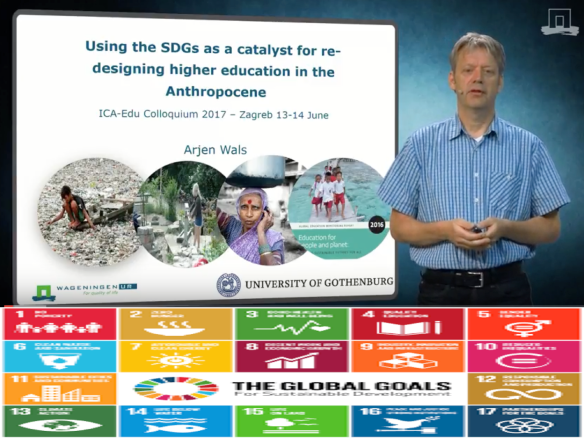
Using the SDGs as a catalyst for re-designing higher education in the Anthropocene

Zagreb

Last week (June 13-14, 2017) the University of Zagreb’s Faculty of Agriculture hosted an the 2017 ICA-Edu Colloquium “Delivering graduates to meet the challenges of sustainable development goals (SDGs): embedding the development of ethical and sustainable values ​​in the curriculum.” The colloquium was organized in cooperation with ICA (the Association for European Life Science Universities) which is the umbrella network of 54 life science universities in Europe. ICA’s goal is to improve higher education and research in agronomy and related sciences.

I was one of the keynote speakers along with Prof. David A. Knauft (University of Georgia) and  Prof. Georg Gratzer (University of Natural Resources and Life Sciences, Vienna – BOKU). Unfortunately I could not be physically present and I had to resort to using the ‘green room’ in the Social Sciences building of Wageningen University (a studio that is used for recording, among other things, short video’s for MOOCS). The 34 minute talk with the title ‘Using the SDGs as a catalyst for re-designing higher education in the Anthropocene’ can be viewed here: Keynote Zagreb ICA Conference

Radical ruralities in practice: Negotiating buen vivir in a Colombian network of sustainability – new article!

The Journal of Rural Studies just released a new paper on the conceptualisation and realization of buen vivit in a Colombian sustainability network. Martha Chaves as a part of her PhD-work (see earlier blog posts on this) led a team of authors that also included Thomas Macintyre, Gerard Verschoor and myself.

JRScover

This paper explores the emerging concept of buen vivir –  interpreted as integrative and collective wellbeing  – as it is being envisioned and practiced by a network of sustainability initiatives in Colombia. As an example of a transition narrative currently taking place in Latin America and beyond, buen vivir represents a turn towards a more biocentric, relational and collective means of understanding and being in the world. Yet despite the many discourses into buen vivir (many of which tout it as an alternative to neoliberal models of development), there is a general lack of research into its varied forms of application, especially in terms of lived experiences. Drawing on the new ruralities literature, this paper explores the extent to which buen vivir visions and practices represent radical new ruralities e so-called alternatives to development. Data were collected from individuals and ecological communities in predominantly rural areas who are members of the Council of Sustainable Settlements of the Americas (CASA), a
network which promotes many of the principles of buen vivir. Through participatory methods, results demonstrate that CASA visions are based on constructing territorial relations through intercultural knowledge exchange and experimentation into alternative lifestyles. Despite the substantial challenges and contradictions of putting these visions into practice, we argue that lived experiences promote processes of self-reflection on what buen vivir really is or could be. We hold that the inclusive nature of buen vivir offers opportunities for diverse peoples to cohere around shared meanings of the ‘good life,’
while providing the freedom to live variations depending on social and ecological context.

Here’s the DOI: //dx.doi.org/10.1016/j.jrurstud.2017.02.007

For a sneak preview you can also have a look here: Chavesetal2017RadicalRuralities

Towards Transgressive Learning through Ontological Politics: Answering the “Call of the Mountain” in a Colombian Network of Sustainability

Just before the end of the year a fascinating paper appeared in the journal Sustainability authored by a multi-author team led by Martha Chaves who just completed het PhD in Wageningen last month.

Chaves, M., Macintyre, T, Verschoor, G & Wals, AEJ (2017)Towards Transgressive Learning through Ontological Politics: Answering the “Call of the Mountain” in a Colombian Network of Sustainability. Sustainability 2017, 9, 21; doi:10.3390/su9010021  Link to the paper.

Abstract: In line with the increasing calls for more transformative and transgressive learning in the context of sustainability studies, this article explores how encounters between different ontologies can lead to socio-ecological sustainability. With the dominant one-world universe increasingly being questioned by those who advocate the existence of many worlds—a so-called pluriverse—there lays the possibility of not only imagining other human–nature realities, but also engaging with them in practice. Moving towards an understanding of what happens when a multiplicity of worlds encounter one another, however, entails a sensitivity to the negotiations between often competing ontologies—or ontological politics. Based on an ethnographic methodology and narrative methods, data were collected from two consecutive intercultural gatherings called El Llamado de la Montaña (The Call of the Mountain), which take place for five days every year in different parts of Colombia. By actively participating in these gatherings of multiplicity, which address complex socio-ecological challenges such as food sovereignty and defence of territory, results show how encounters between different ontologies can result in transformative and potentially transgressive learning in terms of disrupting stubborn routines, norms and hegemonic powers which tend to accelerate un-sustainability. Although we argue that a fundamental part of the wicked sustainability puzzle lies in supporting more relational ontologies, we note that such learning environments also lead to conflicts through inflexibility and (ab)use of power which must be addressed if sustained socio-ecological learning is to take place. Keywords: ontological politics; transformative learning; transgressive learning; sustainability; Colombia; narrative methods.

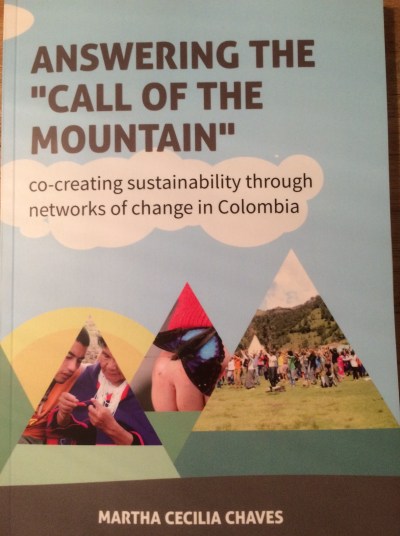
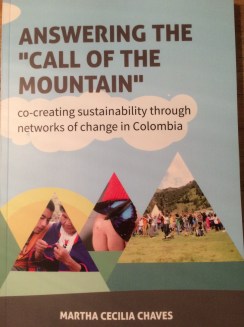
Here’s the cover of Martha Chaves’ PhD-thesis which can be downloaded from the Wageningen University Library system.

marthacover

Unreasonable doubt, viral nonsense and the Post-truth Trump era – avoiding hopelessness and creating sustainability by default


BeyondUnreasonableDoubtInvite

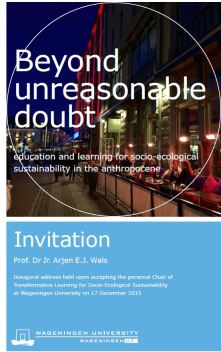
On December 17th, one year ago, the warmest December 17th on record on The Netherlands, I gave my a second inaugural address at Wageningen University titled: Beyond unreasonable doubt –  education and learning for socio-ecological sustainability in the anthropocene  (link to the text) the address took place exactly 6 months after Donald Trump announced his candidacy for President of the USA. At that time nobody really thought he had any chance but that was then. Now that we have entered a new phase of potential depression, hopelessness, psychic numbing, withdrawal, giving up, loss of energy, it seems like the challenge of moving towards a more sustainable world has become greater than ever before which is why I am re-posting the video that Wageningen University made back then about the role of education in creating more critical, mindful, empathic and responsible citizens willing and able to turn the tide and making living lightly and equitably on the Earth the default rather than the exception.

Here is the link to the 2,5 minute video that may be more accessible than the booklet (I hope it spreads as rapidly as some of the non-sense that spreads with lightening speed these days):

Breathing sustainability


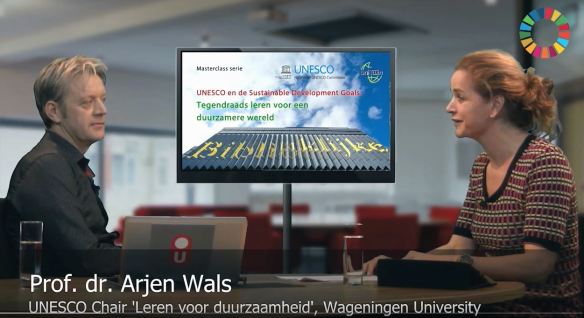
Interview UNESCO Master Class over Toekomstbestendig onderwijs in een duurzamere wereld – nu terug te zien

unescomasterclass

Vorige keer kondigde ik het vijfde gesprek dat Anouschka Laheij hield met UNESCO Chairs in het kader van de Masterclass over duurzame ontwikkeling aan. Dit keer mocht ik zelf opdraven om te praten over hoe moeilijk duurzaamheid ons wordt gemaakt en hoe makkelijk het wordt gemaakt om onduurzaam te zijn, maar ook over de aantrekkelijke onduidelijkheid van een schijnbaar vaag begrip als duurzame ontwikkeling en over hoe je onderwijs en leeromgevingen anders kunt inrichten zodat jongeren leren omgaan met complexiteit, onzekerheid en ambiguïteit. En niet alleen ‘leren omgaan met’ maar ook leren veranderen en leren de wereld te veranderen.

Het hele interview

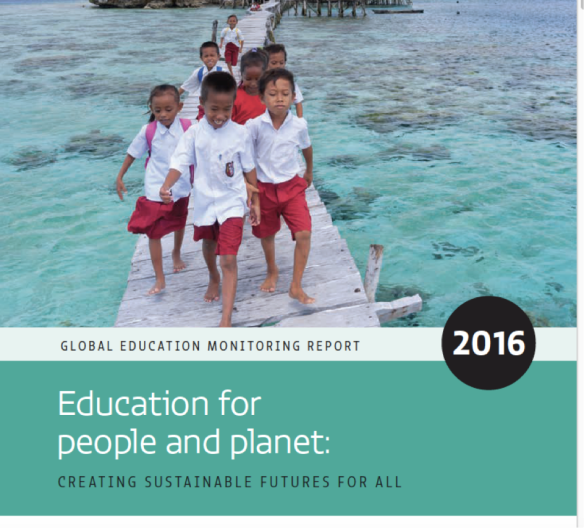
In het gesprek van 1 uur komen een veelheid vragen aan bod zoals:  Wat voor type onderwijs, wat voor soort leerprocessen en leeromgevingen zijn nu bij uitstek geschikt om te breken met onduurzame waarden, routines, leefstijlen en systemen? Hoe kun je gedrag en mogelijkheden om duurzaam te handelen creëren die kunnen leiden tot een transitie naar een duurzamere wereld? Een wereld waarin alle Duurzame Ontwikkelingsdoelen (SDG’s) in samenhang een plek krijgen. Zie ook mijn eerder blog post hierover in het kader van het verschijnen van het Global Education Monitor Report 2016.

gem2916

Answering the “Call of the Mountain”: Co-creating Sustainability through Networks of Change in Colombia

It is one thing to talk about wanting to live in harmonious relations with people, nature and Planet or Mother Earth, but quite another to put this into practice.

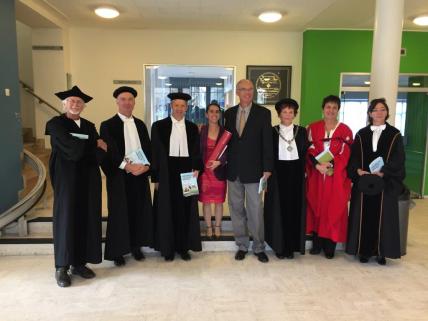
Today, Tuesday November 22nd, the day the FARC and the Colombian government are signing a new peace treaty, one of PhD students, Martha Chaves, successfully defended her dissertation. Martha’s thesis represents a systematic attempt to investigate individuals, communities, networks and gatherings of networks that seek to develop a more relational and caring way of living and of being in the world. In her native Colombia she studied what is it like to attempt to bring the principles of buen vivir such as; reconnecting to ancestral wisdom, questioning values of competition and individuality, and forming new relations to place and territory, into practice. Below you see a happy group of people who all played a role in the ceremony.

marthacover

Her research unveils the tensions between the dominant ontology or (ways of being) of modernity, and other marginalized more relational and cosmological ones such as those of Indigenous Andean communities. Her thesis also re-affirms the importance of plurality in creating the ‘dissonance’ that invites continuous learning that is sometimes at the edges of people’s comfort zones. More so, she shows how intercultural encounters between different ontological positions can lead to more a confronting and overcoming of our unsustainable habits. As such the thesis can help inform socio-ecological niches and movements across the globe that seek to provide a counter narrative to economic globalization, modernity and the neo-liberal agenda.

marthadefense1

After the defence – from left to right: Prof. Danny Wildemeersch, Prof. Rutgerd Boelens, myself, Dr. Martha Chaves, Dr. Gerard Verschoor, Deputy Rector Prof. Francine Govers, Prof. Heila Lotz-Sisitka and Prof. Noelle Aarts.

Furthermore, her results show or at least suggest that encounters between different ontologies can result in transformative and potentially ‘transgressive’ learning in terms of disrupting stubborn routines, norms and hegemonic powers which tend to accelerate unsustainablity. This finding connects well with here future work within the ISSC-funded project on T-learning (www.transgressivelearning.org) that I blogged about in the post below this one.

Afterwards there was a WASS seminar Symposium “Disruptive Networks of Change: Can ‘Transgressive’ learning alter the status quo?” where some critical follow-up questions were asked such as: What types of learning are needed to disrupt ingrained unsustainable behaviour? And how can learning-based change be upscaled? With invited speakers from the fields of environmental education and social learning, and building on the ISSC funded T-learning project which addresses issues of transformative/transgressive learning, we will set out to explore these questions, and possible paths towards more sustainable futures. Martha Chaves first presented here work briefly (presentation-for-defense-22-nov-2016), followed by responding presentations by Prof. Heila Lotz-Sisitka of Rhodes University in South Africa (issc-tkn-seminar-wageningenn) and by Prof. Danny Wildemeersch (paper-presentation-maynooth) of the University of Leuven in Belgium.