Op uitnodiging van Monique Volman heb ik samen met Jaap Schuitema een hoofdstuk geschreven voor een groot werk samengesteld door Frank Cornelissen getiteld ´Maak samen je eigen onderwijs´. Het is vorige week verschenen. Ik ben er blij mee want alhoewel ik regelmatig schrijf over duurzaam onderwijs en duurzaamheid in onderwijs, doe ik dat meestal in de Engelse taal en dat is best zonde.
Het hoofdstuk getitled ´Duurzaamheid als aanjager van integrale onderwijsvernieuwing´ geeft een aardig beeld van hoe onderwijs dat wil bijdragen aan een wereld die gezonder, vrediger, eerlijker en duurzamer is dan de wereld waarin wij nu leven, vormgegeven kan worden. Jaap en ik introduceren o.a. de whole school approach benadering. Ik heb geen officiele pdf-versie maar kan wel als voorproefje een ouderwetse kopie delen. Via de link onderaan deze post kom je erbij voor eigen gebruik. Voor een mooiere versie raad ik aan het boek te bestellen via de website van o.a. de uitgever Boom en wel hier.
De volledige biobliografische gegevens van ons hoofdstuk zijn als volgt:
Schuitema, J. & Wals, A. (2025) Duurzaamheid als aanjager van integrale onderwijsvernieuwing. In: Cornelissen, J. et al. (Red.) Maak samen je eigen onderwijs: verandereren, vernieuwen en verbeteren van schoolteams. Boom, Meppel. p. 128-136
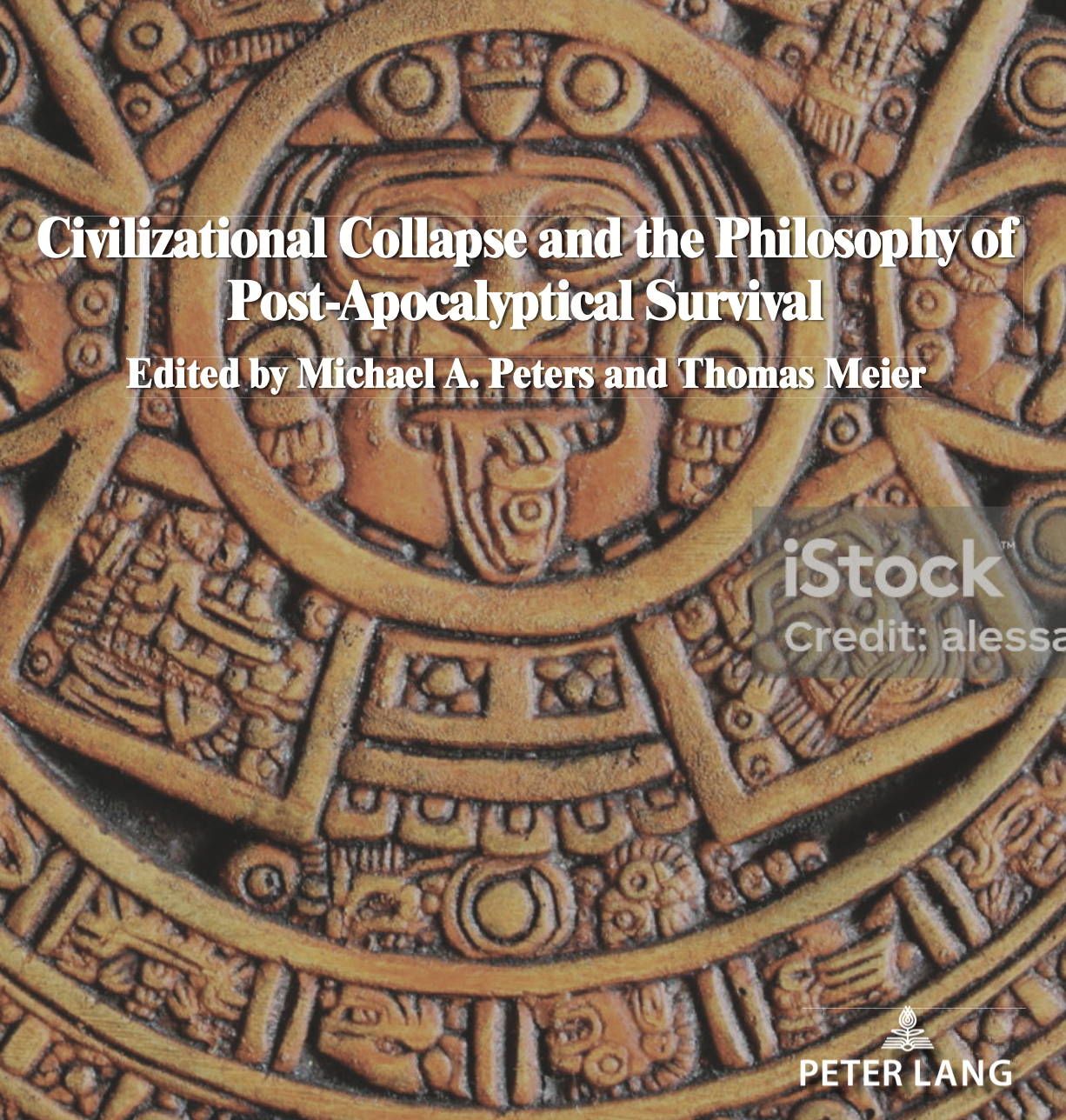
“Collapse” “The end of the world as we know it” “Amargeddon” “Dystopian Futures” “Maintaining hope on a dying planet” – words, concepts, phrases, pointing at the serious state of Earth. This remarkeable book with a range of perspectives on what to do, is a must read for educators, activitsts, researchers and composites thereof. From the back cover:
“The collapse of civilization, the end of the world as we know it, has long been a cultural imaginary, but has rarely been as topical as it is today. Beyond the phantasmagoria of violence, depression and despair, the conviction of being doomed has always been present It can be a challenge to imagine a new, post-apocalyptic world, be it utopian or dystopian. Beyond questions of immediate survival, there is a growing concern about how to educate humanity for a new life after the end of this world. In this volume, the editors, Michael A. Peters and Thomas Meier, renowned scholars of educational and apocalyptic studies, have brought together 31 contributions that offer a diversity of perspectives on such post-apocalyptic education, from abstract philosophical reflections to applied studies, from historical and political analyses of how we got into the current situation of global devastation to decolonial perspectives and essayistic explorations.”
I was invited to contribute a chapter on what I have dubbed ´Earth-centered education´: Earth Centred Education: An Invitation to Relational Transgressive Learning as a Counter-Hegemonic Force in Times of Systemic Global Dysfunction Have a look at the ToC and consider getting a copy of the book from Peter Lang here
I am providing a link to the table of contents of the book and the typeset version of my chapter here.
Photo above comes from Wanås Konst – Center for Art & Learning, presents and communicates contemporary art that challenges and redefines society, working outside in the landscape around Wanås in Skåne, southern Sweden
Here is a chapter I have been wanting to write and get out for a while. In it I pose that fifty years of education and learning in relation to the environment and sustainability have not made a dent in the current systemic global dysfunction that is propelling humanity toward collapse. In many parts of the world, education, learning, and capacity-building have been hijacked serve an extractivist and exploitive economy that cultivates materialist lifestyles and promotes extreme wealth inequality.
In this chapter, published in a fascinating handbook, I introduce the related concepts of cotonomy and eco-Bildung as a way to transgress this dysfunction and to break with hegemonic structures and systems that are underneath. Ideas from Daoism, ecopedagogy, and Bildung are brought together as socio-critical transitional pathway that moves humanity beyond sustainability.
Full citation:
Wals, A.E.J. (2025). On Cotonomy and Eco-Bildung as a Relational Transitional Pathway Toward Post-sustainability. In: Peters, M.A., Green, B.J., Misiaszek, G.W., Zhu, X. (eds) Handbook of Ecological Civilization. Springer International Handbooks of Education. Springer, Singapore. https://doi.org/10.1007/978-981-97-8101-0_8-1
Note: this is not an open-access chapter unfortunately but do send me an email: arjen.wals@wur.nl or via LinkedIn @arjenwals and I might be able to share the proofs with you.
Two papers I co-authored with different colleagues came out in the same Special Issue of the Australian Journa of Environmental Education published by Cambridge University Press. Both papers are published with open access.
The first paper led by PhD-candidate at Wageningen University, Reineke van Tol is on the potential of Wilde Pedagogies for renewing and reorienting higher education towards a posthumanist and relational perspective.
Citation: van Tol RS, Wals A. Wild Pedagogies in Practice: Inspiration for Higher Education. Australian Journal of Environmental Education. Published online 2025:1-23. doi:10.1017/aee.2025.16
The second paper led by Koen Arts is on Embedding Outdoor Relational Education in Academia and the barriers and opportunities we are running into in our home instiution: Wageningen University in The Netherlands.
Citation: Arts K, Roncken P, Buijs A, Wals A. Embedding Outdoor Relational Education in Academia: Perceived Barriers and Opportunities at a Dutch University. Australian Journal of Environmental Education. Published online 2025:1-21. doi:10.1017/aee.2025.24
In the first paper (van Tol and Wals, 2025) Wild Pedagogies (WP) are introduced as a critical, relational alternative to current, often unsustainable learning practices. WP aim to offer a way of learning in, with, through and for nature, embracing a post-humanist, relational perspective. So far, WP have mainly been explored theoretically. Increasingly, educators both within and outside of formal education, are inspired and apply WP in their education. Throughout the world, examples of learning that fit into WPs’ living definition, are emerging. However, concrete inspiration for how to bring WP theory into practice, is still largely lacking. In this paper, we explore three emerging approaches at Wageningen University (The Netherlands), that are inspired by wild pedagogies. Empirically, we combine formative evaluations of course designs with participant observation in a collective case study setting over three years. The empirical research is embedded in an explorative literature review that led us to four explorative areas of WP, namely (1) Wild and caring learning spaces (2) Learning from self-will and wonder (3) Relational learning with the world and (4) Disruptive learning for the world. Eventually we present concrete inspiration on those four areas for implementing WP in formal higher education. You can find the full paper here.
In the second paper (Arts et a., 2025) a common denominator of these more relational approaches is an emphasis on learning outdoors. This paper investigates the budding concept and practice of outdoor relational education at a university, specifically Wageningen University (WU) in the Netherlands. Based on 31 semi-structured interviews with protagonists and other stakeholders involved in or affiliated with outdoor relational education at WU, we identify associations, key elements and perceived benefits. Our research provides insight into what outdoor relational education and associated concepts are perceived to be in this context, how they are engaged and what the key experienced opportunities and barriers are to implement outdoor relational education further at WU. Complementary to theorisations of wild pedagogies and related approaches, our results offer empirical illustrations of wild pedagogies “in action” in an institutional academic setting that is not necessarily conducive to such developments. You can find the full paper here.
We are about to end the first year of an EU-funded project on developing LivingLabs for Nature-Based Solutions and will soon ‘implement’ / unfold 7 LivingLabs in the participating countries. Below some basic information that you can also find on the ENABLS Website. Together with Mieke de Wit, ouise van der Stok and Lian Kasper, I am representing Education & Learning Sciences of Wageningen University in this major project.
This collaborative multi-authored paper develops the methodological concept of river co-learning arenas (RCAs) and explores their potential to strengthen innovative grassroots river initiatives, enliven river commons, regenerate river ecologies, and foster greater socio-ecological justice. The integrity of river systems has been threatened in profound ways over the last century. Pollution, damming, canalisation, and water grabbing are some examples of pressures threatening the entwined lifeworlds of human and non-human communities that depend on riverine systems. Finding ways to reverse the trends of environmental degradation demands complex spatial–temporal, political, and institutional articulations across different levels of governance (from local to global) and among a plurality of actors who operate from diverse spheres of knowledge and systems of practice, and who have distinct capacities to affect decision-making. In this context, grassroots river initiatives worldwide use new multi-actor and multi-level dialogue arenas to develop proposals for river regeneration and promote social-ecological justice in opposition to dominant technocratic-hydraulic development strategies. This paper conceptualises these spaces of dialogue and action as RCAs and critically reflects on ways of organising and supporting RCAs while facilitating their cross-fertilisation in transdisciplinary practice. By integrating studies, debates, and theories from diverse disciplines, we generate multi-faceted insights and present cornerstones for the engagement with and/or enaction of RCAs. This encompasses five main themes central to RCAs: (1) River knowledge encounters and truth regimes, (2) transgressive co-learning, (3) confrontation and collaboration dynamics, (4) ongoing reflexivity, (5) transcultural knowledge assemblages and translocal bridging of rooted knowledge.
Citation:
De Souza, D. T., Hommes, L., Wals, A., Hoogesteger, J., Boelens, R., Duarte-Abadía, B., … Joy, K. J. (2024). River co-learning arenas: principles and practices for transdisciplinary knowledge co-creation and multi-scalar (inter)action. Local Environment, 1–23. https://doi.org/10.1080/13549839.2024.2428215
We are pleased to share with you the publication of our new book, Education and Learning for Sustainable Futures: 50 years of learning and environmental change. This book explores fundamental questions about how the role of education has evolved over the decades since the pivotal 1972 Stockholm Conference, which brought environmental learning to the forefront of global awareness.
Co-authors, Daniella Tilbury and Thomas Macintyre and myself, have attempted to find some answers by tracking through the decades (1970-2020) the development of narratives, thinking, and practice of learning and education in support of the environment and sustainability. What is clear is that the profile and presence of learning and education for the environment has been elevated in today’s policy discourses and communities of practice. Yet, our analysis identified some clear differences in the way education and learning for the environment has been approached over time.
In our new book, we trace these changes over the decades while looking ahead to the challenges and opportunities of the future. A key wildcard in this journey is Artificial Intelligence (AI), which holds immense potential to bridge digital and green agendas, enabling smarter environmental management and driving innovation toward a sustainable future. However, we also address critical concerns: data privacy breaches, outsourcing human thinking to profit-driven algorithms, exacerbation of inequalities, and the environmental footprint of AI infrastructure.
This book provides a light way into the history, developments and prospects of the field of Environmental and Sustainability Education.
Full reference:
Macintyre, T., Tilbury, D., & Wals, A. (2024). Education and Learning for Sustainable Futures: 50 Years of Learning for Environment and Change (1st ed.). Routledge. https://doi.org/10.4324/9781003467007
Our thanks also go to Stakeholder Forum and to @JanGustav for his leadership role in the Stockholm+50 reflective dialogues, and to UNEP/ the Swedish Government for spurring us on to track the historical development of education and learning for the environment. We are also grateful to @Routledge for taking an interest in publishing the text.
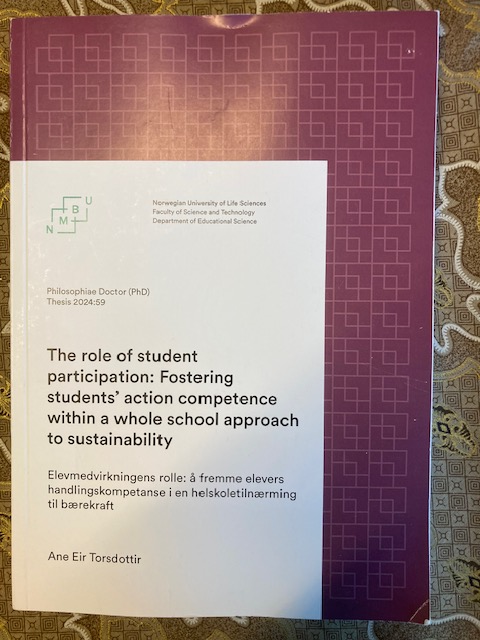
On Friday November 1st one of my Norwegian PhD Candidates successfully defended her dissertation. Over the past few years I have been working with colleagues both at Wageningen University and at the Norwegian Life Sciences University (NMBU) on researching the potential merits of so-called Whole School and/or Whole Institution Approaches (WSA/WIA) to sustainability. At NMBU there are currently four PhD-candidates doing research related to this, Ane Eir Thorsdottir is or rather, was one of them. Her work focusses on one aspect of the WSA which is critically important: students participation. In addition to myself, Prof Astrid Sinnes of NMBU and Dr. Daniel Olsson of Karlstad University in Sweden were her supervisors. Jan Cincera and Elin Saether (Olso Univerity) were her ‘ opponents’ .She has published three articles that are central in the dissertation: two in Environmental Education Research and one in Global Environmental Research.
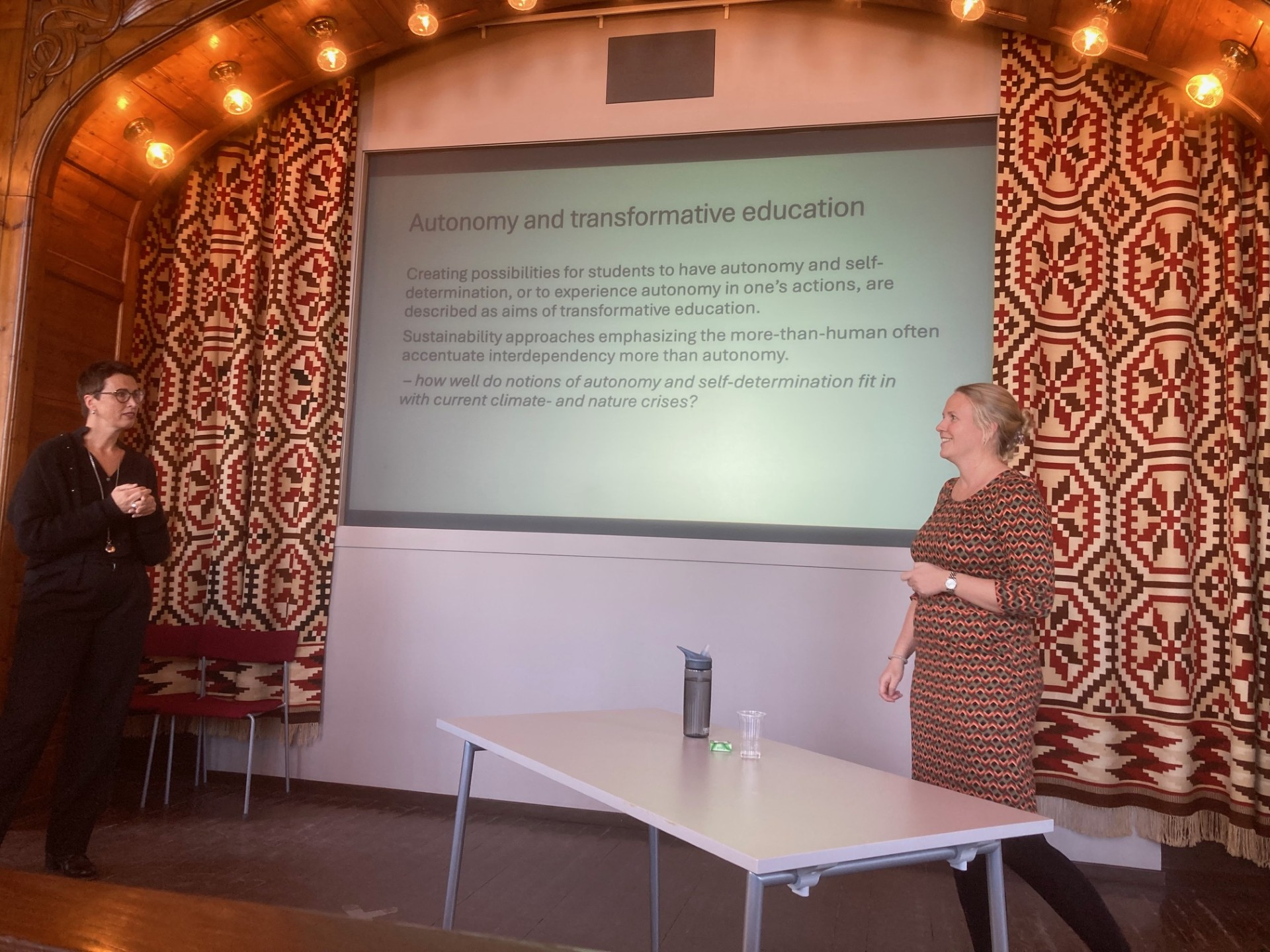
Elin Seather (left) having a dialogue with Ane (right) during the defence – posing an interesting question about autonomy and self-determination as pedagogical principles in a world that requires a decentering of ‘ self’ and opening up for ‘ other’ as well.
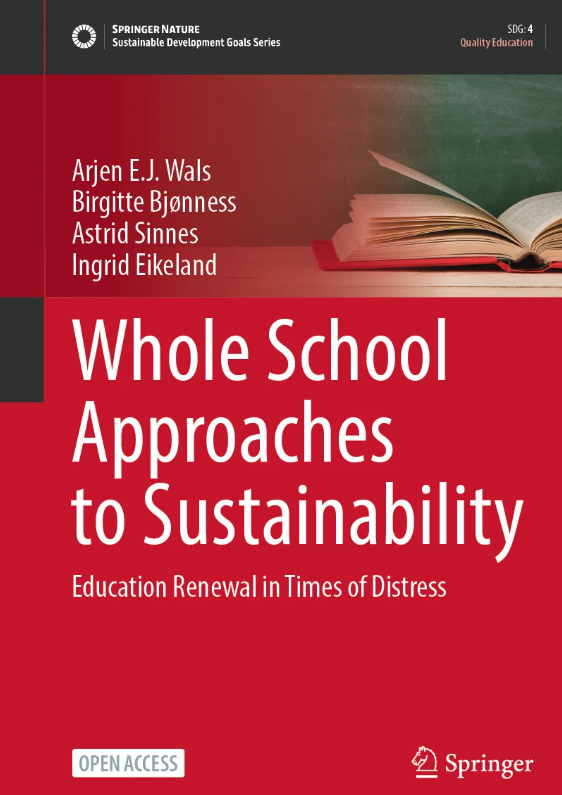
At last – the edited volume on ‘Whole School Approaches to Sustainability – Educational renewal in times of distress’ has come out. Together with co-editors, Birgitte Bjønness, Astrid Sinnes and Ingrid Eikeland, and managing editor Stine Marie FyskeHaraldsen, we have worked with authors from around the world to create this rich picture of principles, practices and prospects of school working more systemically and holistically with sustainability, rather than treating it like another subject to be added to an already overcrowded curriculum.
The book has been made Open Acess and all 24 (!) chapters can be downloaded for free thanks to a grant provided through the Dutch Government-Supported Programme for Learning for Sustainable Development (LvDO).
We wish to acknowledge Roel van Raaij who has been an advocate of Education for Sustainable Development, both nationally and internationally, from within the Dutch government for decades, and Ellen Leusink who facilitates and supports ESD through the LvDO program and paved the way for the open access.
We also want to acknowledge the Department of Educational Science at the Norwegian Life Science University (NMBU led by Hans Erik Lefdal together with Akershus county municipality (the school district South of Oslo) for the support to establish and run the University—School partnership for the last 6 years or so, continuing to this day. The partnership with schools, especially the collaboration with school coordinators and principals, have supported the development of the Whole School Approach through research and praxis. Without this foundation and support, we would not have had the knowledge, time, and confidence to work on this book.
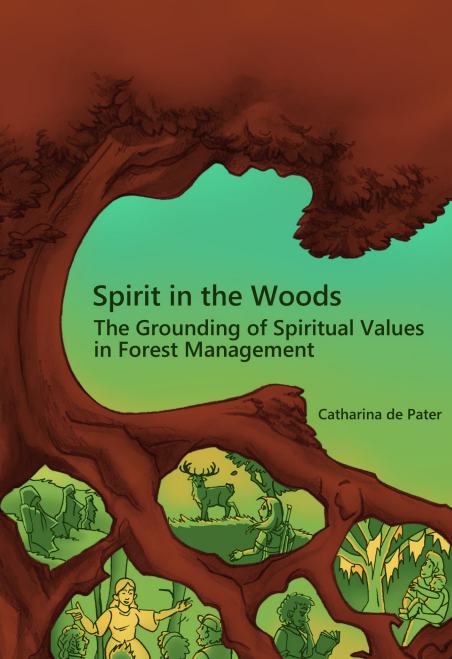
Last Tuesday – April 16th, 2024 – was a special day as the day before her 72nd birthday, Cathrien de Pater received her PhD-degree with some goundhealing research on the role of spirituality in forest management. What used to be a taboe topic in the world of academia, now receives the attention it deserves as we are grappling with finding more sustainable ways of living. The defense took place in a full auditorium at Wageningen University and was preceeded by a symposium featuring Prof. Bron Taylor, University of Florida, founder of the International Society & Journal for the Study of Religion, Nature and Culture, Ms. Shaohua Wang MA, University of Barcelona, PhD researcher in Spiritual Tourism and Prof. Vykintas Vaitkevicius, Klaipeda University, Lithuania, author of Studies into the Balts’ Sacred Places.
It was a pleasure and an honour to be Chairing Cathrien’s dissertation committee, together with co-promotor Dr. Bas Verschuren of the Forestry and Nature Conservtaion Policy Group at WUR. I would like to acknowledge in particular the role of the late Dr Birgit Elands who played a key role in the early stages of this research but sadly passed away too soon to see this journey come to a close. Fortunately both Birgit’s spirit will travel further through the wonderful work Carthrien has done over the years and will concitnue to do in the years to come.
Below you find the introductory part of the summary of the dissertaion. The full dissertation will be made available via the Wageningen UR Library.
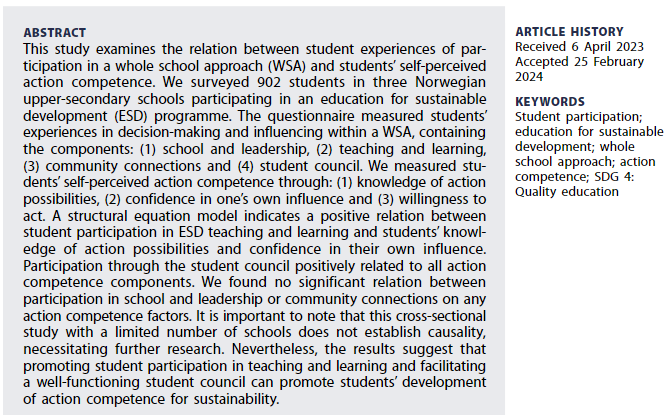
Over the past few years I have been working with colleagues both at Wageningen University and at the Norwegian Life Sciences University (NMBU) on researching the potential merits of so-called Whole School and/or Whole Institution Approaches (WSA/WIA) to sustainability. At NMBU there are currently four PhD projects related to this. One of the PhD candidates I am working with is Ane Thorsdottir who focusses on one aspect of the WSA which is critically important: students participation. A paper of which she is the lead researcher and lead author just came out in Environmental Education Research (open access). In the paper students’ self-perceived action competence within a WSA is a central topc. Here is the abstract:
Here is the full reference and a link to the full paper:
Ane Eir Torsdottir, Daniel Olsson, Astrid Tonette Sinnes & Arjen Wals (2024) The relationship between student participation and students’ self-perceived action competence for sustainability in a whole school approach, Environmental Education Research, DOI: 10.1080/13504622.2024.2326462
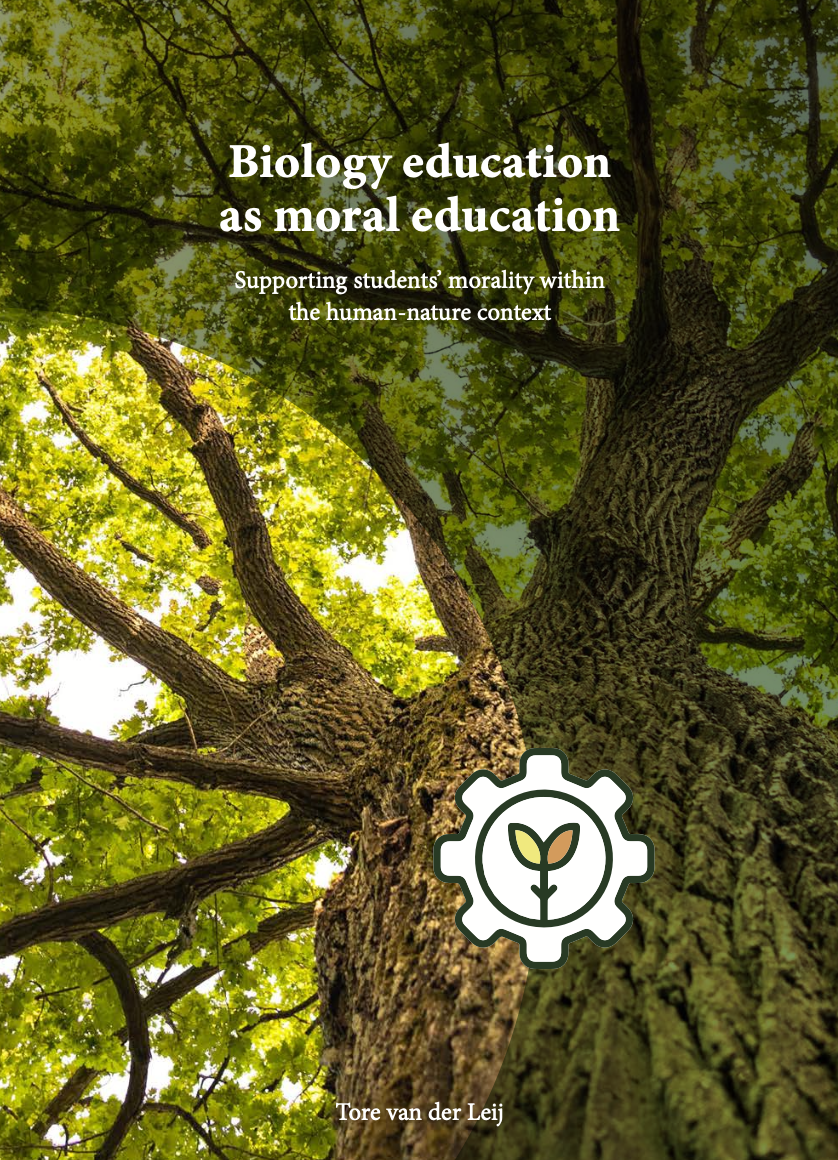
On this day, February 13th, one of my first Masters students during my tenure at Wageningen University (in the mid-1990s!), Tore van der Leij, defended his PhD on ´Biology Education as a moral education´. He did so in the Aula of the University of Groningen which hosted his research. Tore is a Biology Teacher at Hondsrug College Secondary School in Emmen in the North of the Netherlands. Under the mentorshop of Prof. Martin Goedhart (RUG), Prof. Lucy Avraamidou (RUG) and myself, Tore worked, over a period of 7 years (COVID19 inclusive) with secondary school students and fellow teachers in two schools in figuring out how their morality can best be developed within the human-nature context. He developed a series of lessons to help trigger students´morality (all available in Dutch in the appendix). Tore had all four of his empirical chapters published in high quality journals. As an appetiser for his excellent work, I am sharing the Epilogue of his thesis below. The entire thesis can be downloaded via the University of Groningen´s Library System.
Epilogue
“As I described in the introduction to this chapter, many biology teachers in the Netherlands consider supporting students in developing skills related to morality important (e.g., CvTE, 2019; SLO, 2021; Van Maanen, 2021). Unfortunately, most teachers do not get around to it, mainly because of the overloaded exam programme (CvTE, 2019; SLO, 2021). In addition, the skills are not tested in the central exams, but only in the school exams. As a result, supporting students in developing skills related to morality are not teachers’ priority.
All this notwithstanding, the outlined urgency of the context in which supporting students’ morality should take place is evident. Above that, given that many biology teachers do consider supporting students’ morality important, it is my hope that the results from this research project provide a valuable practical interpretation of biology education aimed at supporting students’ morality in the human-nature context.
When I started this PhD journey in 2016, an important motive for conducting this research project was my concern about the socio-ecological challenges, both globally and locally, in which the negative impact of human actions on ‘other-than-human’ beings, and future generations have become increasingly prominent. I felt, and still feel, that education should respond to this urgency by providing our students with the necessary ‘free space’, ‘skolè’, to develop, form and reflect upon these challenges, and give them opportunities to act in relation to the constantly changing world around them.
The fact that Gretha Thunberg (a 15-year old student at the time) with her ‘Skolstrejk för klimatet’ in 2018 (about two years after the start of this research project) chose not to go to school, is perhaps illustrative for education’s challenge to offer our students the valuable and meaningful education, that meets the big challenges of our time. In any case, the following that Gretha has received since then – for instance, the Climate Strikes in which tens of thousands of young people participated – shows that there is plenty of commitment, need and motivation among young people to engage with these moral dilemmas.”
Led by Daniel Couceiro, I was priviledged to join a group of reflective practitioners and colleague Valentina Tassone on the meaning of stewardship in a troubled highly biodiverse region Here you have the main premise of the paper but please go to the full paper for a more in-depth encounter with the work.
Nature degradation is rooted in the disruption of the human-land connection. Its restoration requires the regeneration of environmental stewardship as a way to live within environmental limits, especially for younger generations. In this study we used the implementation of a year-round, non-formal environmental education program during COVID-19 times to explore environmental stewardship in adolescents between 14- and 18-years old from the Sierra Nevada de Santa Marta, Colombia. Using a qualitative methodology, we mapped expressions of environmental stewardship among local youth. We found several barriers that can be challenged and levers that can be nurtured through inclusive, place-based and collaborative environmental education strategies to foster youth’s environmental stewardship in Colombian’s high-biodiverse regions.
Full citation and link to open access paper:
Daniel Couceiro, Ivona Radoslavova Hristova, Valentina Tassone, Arjen Wals & Camila Gómez (2023) Exploring environmental stewardship and youth engagement in biodiversity among youth from a high-biodiverse region in Colombia, The Journal of Environmental Education, DOI: 10.1080/00958964.2023.2238649
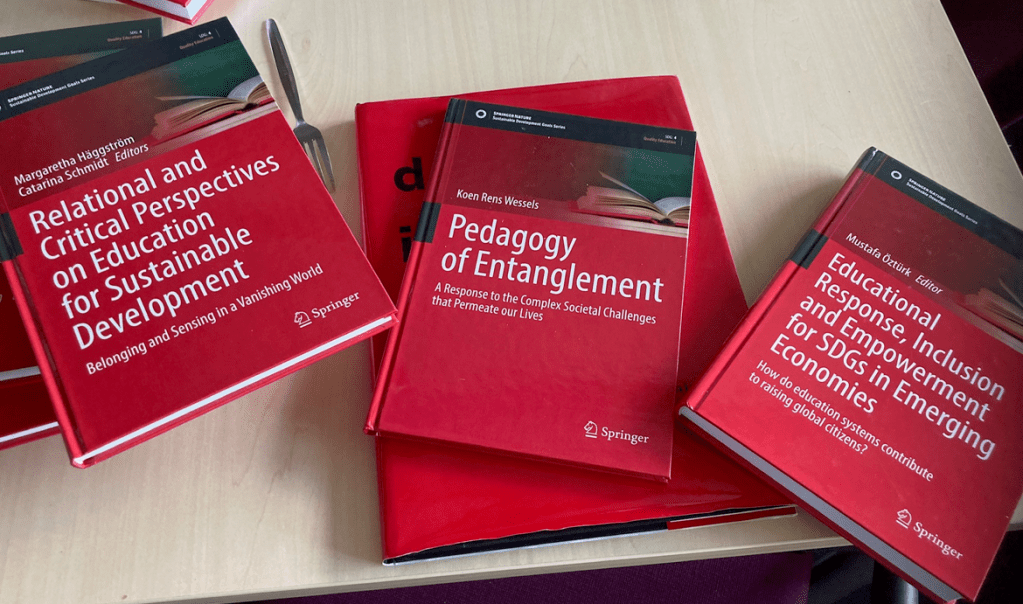
Recently, a few more titles appeared in the Springer SDG4 Series that are expanding horizons, addressing blind spots and offer guidelines for alternative ways of thinking and acting in and through education in light of pressing global sustainability challenges. One of them finally arrived on my desk today: Koen Wessel’s “Pedagogy of Entanglement: a response to complex societal challenges that permeate our lives”. This book is a real treasure that is based on Koen’s dissertation which he completed last year at Utrecht University (with joint supervision from Wageningen University). You can find the book here.
The Springer Sustainable Development Goals Series aims to provide a comprehensive platform to the scientific, teaching and research communities studying issues in the fields of geography, earth sciences, environmental science, social sciences, engineering, policy, planning, and human geosciences in order to contribute knowledge toward achieving the current 17 Sustainable
Development Goals. Volumes in the series are organized by relevant goal and guided by an expert international panel of advisors.
The subseries that I am co-editing together with Nicole Ardoin of Standford University, focuses on SDG 4: Quality Education and more specifically on the following questions: What kind of quality or qualities must education have in order to be able to contribute to Sustainable Development as expressed by the SDGs? How can such education be developed, implemented and assessed in a wide range of contexts across the globe? How can quality education, that contributes to the well-being of all people and the whole planet, becomeaccessible for everyone?
Topics covered by the SDG 4 subseries include, but are to limited to: education policy and governance for ESD/ESE and Global Citizenship Education (GCE), conceptualizing sustainability competence other possible learning outcomes of ESD and GCE, pedagogical approaches to ESD/ESE and GCE, the role of teacher training/professional development in fostering ESD/ESE/GCE,
assessment of ESD/ESE and GCE-related learning, creating whole school or whole institution approaches to sustainability, making ESD/ESE and GCE accessible and relevant for all learners in a wide range of context across the globe.
Should you be interested in writing or editing a book for this Series, contact Zachary Romano in Springer’s New York office or drop me or Nicole a line!
One of my PhD’s. Tore van der Leij – jointly supervised with Prof Martin Goedhart and Prof. Lucy Avramidoo, both from Groningnen University here in The Netherlands where Tore hopes to receive his degree sometime this year – just had one of his studies published in the Journal of Biological Education.
The paper, of which Tore is the lead-author, poses that in addressing contemporary socio-ecological challenges it is imperative to engage individuals with the moral dilemmas in the human-nature context. A socioscientific-issues (SSI) approach to secondary biology education can contribute to engaging students in moral dilemmas and reflecting on their values.
Following a design research methodology, the paper aimed to: (1) develop a set of design principles of an intervention in Dutch upper secondary SSI biology education, aimed at supporting secondary biology students’ morality in the human-nature context; (2) concretise the design principles as a module.The practical output of the study is a module, which was refined and improved during the design phase, and then implemented by two biology teachers. In this paper, we present an exemplary example of a lesson from the module. As theoretical output, the paper discusses the role of the design principles: nature of the dilemmas; Four Component Model of morality; group work; and ethical matrix. Based on experiences in classrooms, recommendations are provided for further research and practice.
Full citation: Leij, T. van der; Goedhart, M.; Avraamidou, L. & Wals, A. (2023) Designing a module for supporting secondary biology students’ morality through socioscientific issues in the human-nature context, Journal of Biological Education, DOI: 10.1080/00219266.2023.2174160
For another paper related to this research see:
Tore Van Der Leij, Lucy Avraamidou, Arjen Wals & Martin Goedhart (2022) Supporting Secondary Students’ Morality Development in Science Education, Studies in Science Education, 58:2, 141-181, DOI: 10.1080/03057267.2021.1944716