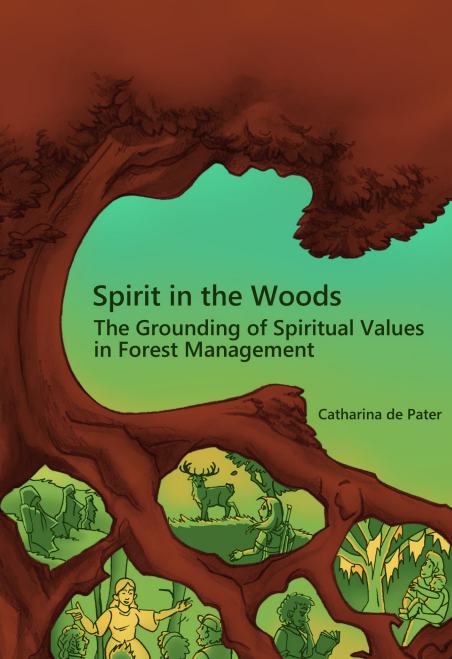
Catharina de Pater successfully defends: ‘Spirit in the Woods – the grounding of spiritual values in forest management’

Last Tuesday – April 16th, 2024 – was a special day as the day before her 72nd birthday, Cathrien de Pater received her PhD-degree with some goundhealing research on the role of spirituality in forest management. What used to be a taboe topic in the world of academia, now receives the attention it deserves as we are grappling with finding more sustainable ways of living. The defense took place in a full auditorium at Wageningen University and was preceeded by a symposium featuring Prof. Bron Taylor, University of Florida, founder of the International Society & Journal for the Study of Religion, Nature and Culture, Ms. Shaohua Wang MA, University of Barcelona, PhD researcher in Spiritual Tourism and Prof. Vykintas Vaitkevicius, Klaipeda University, Lithuania, author of Studies into the Balts’ Sacred Places.

It was a pleasure and an honour to be Chairing Cathrien’s dissertation committee, together with co-promotor Dr. Bas Verschuren of the Forestry and Nature Conservtaion Policy Group at WUR. I would like to acknowledge in particular the role of the late Dr Birgit Elands who played a key role in the early stages of this research but sadly passed away too soon to see this journey come to a close. Fortunately both Birgit’s spirit will travel further through the wonderful work Carthrien has done over the years and will concitnue to do in the years to come.

Below you find the introductory part of the summary of the dissertaion. The full dissertation will be made available via the Wageningen UR Library.

Rethinking pedagogy in the face of complex societal challenges: helpful perspectives for teaching the entangled student

This paper appeared online in 2022 and was a part of the wonderful dissertation of Koen Wessels which was later published by Springer Nature as a book within the publisher´s SDG 4 ´Quality Education´ Series. Now has been formally published in open-access form as a part of the latest issue of Pedagogy, Culture and Society. Full citattion: Wessels, K. R., Bakker, C., Wals, A. E. J., & Lengkeek, G. (2024). Rethinking pedagogy in the face of complex societal challenges: helpful perspectives for teaching the entangled student. Pedagogy, Culture & Society32(3), 759–776. View and download here: https://doi.org/10.1080/14681366.2022.2108125

Here is the abstract to give you a bit of a flavor of the paper:

New paper out: Vocational education for a sustainable future

Saskia Weijzen published her first article as a part of her PhD-journey. The full title is:  Vocational education for a sustainable future: Unveiling the collaborative learning narratives to make space for learning

I am sharing the abstract here to pique, hopefully, your curiosity:

In the light of urgent global sustainability challenges, vocational education is searching for new approaches that are more just and future proof. At least a part of the answer seems to lie in so-called collaborative learning arrangements where students together with societal actors explore sustainability-related challenges. The amount of this kind of arrangements in which vocational education participates increases. Empirical studies on what actually goes on in the collaborative arrangements are rather scarce. This study addresses the theory-practice gap by applying a participatory design. The study unveils that deeply seated educational and socio-cultural routines like the student as learner, alienation from issues, a bias towards cognitive knowing and ‘solving’ problems seem to limit the possibilities for more genuine collaboration to emerge. The study also found that by intervening with creative and reflexive methods, space for transformative learning can unfold that allows engagement with existential questions like ‘what is it what I really got to do here?’. The opening up of these spaces was accompanied by longings to go beyond the rosy narratives of collaborative learning arrangements and to have more attention for the persistent embeddedness of educational routines in the societal issues around us. Vocational education as society. What happens if we progress towards vocational education for sustainable futures with more modesty and introspection?

The full citation and doi (it is open access!) is:

Weijzen, S. M. G., Onck, C., Wals, A. E., Tassone, V. C., & Kuijer-Siebelink, W. (2024). Vocational education for a sustainable future: Unveiling the collaborative learning narratives to make space for learning. Journal of Vocational Education & Training76(2), 331–353. https://doi.org/10.1080/13636820.2023.2270468

Another WSA paper: The relationship between student participation and students’ self-perceived action competence for sustainability in a Whole School Approach

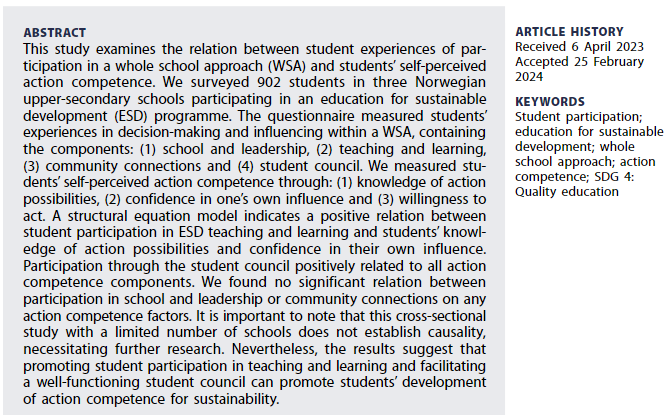
Over the past few years I have been working with colleagues both at Wageningen University and at the Norwegian Life Sciences University (NMBU) on researching the potential merits of so-called Whole School and/or Whole Institution Approaches (WSA/WIA) to sustainability. At NMBU there are currently four PhD projects related to this. One of the PhD candidates I am working with is Ane Thorsdottir who focusses on one aspect of the WSA which is critically important: students participation. A paper of which she is the lead researcher and lead author just came out in Environmental Education Research (open access). In the paper students’ self-perceived action competence within a WSA is a central topc. Here is the abstract:

Here is the full reference and a link to the full paper:

Ane Eir Torsdottir, Daniel Olsson, Astrid Tonette Sinnes & Arjen Wals (2024) The relationship between student participation and students’ self-perceived action competence for sustainability in a whole school approach, Environmental Education Research, DOI: 10.1080/13504622.2024.2326462

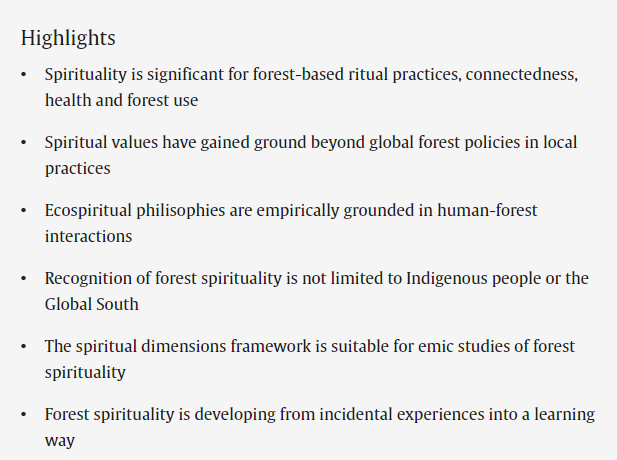
Just out: Exploring spiritual values in forest management practices in the Netherlands

On April 16th 2024 my most Senior PhD-student Catharina de Pater will defend here theis titled ‘ Today one of her chapters got published in Elsevier’s ‘Trees, Forests and People’ – an intriguing peer-reviewed journal. The paper’s title is: Exploring spiritual values in forest management practices in the Netherlands. It was a pleasure working with Cathrien and co-supervisor Bas Verschuren on her PhD-work in general and on this paper in particular. The paper is open-access and available to all.

Catharina de Pater, Bas Verschuuren, Sonja Greil, Arjen Wals, Exploring spiritual values in forest management practices in the Netherlands, Trees, Forests and People, 2024,
https://doi.org/10.1016/j.tfp.2024.100522.

Here is the link to the paper: https://www.sciencedirect.com/science/article/pii/S266671932400030X

Here are some main highlights:

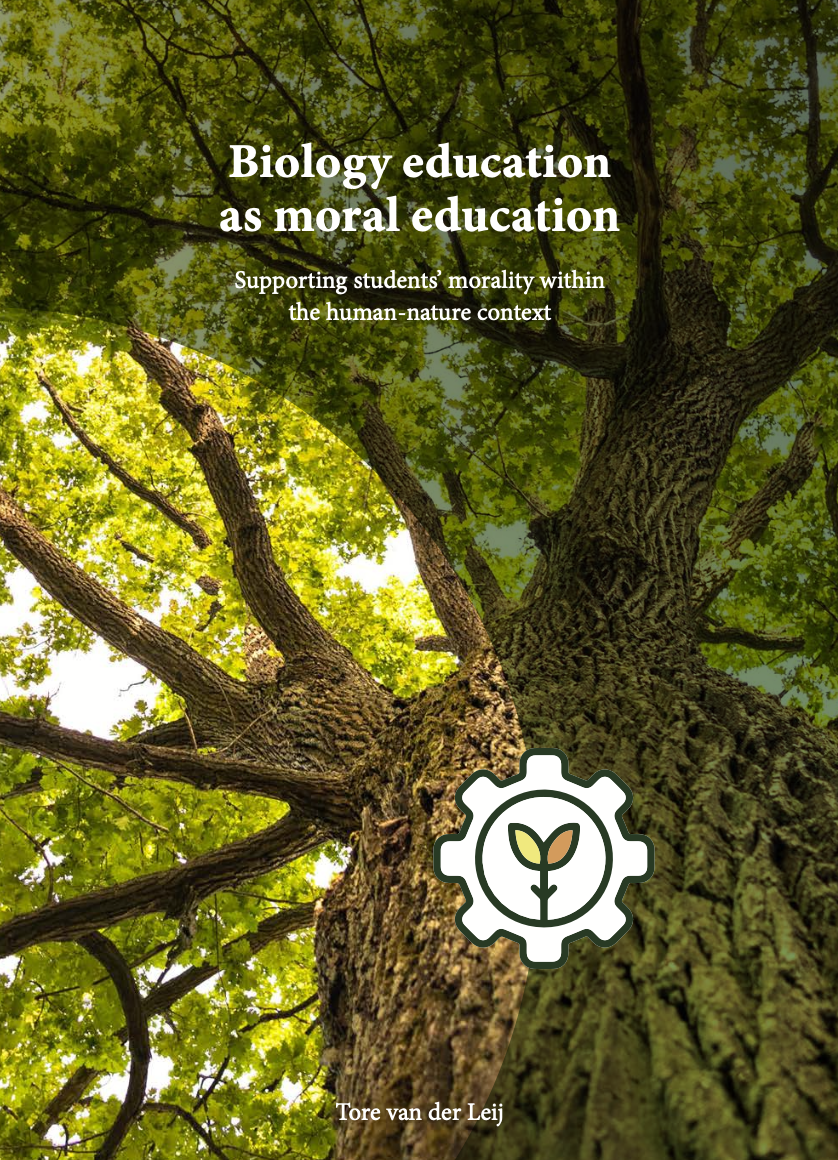
Tore vd Leij successfully defends: ´Biology education as moral education: Supporting students’ morality within the human- nature context´

On this day, February 13th, one of my first Masters students during my tenure at Wageningen University (in the mid-1990s!), Tore van der Leij, defended his PhD on ´Biology Education as a moral education´. He did so in the Aula of the University of Groningen which hosted his research. Tore is a Biology Teacher at Hondsrug College Secondary School in Emmen in the North of the Netherlands. Under the mentorshop of Prof. Martin Goedhart (RUG), Prof. Lucy Avraamidou (RUG) and myself, Tore worked, over a period of 7 years (COVID19 inclusive) with secondary school students and fellow teachers in two schools in figuring out how their morality can best be developed within the human-nature context. He developed a series of lessons to help trigger students´morality (all available in Dutch in the appendix). Tore had all four of his empirical chapters published in high quality journals. As an appetiser for his excellent work, I am sharing the Epilogue of his thesis below. The entire thesis can be downloaded via the University of Groningen´s Library System.

Epilogue

“As I described in the introduction to this chapter, many biology teachers in the Netherlands consider supporting students in developing skills related to morality important (e.g., CvTE, 2019; SLO, 2021; Van Maanen, 2021). Unfortunately, most teachers do not get around to it, mainly because of the overloaded exam programme (CvTE, 2019; SLO, 2021). In addition, the skills are not tested in the central exams, but only in the school exams. As a result, supporting students in developing skills related to morality are not teachers’ priority.

All this notwithstanding, the outlined urgency of the context in which supporting students’ morality should take place is evident. Above that, given that many biology teachers do consider supporting students’ morality important, it is my hope that the results from this research project provide a valuable practical interpretation of biology education aimed at supporting students’ morality in the human-nature context.

When I started this PhD journey in 2016, an important motive for conducting this research project was my concern about the socio-ecological challenges, both globally and locally, in which the negative impact of human actions on ‘other-than-human’ beings, and future generations have become increasingly prominent. I felt, and still feel, that education should respond to this urgency by providing our students with the necessary ‘free space’, ‘skolè’, to develop, form and reflect upon these challenges, and give them opportunities to act in relation to the constantly changing world around them.

The fact that Gretha Thunberg (a 15-year old student at the time) with her ‘Skolstrejk för klimatet’ in 2018 (about two years after the start of this research project) chose not to go to school, is perhaps illustrative for education’s challenge to offer our students the valuable and meaningful education, that meets the big challenges of our time. In any case, the following that Gretha has received since then – for instance, the Climate Strikes in which tens of thousands of young people participated – shows that there is plenty of commitment, need and motivation among young people to engage with these moral dilemmas.”

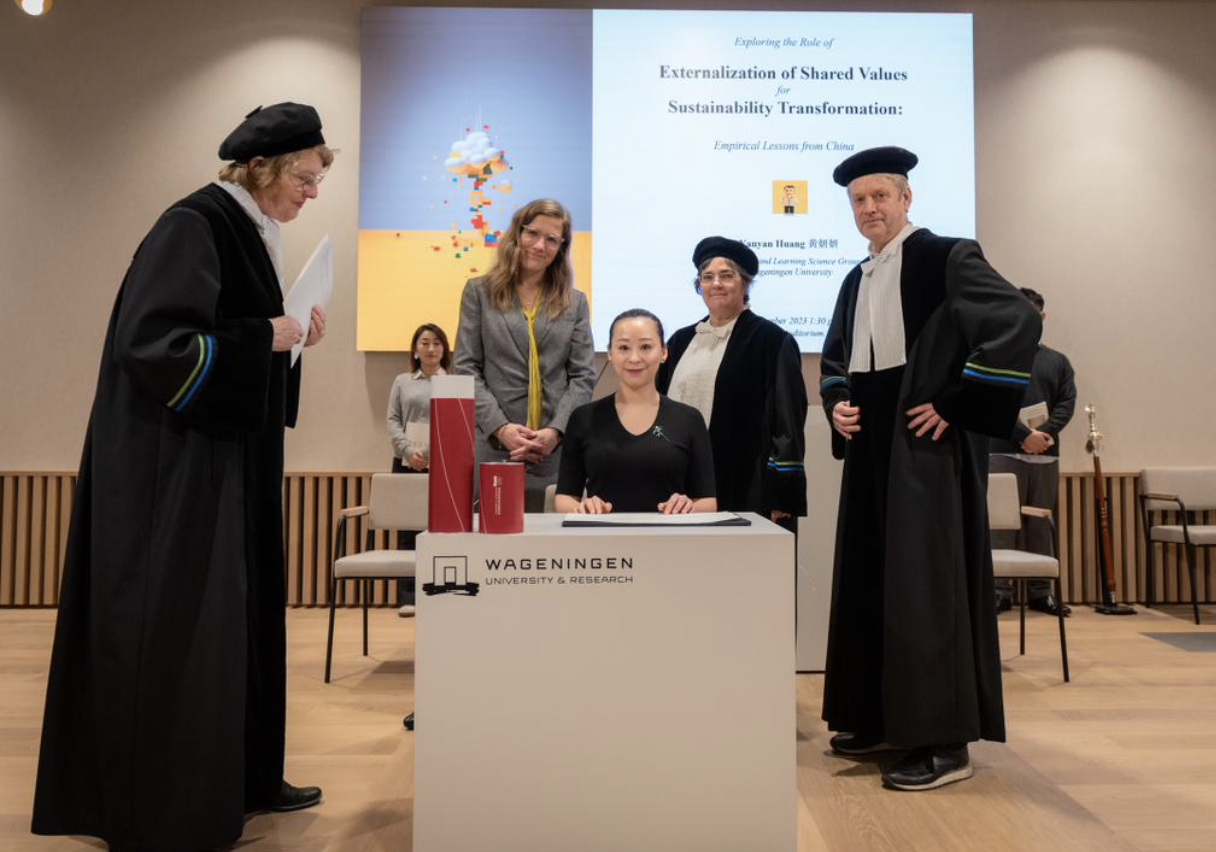
Yanyan Huang successfully defends her thesis ´Exploring the Role of Externalization of Shared Values for Sustainability Transformation´

Yanyan Huang receving her PhD degree with on her side second promotor Prof Marie Harder of Fudan University, Co-promotor Dr. Renate W<esselink and myself.

On December 19th Yanyan Huang successfully defended her thesis in the aula of Wageningen university. Her thesis presents an in-depth exploration to unravel the roles/potential of the externalization of shared values in facilitating sustainability transformation. Although the need for sustainability transformation is increasing globally and the profound influence of values for sustainability transformation is already established, there is still not sufficient understanding in how to purposefully navigate values for sustainability transformation. This thesis strives to fill this gap by introducing a new perspective: conceptualizing values as tacit knowledge and leveraging the SECI model from the Knowledge Creation Theory. Synthesizing results from empirical data collected from cases conducted in Shanghai, China, this thesis identifies the roles of externalization of shared values with respect to its outcome (shared values) and the procedure (externalization) for sustainability transformation. Further, this thesis presents discussions of the underlying mechanism through which shared values, when externalized, facilitate substantial sustainability transformations, and reflections on the implication for researchers from the field of sustainability science. For those who aim to promote sustainability transformation, this thesis not only enhances the understanding of the dynamic interplay between shared values and sustainability transformation, but also provides a specific roadmap to unleash the potential of the externalization of shared values for sustainability transformation to respond to the above- mentioned gap. With its new perspective, this thesis also underscores the necessity of considering the procedures through which values/shared values are involved.

The entire thesis can be downloaded via the Wageningen University Library.

Marieke Versteijlen successfully defended her PhD thesis on Blended learning in higher education from a sustainability perspective

On December 12th Marieke Versteijlen of Avans Hogeschool successfully defended her thesis at the Wageningen University. Marieke was co-supervised by myself and Transportation Scientist Prof. Bert van Wee of Delft University in the aula of Wageningen University. The thesis was approved and discussed by a committee consisting of Prof. Taeke Tillema of Groningen University, Prof. Arnold Brecht, Dean of Educaiton, Wageningen University, Dr. Sally Windsor of Gothenburg University in Sweden and Dr. Wim Lambrechts of the Open University of The Netherlands.

Marieke’s research addresses the high environmental impact of students commuting to the higher educational institution (HEI) by exploring the potential of digital technology to lower the travel movements of students.

The research explores how on-campus and online education can be balanced in a blended learning design to decrease student commute without compromising educational quality. By applying a form of Educational Design Research (EDR), involving key HEI stakeholders, guidelines and principles were found that can support the design of blended education to simultaneously meet these environmental and educational requirements.

The three stages of EDR were followed to design the sustainable blended intervention, explorationconstruction and reflection. In the exploration stage, the environmental impact of students commuting to and from campus was explored across several Dutch HEIs and compared with international research on HEIs’ carbon footprint, confirming its large contribution. Also showing that only a few Dutch sustainability and ICT professionals recognized the potential of online learning to lower carbon emissions due to student commute.

After establishing the environmental impact of student travel, the considerations and (de)motivators of Dutch students influencing their travel mode choices and their decisions about whether to travel to their institution or to study online were explored. Their travel mode choice is mostly based on habit and influenced by travel-regulating measures of the Dutch government (a free public transport permit) and HEIs (high parking costs). Their decision to make a trip to campus seems to be a reasoned choice, influenced by the number and time of the day of their scheduled classes, the type of learning activity and their perceived study abilities.

In the construction stage, design principles and associated recommendations were developed to design sustainability-oriented blended education through a realist review and by cooperating with a team of eight educational professionals to design a blended study programme. Lecturers can use these design principles to guide and assess the quality of a blended learning unit. The acquisition of sustainability competencies by the students was considered one of the aspects of educational quality. The implementation of the prototype was severely impacted by the COVID-19 pandemic in 2020. The government restrictions changed the intended blend to mainly online education. Instead of measuring student travel emissions as a result of the design, a possible attitude change of students toward online learning and commuting that might have been caused by going through a period of primarily online learning due to COVID-19 restrictions, was studied. The students experienced that online meetings can be productive and efficient, and less time is lost in travel. Both were appreciated by the students.

This research adds a sustainable perspective and a step toward a detailed pedagogical framework to what is already known about blended learning. Although we could not measure the impact of a blended learning design on student travel emissions due to COVID-19, there are strong indicators that a blended learning design can be used to decrease its environmental impact by reducing student commute. The findings of this study can contribute to a whole-institution approach embedding sustainability in all aspects of the institution.

The entire thesis is available through open access through the Wageningen Library as are the four peer reviewed papers that all have been published.

Exploring environmental stewardship among youth from a high-biodiverse region in Colombia – new study!

Source: Salva La Selva

Led by Daniel Couceiro, I was priviledged to join a group of reflective practitioners and colleague Valentina Tassone on the meaning of stewardship in a troubled highly biodiverse region Here you have the main premise of the paper but please go to the full paper for a more in-depth encounter with the work.

Nature degradation is rooted in the disruption of the human-land connection. Its restoration requires the regeneration of environmental stewardship as a way to live within environmental limits, especially for younger generations. In this study we used the implementation of a year-round, non-formal environmental education program during COVID-19 times to explore environmental stewardship in adolescents between 14- and 18-years old from the Sierra Nevada de Santa Marta, Colombia. Using a qualitative methodology, we mapped expressions of environmental stewardship among local youth. We found several barriers that can be challenged and levers that can be nurtured through inclusive, place-based and collaborative environmental education strategies to foster youth’s environmental stewardship in Colombian’s high-biodiverse regions.

Full citation and link to open access paper:

Daniel Couceiro, Ivona Radoslavova Hristova, Valentina Tassone, Arjen Wals & Camila Gómez (2023) Exploring environmental stewardship and youth engagement in biodiversity among youth from a high-biodiverse region in Colombia, The Journal of Environmental Education, DOI: 10.1080/00958964.2023.2238649

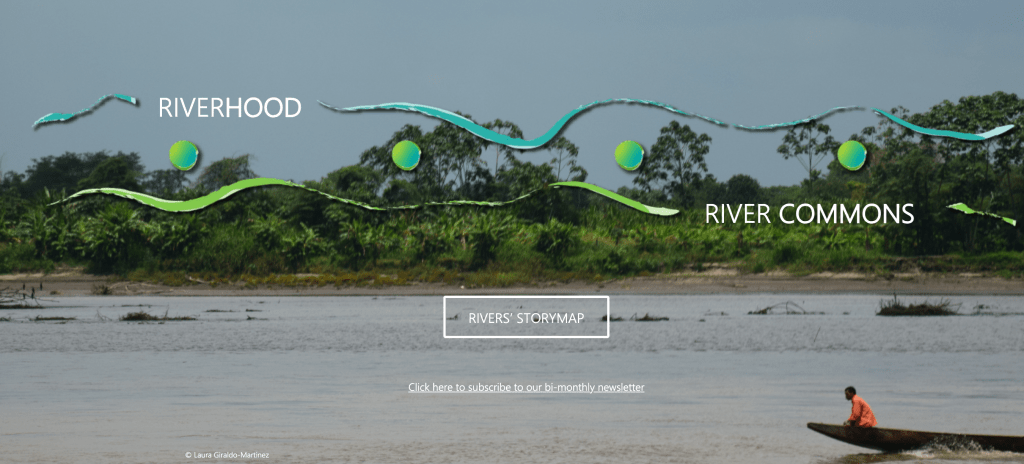
Riverhood: political ecologies of socionature commoning and translocal struggles for water justice – now available through open access

Source: movingrivers.org

This multi-authored paper comes out of two groundbreaking riverfocused programs that are highly interconnected: Riverhood and Rivercommons. This is a foundational paper looking at the consequences and possible ways out of mega-damming, pollution and depletion endanger rivers worldwide. Meanwhile, modernist imaginaries of ordering ‘unruly waters and humans’ have become cornerstones of hydraulic-bureaucratic and capitalist development. They separate hydro/social worlds, sideline river-commons cultures, and deepen socio-environmental injustices. But myriad new water justice movements (NWJMs) proliferate: rooted, disruptive, transdisciplinary, multi-scalar coalitions that deploy alternative river–society ontologies, bridge South–North divides, and translate river-enlivening practices from local to global and vice-versa. This paper’s framework conceptualizes ‘riverhood’ to engage with NWJMs and river commoning initiatives. We suggest four interrelated ontologies, situating river socionatures as arenas of material, social and symbolic co-production: ‘river-as-ecosociety’, ‘river-as-territory’, ‘river-as-subject’, and ‘river-as-movement’.

The full paper can be found here while the team´s website movingrivers can be found here!

While Higher Education is grappling with enormous sustainability challenges Ghent University is about to downsize its successful Green Office

n a time where universities across the globe are trying to figure out how to remain relevant, responsive and responsible in times of climate urgency, biodiversity collapse and rising inequality, Ghent University is about to downsize its infamous Green Office in light of necessary ‘budget cuts’. I have worked with the Ghent Green Office and some of its key members for many years and find it hard to believe. Later this week the university leadership will determine whether it will downsize or continue to fully support some of the most dedicated and capable people and the structures they have created over the years to make sustainability part of the DNA of university and the wider community of Ghent. Together with educators and researchers based at universities across Europe we wrote a letter urging the leadership to rethink its down-sizing plans and to adopt a more visionary and hopeful stance. You can read the letter here:

High school biology students’ use of values in their moral argumentation and decision-making in times of polarization, confusion and unsustainability

Another paper based on PhD Tore van der Leij just appeared in the Journal of Moral Education. I took the liberty to add a few words to the title… ‘in times of polarization, confusion and unsustainability’ to emphasize the importance of this work.

In this qualitative case study Tore examined the impact of a specially-designed classroom intervention for a group of 15–16-year-old Dutch biology students’ use of values in contemplating five socioscientific issues in the human-nature context. The students worked in small groups to support various aspects of their morality. An ethical matrix was used as a heuristic to explore different arguments and moral values from different perspectives. The collected data consisted of written assignments, group conversations, and individual interviews. The results show that students’ use of values differed from one issue to another. The values they used in their moral decision-making indicated that the influence of the intervention activities, aimed at enhancing a relationship between moral agent (student) and moral object (topic), was limited. The study provides evidence that the intervention positively conduced to students’ cognition of the values that are personally relevant. Recommendations for further theorization, research and practice are discussed.

Here is the link: https://www.tandfonline.com/doi/full/10.1080/03057240.2023.2185595

Full citaton:Leij, Tote, van der, Martin Goedhart, Lucy Avraamidou & Arjen Wals (2023) High school biology students’ use of values in their moral argumentation and decision-making, Journal of Moral Education, DOI: 10.1080/03057240.2023.2185595

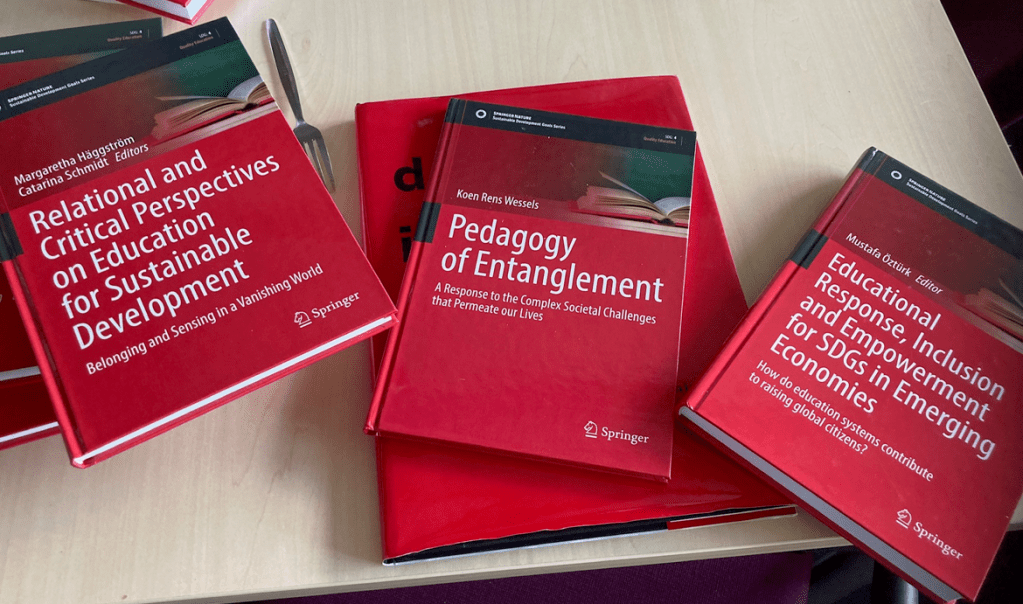
Pedagogy of Entanglement and other groundbreaking works – Springer SDG4-Series taking off

Recently, a few more titles appeared in the Springer SDG4 Series that are expanding horizons, addressing blind spots and offer guidelines for alternative ways of thinking and acting in and through education in light of pressing global sustainability challenges. One of them finally arrived on my desk today: Koen Wessel’s “Pedagogy of Entanglement: a response to complex societal challenges that permeate our lives”. This book is a real treasure that is based on Koen’s dissertation which he completed last year at Utrecht University (with joint supervision from Wageningen University).  You can find the book here.

The Springer Sustainable Development Goals Series aims to provide a comprehensive platform to the scientific, teaching and research communities studying issues in the fields of geography, earth sciences, environmental science, social sciences, engineering, policy, planning, and human geosciences in order to contribute knowledge toward achieving the current 17 Sustainable

Development Goals. Volumes in the series are organized by relevant goal and guided by an expert international panel of advisors.

The subseries that I am co-editing together with Nicole Ardoin of Standford University, focuses on SDG 4: Quality Education and more specifically on the following questions: What kind of quality or qualities must education have in order to be able to contribute to Sustainable Development as expressed by the SDGs? How can such education be developed, implemented and assessed in a wide range of contexts across the globe? How can quality education, that contributes to the well-being of all people and the whole planet, becomeaccessible for everyone?

Topics covered by the SDG 4 subseries include, but are to limited to: education policy and governance for ESD/ESE and Global Citizenship Education (GCE), conceptualizing sustainability competence other possible learning outcomes of ESD and GCE, pedagogical approaches to ESD/ESE and GCE, the role of teacher training/professional development in fostering ESD/ESE/GCE,

assessment of ESD/ESE and GCE-related learning, creating whole school or whole institution approaches to sustainability, making ESD/ESE and GCE accessible and relevant for all learners in a wide range of context across the globe.

Should you be interested in writing or editing a book for this Series, contact Zachary Romano in Springer’s New York office or drop me or Nicole a line!

White Paper on Regenerative Higher Education – Rethinking education in times of dysfunction and collapse

Regrettably this white paper is only available in Dutch. Some ot the ideas artuclated in the paper can also be found in The Regenerative Education Podcast Series created by PhD Bas van den Berg see: The Regenerative Education Podcasts – Planting the seeds of change

Ik maak sinds een paar jaar deeluit van een Nederlandse  Community of Practice rondom Regenerative Higher Education bestaande uit PhDs en medewerkers van verschillende universiteiten en hoge scholen. Dit White Paper is het resultaat van de samenwerking in de Community of Practice en is samengesteld door Martine de Wit en gebaseerd op interviews met Bas van den Berg, Daan Buijs, Mieke Lopes Cardozo, Marlies van der Wee en Arjen Wals. Met input van Nina Bohm, Linda de Greef, Michaela Hordijk, Naomie Tieks, Koen Wessels, Rosanne van Wieringen, en Roosmarijn van Woerden. De illustraties en vormgeving zijn verzorgd door Mari Genova.

Het paper vertrekt vanuit de vraag:

Onderwijs dat het beste haalt uit onszelf en onze studenten, op weg naar herstel van de aarde. Hoe komen we daar?

Lees hier ons verhaal en laat ons weten wat resoneert, schuurt of wat het anderzins losmaakt!

A regenerative decolonization perspective on Education for Sustainable Development (ESD) from Latin America – new research

Central Figure in the article:  Regenerative education through decolonial praxis.

Led by former Wageningen University PhD Dr. Thomas Macintyre and current Wageningen University Post-Doc, Dr Daniele Tubino de Souza, I was priviledged to collaborate on this new paper that appeared in the latest issue of Compare: A Journal of Comparative and International Education. This paper provides a Latin American perspective on ESD, with a focus on transformative and participatory learning in community contexts. With a long history of critical pedagogies, Latin America provides a fertile ground for exploring alternative forms of education as a means to address deep-rooted challenges in western traditional strands of education. We start by providing an overview of pertinent educational currents present in Latin America, then ground these perspectives in two case studies carried out by the authors – one from Colombia, the other from Brazil – which explore grassroots initiatives in community settings that utilise different forms of education and learning. We then propose an integrative model to foster alternative educational approaches that might lead to decolonial and regenerative praxis, finishing with a discussion on how Latin American-rooted regenerative decolonisation perspective and praxis can inform global ESD discourses.

You can find the full paper here: https://www.tandfonline.com/doi/full/10.1080/03057925.2023.2171262

Full citation: Macintyre, T. Tubino de Souza, D. & Wals, A.E.J. (2023) A regenerative decolonization perspective on ESD from Latin America, Compare: A Journal of Comparative and International Education, DOI: 10.1080/03057925.2023.2171262