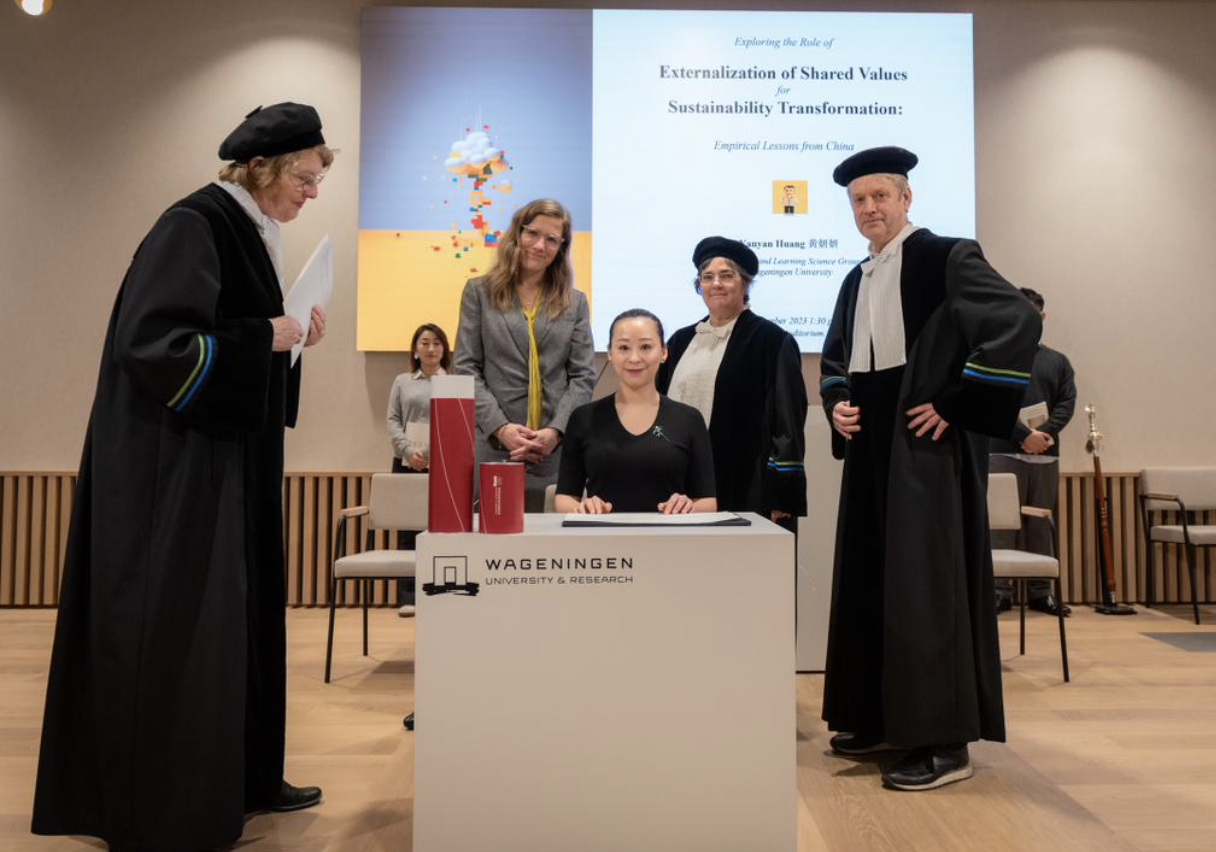
Yanyan Huang receving her PhD degree with on her side second promotor Prof Marie Harder of Fudan University, Co-promotor Dr. Renate W<esselink and myself.
On December 19th Yanyan Huang successfully defended her thesis in the aula of Wageningen university. Her thesis presents an in-depth exploration to unravel the roles/potential of the externalization of shared values in facilitating sustainability transformation. Although the need for sustainability transformation is increasing globally and the profound influence of values for sustainability transformation is already established, there is still not sufficient understanding in how to purposefully navigate values for sustainability transformation. This thesis strives to fill this gap by introducing a new perspective: conceptualizing values as tacit knowledge and leveraging the SECI model from the Knowledge Creation Theory. Synthesizing results from empirical data collected from cases conducted in Shanghai, China, this thesis identifies the roles of externalization of shared values with respect to its outcome (shared values) and the procedure (externalization) for sustainability transformation. Further, this thesis presents discussions of the underlying mechanism through which shared values, when externalized, facilitate substantial sustainability transformations, and reflections on the implication for researchers from the field of sustainability science. For those who aim to promote sustainability transformation, this thesis not only enhances the understanding of the dynamic interplay between shared values and sustainability transformation, but also provides a specific roadmap to unleash the potential of the externalization of shared values for sustainability transformation to respond to the above- mentioned gap. With its new perspective, this thesis also underscores the necessity of considering the procedures through which values/shared values are involved.
The entire thesis can be downloaded via the Wageningen University Library.
This multi-authored paper comes out of two groundbreaking riverfocused programs that are highly interconnected: Riverhood and Rivercommons. This is a foundational paper looking at the consequences and possible ways out of mega-damming, pollution and depletion endanger rivers worldwide. Meanwhile, modernist imaginaries of ordering ‘unruly waters and humans’ have become cornerstones of hydraulic-bureaucratic and capitalist development. They separate hydro/social worlds, sideline river-commons cultures, and deepen socio-environmental injustices. But myriad new water justice movements (NWJMs) proliferate: rooted, disruptive, transdisciplinary, multi-scalar coalitions that deploy alternative river–society ontologies, bridge South–North divides, and translate river-enlivening practices from local to global and vice-versa. This paper’s framework conceptualizes ‘riverhood’ to engage with NWJMs and river commoning initiatives. We suggest four interrelated ontologies, situating river socionatures as arenas of material, social and symbolic co-production: ‘river-as-ecosociety’, ‘river-as-territory’, ‘river-as-subject’, and ‘river-as-movement’.
The full paper can be found here while the team´s website movingrivers can be found here!
n a time where universities across the globe are trying to figure out how to remain relevant, responsive and responsible in times of climate urgency, biodiversity collapse and rising inequality, Ghent University is about to downsize its infamous Green Office in light of necessary ‘budget cuts’. I have worked with the Ghent Green Office and some of its key members for many years and find it hard to believe. Later this week the university leadership will determine whether it will downsize or continue to fully support some of the most dedicated and capable people and the structures they have created over the years to make sustainability part of the DNA of university and the wider community of Ghent. Together with educators and researchers based at universities across Europe we wrote a letter urging the leadership to rethink its down-sizing plans and to adopt a more visionary and hopeful stance. You can read the letter here:
Regrettably this white paper is only available in Dutch. Some ot the ideas artuclated in the paper can also be found in The Regenerative Education Podcast Series created by PhD Bas van den Berg see: The Regenerative Education Podcasts – Planting the seeds of change
Ik maak sinds een paar jaar deeluit van een Nederlandse Community of Practice rondom Regenerative Higher Education bestaande uit PhDs en medewerkers van verschillende universiteiten en hoge scholen. Dit White Paper is het resultaat van de samenwerking in de Community of Practice en is samengesteld door Martine de Wit en gebaseerd op interviews met Bas van den Berg, Daan Buijs, Mieke Lopes Cardozo, Marlies van der Wee en Arjen Wals. Met input van Nina Bohm, Linda de Greef, Michaela Hordijk, Naomie Tieks, Koen Wessels, Rosanne van Wieringen, en Roosmarijn van Woerden. De illustraties en vormgeving zijn verzorgd door Mari Genova.
Het paper vertrekt vanuit de vraag:
Onderwijs dat het beste haalt uit onszelf en onze studenten, op weg naar herstel van de aarde. Hoe komen we daar?
Lees hier ons verhaal en laat ons weten wat resoneert, schuurt of wat het anderzins losmaakt!
Central Figure in the article: Regenerative education through decolonial praxis.
Led by former Wageningen University PhD Dr. Thomas Macintyre and current Wageningen University Post-Doc, Dr Daniele Tubino de Souza, I was priviledged to collaborate on this new paper that appeared in the latest issue of Compare: A Journal of Comparative and International Education. This paper provides a Latin American perspective on ESD, with a focus on transformative and participatory learning in community contexts. With a long history of critical pedagogies, Latin America provides a fertile ground for exploring alternative forms of education as a means to address deep-rooted challenges in western traditional strands of education. We start by providing an overview of pertinent educational currents present in Latin America, then ground these perspectives in two case studies carried out by the authors – one from Colombia, the other from Brazil – which explore grassroots initiatives in community settings that utilise different forms of education and learning. We then propose an integrative model to foster alternative educational approaches that might lead to decolonial and regenerative praxis, finishing with a discussion on how Latin American-rooted regenerative decolonisation perspective and praxis can inform global ESD discourses.
Full citation: Macintyre, T. Tubino de Souza, D. & Wals, A.E.J. (2023) A regenerative decolonization perspective on ESD from Latin America, Compare: A Journal of Comparative and International Education, DOI: 10.1080/03057925.2023.2171262
In this Embodiment Talk I am interviewed by Marjon van Opijnen of the Embodiment Lab
We talk about the importance of embodiment in education. And how we can create education systems that create space for connections with ourselves, the other and the world. We talk about:
• What embodiment means for education;
• How education can help to create true connections with ourselves, the other and the world;
• The different forms of learning in eduation and how these can contribute to a more sustainable world;
• How education can teach us to criticize, connect and care. And that vulnerability can exist next to strength;
• How to integrate a systemic perspective in the education system.
Innovation, preferably of the continuous kind, seems to be what drives much of what we do. The idea being that in order to ‘stay on top’, ‘remain ahead of the game’, ‘be responsive’ to constant change – ironically the result of the same pre-occupation with innovation – and to be competitive in a rapidly changing and expanding market, one cannot sit still.
Ideas of contemplation, conservation, preservation, just ‘being’ in a place or in a moment of time, slowing down, are not popular and are even considered detrimental and a distraction from the way ‘forward’. To use the four seasons as a metaphor: in the world of business, but, indeed, also in our private world, it must always be Spring and Summer, where things grow, expand, pop-up, and where we can be productive, ‘add to basket’, harvest and ‘consume’. The Fall and Winter where there is decay, slowing down, decomposition, hibernation, regeneration, and, yes, even death, are to be avoided or kept to a minimum at best.
This tyranny of innovation has many of us in a constant state of restlessness, distraction, anxiety and guilt. Doing nothing or being bored, for that matter, is almost impossible in an ‘always-on’ society, where screens and digital devices – all products of innovation – continuously and successfully capture our ‘eye-ball attention’. Observe people in a train or bus as they look at their smart phones scrolling for something exciting, gazing into a rabbit hole. Watch them pause for a moment when the run out of scrolling options, even putting here phone in their pockets, and then count the seconds until they have thought of something else to look up on their phones. Typically, based on my own limited research, it will take less than 30 seconds. Try to be bored on the couch with your phone within reach. Being bored on the couch or talking a walk I the forest, is not only difficult, but also not what companies want: nobody is making any money when you’re not on your phone or, worse when you phone is off, and nothing can be mined.
And, ‘yes’, I too find myself frequently on scrolling on my phone, tweeting, LinkedIn-ing, checking my mail, and tomorrow’s weather, so being aware of this happening is not enough to do something about it. It is a highly resilient mechanism that is hard to change.
The point I am making is that the tyranny of innovation and associated growth and expansion thinking, is deeply seated and is a part of the current sustainability problem, not a part of the solution. Even when adding ‘responsible’ to innovation, we are stuck in a narrative underpinned by a paradigm of ‘extractivism’ (colonization of the mind as the last frontier) and commodification (the idea that everything can be owned, packaged, bought and sold, from water, to land to air, to personal information and ideas). Even personal growth, ‘working on yourself’, yoga, meditation, has become an industry. If we are to move towards a more sustainable world then we must interrogate this abuse of innovation. I say ‘abuse’ to indicate that it is quite alright to change, learn, grow and unfold, in light of challenges, but there needs to be a balance with being at peace with who you are, where you are and what you have; a time to connect, wonder, ponder, reflect and to just be.
As a counter hegemonic concept that might help shift the narrative, I would like to introduce the concept of unnovation (noun) and to unnovate (verb). Unnovation is the process of becoming contemplative, cherishing who you are, where you are in terms of time and place and what you have. It is at heart of mindful preservation and conservation and a more cyclical way of living characterized by a dynamic equilibrium between times of being responsive, inquisitive, searching, (co)creating – times of ‘becoming’ and times of slowing down and ‘being’. Sometimes this will require the undoing of innovations that have turned out to be highly unsustainable and damaging for people and planet. This refers to the more active verb version of unnovation: to unnovate.
Basically, I am throwing this out there to solicit some responses and check if this gets any traction. Feel free to comment or add references/sources.
Climate change is not a new issue for education, but new levels of consensus and concern are emerging, suggesting that new policy developments may follow. This NORRAG Special Issue (NSI 07) addresses the question of how education is to equip learners to participate in climate action that would fundamentally disrupt existing problematic systems. This NSI has the potential to inform pedagogical praxis, co-learning, curriculum, climate action, policy formulation, frameworks for evaluating success, resourcing decisions and what we might consider educative acts for engaging with climate change and its multi-dimensional uncertainties, risks and opportunities.
Edited by South African Professors Eureta Rosenberg and Heila Lotz-Sisitka, this is one of the most comprehensive and ground braking collections of papers available at the moment. The special issue is completely open access. You can find the full table of contents here.
I am very pleased to have found two wonderful Norwegian colleagues – Astrid Sinnes of the Norwegian Life Sciences University and Ole Andreas Kvamme of the University of Oslo who were willing to join in writing a contribution which is titled: School Strikes as Catalysts for Rethinking Educational Institutions, Purposes and Practices
I am also delighted to see two of my former PhD’s, Thomas Macintyre and Martha Chaves, based in Colombia in the special issue as well with a paper on Climate Change Resilience through Collaborative Learning in the Colombian Coffee Region – they co-authored with Tatiana Monroy who, like omas and Martha volunteers for Fundación Mentes en Transición, Colombia, South America
There will be an online launch of the NORRAG Special Issue 07 (NSI 07): Education in Times of Climate Change, will take place on 6 October 2022 at 16:00 – 17:30 CEST. For more information about the llaunch event have look here!
Another most interesting paper just came out in the journal Pedagogy, Culture and Society. This time led by – now former PhD candidate – Koen Wessels who received his PhD last June. Here is some key info on the paper and its key concept ‘pedagogy of entanglement’ which is at the heart of Koen’s research.
Confronted by myriad interconnected societal challenges, this paper asks: what kind of pedagogy does justice to the experience and challenge of living in a complex world? Departing from a critical reading of a preparative-logic to education, this paper emphasises students’ entangledness: more-or-less consciously, students are uniquely shaped-by and shapers-of complex societal challenges in a here-and-now sense. Utilising this premise, the paper develops a set of pedagogical perspectives that might inspire and help teachers to design their own responses to particular complex societal challenges in their unique teaching contexts. Drawing on emerging outcomes from a narrative diffractive inquiry with 12 teachers as co-researchers and engaging with complexity thinking, six perspectives are presented and discussed: entanglement-orientedness, entanglement-awareness, hopeful action, inquiry within complex societal challenges, practicing perceptiveness, and practicing integrity. Together, these perspectives offer a heuristic for embracing complexity in education.
Full citation: Koen R. Wessels, Cok Bakker, Arjen E.J. Wals & George Lengkeek (2022) Rethinking pedagogy in the face of complex societal challenges: helpful perspectives for teaching the entangled student, Pedagogy, Culture & Society, DOI: 10.1080/14681366.2022.2108125
Regenerative forms of higher education are emerging, and required, to connect with some of the grand transition challenges of our times. This paper explores the lived experience of 21 students learning to navigate a regenerative form of higher education in the Mission Impact course at The Hague University of Applied Sciences. This semester-length course ran for two iterations with the intention of connecting the students with local transitions towards a more circular society, one where products are lasting and have multiple lives when they are shared, refurbished, or become a source for a new product. At the end of each iteration, the students reflected on their experience using the Living Spiral Framework, which served as basis for an interpretative phenomenological analysis of their journey navigating this transformative course. The results of this study include four themes; (1) Opting in—Choosing RHE, (2) Learning in Regenerative Ways, (3) Navigating Resistance(s), and (4) Transformative Impacts of RHE. These themes can be used by practitioners to design and engage with regenerative forms of higher education, and by scholars to guide further inquiry. View Full-Text
Earlier this month the 8th Report from the Global University Network fir Innovation (GUNi) was published with a wealth of contributions critiquing current resilient modes and models of education and outlinig alternative one in light of the current systemic global dysfunction we find ourselves in. I was asked to contribute a chapter on transgressive learning. The link to the chapter is here
The full citation for my chapter is: Wals, AEJ (2022) Transgressive learning, resistance pedagogy and disruptive capacity building as levers for sustainability. In: Higher Education in the World 8 – Special issue New Visions for HigherEducation, Barcelona: Global University Network for Innovation (GUNi). Open access: www.guni-call4action.org, p216-222.
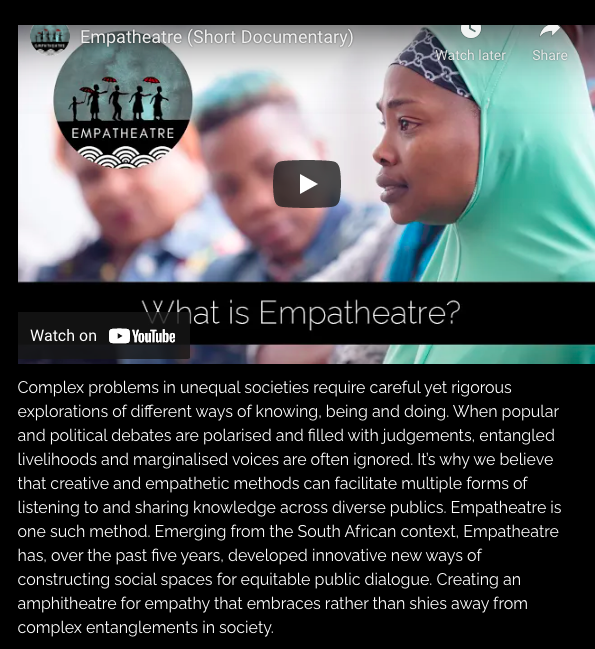
Empatheatre is one example from South Africa showing how drama can educate towards empathy and social and environmental justicehttps://www.empatheatre.com/about
One of the Swedish PhD-Candidates I have been working with over the last few years, Julia Fries, based at Stockholm University, is co-organising two fascinating workshops focusing on drama-based approaches in higher education for sustainability.
Below you find an invitation to participate in two international workshops on new formats for Sustainability teaching, funded by the Swedish Research Council and organised by Stockholm Resilience Center and the Department for Teaching and Learning at Stockholm University.
The project explores how drama-based methods can support reflective, embodied and transformative learning about sustainability amongst higher education students. The research ambition is to further current understanding of the role of experiential learning and how these methods support such learning. The format designed will allow to both support pedagogic development in participants academic teaching practice, and address the research questions.
Two international workshops will bring together drama educators and educators in fields related to sustainability, to share different drama-based, interactive methods and explore what these can bring to education in sustainability sciences or sustainability in other subject areas.
Quote from project description:
This project concerns teaching and learning for Sustainability in Higher Education. The cross-disciplinary field of sustainability can be characterised as extremely unsettled and value-loaded, a challenging academic subject for both teachers and students. Consequently, adequate teaching methods has to be developed in order to tackle sustainability issues in a creative and inclusive way. This has been recognised in relation to primary and secondary education but not so much at university level. Attempts are made to achieve this, by adopting a less traditional teaching approach and relation to the world outside the university. Based on this, we propose two explorative workshops for university teachers/researchers. The purpose of the first workshop is to introduce and explore a set of highly interactive teaching approaches to a group of university teachers/researchers in Scandinavia and Europe. After the first workshop, these teaching approaches will be applied, tried out and documented, as part of the participants ongoing teaching at their universities. The purpose of the second workshop is to evaluate these interactive approaches, by sharing teaching experiences and learning outcomes among students in higher education. The overarching aim is to explore and compare a set of interactive teaching approaches, in terms of applicability and student impact in Higher Education for Sustainability. Based on the outcome, scientific papers will be presented and/or a book will be published.
Practicalities: The first workshop will be in Stockholm 6-9 Sept. 2022 and the second in May or June 2023. Thanks to a grant from the Swedish Research Council we are able to offer 15 participants free meals and accommodation, but travel expenses are not included in the offer. Participants are expected to take part in both workshops. A detailed program for the first event will be presented later this spring. Questions can be directed to eva.osterlind@su.se or t.wall@ ljmu.ac.uk
Handmade painting by a student on “Empowerment – a rising sensation that liberates you from ‘sinking’ into negativity” – using artistic forms of evaluation of learning, helped both subjectification and creating a sense of community in the course
This paper recently appeared in International Journal of Sustainability in Higher Education. It explores students’ sense of community and belonging in an online course on environmental and sustainable education during times of physical distancing as a result of the COVID-19 pandemic. Using a case study approach, the results show that students perceived a sense of community that was collectively build during the four week program. Sense of community was linked to and facilitated by the learning environment and the educators’ and students’ role throughout the course. Prominent factors here are interaction and inclusion created with mutual effort by design, the educator and student.
This research arose after the course ELS-31806 Environmental Education and Learning for Sustainability[1] was converted as an ‘offline’ course into an online course due to COVID-19. The original content of the course enables students to systematically discuss important concerns in the development of an effective curriculum and/or operation for the environment and sustainable development using a range of instrumental and emancipatory approaches. But foremost ELS-31806 is a course that has always been, well appreciated and highly valued by participants for its highly experiential and hands-on approach.
However, due to COVID-19 this year’s course (2020) was changed into a less experiential on-line format mediated by Zoom for interaction and by Brightspace for course structure and organisation. This somewhat ad-hoc and sudden departure from the traditional successful format, lowered the instructors, and probably also, the students’ expectations about the course’ ability to create a vibrant learning community. Yet, contrary to pre-course expectations, ‘something’ (i.e. a sense) arose over the course of four weeks online education that both students and staff considered to be special or meaningful. These hunches got confirmed several weeks after by Wageningen UR’s student evaluation system PACE which revealed that the students highly valued the course.
We were intrigued by the question of how this online edition evoked similar, or nearly similar outcomes to its offline counterpart. After first checking whether our hunches were right about the course and what might explain the high evaluation marks, we centre in the paper’s main question:
What are key characteristics of an online course that fosters subjectification (personal development and inner-sustainability in relation to others and the other) and creates a sense of community?
The paper was led by former MsC student Robbert Hesen and co-authored by myself and ELS Postdoc Rebekah Tauritz.
An impression of Tamera EcoVillage in Portugal, one of the cases that was part of the study
Here is the latest paper on a research project led by PhD Candidate Siri Pisters that appeared in the Journal of Transformative Education. Thie article explores learning processes that underpin ecovillages as place based ‘sustainability initiatives’. Through the theoretical lens of place- based transformative learning (PBTL), developed in earlier work led by Siri as well (Pisters et al., 2019, 2020), empirical data from life-story interviews and photovoice sessions from three ecovillages is analysed and discussed. The results support, illustrate and deepen the meaning of the four dimensions of the theoretical framework: connection to place, compassionate connection, creativity and transgression (Figure 1, below). They show how the co-existence of ‘community’ and ‘disruption’ is essential in PBTL where community brings connection, cohesion and stability to a change process whereas disruption paves the way for disrupting old structures and experiment with new ones. This article shows how a change in inner consciousness is related to alternative practices and structures that re-define relationships with ourselves, other humans and the material, more-than-human world.
A Four dimensional model of place-based transformative learning (Source: Pisters et al., 2022)
Pisters SR, Vihinen H, Figueiredo E, Wals AEJ. ‘We Learned the Language of the Tree’ Ecovillages as Spaces of Place-Based Transformative Learning. Journal of Transformative Education. March 2022. doi:10.1177/15413446211068550
This 5 minute video was recorded at WEEC 2022 in Prague by Alex Kudryavtsev – a research associate at Cornell University for the “Environmental Education & Community Engagement” online course by Cornell and NAAEE. I introduce transdisciplinary, transgressive and transformative learning in the context of citizens monitoring air pollution s a form of citizen science. I use the city of Rotterdam in The Netherlands as an example (althoughI do some justice to the city of Rotterdam as my example is somewhat dated:. it is a short video and much more is to be said about Rotterdam as the city government now pro-actively works with citizens in an air quality monitoring network. ‘Luchtbrug’ see: https://www.themayor.eu/en/a/view/rotterdam-citizens-concerned-with-air-quality-form-a-club-8089