
Imagining Sustainability: A Nomadic Inquiry of Applied Drama in Higher Education

At last a chapter appeared in the wonderful Handbook of Ecological Civilization published by Springer that I am proud of both for its content and for the pleasure of working with PhD candidate from Stockholm University, Julia Fries. Julia over the years has developed a wonderful collection of arts-based, drama-inspired research in a somewhat unusual setting: business education. Her research embodies her pedagogy which is fascinating. This chapter explores how drama can contribute to the necessary renewal of higher education to meet the sustainability challenges of our time. Results are presented from a drama-based research project in higher education, and in a youth project. In the chapter, so-called nomadic enquiry is combined with an arts-based approach to participant interviews. Through this innovative method, an image of a rhizome emerged. This rhizome of expanded learning highlights five necessities or critical nodes for expanded sustainability-oriented learning: emer-gence, expansion through role, embodiment, connection to self and others, and crucial conditions. The rhizomatic perspective not only shows the transformative potential of drama in higher education and adult learning but also identifies the levers and barriers teachers, students, and the academy as an institution are likely to encounter when trying to move towards a socio-ecologically more civilized world. The results point to how the integration of knowledge and wisdom that are striven for in the philosophy of ecological civilization can be put into pedagogical practice through the holistic learning of drama.

The Handbook of Ecological Civilization, unfortunately, is not an Open Access Handbook – but your library may have access. But I am happy to share the corrected proffs for your own use here!

Full citation: Fries, J., Wals, A. (2025). Imagining Sustainability: A Nomadic Inquiry of Applied Drama in Higher Education. In: Peters, M.A., Green, B.J., Misiaszek, G.W., Zhu, X. (eds) Handbook of Ecological Civilization. Springer International Handbooks of Education. Springer, Singapore. https://doi.org/10.1007/978-981-97-8101-0_73-1
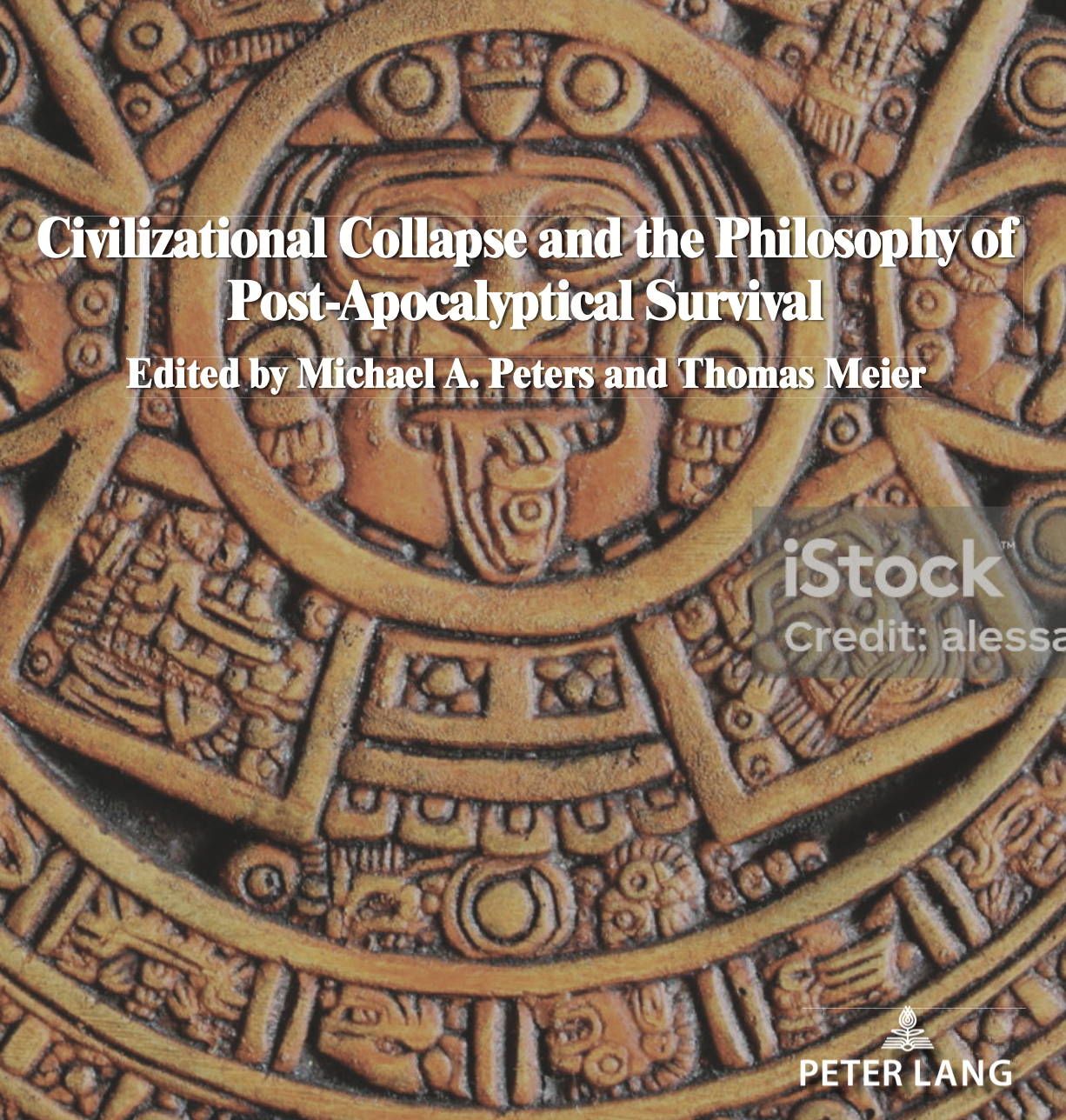
New book: Civilizational Collapse and the Philosophy of Post-apocalyptical Survival

“Collapse” “The end of the world as we know it” “Amargeddon” “Dystopian Futures” “Maintaining hope on a dying planet” – words, concepts, phrases, pointing at the serious state of Earth. This remarkeable book with a range of perspectives on what to do, is a must read for educators, activitsts, researchers and composites thereof. From the back cover:

“The collapse of civilization, the end of the world as we know it, has long been a cultural imaginary, but has rarely been as topical as it is today. Beyond the phantasmagoria of violence, depression and despair, the conviction of being doomed has always been present It can be a challenge to imagine a new, post-apocalyptic world, be it utopian or dystopian. Beyond questions of immediate survival, there is a growing concern about how to educate humanity for a new life after the end of this world. In this volume, the editors, Michael A. Peters and Thomas Meier, renowned scholars of educational and apocalyptic studies, have brought together 31 contributions that offer a diversity of perspectives on such post-apocalyptic education, from abstract philosophical reflections to applied studies, from historical and political analyses of how we got into the current situation of global devastation to decolonial perspectives and essayistic explorations.”

I was invited to contribute a chapter on what I have dubbed ´Earth-centered education´: Earth Centred Education: An Invitation to Relational Transgressive Learning as a Counter-Hegemonic Force in Times of Systemic Global Dysfunction Have a look at the ToC and consider getting a copy of the book from Peter Lang here

I am providing a link to the table of contents of the book and the typeset version of my chapter here.

Wild Pedagogies in Practice: Inspiration for Higher Education – two new papers!

Two papers I co-authored with different colleagues came out in the same Special Issue of the Australian Journa of Environmental Education published by Cambridge University Press. Both papers are published with open access.

The first paper led by PhD-candidate at Wageningen University, Reineke van Tol is on the potential of Wilde Pedagogies for renewing and reorienting higher education towards a posthumanist and relational perspective.

Citation: van Tol RS, Wals A. Wild Pedagogies in Practice: Inspiration for Higher Education. Australian Journal of Environmental Education. Published online 2025:1-23. doi:10.1017/aee.2025.16

The second paper led by Koen Arts is on Embedding Outdoor Relational Education in Academia and the barriers and opportunities we are running into in our home instiution: Wageningen University in The Netherlands.

Citation: Arts K, Roncken P, Buijs A, Wals A. Embedding Outdoor Relational Education in Academia: Perceived Barriers and Opportunities at a Dutch University. Australian Journal of Environmental Education. Published online 2025:1-21. doi:10.1017/aee.2025.24

In the first paper (van Tol and Wals, 2025) Wild Pedagogies (WP) are introduced as a critical, relational alternative to current, often unsustainable learning practices. WP aim to offer a way of learning in, with, through and for nature, embracing a post-humanist, relational perspective. So far, WP have mainly been explored theoretically. Increasingly, educators both within and outside of formal education, are inspired and apply WP in their education. Throughout the world, examples of learning that fit into WPs’ living definition, are emerging. However, concrete inspiration for how to bring WP theory into practice, is still largely lacking. In this paper, we explore three emerging approaches at Wageningen University (The Netherlands), that are inspired by wild pedagogies. Empirically, we combine formative evaluations of course designs with participant observation in a collective case study setting over three years. The empirical research is embedded in an explorative literature review that led us to four explorative areas of WP, namely (1) Wild and caring learning spaces (2) Learning from self-will and wonder (3) Relational learning with the world and (4) Disruptive learning for the world. Eventually we present concrete inspiration on those four areas for implementing WP in formal higher education. You can find the full paper here.

In the second paper (Arts et a., 2025) a common denominator of these more relational approaches is an emphasis on learning outdoors. This paper investigates the budding concept and practice of outdoor relational education at a university, specifically Wageningen University (WU) in the Netherlands. Based on 31 semi-structured interviews with protagonists and other stakeholders involved in or affiliated with outdoor relational education at WU, we identify associations, key elements and perceived benefits. Our research provides insight into what outdoor relational education and associated concepts are perceived to be in this context, how they are engaged and what the key experienced opportunities and barriers are to implement outdoor relational education further at WU. Complementary to theorisations of wild pedagogies and related approaches, our results offer empirical illustrations of wild pedagogies “in action” in an institutional academic setting that is not necessarily conducive to such developments. You can find the full paper here.

The art of arts-based interventions in transdisciplinary sustainability research

Led by PhD-Candidate Sophia-Marie Horvath of Department of Forest- and Soil Sciences, Institute of Forest Ecology, University of Natural Resources and Life Sciences in Vienna, a paper just came out in Sustainability Science on the contribution of arts-based interventions in transdisciplinary sustainability research. Transdisciplinary, co-creative research deals with complex real-world problems, with complexity being a common denominator of sustainability issues. It is often understood as an interplay of two dimensions, collaboration and creativity, that facilitates the integration of different forms of knowledge and the creation of transformative outcomes. In the end, it aims to find more holistic and systemic solutions to complex real-world problems. Increasingly, Arts-Based Interventions (ABIs) are proposed to support sustainability-oriented transdisciplinary research. However, little research has been done so far to gauge the extent to which adding arts to the mix actually benefits the transdisciplinary research process and outcomes. In the research project reported on in this article, we took a first step into the realm of the arts by including ABIs into transdisciplinary brainstorming sessions. You can find the full paper here: https://link.springer.com/article/10.1007/s11625-024-01614-2#citeas

Full citation: Horvath, SM., Payerhofer, U., Wals, A. et al. The art of arts-based interventions in transdisciplinary sustainability research. Sustain Sci (2025). https://doi.org/10.1007/s11625-024-01614-2

Characteristics and challenges of teaching and learning in sustainability-oriented Living Labs within higher education: a literature review – Open Access!

This paper led by ELS-WUR PhD-candidate Marlies van der Wee – Bedeker was published earlier this Fall. The paper is the first peer reviewed article based on her research that is grounded in the City of Rotterdam using her home institute Hogeschool Rotterdam as a base. Below a summary of the main fiindings. The full paper can be found here!

Full citation:

van der Wee, M.L.E.Tassone, V.C.Wals, A.E.J. and Troxler, P. (2024), “Characteristics and challenges of teaching and learning in sustainability-oriented Living Labs within higher education: a literature review”, International Journal of Sustainability in Higher Education, Vol. 25 No. 9, pp. 255-277. https://doi.org/10.1108/IJSHE-10-2023-0465

Rethinking pedagogy in the face of complex societal challenges: helpful perspectives for teaching the entangled student

This paper appeared online in 2022 and was a part of the wonderful dissertation of Koen Wessels which was later published by Springer Nature as a book within the publisher´s SDG 4 ´Quality Education´ Series. Now has been formally published in open-access form as a part of the latest issue of Pedagogy, Culture and Society. Full citattion: Wessels, K. R., Bakker, C., Wals, A. E. J., & Lengkeek, G. (2024). Rethinking pedagogy in the face of complex societal challenges: helpful perspectives for teaching the entangled student. Pedagogy, Culture & Society32(3), 759–776. View and download here: https://doi.org/10.1080/14681366.2022.2108125

Here is the abstract to give you a bit of a flavor of the paper:

New paper out: Vocational education for a sustainable future

Saskia Weijzen published her first article as a part of her PhD-journey. The full title is:  Vocational education for a sustainable future: Unveiling the collaborative learning narratives to make space for learning

I am sharing the abstract here to pique, hopefully, your curiosity:

In the light of urgent global sustainability challenges, vocational education is searching for new approaches that are more just and future proof. At least a part of the answer seems to lie in so-called collaborative learning arrangements where students together with societal actors explore sustainability-related challenges. The amount of this kind of arrangements in which vocational education participates increases. Empirical studies on what actually goes on in the collaborative arrangements are rather scarce. This study addresses the theory-practice gap by applying a participatory design. The study unveils that deeply seated educational and socio-cultural routines like the student as learner, alienation from issues, a bias towards cognitive knowing and ‘solving’ problems seem to limit the possibilities for more genuine collaboration to emerge. The study also found that by intervening with creative and reflexive methods, space for transformative learning can unfold that allows engagement with existential questions like ‘what is it what I really got to do here?’. The opening up of these spaces was accompanied by longings to go beyond the rosy narratives of collaborative learning arrangements and to have more attention for the persistent embeddedness of educational routines in the societal issues around us. Vocational education as society. What happens if we progress towards vocational education for sustainable futures with more modesty and introspection?

The full citation and doi (it is open access!) is:

Weijzen, S. M. G., Onck, C., Wals, A. E., Tassone, V. C., & Kuijer-Siebelink, W. (2024). Vocational education for a sustainable future: Unveiling the collaborative learning narratives to make space for learning. Journal of Vocational Education & Training76(2), 331–353. https://doi.org/10.1080/13636820.2023.2270468