New book on 50 years of Education and Learning for Sustainable Futures

We are pleased to share with you the publication of our new book, Education and Learning for Sustainable Futures: 50 years of learning and environmental change. This book explores fundamental questions about how the role of education has evolved over the decades since the pivotal 1972 Stockholm Conference, which brought environmental learning to the forefront of global awareness.

Co-authors, Daniella Tilbury and Thomas Macintyre and myself, have attempted to find some answers by tracking through the decades (1970-2020) the development of narratives, thinking, and practice of learning and education in support of the environment and sustainability. What is clear is that the profile and presence of learning and education for the environment has been elevated in today’s policy discourses and communities of practice. Yet, our analysis identified some clear differences in the way education and learning for the environment has been approached over time. 

In our new book, we trace these changes over the decades while looking ahead to the challenges and opportunities of the future.  A key wildcard in this journey is Artificial Intelligence (AI), which holds immense potential to bridge digital and green agendas, enabling smarter environmental management and driving innovation toward a sustainable future. However, we also address critical concerns: data privacy breaches, outsourcing human thinking to profit-driven algorithms, exacerbation of inequalities, and the environmental footprint of AI infrastructure.

This book provides a light way into the history, developments and prospects of the field of Environmental and Sustainability Education.

Full reference:

Macintyre, T., Tilbury, D., & Wals, A. (2024). Education and Learning for Sustainable Futures: 50 Years of Learning for Environment and Change (1st ed.). Routledge. https://doi.org/10.4324/9781003467007

Wish to read more? Our book is open access thanks to the funding of the Dutch Government that funded this publication: https://www.routledge.com/Education-and-Learning-for-Sustainable-Futures-50-Years-of-Learning-for-Environment-and-Change/Macintyre-Tilbury-Wals/p/book/9781032727912

Our thanks also go to Stakeholder Forum and to @JanGustav for his leadership role in the Stockholm+50 reflective dialogues, and to UNEP/ the Swedish Government for spurring us on to track the historical development of education and learning for the environment. We are also grateful to @Routledge for taking an interest in publishing the text.
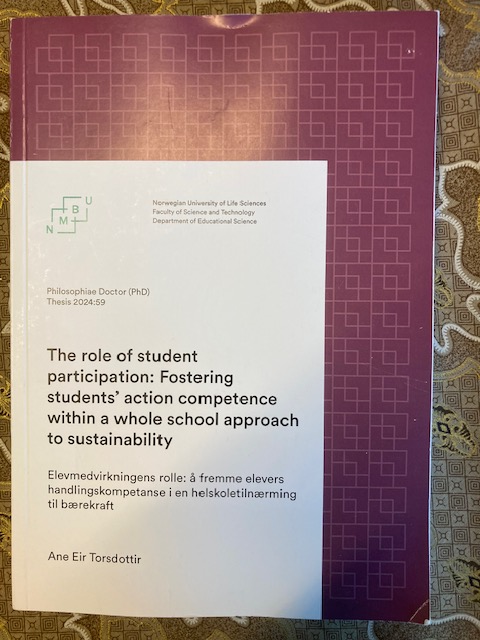
Ane Eir Thorsdottir Successfully Defends PhD-dissertation on Youth Participation in a Whole School Approach

On Friday November 1st one of my Norwegian PhD Candidates successfully defended her dissertation. Over the past few years I have been working with colleagues both at Wageningen University and at the Norwegian Life Sciences University (NMBU) on researching the potential merits of so-called Whole School and/or Whole Institution Approaches (WSA/WIA) to sustainability. At NMBU there are currently four PhD-candidates doing research related to this, Ane Eir Thorsdottir is or rather, was one of them. Her work focusses on one aspect of the WSA which is critically important: students participation. In addition to myself, Prof Astrid Sinnes of NMBU and Dr. Daniel Olsson of Karlstad University in Sweden were her supervisors. Jan Cincera and Elin Saether (Olso Univerity) were her ‘ opponents’ .She has published three articles that are central in the dissertation: two in Environmental Education Research and one in Global Environmental Research.


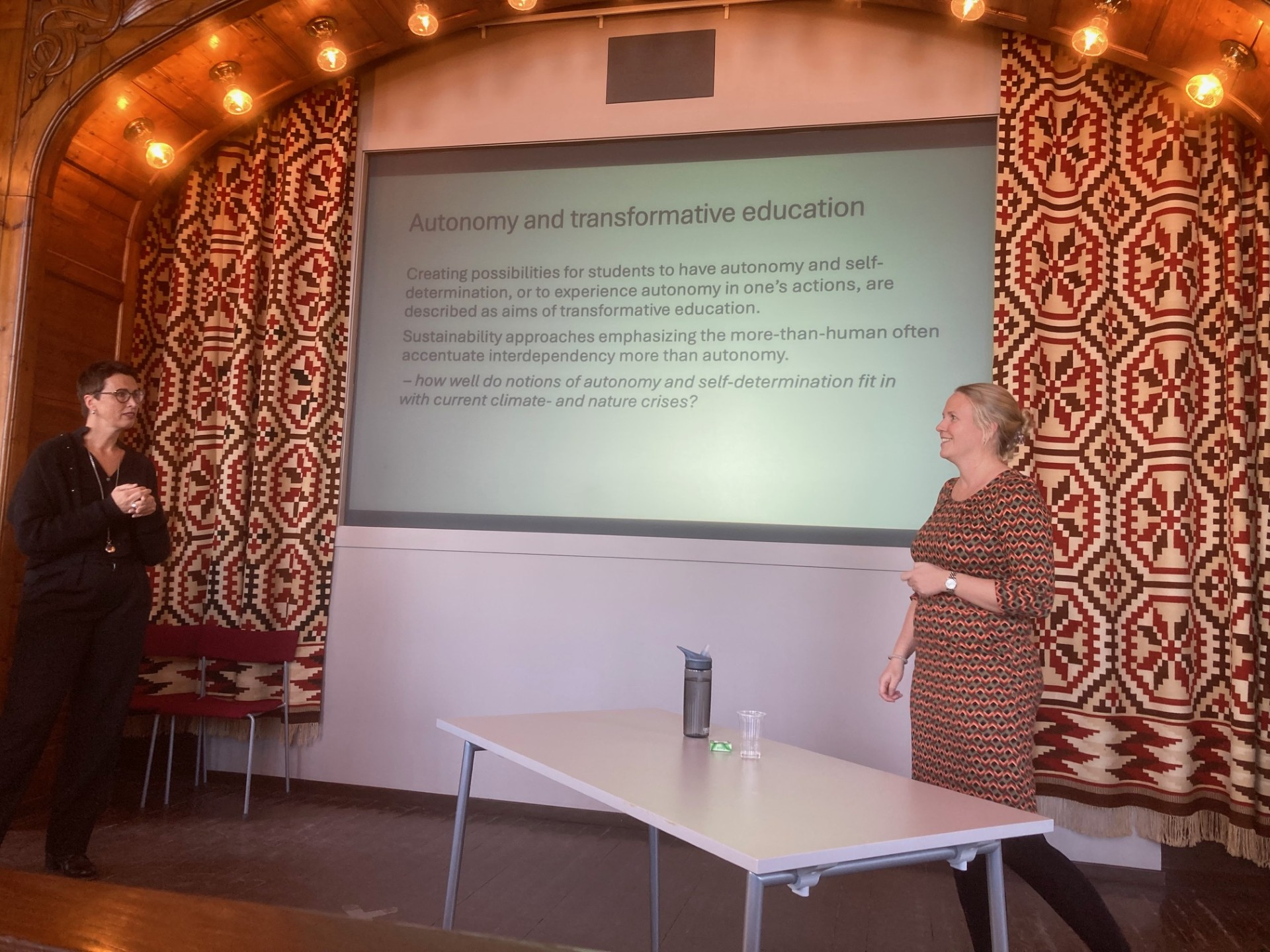
Elin Seather (left) having a dialogue with Ane (right) during the defence – posing an interesting question about autonomy and self-determination as pedagogical principles in a world that requires a decentering of ‘ self’ and opening up for ‘ other’ as well.

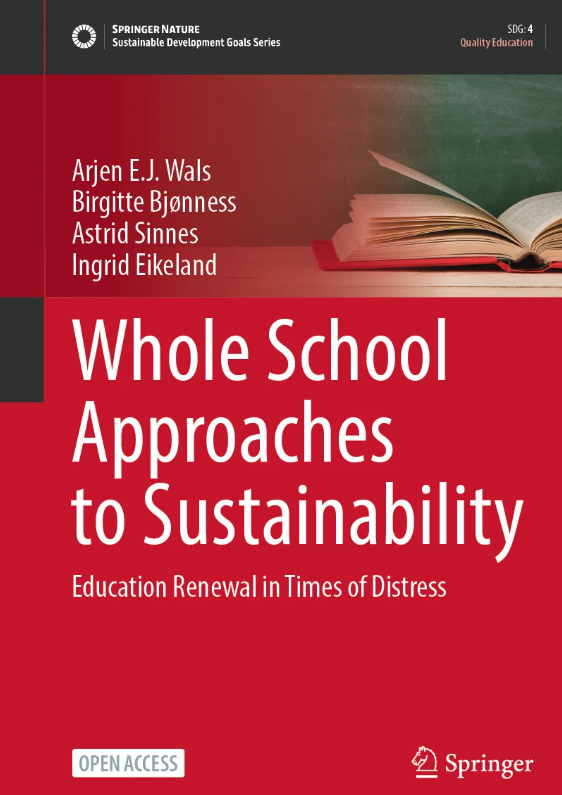
Whole School Approaches to Sustainability

Education Renewal in Times of Distress

LInk to the book: https://link.springer.com/book/10.1007/978-3-031-56172-6

At last – the edited volume on ‘Whole School Approaches to Sustainability – Educational renewal in times of distress’ has come out. Together with co-editors, Birgitte Bjønness, Astrid Sinnes and Ingrid Eikeland, and managing editor Stine Marie FyskeHaraldsen, we have worked with authors from around the world to create this rich picture of principles, practices and prospects of school working more systemically and holistically with sustainability, rather than treating it like another subject to be added to an already overcrowded curriculum.

The book has been made Open Acess and all 24 (!) chapters can be downloaded for free thanks to a grant provided through the Dutch Government-Supported Programme for Learning for Sustainable Development (LvDO).

We wish to acknowledge Roel van Raaij who has been an advocate of Education for Sustainable Development, both nationally and internationally, from within the Dutch government for decades, and Ellen Leusink who facilitates and supports ESD through the LvDO program and paved the way for the open access.

We also want to acknowledge the Department of Educational Science at
the Norwegian Life Science University (NMBU led by Hans Erik Lefdal together with Akershus county municipality (the school district South of Oslo) for the support to establish and run the University—School partnership for the last 6 years or so, continuing to this
day. The partnership with schools, especially the collaboration with school
coordinators and principals, have supported the development of the Whole
School Approach through research and praxis. Without this foundation and
support, we would not have had the knowledge, time, and confidence to work
on this book.

Here is the link to the book: https://link.springer.com/book/10.1007/978-3-031-56172-6

Do students have anything to say? Student participation in a whole school approach to sustainability

Source: https://www.undp.org/blog/placing-meaningful-youth-engagement-heart-environmental-action

Today, the first article from Ane Torsdottir’s PhD Research on High School student’s partcipation in schools trying to work within a Whole School Approach in Southern Norway, was published in Environmental Education Research. The article, co-authored by her supervising team with Daniel Olsson, Astrid Sinnes and myself, demonstrates how a questionnaire gauging students’ experiences of participation in decision-making at their school can operationalise student participation in a whole school approach (WSA) to education for sustainable development model.

Some 902 students in three upper secondary schools participated in the study by giving their answers to Likert-scale items developed to tap into their experience of participation in the decision-making at their school.

The students identified four distinct pathways of participation:

(i) School and Leadership,

(ii) Teaching and Learning,

(iii) Community Connections, and

(iv) Student Council.

The results are discussed in the light of focus group interviews with eleven of the participants. The student WSA participation questionnaire proved to be a reliable and valid instrument that, together with the student WSA participation model, can be used by school leaders wanting to increase student participation, and by researchers investigating student participation throughout the whole school.

Article link: here

Full citation:Torsdottir A.E, Sinnes A, Olsson D. & Wals, A. (2023) Do students have anything to say? Student participation in a whole school approach to sustainability, Environmental Education Research, DOI: 10.1080/13504622.2023.2213427

White Paper on Regenerative Higher Education – Rethinking education in times of dysfunction and collapse

Regrettably this white paper is only available in Dutch. Some ot the ideas artuclated in the paper can also be found in The Regenerative Education Podcast Series created by PhD Bas van den Berg see: The Regenerative Education Podcasts – Planting the seeds of change

Ik maak sinds een paar jaar deeluit van een Nederlandse  Community of Practice rondom Regenerative Higher Education bestaande uit PhDs en medewerkers van verschillende universiteiten en hoge scholen. Dit White Paper is het resultaat van de samenwerking in de Community of Practice en is samengesteld door Martine de Wit en gebaseerd op interviews met Bas van den Berg, Daan Buijs, Mieke Lopes Cardozo, Marlies van der Wee en Arjen Wals. Met input van Nina Bohm, Linda de Greef, Michaela Hordijk, Naomie Tieks, Koen Wessels, Rosanne van Wieringen, en Roosmarijn van Woerden. De illustraties en vormgeving zijn verzorgd door Mari Genova.

Het paper vertrekt vanuit de vraag:

Onderwijs dat het beste haalt uit onszelf en onze studenten, op weg naar herstel van de aarde. Hoe komen we daar?

Lees hier ons verhaal en laat ons weten wat resoneert, schuurt of wat het anderzins losmaakt!

 Education in Times of Climate Change – comprehensive NORRAG Special Volume

Climate change is not a new issue for education, but new levels of consensus and concern are emerging, suggesting that new policy developments may follow. This NORRAG Special Issue (NSI 07) addresses the question of how education is to equip learners to participate in climate action that would fundamentally disrupt existing problematic systems. This NSI has the potential to inform pedagogical praxis, co-learning, curriculum, climate action, policy formulation, frameworks for evaluating success, resourcing decisions and what we might consider educative acts for engaging with climate change and its multi-dimensional uncertainties, risks and opportunities. 

Edited by South African Professors Eureta Rosenberg and Heila Lotz-Sisitka, this is one of the most comprehensive and ground braking collections of papers available at the moment. The special issue is completely open access. You can find the full table of contents here.

I am very pleased to have found two wonderful Norwegian colleagues – Astrid Sinnes of the Norwegian Life Sciences University and Ole Andreas Kvamme of the University of Oslo who were willing to join in writing a contribution which is titled: School Strikes as Catalysts for Rethinking Educational Institutions, Purposes and Practices

I am also delighted to see two of my former PhD’s, Thomas Macintyre and Martha Chaves, based in Colombia in the special issue as well with a paper on Climate Change Resilience through Collaborative Learning in the Colombian Coffee Region – they co-authored with Tatiana Monroy who, like omas and Martha volunteers for Fundación Mentes en Transición, Colombia, South America

There will be an online launch of the NORRAG Special Issue 07 (NSI 07): Education in Times of Climate Change, will take place on 6 October 2022 at 16:00 – 17:30 CEST. For more information about the llaunch event have look here!

Transgressive learning, resistance pedagogy and disruptive capacitybuilding as levers for sustainability

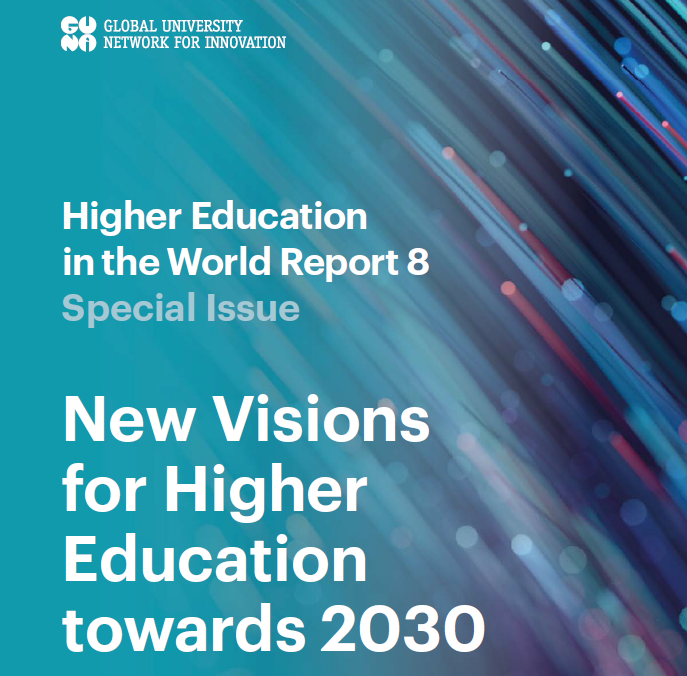
Earlier this month the 8th Report from the Global University Network fir Innovation (GUNi) was published with a wealth of contributions critiquing current resilient modes and models of education and outlinig alternative one in light of the current systemic global dysfunction we find ourselves in. I was asked to contribute a chapter on transgressive learning. The link to the chapter is here

You can find the entire book at www.guni-call4action.org

The full citation for my chapter is: Wals, AEJ (2022) Transgressive learning, resistance pedagogy and disruptive capacity building as levers for sustainability. In: Higher Education in the World 8 – Special issue New Visions for Higher Education, Barcelona: Global University Network for Innovation (GUNi). Open access: www.guni-call4action.org, p216-222.

Whole School Approaches (WSA) to Sustainability – Principles, Practices and Prospects – Call for Contributions

It is my pleasure to share two calls for contributions in relation to the development of a Whole School Approach (WSA) to Sustainability. The first one relates to an international hybrid conference organized by the Dutch government that will take place in The Netherlands and partially online late March of 2022, the second one relates to an edited Volume on the topic in the Springer SDG4 Series on Quality Education.

  1. Call for exemplary practices of a Whole School Approach to Sustainable Development

The Dutch Ministry of Economic Affairs and Climate Policy have commissioned a report to provide practical examples of how a Whole Institution/ Whole School Approach (WSA) is being used in practice around the world to engage with SDG4 – Quality Education, especially in relation to sustainable development issues as covered by the other SDGs. The reports aim is to highlight different aspects of a WSA  – curriculum development, pedagogical innovation, school management and leadership, school-community relationships, professional development of staff, and the school as a ‘living laboratory’ for experimenting with healthy, equitable, democratic, and ecologically sustainable living – especially how these aspects can be integrated to mutually strengthen each other.

We are particularly interested in so-called critical case-studies that do not only highlight best-practice strategies and success stories, but also share the struggles, set-backs and challenges underneath and ways to overcome them. The report will be published as part of the WSA International Conference happening in The Netherlands on the 30th-31st March.

If you know of such a school (primary, secondary, or vocational) from your country that can be used as an exemplary example of a WSA in action, or want further details, please contact Rosalie Mathie via email. rosalie.mathie@nmbu.no before February 15th so she can still contact people connected to the exemplary case.

2 Call for Abstracts Springer SDG4 Series
Whole School Approaches to Sustainability – Principles, Practices  and Prospects


Ingrid Eikeland, Brigitte Bjønness, Astrid Sinnes and Arjen Wals (Eds)

Schools across the globe are seeking to respond to emerging topics like; climate change, biodiversity loss, healthy food and food security, and global citizenship. They are increasingly encouraged to do so by educational policies that recognize the importance of these topics and by the Sustainable Development Goals (SDGs).

While there is recognition that such topics should not be added on to an already full curriculum, but rather require more systemic and integrated approaches, doing so in practice has proven to be difficult. This edited Volume seeks to engage educators, school leaders, educational policy-makers and scholars of sustainability in education in key principles, critical perspectives, generative processes and tools that can help realize a Whole School Approach to Sustainability. The book will contain three sections:  1) Principles & Perspectives, 2) Critically Reflexive Contextual Case Studies (Early Childhood, Primary, Secondary and Vocational Education) and 3) Synthesis: Challenges and Prospects.

The editors are inviting abstracts (no more than 500 words) of potential chapters. Contributions can be research-based (spanning different genres of research) but can also be more conceptual in the form of critically reflexive essays. Abstracts should indicate a best fit with one of the sections and need to be accompanied with short bios of the author(s) and, if possible, references to prior publications that relate to the topic.

Please send your initial ideas for a contribution or any queries you may have to: ingrid.eikeland@nmbu.no before March 1st. All abstracts will be reviewed by the editors and a selection will be made for further development into a full manuscript to be published by the end of 2022.

T-learning in Times of Transition Towards a Sustainable World – Keynote held for Learning for Sustainability Scotland

I was invited to give the closing keynote of the 2020 Annual General Meeting and Networking of Learning for Sustainability Scotland. The event was held online for the first time on 12th January 2021. More than 150 members gathered to explore the theme Building Forward Better: The role of Learning for Sustainability – What role does Learning for Sustainability play in making the world a better place, and how can we make this a reality? You can find a summary of the event and link to each of the programma elements here: https://learningforsustainabilityscotland.org/2021/01/28/report-from-the-lfs-scotland-jan-dec-2020-agm/

My talk titled ‘T-learning in Times of Transition Towards a Sustainable World’ presented an ultimately hopeful perspective on the role of new forms of learning and more ecological approaches of education in overcoming global systemic dysfunction – outlining some principles, perspectives and sharing international practice. You can see the 40 minute talk introduced generously by Rehema White, here: https://media.ed.ac.uk/media/1_gcmxxtyz The talk is followed up by some responses to questions raised by the participants.