Imagining Sustainability: A Nomadic Inquiry of Applied Drama in Higher Education

At last a chapter appeared in the wonderful Handbook of Ecological Civilization published by Springer that I am proud of both for its content and for the pleasure of working with PhD candidate from Stockholm University, Julia Fries. Julia over the years has developed a wonderful collection of arts-based, drama-inspired research in a somewhat unusual setting: business education. Her research embodies her pedagogy which is fascinating. This chapter explores how drama can contribute to the necessary renewal of higher education to meet the sustainability challenges of our time. Results are presented from a drama-based research project in higher education, and in a youth project. In the chapter, so-called nomadic enquiry is combined with an arts-based approach to participant interviews. Through this innovative method, an image of a rhizome emerged. This rhizome of expanded learning highlights five necessities or critical nodes for expanded sustainability-oriented learning: emer-gence, expansion through role, embodiment, connection to self and others, and crucial conditions. The rhizomatic perspective not only shows the transformative potential of drama in higher education and adult learning but also identifies the levers and barriers teachers, students, and the academy as an institution are likely to encounter when trying to move towards a socio-ecologically more civilized world. The results point to how the integration of knowledge and wisdom that are striven for in the philosophy of ecological civilization can be put into pedagogical practice through the holistic learning of drama.

The Handbook of Ecological Civilization, unfortunately, is not an Open Access Handbook – but your library may have access. But I am happy to share the corrected proffs for your own use here!

Full citation: Fries, J., Wals, A. (2025). Imagining Sustainability: A Nomadic Inquiry of Applied Drama in Higher Education. In: Peters, M.A., Green, B.J., Misiaszek, G.W., Zhu, X. (eds) Handbook of Ecological Civilization. Springer International Handbooks of Education. Springer, Singapore. https://doi.org/10.1007/978-981-97-8101-0_73-1

And now for something completely (?) different: Sustainable Elite Youth Sports

The field of sustainability and education in the context of sustainability is rather fluid and not easily defined or delineated, Part of the challenge is to look for connections and relationships. As a scholar in the field I try to do that and this sometimes gets me in, for me at least, somewhat unusual areas. When a Visiting Professor at the University of Gothenburg I connected with two scholars who we also in the Faculty of Education but working in quite a different area from my own – the interface of sports and health science & education science – Dean Barker and Nathalia Barker-Ruchti. The were intrigued by the heuristic Bob Jickling and I developed on instrumental authoritative and emancipatory relational approaches to education. They figured that this heuristic might be relevant for characterizing different coaching styles that can be found in high performance sports. It led to this paper back then: Barker, D., Barker-Ruchti, N., Wals, A.E.J., Tinning R. (2014) High performance sport and sustainability: a contradiction of terms?, Reflective Practice, 15, (1). Now over 10 years later this paper travels further into a new collaboration led by Astrid Schubring @schubring that was (pre)published this week in Sustainable Development in an article titled: Sustainable Elite Youth Sports: A Systematic Scoping Review of the Social Dimensions Sports have been identified as an important contributor to social sustainability, and the benefits for health, well-being, and social learning in young people are well evidenced. Youth elite sports, however, have been criticized as being unsustainable. Following calls for a more socially sustainable development of youth elite sports, research on the topic has increased. However, studies vary in disciplinary origin, concepts, content, and methodology. The aim of this systematic scoping review is to identify and synthesize the current disciplinary research knowledge. You can read the article here!

Wild Pedagogies in Practice: Inspiration for Higher Education – two new papers!

Two papers I co-authored with different colleagues came out in the same Special Issue of the Australian Journa of Environmental Education published by Cambridge University Press. Both papers are published with open access.

The first paper led by PhD-candidate at Wageningen University, Reineke van Tol is on the potential of Wilde Pedagogies for renewing and reorienting higher education towards a posthumanist and relational perspective.

Citation: van Tol RS, Wals A. Wild Pedagogies in Practice: Inspiration for Higher Education. Australian Journal of Environmental Education. Published online 2025:1-23. doi:10.1017/aee.2025.16

The second paper led by Koen Arts is on Embedding Outdoor Relational Education in Academia and the barriers and opportunities we are running into in our home instiution: Wageningen University in The Netherlands.

Citation: Arts K, Roncken P, Buijs A, Wals A. Embedding Outdoor Relational Education in Academia: Perceived Barriers and Opportunities at a Dutch University. Australian Journal of Environmental Education. Published online 2025:1-21. doi:10.1017/aee.2025.24

In the first paper (van Tol and Wals, 2025) Wild Pedagogies (WP) are introduced as a critical, relational alternative to current, often unsustainable learning practices. WP aim to offer a way of learning in, with, through and for nature, embracing a post-humanist, relational perspective. So far, WP have mainly been explored theoretically. Increasingly, educators both within and outside of formal education, are inspired and apply WP in their education. Throughout the world, examples of learning that fit into WPs’ living definition, are emerging. However, concrete inspiration for how to bring WP theory into practice, is still largely lacking. In this paper, we explore three emerging approaches at Wageningen University (The Netherlands), that are inspired by wild pedagogies. Empirically, we combine formative evaluations of course designs with participant observation in a collective case study setting over three years. The empirical research is embedded in an explorative literature review that led us to four explorative areas of WP, namely (1) Wild and caring learning spaces (2) Learning from self-will and wonder (3) Relational learning with the world and (4) Disruptive learning for the world. Eventually we present concrete inspiration on those four areas for implementing WP in formal higher education. You can find the full paper here.

In the second paper (Arts et a., 2025) a common denominator of these more relational approaches is an emphasis on learning outdoors. This paper investigates the budding concept and practice of outdoor relational education at a university, specifically Wageningen University (WU) in the Netherlands. Based on 31 semi-structured interviews with protagonists and other stakeholders involved in or affiliated with outdoor relational education at WU, we identify associations, key elements and perceived benefits. Our research provides insight into what outdoor relational education and associated concepts are perceived to be in this context, how they are engaged and what the key experienced opportunities and barriers are to implement outdoor relational education further at WU. Complementary to theorisations of wild pedagogies and related approaches, our results offer empirical illustrations of wild pedagogies “in action” in an institutional academic setting that is not necessarily conducive to such developments. You can find the full paper here.

The art of arts-based interventions in transdisciplinary sustainability research

Led by PhD-Candidate Sophia-Marie Horvath of Department of Forest- and Soil Sciences, Institute of Forest Ecology, University of Natural Resources and Life Sciences in Vienna, a paper just came out in Sustainability Science on the contribution of arts-based interventions in transdisciplinary sustainability research. Transdisciplinary, co-creative research deals with complex real-world problems, with complexity being a common denominator of sustainability issues. It is often understood as an interplay of two dimensions, collaboration and creativity, that facilitates the integration of different forms of knowledge and the creation of transformative outcomes. In the end, it aims to find more holistic and systemic solutions to complex real-world problems. Increasingly, Arts-Based Interventions (ABIs) are proposed to support sustainability-oriented transdisciplinary research. However, little research has been done so far to gauge the extent to which adding arts to the mix actually benefits the transdisciplinary research process and outcomes. In the research project reported on in this article, we took a first step into the realm of the arts by including ABIs into transdisciplinary brainstorming sessions. You can find the full paper here: https://link.springer.com/article/10.1007/s11625-024-01614-2#citeas

Full citation: Horvath, SM., Payerhofer, U., Wals, A. et al. The art of arts-based interventions in transdisciplinary sustainability research. Sustain Sci (2025). https://doi.org/10.1007/s11625-024-01614-2

Characteristics and challenges of teaching and learning in sustainability-oriented Living Labs within higher education: a literature review – Open Access!

This paper led by ELS-WUR PhD-candidate Marlies van der Wee – Bedeker was published earlier this Fall. The paper is the first peer reviewed article based on her research that is grounded in the City of Rotterdam using her home institute Hogeschool Rotterdam as a base. Below a summary of the main fiindings. The full paper can be found here!

Full citation:

van der Wee, M.L.E.Tassone, V.C.Wals, A.E.J. and Troxler, P. (2024), “Characteristics and challenges of teaching and learning in sustainability-oriented Living Labs within higher education: a literature review”, International Journal of Sustainability in Higher Education, Vol. 25 No. 9, pp. 255-277. https://doi.org/10.1108/IJSHE-10-2023-0465

Rethinking pedagogy in the face of complex societal challenges: helpful perspectives for teaching the entangled student

This paper appeared online in 2022 and was a part of the wonderful dissertation of Koen Wessels which was later published by Springer Nature as a book within the publisher´s SDG 4 ´Quality Education´ Series. Now has been formally published in open-access form as a part of the latest issue of Pedagogy, Culture and Society. Full citattion: Wessels, K. R., Bakker, C., Wals, A. E. J., & Lengkeek, G. (2024). Rethinking pedagogy in the face of complex societal challenges: helpful perspectives for teaching the entangled student. Pedagogy, Culture & Society32(3), 759–776. View and download here: https://doi.org/10.1080/14681366.2022.2108125

Here is the abstract to give you a bit of a flavor of the paper:

New paper out: Vocational education for a sustainable future

Saskia Weijzen published her first article as a part of her PhD-journey. The full title is:  Vocational education for a sustainable future: Unveiling the collaborative learning narratives to make space for learning

I am sharing the abstract here to pique, hopefully, your curiosity:

In the light of urgent global sustainability challenges, vocational education is searching for new approaches that are more just and future proof. At least a part of the answer seems to lie in so-called collaborative learning arrangements where students together with societal actors explore sustainability-related challenges. The amount of this kind of arrangements in which vocational education participates increases. Empirical studies on what actually goes on in the collaborative arrangements are rather scarce. This study addresses the theory-practice gap by applying a participatory design. The study unveils that deeply seated educational and socio-cultural routines like the student as learner, alienation from issues, a bias towards cognitive knowing and ‘solving’ problems seem to limit the possibilities for more genuine collaboration to emerge. The study also found that by intervening with creative and reflexive methods, space for transformative learning can unfold that allows engagement with existential questions like ‘what is it what I really got to do here?’. The opening up of these spaces was accompanied by longings to go beyond the rosy narratives of collaborative learning arrangements and to have more attention for the persistent embeddedness of educational routines in the societal issues around us. Vocational education as society. What happens if we progress towards vocational education for sustainable futures with more modesty and introspection?

The full citation and doi (it is open access!) is:

Weijzen, S. M. G., Onck, C., Wals, A. E., Tassone, V. C., & Kuijer-Siebelink, W. (2024). Vocational education for a sustainable future: Unveiling the collaborative learning narratives to make space for learning. Journal of Vocational Education & Training76(2), 331–353. https://doi.org/10.1080/13636820.2023.2270468

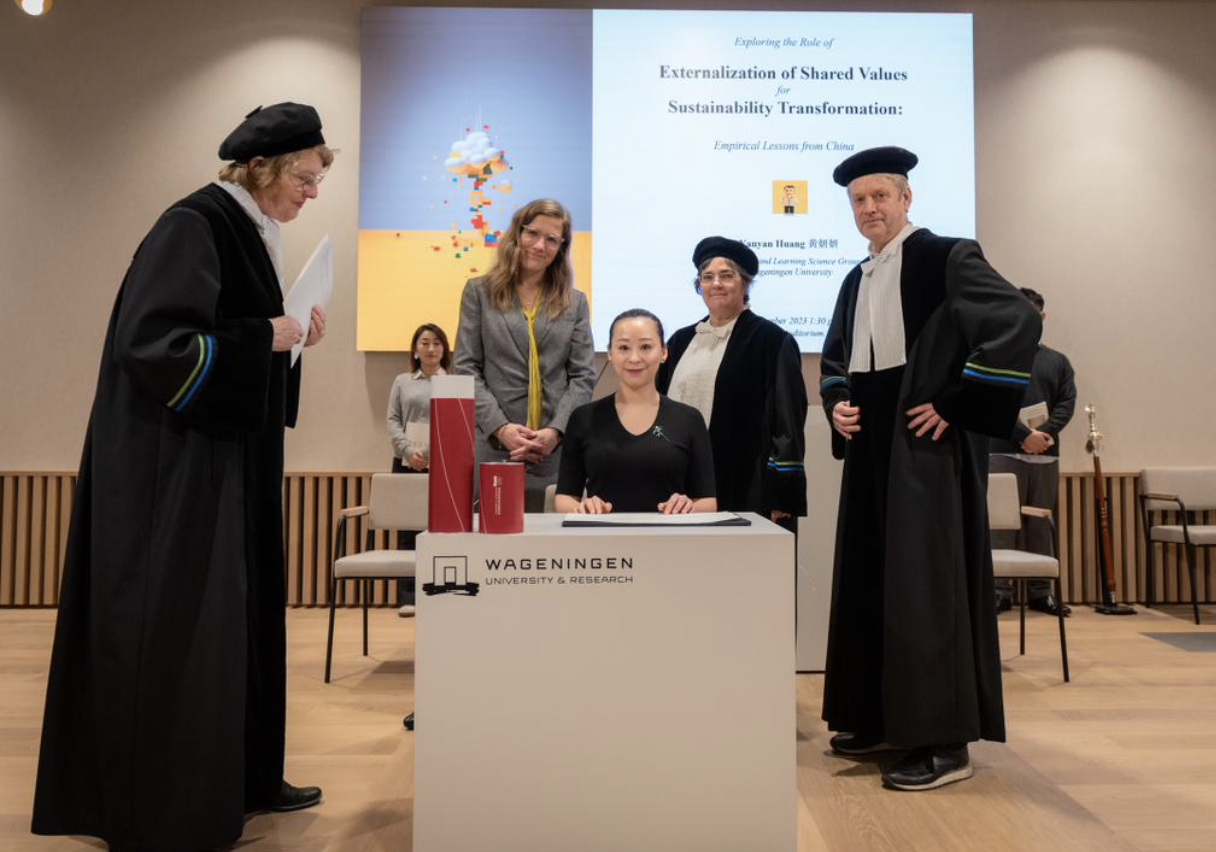
Yanyan Huang successfully defends her thesis ´Exploring the Role of Externalization of Shared Values for Sustainability Transformation´

Yanyan Huang receving her PhD degree with on her side second promotor Prof Marie Harder of Fudan University, Co-promotor Dr. Renate W<esselink and myself.

On December 19th Yanyan Huang successfully defended her thesis in the aula of Wageningen university. Her thesis presents an in-depth exploration to unravel the roles/potential of the externalization of shared values in facilitating sustainability transformation. Although the need for sustainability transformation is increasing globally and the profound influence of values for sustainability transformation is already established, there is still not sufficient understanding in how to purposefully navigate values for sustainability transformation. This thesis strives to fill this gap by introducing a new perspective: conceptualizing values as tacit knowledge and leveraging the SECI model from the Knowledge Creation Theory. Synthesizing results from empirical data collected from cases conducted in Shanghai, China, this thesis identifies the roles of externalization of shared values with respect to its outcome (shared values) and the procedure (externalization) for sustainability transformation. Further, this thesis presents discussions of the underlying mechanism through which shared values, when externalized, facilitate substantial sustainability transformations, and reflections on the implication for researchers from the field of sustainability science. For those who aim to promote sustainability transformation, this thesis not only enhances the understanding of the dynamic interplay between shared values and sustainability transformation, but also provides a specific roadmap to unleash the potential of the externalization of shared values for sustainability transformation to respond to the above- mentioned gap. With its new perspective, this thesis also underscores the necessity of considering the procedures through which values/shared values are involved.

The entire thesis can be downloaded via the Wageningen University Library.

Marieke Versteijlen successfully defended her PhD thesis on Blended learning in higher education from a sustainability perspective

On December 12th Marieke Versteijlen of Avans Hogeschool successfully defended her thesis at the Wageningen University. Marieke was co-supervised by myself and Transportation Scientist Prof. Bert van Wee of Delft University in the aula of Wageningen University. The thesis was approved and discussed by a committee consisting of Prof. Taeke Tillema of Groningen University, Prof. Arnold Brecht, Dean of Educaiton, Wageningen University, Dr. Sally Windsor of Gothenburg University in Sweden and Dr. Wim Lambrechts of the Open University of The Netherlands.

Marieke’s research addresses the high environmental impact of students commuting to the higher educational institution (HEI) by exploring the potential of digital technology to lower the travel movements of students.

The research explores how on-campus and online education can be balanced in a blended learning design to decrease student commute without compromising educational quality. By applying a form of Educational Design Research (EDR), involving key HEI stakeholders, guidelines and principles were found that can support the design of blended education to simultaneously meet these environmental and educational requirements.

The three stages of EDR were followed to design the sustainable blended intervention, explorationconstruction and reflection. In the exploration stage, the environmental impact of students commuting to and from campus was explored across several Dutch HEIs and compared with international research on HEIs’ carbon footprint, confirming its large contribution. Also showing that only a few Dutch sustainability and ICT professionals recognized the potential of online learning to lower carbon emissions due to student commute.

After establishing the environmental impact of student travel, the considerations and (de)motivators of Dutch students influencing their travel mode choices and their decisions about whether to travel to their institution or to study online were explored. Their travel mode choice is mostly based on habit and influenced by travel-regulating measures of the Dutch government (a free public transport permit) and HEIs (high parking costs). Their decision to make a trip to campus seems to be a reasoned choice, influenced by the number and time of the day of their scheduled classes, the type of learning activity and their perceived study abilities.

In the construction stage, design principles and associated recommendations were developed to design sustainability-oriented blended education through a realist review and by cooperating with a team of eight educational professionals to design a blended study programme. Lecturers can use these design principles to guide and assess the quality of a blended learning unit. The acquisition of sustainability competencies by the students was considered one of the aspects of educational quality. The implementation of the prototype was severely impacted by the COVID-19 pandemic in 2020. The government restrictions changed the intended blend to mainly online education. Instead of measuring student travel emissions as a result of the design, a possible attitude change of students toward online learning and commuting that might have been caused by going through a period of primarily online learning due to COVID-19 restrictions, was studied. The students experienced that online meetings can be productive and efficient, and less time is lost in travel. Both were appreciated by the students.

This research adds a sustainable perspective and a step toward a detailed pedagogical framework to what is already known about blended learning. Although we could not measure the impact of a blended learning design on student travel emissions due to COVID-19, there are strong indicators that a blended learning design can be used to decrease its environmental impact by reducing student commute. The findings of this study can contribute to a whole-institution approach embedding sustainability in all aspects of the institution.

The entire thesis is available through open access through the Wageningen Library as are the four peer reviewed papers that all have been published.

While Higher Education is grappling with enormous sustainability challenges Ghent University is about to downsize its successful Green Office

n a time where universities across the globe are trying to figure out how to remain relevant, responsive and responsible in times of climate urgency, biodiversity collapse and rising inequality, Ghent University is about to downsize its infamous Green Office in light of necessary ‘budget cuts’. I have worked with the Ghent Green Office and some of its key members for many years and find it hard to believe. Later this week the university leadership will determine whether it will downsize or continue to fully support some of the most dedicated and capable people and the structures they have created over the years to make sustainability part of the DNA of university and the wider community of Ghent. Together with educators and researchers based at universities across Europe we wrote a letter urging the leadership to rethink its down-sizing plans and to adopt a more visionary and hopeful stance. You can read the letter here:

White Paper on Regenerative Higher Education – Rethinking education in times of dysfunction and collapse

Regrettably this white paper is only available in Dutch. Some ot the ideas artuclated in the paper can also be found in The Regenerative Education Podcast Series created by PhD Bas van den Berg see: The Regenerative Education Podcasts – Planting the seeds of change

Ik maak sinds een paar jaar deeluit van een Nederlandse  Community of Practice rondom Regenerative Higher Education bestaande uit PhDs en medewerkers van verschillende universiteiten en hoge scholen. Dit White Paper is het resultaat van de samenwerking in de Community of Practice en is samengesteld door Martine de Wit en gebaseerd op interviews met Bas van den Berg, Daan Buijs, Mieke Lopes Cardozo, Marlies van der Wee en Arjen Wals. Met input van Nina Bohm, Linda de Greef, Michaela Hordijk, Naomie Tieks, Koen Wessels, Rosanne van Wieringen, en Roosmarijn van Woerden. De illustraties en vormgeving zijn verzorgd door Mari Genova.

Het paper vertrekt vanuit de vraag:

Onderwijs dat het beste haalt uit onszelf en onze studenten, op weg naar herstel van de aarde. Hoe komen we daar?

Lees hier ons verhaal en laat ons weten wat resoneert, schuurt of wat het anderzins losmaakt!

Rethinking pedagogy in the face of complex societal challenges: helpful perspectives for teaching the entangled student

Another most interesting paper just came out in the journal Pedagogy, Culture and Society. This time led by – now former PhD candidate – Koen Wessels who received his PhD last June. Here is some key info on the paper and its key concept ‘pedagogy of entanglement’ which is at the heart of Koen’s research.

Confronted by myriad interconnected societal challenges, this paper asks: what kind of pedagogy does justice to the experience and challenge of living in a complex world? Departing from a critical reading of a preparative-logic to education, this paper emphasises students’ entangledness: more-or-less consciously, students are uniquely shaped-by and shapers-of complex societal challenges in a here-and-now sense. Utilising this premise, the paper develops a set of pedagogical perspectives that might inspire and help teachers to design their own responses to particular complex societal challenges in their unique teaching contexts. Drawing on emerging outcomes from a narrative diffractive inquiry with 12 teachers as co-researchers and engaging with complexity thinking, six perspectives are presented and discussed: entanglement-orientedness, entanglement-awareness, hopeful action, inquiry within complex societal challenges, practicing perceptiveness, and practicing integrity. Together, these perspectives offer a heuristic for embracing complexity in education.

You can get to the paper via this link: https://www.tandfonline.com/doi/full/10.1080/14681366.2022.2108125

Full citation: Koen R. Wessels, Cok Bakker, Arjen E.J. Wals & George Lengkeek (2022) Rethinking pedagogy in the face of complex societal challenges: helpful perspectives for teaching the entangled student, Pedagogy, Culture & Society, DOI: 10.1080/14681366.2022.2108125

Transgressive learning, resistance pedagogy and disruptive capacitybuilding as levers for sustainability

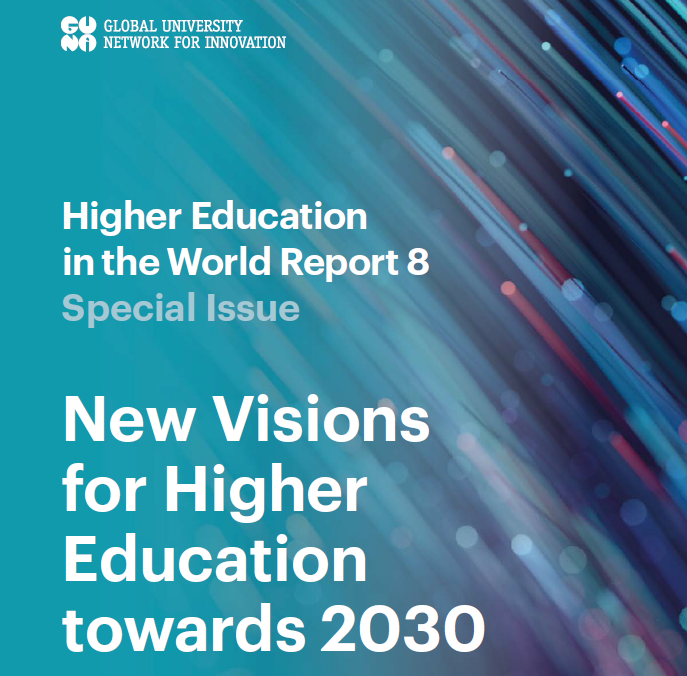
Earlier this month the 8th Report from the Global University Network fir Innovation (GUNi) was published with a wealth of contributions critiquing current resilient modes and models of education and outlinig alternative one in light of the current systemic global dysfunction we find ourselves in. I was asked to contribute a chapter on transgressive learning. The link to the chapter is here

You can find the entire book at www.guni-call4action.org

The full citation for my chapter is: Wals, AEJ (2022) Transgressive learning, resistance pedagogy and disruptive capacity building as levers for sustainability. In: Higher Education in the World 8 – Special issue New Visions for Higher Education, Barcelona: Global University Network for Innovation (GUNi). Open access: www.guni-call4action.org, p216-222.

Exploring Drama-based Methods Higher Education for Sustainability – an invitation

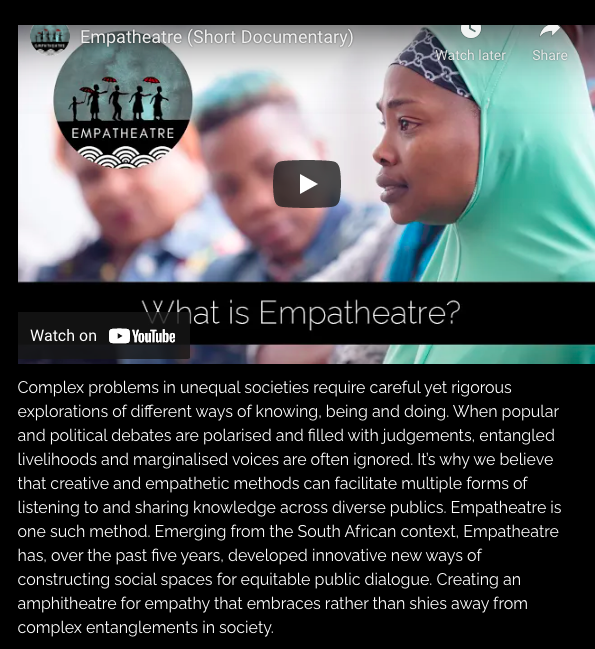
Empatheatre is one example from South Africa showing how drama can educate towards empathy and social and environmental justicehttps://www.empatheatre.com/about

One of the Swedish PhD-Candidates I have been working with over the last few years, Julia Fries, based at Stockholm University, is co-organising two fascinating workshops focusing on drama-based approaches in higher education for sustainability.

Below you find an invitation to participate in two international workshops on new formats for Sustainability teaching, funded by the Swedish Research Council and organised by Stockholm Resilience Center and the Department for Teaching and Learning at Stockholm University.

The project explores how drama-based methods can support reflective, embodied and transformative learning about sustainability amongst higher education students. The research ambition is to further current understanding of the role of experiential learning and how these methods support such learning. The format designed will allow to both support pedagogic development in participants academic teaching practice, and address the research questions.

Two international workshops will bring together drama educators and educators in fields related to sustainability, to share different drama-based, interactive methods and explore what these can bring to education in sustainability sciences or sustainability in other subject areas.

Quote from project description:

This project concerns teaching and learning for Sustainability in Higher Education. The cross-disciplinary field of sustainability can be characterised as extremely unsettled and value-loaded, a challenging academic subject for both teachers and students. Consequently, adequate teaching methods has to be developed in order to tackle sustainability issues in a creative and inclusive way. This has been recognised in relation to primary and secondary education but not so much at university level. Attempts are made to achieve this, by adopting a less traditional teaching approach and relation to the world outside the university. Based on this, we propose two explorative workshops for university teachers/researchers.   The purpose of the first workshop is to introduce and explore a set of highly interactive teaching approaches to a group of university teachers/researchers in Scandinavia and Europe. After the first workshop, these teaching approaches will be applied, tried out and documented, as part of the participants ongoing teaching at their universities. The purpose of the second workshop is to evaluate these interactive approaches, by sharing teaching experiences and learning outcomes among students in higher education. The overarching aim is to explore and compare a set of interactive teaching approaches, in terms of applicability and student impact in Higher Education for Sustainability. Based on the outcome, scientific papers will be presented and/or a book will be published.

Practicalities: The first workshop will be in Stockholm 6-9 Sept. 2022 and the second in May or June 2023. Thanks to a grant from the Swedish Research Council we are able to offer 15 participants free meals and accommodation, but travel expenses are not included in the offer. Participants are expected to take part in both workshops. A detailed program for the first event will be presented later this spring. Questions can be directed to eva.osterlind@su.se or t.wall@ ljmu.ac.uk

Are you interested? Please register here: https://forms.gle/frRFxrbgdoL8mrabA