
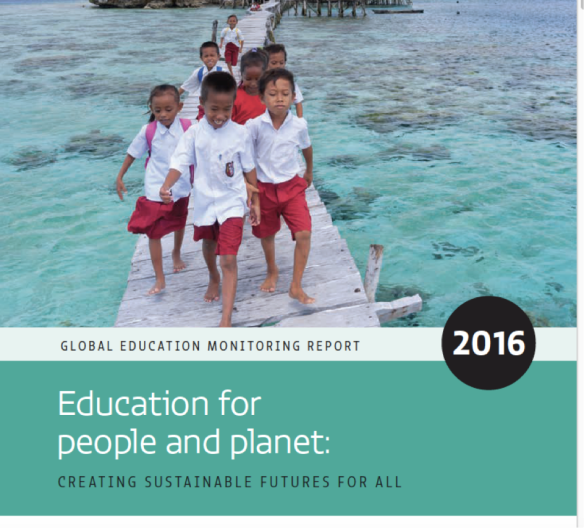
GEM2016 – Education for People and Planet: creating sustainable futures for all – now available (open access)

gem2916

On September 6th the new Global Education Monitor report was launched – and it comes highly recommended as a comprehensive report that can help re-orient education towards sustainability and helping education become more responsive, relevant and responsible in light of today’s global challenges. It was a pleasure for me to help the GEM2016 team in preparing this report – especially in the Introduction and the first two chapters. The full report can be downloaded at: http://gem-report-2016.unesco.org/en/home/ or by clicking gem2016educationforpeopleandplanet. The report – over 550 pages – will appear in multiple languages in due time and is also available in a summary form. It can be an useful text in higher education when read critically and properly discussed.

Below is a short introduction to the report from the GEM2016 website.

At the 70th Session of the United Nations General Assembly in September 2015, member states adopted a new global development agenda, Transforming our world: the 2030 Agenda for Sustainable Development. At its heart are 17 Sustainable Development Goals (SDGs), including SDG 4 on education. The SDGs establish development priorities to 2030 and succeed both the Millennium Development Goals and the Education for All (EFA) goals, whose deadlines expired in 2015.

Education will not deliver its full potential to catapult the world forward unless participation rates dramatically improve, learning becomes a lifelong pursuit and education systems fully embrace sustainable development

The Global Education Monitoring Report (GEM Report), which builds on the experience of the previous EFA Global Monitoring Report series, received a new mandate to assess the progress of education under the 2030 Agenda. The 2016 GEM Report, the first of the new 15-year series, explores the complex relationship between education and other facets of sustainable development, along with the monitoring implications for SDG 4. It shows that education will not deliver its full potential to catapult the world forward unless school participation rates dramatically improve, learning becomes a lifelong pursuit and education systems fully embrace sustainable development.

The thematic part of the report highlights evidence, practices and policies that demonstrate how education can serve as a catalyst for the overall sustainable development agenda. It presents compelling arguments for the types of education that are vital for achieving the goals of poverty reduction, hunger eradication, improved health, gender equality and empowerment, sustainable agriculture, resilient cities and more equal, inclusive and just societies.

The monitoring part tackles the many challenges concerning how to assess progress on SDG 4, including concrete recommendations for policy change. Each of the seven education targets and three means of implementation in SDG 4 are examined in turn. In addition, education finance and education systems are analysed, as is the extent to which education can be monitored in the other SDG goals. Building blocks and potential synergies for a more effective and efficient global education monitoring agenda over the next 15 years are identified at the national, regional and international levels.


Sustainability Citizenship in Cities: Theory and Practice – now available!

sustainability-citizenship-in-cities-theory-and-practice-by-ralph-horne-1317391071

Australian colleagues Ralphe Horne, John Fien, Beau Beza and Anitra Nelson edited a fascinating book on ‘sustainability citizenship’ to which I was priviledged to contribute a chapter together with Frans Lenglet. Urban sustainability citizenship situates citizens as social change agents with an ethical and self-interested stake in living sustainably with the rest of Earth. Such citizens not only engage in sustainable household practices but respect the importance of awareness raising, discussion and debates on sustainability policies for the common good and maintenance of Earth’s ecosystems.

The publisher’s website describes the book as follows:

Sustainability Citizenship in Cities seeks to explain how sustainability citizenship can manifest in urban built environments as both responsibilities and rights. Contributors elaborate on the concept of urban sustainability citizenship as a participatory work-in-progress with the aim of setting its practice firmly on the agenda. This collection will prompt practitioners and researchers to rethink contemporary mobilisations of urban citizens challenged by various environmental crises, such as climate change, in various socio-economic settings.

This book is a valuable resource for students, academics and professionals working in various disciplines and across a range of interdisciplinary fields, such as: urban environment and planning, citizenship as practice, environmental sociology, contemporary politics and governance, environmental philosophy, media and communications, and human geography.

The chapter Frans Lenglet and I wrote is titled: “Sustainability citizens: collaborative and disruptive social learning” and emphasizes the role of learning and cultivating diversity and generative conflict in co-determining what it means to be sustainable within the everyday realities people find themselves. It is argued that in order to brake with stubborn unstustainabel routines – that are heavily promoted and strenghtened in a market, growth and consumption-oriented society, citizens will also need to develop disruptive capacity and engage in transgressive learning (see my earlier post about transgressive learning and the work within the ICSS project on T-learning led by Prof. Heila Lotz-Sisitka from Rhodes Univerity in South Africa). If you want to have a look at our chapter you can find it here: SustainabilityCitizenshipWalsLenglet2016 (for personal use). The full reference is:

Wals, A.E.J. & F. Lenglet (2016). Sustainability citizens: collaborative and disruptive social learning. In: R. Horne, J. Fien, B.B. Beza & A. Nelson (Eds.) Sustainability Citizenship in Cities: Theory and Practice. London: Earthscan, p. 52-66.

If you want to get a hold of the entire book visit: https://www.routledge.com/Sustainability-Citizenship-in-Cities-Theory-and-practice/Horne-Fien-Beza-Nelson/p/book/9781138933637


Education for people and planet: Creating sustainable futures for all – GEM-2016 soon to be launched

global-education-monitoring-report-300x225

Starting in 2016 a new series of UNESCO reports, the Global Education Monitoring (GEM) Reports, will monitor the state of education in the new framework of the Sustainable Development Goals (SDGs). The new series replaces the earlier Global Monitoring Report (GMR) series. I was brought on board the GEM 2016 Team last December to provide input on the thematic part of the report – especially to provide feedback on the relationship between education and achieving sustainability.

The report has been titled: ‘Education for people and planet: Creating sustainable futures for all’. It is a very comprehensive and well-researched report that seeks to be geographically balanced in its analysis and examples. There are two parts: a thematic part and a monitoring part. My role was mainly limited to providing feedback to the thematic part which covers 5 ‘Ps’s: Planet, Prosperity, People, Place and Partnerships. The thematic Part 1 of the Report focuses on examining the complex interrelationships and links between education and key development sectors. It determines which education strategies, policies and programmes are most effectively linked to the economic, social, environmental and political priorities of the new sustainable development agenda.  Part 2 establishes a much needed a monitoring framework for education post-2015, and examine key financing and governance challenges for the post-2015 era.

You can read the concept note that underpins the report here. 

The GEM 2016 report will appear in multiple languages.

Sign up to receive the report in your inbox as soon as it’s released.