Imagining Sustainability: A Nomadic Inquiry of Applied Drama in Higher Education

At last a chapter appeared in the wonderful Handbook of Ecological Civilization published by Springer that I am proud of both for its content and for the pleasure of working with PhD candidate from Stockholm University, Julia Fries. Julia over the years has developed a wonderful collection of arts-based, drama-inspired research in a somewhat unusual setting: business education. Her research embodies her pedagogy which is fascinating. This chapter explores how drama can contribute to the necessary renewal of higher education to meet the sustainability challenges of our time. Results are presented from a drama-based research project in higher education, and in a youth project. In the chapter, so-called nomadic enquiry is combined with an arts-based approach to participant interviews. Through this innovative method, an image of a rhizome emerged. This rhizome of expanded learning highlights five necessities or critical nodes for expanded sustainability-oriented learning: emer-gence, expansion through role, embodiment, connection to self and others, and crucial conditions. The rhizomatic perspective not only shows the transformative potential of drama in higher education and adult learning but also identifies the levers and barriers teachers, students, and the academy as an institution are likely to encounter when trying to move towards a socio-ecologically more civilized world. The results point to how the integration of knowledge and wisdom that are striven for in the philosophy of ecological civilization can be put into pedagogical practice through the holistic learning of drama.

The Handbook of Ecological Civilization, unfortunately, is not an Open Access Handbook – but your library may have access. But I am happy to share the corrected proffs for your own use here!

Full citation: Fries, J., Wals, A. (2025). Imagining Sustainability: A Nomadic Inquiry of Applied Drama in Higher Education. In: Peters, M.A., Green, B.J., Misiaszek, G.W., Zhu, X. (eds) Handbook of Ecological Civilization. Springer International Handbooks of Education. Springer, Singapore. https://doi.org/10.1007/978-981-97-8101-0_73-1

Wild Pedagogies in Practice: Inspiration for Higher Education – two new papers!

Two papers I co-authored with different colleagues came out in the same Special Issue of the Australian Journa of Environmental Education published by Cambridge University Press. Both papers are published with open access.

The first paper led by PhD-candidate at Wageningen University, Reineke van Tol is on the potential of Wilde Pedagogies for renewing and reorienting higher education towards a posthumanist and relational perspective.

Citation: van Tol RS, Wals A. Wild Pedagogies in Practice: Inspiration for Higher Education. Australian Journal of Environmental Education. Published online 2025:1-23. doi:10.1017/aee.2025.16

The second paper led by Koen Arts is on Embedding Outdoor Relational Education in Academia and the barriers and opportunities we are running into in our home instiution: Wageningen University in The Netherlands.

Citation: Arts K, Roncken P, Buijs A, Wals A. Embedding Outdoor Relational Education in Academia: Perceived Barriers and Opportunities at a Dutch University. Australian Journal of Environmental Education. Published online 2025:1-21. doi:10.1017/aee.2025.24

In the first paper (van Tol and Wals, 2025) Wild Pedagogies (WP) are introduced as a critical, relational alternative to current, often unsustainable learning practices. WP aim to offer a way of learning in, with, through and for nature, embracing a post-humanist, relational perspective. So far, WP have mainly been explored theoretically. Increasingly, educators both within and outside of formal education, are inspired and apply WP in their education. Throughout the world, examples of learning that fit into WPs’ living definition, are emerging. However, concrete inspiration for how to bring WP theory into practice, is still largely lacking. In this paper, we explore three emerging approaches at Wageningen University (The Netherlands), that are inspired by wild pedagogies. Empirically, we combine formative evaluations of course designs with participant observation in a collective case study setting over three years. The empirical research is embedded in an explorative literature review that led us to four explorative areas of WP, namely (1) Wild and caring learning spaces (2) Learning from self-will and wonder (3) Relational learning with the world and (4) Disruptive learning for the world. Eventually we present concrete inspiration on those four areas for implementing WP in formal higher education. You can find the full paper here.

In the second paper (Arts et a., 2025) a common denominator of these more relational approaches is an emphasis on learning outdoors. This paper investigates the budding concept and practice of outdoor relational education at a university, specifically Wageningen University (WU) in the Netherlands. Based on 31 semi-structured interviews with protagonists and other stakeholders involved in or affiliated with outdoor relational education at WU, we identify associations, key elements and perceived benefits. Our research provides insight into what outdoor relational education and associated concepts are perceived to be in this context, how they are engaged and what the key experienced opportunities and barriers are to implement outdoor relational education further at WU. Complementary to theorisations of wild pedagogies and related approaches, our results offer empirical illustrations of wild pedagogies “in action” in an institutional academic setting that is not necessarily conducive to such developments. You can find the full paper here.

Creating LivingLabs for Nature-Based Solutions – ENABLS Takes Off

We are about to end the first year of an EU-funded project on developing LivingLabs for Nature-Based Solutions and will soon ‘implement’ / unfold 7 LivingLabs in the participating countries. Below some basic information that you can also find on the ENABLS Website. Together with Mieke de Wit, ouise van der Stok and Lian Kasper, I am representing Education & Learning Sciences of Wageningen University in this major project.

ENABLS is also on LinkedIn and Instagram

Characteristics and challenges of teaching and learning in sustainability-oriented Living Labs within higher education: a literature review – Open Access!

This paper led by ELS-WUR PhD-candidate Marlies van der Wee – Bedeker was published earlier this Fall. The paper is the first peer reviewed article based on her research that is grounded in the City of Rotterdam using her home institute Hogeschool Rotterdam as a base. Below a summary of the main fiindings. The full paper can be found here!

Full citation:

van der Wee, M.L.E.Tassone, V.C.Wals, A.E.J. and Troxler, P. (2024), “Characteristics and challenges of teaching and learning in sustainability-oriented Living Labs within higher education: a literature review”, International Journal of Sustainability in Higher Education, Vol. 25 No. 9, pp. 255-277. https://doi.org/10.1108/IJSHE-10-2023-0465

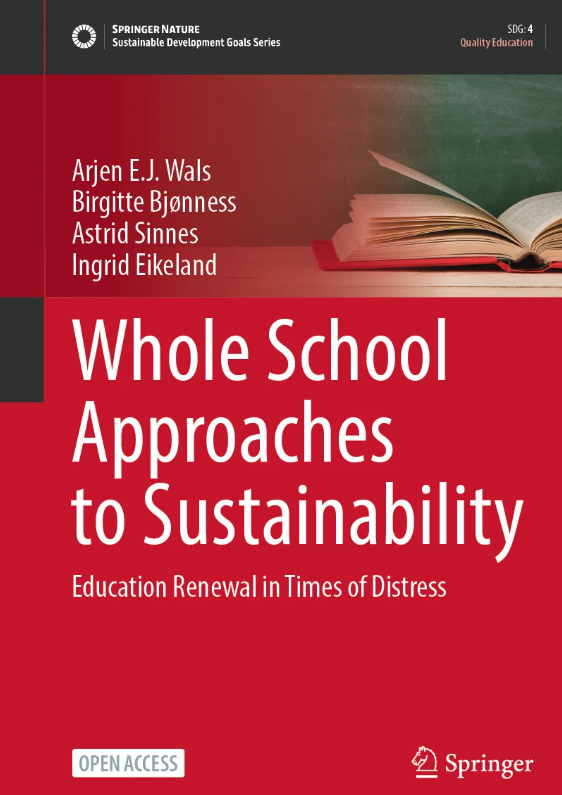
Whole School Approaches to Sustainability

Education Renewal in Times of Distress

LInk to the book: https://link.springer.com/book/10.1007/978-3-031-56172-6

At last – the edited volume on ‘Whole School Approaches to Sustainability – Educational renewal in times of distress’ has come out. Together with co-editors, Birgitte Bjønness, Astrid Sinnes and Ingrid Eikeland, and managing editor Stine Marie FyskeHaraldsen, we have worked with authors from around the world to create this rich picture of principles, practices and prospects of school working more systemically and holistically with sustainability, rather than treating it like another subject to be added to an already overcrowded curriculum.

The book has been made Open Acess and all 24 (!) chapters can be downloaded for free thanks to a grant provided through the Dutch Government-Supported Programme for Learning for Sustainable Development (LvDO).

We wish to acknowledge Roel van Raaij who has been an advocate of Education for Sustainable Development, both nationally and internationally, from within the Dutch government for decades, and Ellen Leusink who facilitates and supports ESD through the LvDO program and paved the way for the open access.

We also want to acknowledge the Department of Educational Science at
the Norwegian Life Science University (NMBU led by Hans Erik Lefdal together with Akershus county municipality (the school district South of Oslo) for the support to establish and run the University—School partnership for the last 6 years or so, continuing to this
day. The partnership with schools, especially the collaboration with school
coordinators and principals, have supported the development of the Whole
School Approach through research and praxis. Without this foundation and
support, we would not have had the knowledge, time, and confidence to work
on this book.

Here is the link to the book: https://link.springer.com/book/10.1007/978-3-031-56172-6

Rethinking pedagogy in the face of complex societal challenges: helpful perspectives for teaching the entangled student

This paper appeared online in 2022 and was a part of the wonderful dissertation of Koen Wessels which was later published by Springer Nature as a book within the publisher´s SDG 4 ´Quality Education´ Series. Now has been formally published in open-access form as a part of the latest issue of Pedagogy, Culture and Society. Full citattion: Wessels, K. R., Bakker, C., Wals, A. E. J., & Lengkeek, G. (2024). Rethinking pedagogy in the face of complex societal challenges: helpful perspectives for teaching the entangled student. Pedagogy, Culture & Society32(3), 759–776. View and download here: https://doi.org/10.1080/14681366.2022.2108125

Here is the abstract to give you a bit of a flavor of the paper:

Exploring environmental stewardship among youth from a high-biodiverse region in Colombia – new study!

Source: Salva La Selva

Led by Daniel Couceiro, I was priviledged to join a group of reflective practitioners and colleague Valentina Tassone on the meaning of stewardship in a troubled highly biodiverse region Here you have the main premise of the paper but please go to the full paper for a more in-depth encounter with the work.

Nature degradation is rooted in the disruption of the human-land connection. Its restoration requires the regeneration of environmental stewardship as a way to live within environmental limits, especially for younger generations. In this study we used the implementation of a year-round, non-formal environmental education program during COVID-19 times to explore environmental stewardship in adolescents between 14- and 18-years old from the Sierra Nevada de Santa Marta, Colombia. Using a qualitative methodology, we mapped expressions of environmental stewardship among local youth. We found several barriers that can be challenged and levers that can be nurtured through inclusive, place-based and collaborative environmental education strategies to foster youth’s environmental stewardship in Colombian’s high-biodiverse regions.

Full citation and link to open access paper:

Daniel Couceiro, Ivona Radoslavova Hristova, Valentina Tassone, Arjen Wals & Camila Gómez (2023) Exploring environmental stewardship and youth engagement in biodiversity among youth from a high-biodiverse region in Colombia, The Journal of Environmental Education, DOI: 10.1080/00958964.2023.2238649

Pedagogy of Entanglement and other groundbreaking works – Springer SDG4-Series taking off

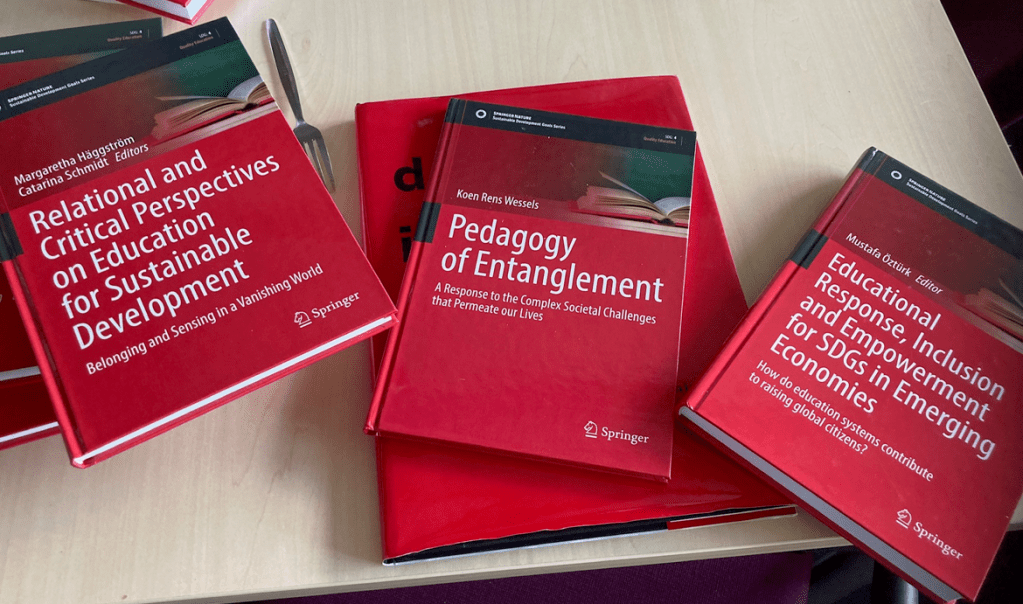
Recently, a few more titles appeared in the Springer SDG4 Series that are expanding horizons, addressing blind spots and offer guidelines for alternative ways of thinking and acting in and through education in light of pressing global sustainability challenges. One of them finally arrived on my desk today: Koen Wessel’s “Pedagogy of Entanglement: a response to complex societal challenges that permeate our lives”. This book is a real treasure that is based on Koen’s dissertation which he completed last year at Utrecht University (with joint supervision from Wageningen University).  You can find the book here.

The Springer Sustainable Development Goals Series aims to provide a comprehensive platform to the scientific, teaching and research communities studying issues in the fields of geography, earth sciences, environmental science, social sciences, engineering, policy, planning, and human geosciences in order to contribute knowledge toward achieving the current 17 Sustainable

Development Goals. Volumes in the series are organized by relevant goal and guided by an expert international panel of advisors.

The subseries that I am co-editing together with Nicole Ardoin of Standford University, focuses on SDG 4: Quality Education and more specifically on the following questions: What kind of quality or qualities must education have in order to be able to contribute to Sustainable Development as expressed by the SDGs? How can such education be developed, implemented and assessed in a wide range of contexts across the globe? How can quality education, that contributes to the well-being of all people and the whole planet, becomeaccessible for everyone?

Topics covered by the SDG 4 subseries include, but are to limited to: education policy and governance for ESD/ESE and Global Citizenship Education (GCE), conceptualizing sustainability competence other possible learning outcomes of ESD and GCE, pedagogical approaches to ESD/ESE and GCE, the role of teacher training/professional development in fostering ESD/ESE/GCE,

assessment of ESD/ESE and GCE-related learning, creating whole school or whole institution approaches to sustainability, making ESD/ESE and GCE accessible and relevant for all learners in a wide range of context across the globe.

Should you be interested in writing or editing a book for this Series, contact Zachary Romano in Springer’s New York office or drop me or Nicole a line!

White Paper on Regenerative Higher Education – Rethinking education in times of dysfunction and collapse

Regrettably this white paper is only available in Dutch. Some ot the ideas artuclated in the paper can also be found in The Regenerative Education Podcast Series created by PhD Bas van den Berg see: The Regenerative Education Podcasts – Planting the seeds of change

Ik maak sinds een paar jaar deeluit van een Nederlandse  Community of Practice rondom Regenerative Higher Education bestaande uit PhDs en medewerkers van verschillende universiteiten en hoge scholen. Dit White Paper is het resultaat van de samenwerking in de Community of Practice en is samengesteld door Martine de Wit en gebaseerd op interviews met Bas van den Berg, Daan Buijs, Mieke Lopes Cardozo, Marlies van der Wee en Arjen Wals. Met input van Nina Bohm, Linda de Greef, Michaela Hordijk, Naomie Tieks, Koen Wessels, Rosanne van Wieringen, en Roosmarijn van Woerden. De illustraties en vormgeving zijn verzorgd door Mari Genova.

Het paper vertrekt vanuit de vraag:

Onderwijs dat het beste haalt uit onszelf en onze studenten, op weg naar herstel van de aarde. Hoe komen we daar?

Lees hier ons verhaal en laat ons weten wat resoneert, schuurt of wat het anderzins losmaakt!

A regenerative decolonization perspective on Education for Sustainable Development (ESD) from Latin America – new research

Central Figure in the article:  Regenerative education through decolonial praxis.

Led by former Wageningen University PhD Dr. Thomas Macintyre and current Wageningen University Post-Doc, Dr Daniele Tubino de Souza, I was priviledged to collaborate on this new paper that appeared in the latest issue of Compare: A Journal of Comparative and International Education. This paper provides a Latin American perspective on ESD, with a focus on transformative and participatory learning in community contexts. With a long history of critical pedagogies, Latin America provides a fertile ground for exploring alternative forms of education as a means to address deep-rooted challenges in western traditional strands of education. We start by providing an overview of pertinent educational currents present in Latin America, then ground these perspectives in two case studies carried out by the authors – one from Colombia, the other from Brazil – which explore grassroots initiatives in community settings that utilise different forms of education and learning. We then propose an integrative model to foster alternative educational approaches that might lead to decolonial and regenerative praxis, finishing with a discussion on how Latin American-rooted regenerative decolonisation perspective and praxis can inform global ESD discourses.

You can find the full paper here: https://www.tandfonline.com/doi/full/10.1080/03057925.2023.2171262

Full citation: Macintyre, T. Tubino de Souza, D. & Wals, A.E.J. (2023) A regenerative decolonization perspective on ESD from Latin America, Compare: A Journal of Comparative and International Education, DOI: 10.1080/03057925.2023.2171262

Just out: Embodiment Talk – a podcast on what embodiment might mean for education and creating true connections with ourselves, the other and the world

In this Embodiment Talk I am interviewed by Marjon van Opijnen of the Embodiment Lab

We talk about the importance of embodiment in education. And how we can create education systems that create space for connections with ourselves, the other and the world. We talk about:

• What embodiment means for education;

• How education can help to create true connections with ourselves, the other and the world;

• The different forms of learning in eduation and how these can contribute to a more sustainable world;

• How education can teach us to criticize, connect and care. And that vulnerability can exist next to strength;

• How to integrate a systemic perspective in the education system.

Here you can go straight to the Podcast: https://www.youtube.com/watch?v=pJlpE3rK0MM&t=153s

Go to: https://www.youtube.com/@embodimentlab-marjonvanopijnen for all the podcasts Marjon has made so far.