In this Embodiment Talk I am interviewed by Marjon van Opijnen of the Embodiment Lab
We talk about the importance of embodiment in education. And how we can create education systems that create space for connections with ourselves, the other and the world. We talk about:
• What embodiment means for education;
• How education can help to create true connections with ourselves, the other and the world;
• The different forms of learning in eduation and how these can contribute to a more sustainable world;
• How education can teach us to criticize, connect and care. And that vulnerability can exist next to strength;
• How to integrate a systemic perspective in the education system.
Climate change is not a new issue for education, but new levels of consensus and concern are emerging, suggesting that new policy developments may follow. This NORRAG Special Issue (NSI 07) addresses the question of how education is to equip learners to participate in climate action that would fundamentally disrupt existing problematic systems. This NSI has the potential to inform pedagogical praxis, co-learning, curriculum, climate action, policy formulation, frameworks for evaluating success, resourcing decisions and what we might consider educative acts for engaging with climate change and its multi-dimensional uncertainties, risks and opportunities.
Edited by South African Professors Eureta Rosenberg and Heila Lotz-Sisitka, this is one of the most comprehensive and ground braking collections of papers available at the moment. The special issue is completely open access. You can find the full table of contents here.
I am very pleased to have found two wonderful Norwegian colleagues – Astrid Sinnes of the Norwegian Life Sciences University and Ole Andreas Kvamme of the University of Oslo who were willing to join in writing a contribution which is titled: School Strikes as Catalysts for Rethinking Educational Institutions, Purposes and Practices
I am also delighted to see two of my former PhD’s, Thomas Macintyre and Martha Chaves, based in Colombia in the special issue as well with a paper on Climate Change Resilience through Collaborative Learning in the Colombian Coffee Region – they co-authored with Tatiana Monroy who, like omas and Martha volunteers for Fundación Mentes en Transición, Colombia, South America
There will be an online launch of the NORRAG Special Issue 07 (NSI 07): Education in Times of Climate Change, will take place on 6 October 2022 at 16:00 – 17:30 CEST. For more information about the llaunch event have look here!
Regenerative forms of higher education are emerging, and required, to connect with some of the grand transition challenges of our times. This paper explores the lived experience of 21 students learning to navigate a regenerative form of higher education in the Mission Impact course at The Hague University of Applied Sciences. This semester-length course ran for two iterations with the intention of connecting the students with local transitions towards a more circular society, one where products are lasting and have multiple lives when they are shared, refurbished, or become a source for a new product. At the end of each iteration, the students reflected on their experience using the Living Spiral Framework, which served as basis for an interpretative phenomenological analysis of their journey navigating this transformative course. The results of this study include four themes; (1) Opting in—Choosing RHE, (2) Learning in Regenerative Ways, (3) Navigating Resistance(s), and (4) Transformative Impacts of RHE. These themes can be used by practitioners to design and engage with regenerative forms of higher education, and by scholars to guide further inquiry. View Full-Text
Earlier this month the 8th Report from the Global University Network fir Innovation (GUNi) was published with a wealth of contributions critiquing current resilient modes and models of education and outlinig alternative one in light of the current systemic global dysfunction we find ourselves in. I was asked to contribute a chapter on transgressive learning. The link to the chapter is here
The full citation for my chapter is: Wals, AEJ (2022) Transgressive learning, resistance pedagogy and disruptive capacity building as levers for sustainability. In: Higher Education in the World 8 – Special issue New Visions for HigherEducation, Barcelona: Global University Network for Innovation (GUNi). Open access: www.guni-call4action.org, p216-222.
Handmade painting by a student on “Empowerment – a rising sensation that liberates you from ‘sinking’ into negativity” – using artistic forms of evaluation of learning, helped both subjectification and creating a sense of community in the course
This paper recently appeared in International Journal of Sustainability in Higher Education. It explores students’ sense of community and belonging in an online course on environmental and sustainable education during times of physical distancing as a result of the COVID-19 pandemic. Using a case study approach, the results show that students perceived a sense of community that was collectively build during the four week program. Sense of community was linked to and facilitated by the learning environment and the educators’ and students’ role throughout the course. Prominent factors here are interaction and inclusion created with mutual effort by design, the educator and student.
This research arose after the course ELS-31806 Environmental Education and Learning for Sustainability[1] was converted as an ‘offline’ course into an online course due to COVID-19. The original content of the course enables students to systematically discuss important concerns in the development of an effective curriculum and/or operation for the environment and sustainable development using a range of instrumental and emancipatory approaches. But foremost ELS-31806 is a course that has always been, well appreciated and highly valued by participants for its highly experiential and hands-on approach.
However, due to COVID-19 this year’s course (2020) was changed into a less experiential on-line format mediated by Zoom for interaction and by Brightspace for course structure and organisation. This somewhat ad-hoc and sudden departure from the traditional successful format, lowered the instructors, and probably also, the students’ expectations about the course’ ability to create a vibrant learning community. Yet, contrary to pre-course expectations, ‘something’ (i.e. a sense) arose over the course of four weeks online education that both students and staff considered to be special or meaningful. These hunches got confirmed several weeks after by Wageningen UR’s student evaluation system PACE which revealed that the students highly valued the course.
We were intrigued by the question of how this online edition evoked similar, or nearly similar outcomes to its offline counterpart. After first checking whether our hunches were right about the course and what might explain the high evaluation marks, we centre in the paper’s main question:
What are key characteristics of an online course that fosters subjectification (personal development and inner-sustainability in relation to others and the other) and creates a sense of community?
The paper was led by former MsC student Robbert Hesen and co-authored by myself and ELS Postdoc Rebekah Tauritz.
On 8 February 2022 SPARK the Movement organizes an interactive online meeting with regional, national and European educators around the question:
How can we mobilize the imaginative power of the region, thus learning together how to take up global challenges and focus on the local impact we can make?
SPARK’s conviction is that sustainability needs to be a part of the ‘everyday fabric of life’. The scale of a region seems to be a most suitable level to examine and enact sustainability in day-to-day life and in everyday business. The meeting is organised by United Nation’s supported Regional Centre of Expertise ‘Fryslan’ in The Netherlands. I will give a short introduction to the Whole School Approach as a key driver of sustainability.
It is my pleasure to share two calls for contributions in relation to the development of a Whole School Approach (WSA) to Sustainability. The first one relates to an international hybrid conference organized by the Dutch government that will take place in The Netherlands and partially online late March of 2022, the second one relates to an edited Volume on the topic in the Springer SDG4 Series on Quality Education.
Call for exemplary practices of a Whole School Approach to Sustainable Development
The Dutch Ministry of Economic Affairs and Climate Policy have commissioned a report to provide practical examples of how a Whole Institution/ Whole School Approach (WSA) is being used in practice around the world to engage with SDG4 – Quality Education, especially in relation to sustainable development issues as covered by the other SDGs. The reports aim is to highlight different aspects of a WSA – curriculum development, pedagogical innovation, school management and leadership, school-community relationships, professional development of staff, and the school as a ‘living laboratory’ for experimenting with healthy, equitable, democratic, and ecologically sustainable living – especially how these aspects can be integrated to mutually strengthen each other.
We are particularly interested in so-called critical case-studies that do not only highlight best-practice strategies and success stories, but also share the struggles, set-backs and challenges underneath and ways to overcome them. The report will be published as part of the WSA International Conference happening in The Netherlands on the 30th-31st March.
If you know of such a school (primary, secondary, or vocational) from your country that can be used as an exemplary example of a WSA in action, or want further details, please contact Rosalie Mathie via email. rosalie.mathie@nmbu.no before February 15th so she can still contact people connected to the exemplary case.
2 Call for Abstracts Springer SDG4 Series Whole School Approaches to Sustainability – Principles, Practices and Prospects
Ingrid Eikeland, Brigitte Bjønness, Astrid Sinnes and Arjen Wals (Eds)
Schools across the globe are seeking to respond to emerging topics like; climate change, biodiversity loss, healthy food and food security, and global citizenship. They are increasingly encouraged to do so by educational policies that recognize the importance of these topics and by the Sustainable Development Goals (SDGs).
While there is recognition that such topics should not be added on to an already full curriculum, but rather require more systemic and integrated approaches, doing so in practice has proven to be difficult. This edited Volume seeks to engage educators, school leaders, educational policy-makers and scholars of sustainability in education in key principles, critical perspectives, generative processes and tools that can help realize a Whole School Approach to Sustainability. The book will contain three sections: 1) Principles & Perspectives, 2) Critically Reflexive Contextual Case Studies (Early Childhood, Primary, Secondary and Vocational Education) and 3) Synthesis: Challenges and Prospects.
The editors are inviting abstracts (no more than 500 words) of potential chapters. Contributions can be research-based (spanning different genres of research) but can also be more conceptual in the form of critically reflexive essays. Abstracts should indicate a best fit with one of the sections and need to be accompanied with short bios of the author(s) and, if possible, references to prior publications that relate to the topic.
Please send your initial ideas for a contribution or any queries you may have to: ingrid.eikeland@nmbu.no before March 1st. All abstracts will be reviewed by the editors and a selection will be made for further development into a full manuscript to be published by the end of 2022.
I have posted about this seminar before. Originally the seminar was going to take place in March but it has been rescheduled to June 13-16. The deadline for submission has shifted as well to February 15th. This is a unique seminar with some great people in the field of environmental and sustainability participating. Have a look here for the key info. https://www.cdo.ugent.be/news/call-proposals-15th-invitational-seminar-ese-research
Last week our editorial introducing the Special Issue for Educational Philosophy and Theory (EPAT) on Education for Sustainable Development in the ‘Capitalocene’ finally appeared. Together with Gothenburg University colleagues, Helena Pedersen, Sally Windsor, Beniamin Knutsson, Dawn Sanders and Olof Franck, we found 8 excellent contributions from some great scholars, after a careful selection and review process. I encourage you to explore the entire SI. Here are the opening lines of our editorial to wet your appetite.
When the thought of this Special Issue began to take shape 3 years ago, we had no clear idea of how it would develop. We wanted to address what we saw as the inability, or even impossibility, of our education system in general, and ESD in particular, to respond to the current climate and environmental crises. We began the call for contributions to the SI with the question ‘Has Education for Sustainable Development (ESD) reached an impasse?’ and referred to Moran and Kendall’s (2009) argument that our various research approaches produce nothing but illusions of education and that education does not exist beyond its simulation. Moran and Kendall continue to argue, drawing on the work of Baudrillard, that current movements in education constitute an ‘improvement agenda’ where more interventions are produced and critiques are repeated ‘over and over’ to foster improvements, ‘pursued as if they were possible’ (Moran & Kendall, 2009, p. 329, italics added). In the call text we used Moran and Kendall’s position on education as a springboard for thinking around ESD and capitalism. In the messy terrain of the debates concerning the ‘Anthropocene’ (Crutzen & Stoermer, 2000) and the ‘Capitalocene’ (Malm & Hornborg, 2014), how does education emerge? Since its conception, the ESD field has been criticised for its hidden and problematic normativity (Jickling, 1992). Regardless of how valid such a critique is, the core idea of ESD is, arguably, a grandiose ‘improvement agenda’ – not only of education, but of the planetary condition as such. There is an assumption that if we can find the appropriate way of ‘doing’ ESD, a sustainable world is within reach.
Yet while working on the Special Issue, one overwhelming real (i.e. not simulated) global event and disaster after the other has occurred: The Fridays for Future strikes; the catastrophic wildfires, hurricanes and flooding across the globe; the heatwaves in the Arctic circle and Pacific Northwest, and, of course, the COVID-19 pandemic – to name a few. Extinction numbers are now at critical levels (IPBES, 2019), climate change impacts are here and increasing in magnitude and frequency (IPCC, 2021), and human-made materials, such as plastic and concrete now outweigh the living biomass of the planet (Elhacham et al., 2020).
How, then, is it at all possible to educate in the midst of this harsh reality, if education itself, and educational critique, cannot be conceived beyond its own illusive patterns of simulation and repetition? As educators, working within these multiple tipping points, where do we stand? Are schools and universities and even ESD, becoming an extension of the globalizing economy and unwillingly accelerating unsustainability (Huckle & Wals, 2015) by equipping people merely to be more effective vandals of the earth? (Orr, 1994). Does the temporality of assumptions held about education (Facer, 2021) impede our ability to respond to the current crisis with urgency? Can educational institutions ever cultivate multi-species approaches to knowledge and justice in a time of mass environmental pillage (e.g. Pedersen, 2021)? And what does this all mean for an individual teacher attempting to nurture hope, and stave off despair (e.g. Ojala et al., 2021), in the face of widespread inequality and lack of access to meaningful biopolitical actions (e.g. Knutsson, 2021)?”
Some journals are truly hidden gems – Airea is a peer-reviewed journal on Arts & Interdisciplinary Research. Together with wonderful colleague Anke de Vrieze of Wageningen UR and Åse Bjurström of University of Gothenburg, former PhD and MSc-student of mine, Natalia Eernstman and current PhD Kelli Rose Pearson, we contributed a paper to a Special Issue on ‘Interdisciplinary relationships within spaces and bodies of collaboration‘. Our paper is titled:
A nice feature of this special journal is that it is fully open access: all wonderful papers can be freely downloaded from the journal’s website here! Please find below the abstract of our paper:
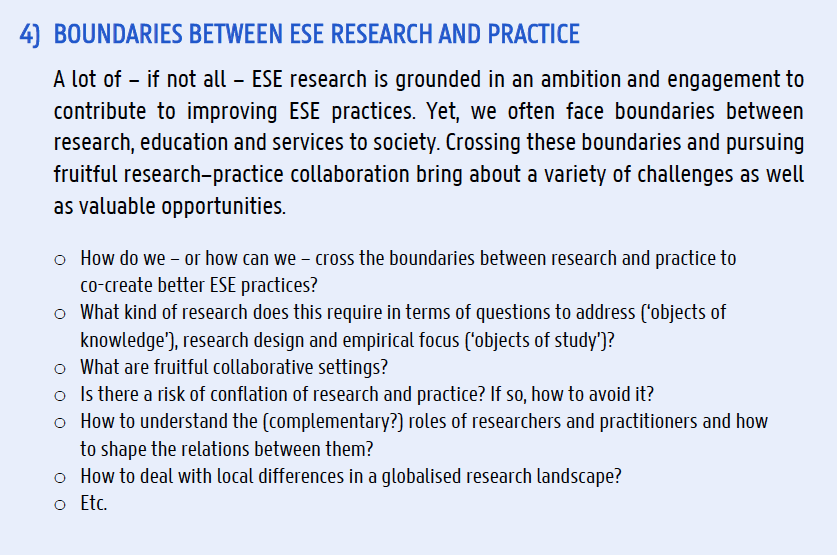
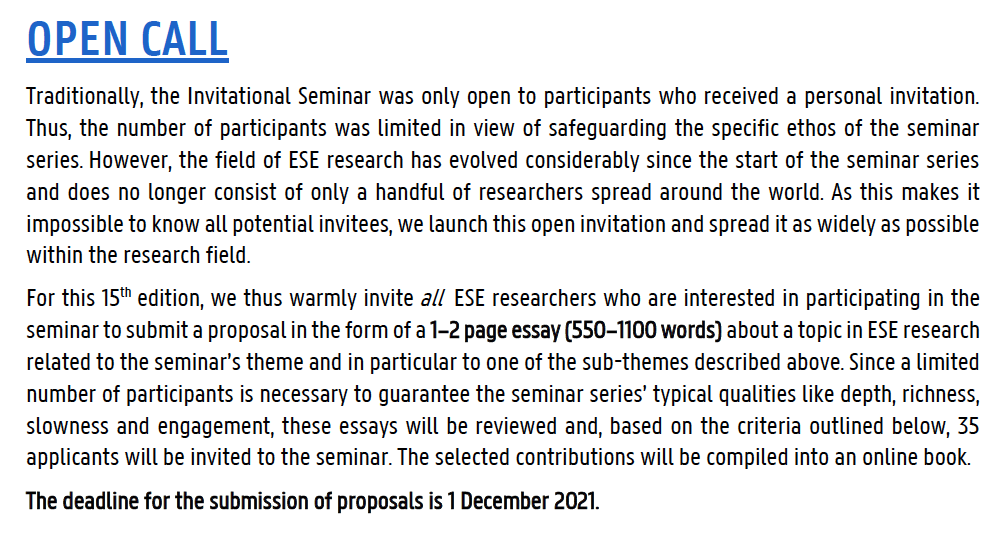
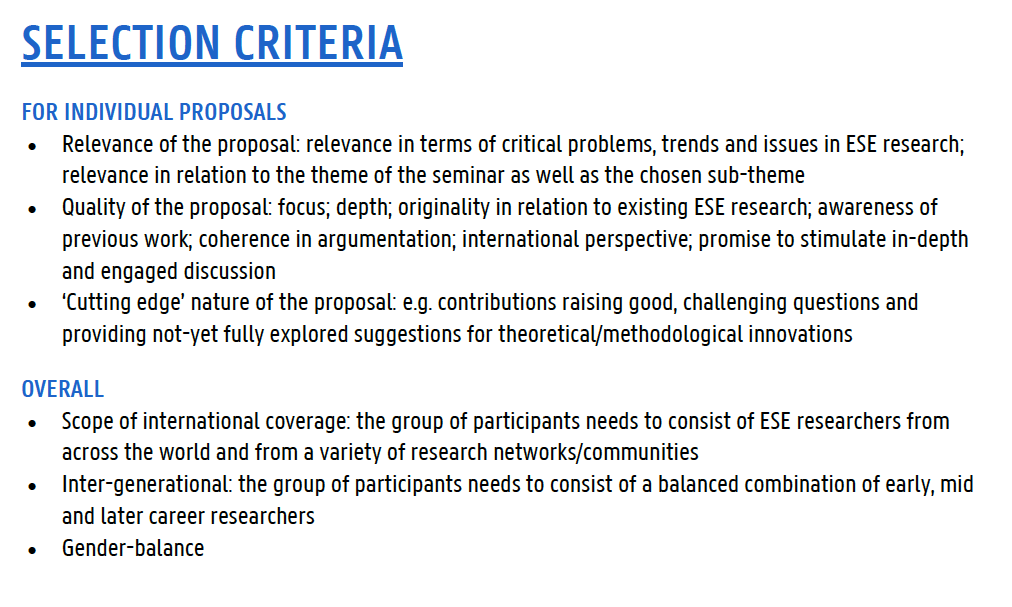
I am happy to announce the return of the infamous Invitational Research Seminars on Environmental & Sustainability Education. As one of the co-organisers I have the privileged to be part of an excellent group led this tim by Katrien van Poeck of Ghent University in Belgium. These are relatively small seminars. While they are no longer ‘by invitation only’ and open to anyone with a strong, insightful, creative, provocative, etc, proposal, spaces will be limited. Have a look a the key info, the theme and the wonderful sub-themes below or go directly to the Centre for Sustainable Development at Ghent University https://www.cdo.ugent.be/news/call-proposalshttps://forms.office.com/pages/responsepage.aspx?id=3hyB1-_sbEmPkaF4YkG5nAXy6iDz_itPuL2K0IeXr0VUOFA5NUdJTzNPVkZHRTRLQVNGMVRRN0c5Ni4u
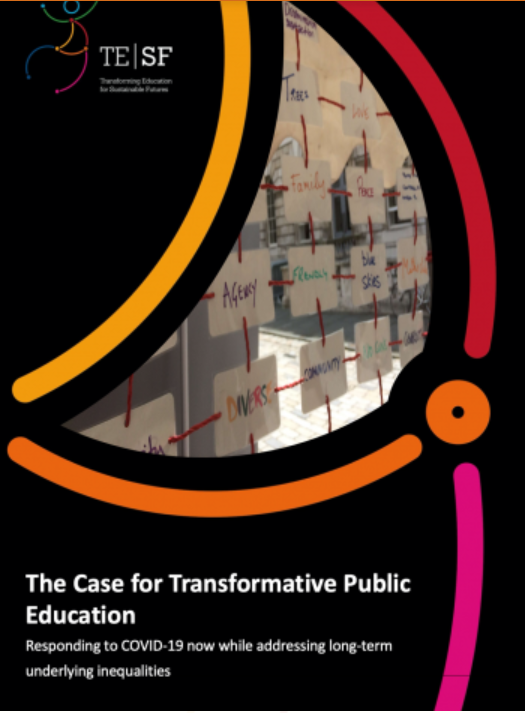
Last Fall a consortium of which I am proud to be a part, along with the Education & Learning Sciences Group of Wageningen University received funding from the UK-government to a so-called GCRF Network Plus on Transforming Education for Sustainable Futures. The network is co-ordinated out of the University of Bristol and includes partners in India, Rwanda, Somalia/Somaliland, South Africa, the United Kingdom and the Netherlands. TESF undertakes collaborative research to Transform Education for Sustainable Futures. We have just released an introductory video (see above) and just released a timely paper:
Why Transformative Public Education matters to the COVID-19 response
Why Transformative Public Education matters for addressing long-term underlying risks to communities
Examples of Transformative Public Education responses to COVID-19
Suggestions for governments and state welfare actors seeking to work with Transformative Public Education
Suggestions for community leaders working with Transformative Public Education
Transformative Public Education in times of physical distancing
Key readings and resources
On the TESF website you will also find other resources you may find of interest. Have a look here TESF Home Page
This is TESF’s first response to the C-19 situation, and we would like to see it widely distributed, given the timely nature of this topic. Please do all you can to share it widely across your networks. https://tesf.network/resource/transformative-public-education/
On April 24th my last formal activity for The Faculty of Education at the University of Gothenburg ended with the successful defence & disputation by my PhD student at GU, Kassahun Weldemariam. Kassahun worked for almost 5 years on a study on sustainability in early childhood education from a posthuman perspective. Prof. Karen Malone was his opponent while Dr. Beniamin Knutsson and Dr. Helena Pedersen were co/supervisors. Due to COVID19 the whole defence had to take place via Zoom which worked well but did strip the event from the usual rituals and festivities afterwards.
The purpose of his dissertation of which three chapters were published in peer reviewed journals and one as a book chapter, was twofold. First, Kassahun explored how the notion of sustainability is conceptualized within early childhood education discourses and how it is manifested in early childhood curricula. Second, the dissertation examined post-anthropocentric possibilities of sustainability within early childhood education.
A major finding of the two studies, relating to the first purpose, is that early childhood education tends to have an anthropocentric bias and over-emphasizes the importance of children’s agency in enhancing their potential to contribute to sustainability. Using this finding as a backdrop, the major finding of the two subsequent studies, relating to the second purpose, is that post-anthropocentric analysis can help to challenge these shortcomings and offer the emergence of a different sustainability ethos. In doing so, sustainability is reconceptualized as a generative concept that opens up possibilities for children to learn-with, become-with and affected by non-humans, i.e. other species and non-human forces. Specific posthuman concepts such as assemblage, distributed agency and becoming-with are used as thinking tools.
Systematic literature review and curricula content analysis were employed as methods for study one and study two respectively. Study three and study four drew ideas from post-qualitative inquiry which employ concepts that allow to experimentally engage with the world and think with/become-with data.
The latter two studies empirically demonstrate emerging possibilities of learning for sustainability with the non-human others/material forces and other species. In the end, the dissertation highlights that post-humanist and new materialist perspectives can provide a post-anthropocentric conceptualisation of sustainability, which paves the way for a more relational ontology, one that could in turn create a pedagogical practice supporting sustainability.
It was a true pleasure working with Kassahun durng the last five years and I am convinced we will be hearing a lot from him in the future. A pdf of his dissertation can be found here>Kassahun Weldemariam_inlaga_med artiklar
Some readers of my blog of might call me a hypocrite – and I cannot really blame you – but despite strong reservations I continue to co-author work that is submitted to Sustainability – the journal, and mainly its publisher’s (MDPI’s) business model, I have critiqued in the past for mass and fast-publishing (find my critique here as well as the response of Paul Vazquez, CEO of MDPI) which can be found here). Sometimes the people I work with do need a quick-turn around time for their manuscripts and still wish to have work published in a recognized journal that has high impact and is open access (when paying the fee… which for the paper I am sharing here was discounted at 50% to acknowledge that lack of means of some of the contributing institutions, here in Brazil). As I stated in my critique, some work is of high quality and has been properly reviewed by two or more people which is the case in the paper I am sharing here which was just published.
Led by former PhD-student Daniele Tubino Sousa, this paper focuses on learning in the context of territorial problems such as the socio-ecological degradation of urban rivers represent a great challenge to achieving sustainability in cities. This issue demands collaborative efforts and the crossing of boundaries determined by actors that act from diverse spheres of knowledge and systems of practice. Based on an integrative territory notion and the boundary approach, the goal of this paper is to comprehend the boundary crossings that take place in multi-actor initiatives towards the resolution of this problem and what type of territorial transformation is produced as an outcome. Our analysis is built on participatory research on the Taquara Stream case, a degraded watercourse in a socio-ecologically vulnerable area, in southern Brazil. Our data analysis applied a visual chronological narrative and an interdisciplinary theoretical framework of analysis that combined concepts related to the territory (geography) and the boundary approach (education). We verified that local territorial issues functioned as boundary objects, fostering and facilitating dialogical interaction among involved actors, knowledge co-production, and collaborative practical actions that led to changes in the territory in terms of practices, comprehensions, and physical concrete transformations. We framed this study as one of territory-based learning meant to advance the understanding of territorial intervention processes towards urban sustainability.